
Wang Gungwu Visiting Fellows Programme 2027: Fully Supported Fellowship at ISEAS – Yusof Ishak Institute in Singapore @ISEAS – Yusof Ishak Institute in Singapore
The Wang Gungwu Visiting Fellows Programme 2027 is now open for applications for post-doctoral researchers and mid-career policy makers interested in producing policy-relevant research on Southeast Asia, big-power relations, regional security, economics, and digital technology.
Hosted by ISEAS – Yusof Ishak Institute in Singapore, the programme honours Professor Wang Gungwu, former Chairman of the Board of Trustees at ISEAS, in recognition of his distinguished 17-year tenure and his major contributions to scholarship, public policy, and the study of Asia.
This visiting fellowship is designed to support the next generation of scholars and policy thinkers whose work examines how international political, economic, security, and technological developments shape Southeast Asia. Successful applicants will be based at ISEAS for the duration of the fellowship and will contribute to the Institute’s research community through publications, seminars, and policy discussions.
About the Wang Gungwu Visiting Fellows Programme
The Wang Gungwu Visiting Fellows Programme supports researchers and policy makers working on issues connected to big-power relations and their impact on Southeast Asia.
The programme is particularly focused on research that is not only academically strong but also relevant to public policy, regional decision-making, and wider debates on Southeast Asia’s role in a changing global order.
Through this fellowship, ISEAS aims to create a platform where emerging and established voices can engage deeply with regional developments, contribute fresh perspectives, and build networks with scholars, policy experts, and practitioners working on Southeast Asian affairs.
Host Institution: ISEAS – Yusof Ishak Institute
The fellowship is hosted by ISEAS – Yusof Ishak Institute, a leading research institute based in Singapore. ISEAS is widely known for its work on Southeast Asian studies, regional politics, economics, society, culture, and international relations.
Fellows will be based at the Institute during their fellowship period and will have access to research facilities, office space, library resources, IT services, and opportunities to engage with the wider ISEAS academic and policy community.
Fellowship Duration
The Wang Gungwu Visiting Fellows Programme may run for:
- A minimum period of two months
- A maximum period of six months
The exact duration of the fellowship is subject to approval by ISEAS.
Successful applicants are expected to be in residence at ISEAS in Singapore for the full duration of their fellowship. This means selected fellows should be prepared to physically relocate to Singapore for the approved fellowship period.
Research Priority Areas
Applicants should propose research that fits within the programme’s key priority areas. The fellowship focuses on the relationship between major global powers and Southeast Asia, with special attention to politics, security, economics, technology, society, and regional influence.
The priority areas include:
1. Developments in US-China Relations and Their Impact on Southeast Asia
Applicants may explore how changing relations between the United States and China affect Southeast Asian countries, regional institutions, foreign policy choices, trade, security alignments, and strategic decision-making.
Possible research themes may include:
- The effect of US-China competition on ASEAN unity
- Southeast Asian foreign policy strategies in a period of big-power rivalry
- Economic consequences of US-China tensions for Southeast Asian economies
- Security partnerships and diplomatic balancing in the region
- Regional responses to geopolitical competition
2. Asia Pacific Security Issues
The programme welcomes research on major security questions affecting the Asia Pacific and Southeast Asia.
Examples of relevant topics include:
- South China Sea disputes
- China-ASEAN relations
- Maritime security
- Regional defence cooperation
- ASEAN’s role in regional security architecture
- Military modernisation and strategic competition
- Security implications of big-power rivalry
This priority area is suitable for applicants interested in how Southeast Asian countries respond to complex and evolving security challenges.
3. Global and Regional Economic Cooperation Initiatives
Applicants may also focus on regional and global economic initiatives and their implications for Southeast Asia.
Relevant topics may include:
- Belt and Road Initiative
- Regional Comprehensive Economic Partnership
- Trade integration in Southeast Asia
- Regional economic cooperation
- Infrastructure financing
- Supply chain shifts
- Economic diplomacy
- The role of Southeast Asia in global trade networks
This area is especially relevant for researchers examining how large-scale economic initiatives shape national development, regional cooperation, and geopolitical influence.
4. The Rise of China and Its Impact on Southeast Asian Communities
The programme also invites research on the social, cultural, political, and economic effects of China’s rise on communities across Southeast Asia.
Possible research directions include:
- Chinese investment and local communities
- Perceptions of China in Southeast Asian societies
- Chinese diaspora and community relations
- Social and cultural influence
- Domestic political responses to China’s rise
- Public attitudes toward Chinese economic and political engagement
This priority area is ideal for applicants whose work connects international developments with local-level community experiences.
5. Digital Media, Technology, Influence, and Perceptions in Southeast Asia
Another major focus area is the use of digital media and technology by countries to advance their interests and shape perceptions in Southeast Asia.
Applicants may explore topics such as:
- Digital diplomacy
- Online influence campaigns
- Strategic communication
- Technology and public opinion
- Digital media and regional politics
- Disinformation and information influence
- Social media narratives involving major powers
- Technology as a tool of geopolitical influence
This is a particularly relevant area for researchers studying the intersection of technology, international relations, public perception, and regional influence.
Expected Outputs from Fellows
Selected Wang Gungwu Visiting Fellows are expected to contribute actively to the intellectual life of ISEAS.
During the fellowship, fellows will be required to:
- Contribute to ISEAS Perspective publications in their area of research
- Contribute to ISEAS Fulcrum publications where relevant
- Present their research findings at an in-house seminar
- Engage with scholars, researchers, and policy experts at ISEAS
- Contribute to discussions on Southeast Asian regional affairs
- Become part of a wider network of regional scholars and policy thinkers
These expected outputs make the fellowship especially valuable for applicants who want to strengthen their publication record, policy writing experience, and regional research networks.
Publication Opportunities
The programme provides fellows with opportunities to publish through ISEAS platforms, especially:
- ISEAS Perspective
- ISEAS Fulcrum
These platforms allow fellows to share research insights with academic, policy, and public audiences. Applicants should therefore be prepared to produce research outputs that are clear, analytical, and relevant to current regional debates.
Beyond the fellowship period, Wang Gungwu Visiting Fellows are also welcome to continue contributing to ISEAS, making the programme a potential gateway to long-term scholarly and policy engagement.
Stipend and Benefits
The Wang Gungwu Visiting Fellows Programme offers several benefits to successful applicants.
1. Monthly Stipend
Successful applicants will receive a fixed monthly stipend for the duration of their fellowship at ISEAS.
The stipend is inclusive of a housing subsidy, helping fellows support their stay in Singapore during the fellowship period.
2. Round-Trip Economy Airfare
The programme provides round-trip economy airfare between the fellow’s home country and Singapore.
This travel support makes the fellowship more accessible to international applicants who need to relocate temporarily to Singapore.
3. Meeting with Professor Wang Gungwu
Where possible, Wang Gungwu Visiting Fellows will be invited to a meeting with Professor Wang Gungwu during their fellowship.
This is a valuable opportunity for fellows to engage with one of the most respected scholars in Asian studies and international history.
4. Access to ISEAS Facilities
Successful fellows will have access to relevant facilities at ISEAS, including:
- Office space
- Computer equipment
- IT services
- ISEAS Library
- Other appropriate research facilities
These resources are intended to support fellows in conducting high-quality research while based at the Institute.
Eligibility Criteria
The Wang Gungwu Visiting Fellows Programme is intended for:
- Post-doctoral researchers
- Mid-career policy makers
Applicants should have strong research interests in the programme’s priority areas and should be able to produce policy-relevant research on Southeast Asia.
Eligibility for Policy Makers Without a PhD
Mid-career policy makers who do not have a PhD or equivalent degree may still apply.
However, their CV or resume must demonstrate:
- An appropriate level of professional experience
- Strong research interest
- Relevant policy, institutional, or professional background
- Capacity to contribute meaningfully to the programme’s research themes
This makes the fellowship suitable not only for academics but also for experienced professionals working in government, policy institutions, think tanks, international organisations, research centres, or related fields.
Application Deadline
All applications must be received no later than:
Tuesday, 4 August 2026
Applicants are strongly encouraged to prepare their materials early and ensure that all supporting documents are submitted before the deadline.
How to Apply
All applications, including supporting documents, must be submitted or uploaded through the official application link:
ISEAS Wang Gungwu Visiting Fellows Programme 2027 Application Form | FormSG
Applicants should ensure that their application is complete before submission.
Recommendation Letters
Applicants are required to provide two referees.
The two referees should send their Letters of Recommendation by email to:
The email subject line should follow this format:
Application for ISEAS Wang Gungwu Visiting Fellows Programme 2027 – [Reference Letter for First Name and Last Name]
Applicants should communicate clearly with their referees and give them enough time to prepare and submit the recommendation letters before the deadline.
Programme Contact Information
For enquiries about the Wang Gungwu Visiting Fellows Programme, applicants may contact:
Mr Malcolm Yiong
Assistant Director, Development
ISEAS – Yusof Ishak Institute
30 Heng Mui Keng Terrace
Singapore 119614
Email: development@iseas.edu.sg
Why You Should Apply
The Wang Gungwu Visiting Fellows Programme 2027 is a strong opportunity for researchers and policy makers who want to deepen their work on Southeast Asia and contribute to policy-relevant scholarship.
The fellowship offers:
- A supported research stay in Singapore
- Access to ISEAS facilities and scholarly networks
- Opportunities to publish through ISEAS platforms
- Engagement with regional scholars and policy experts
- A monthly stipend with housing subsidy
- Round-trip economy airfare
- A chance to contribute to important debates on big-power relations and Southeast Asia
- Possible engagement with Professor Wang Gungwu
For post-doctoral researchers, the fellowship can strengthen academic visibility, publication experience, and regional expertise. For mid-career policy makers, it provides time and institutional support to develop research that can inform policy discussions and regional understanding.
Final Thoughts
The Wang Gungwu Visiting Fellows Programme 2027 is an important fellowship for scholars and policy professionals working on Southeast Asia, international politics, regional security, economics, technology, and big-power relations.
With its focus on policy-relevant research, publication opportunities, institutional support, and residence at ISEAS in Singapore, the programme offers a valuable platform for applicants who want to contribute meaningfully to debates on Southeast Asia’s place in a changing regional and global order.
Interested applicants should prepare their research proposal, supporting documents, and recommendation letters early and submit their full application before the deadline of Tuesday, 4 August 2026.
For more information click here.
Discover more fellowship opportunities on OFY here.

Wang Gungwu Visiting Fellows Programme 2027: Fully Supported Fellowship at ISEAS – Yusof Ishak Institute in Singapore
@ISEAS – Yusof Ishak Institute in Singapore
Location
USA / Global
Work Mode
africa
Posted
about 3 hours ago
Beware of scams! When applying for jobs, you should NEVER have to pay anything. Learn about job scams.
Get jobs in your inbox
Join over 10,000 subscribers receiving our weekly newsletter.
You might also like
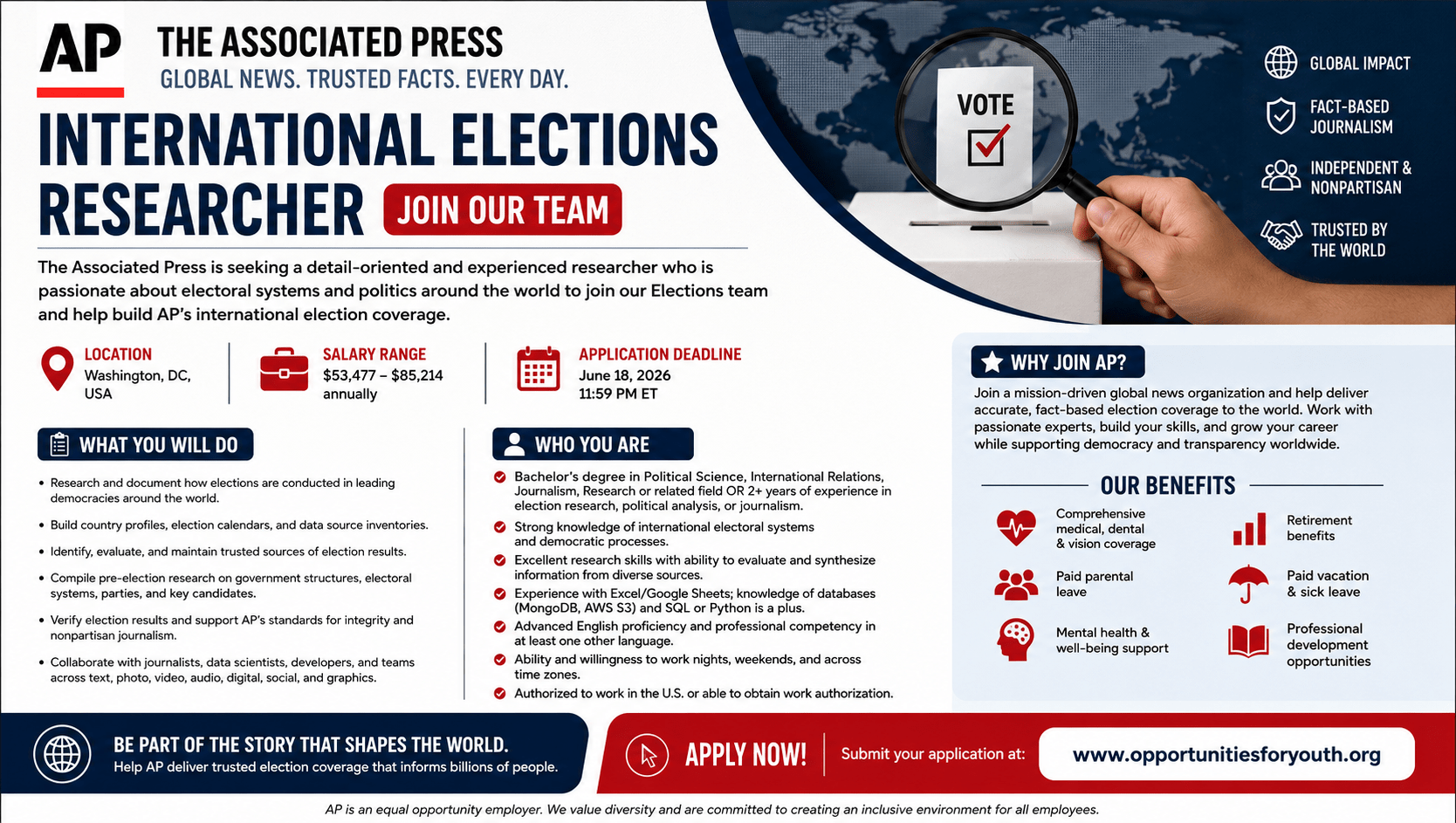
International Elections Researcher
Associated Press
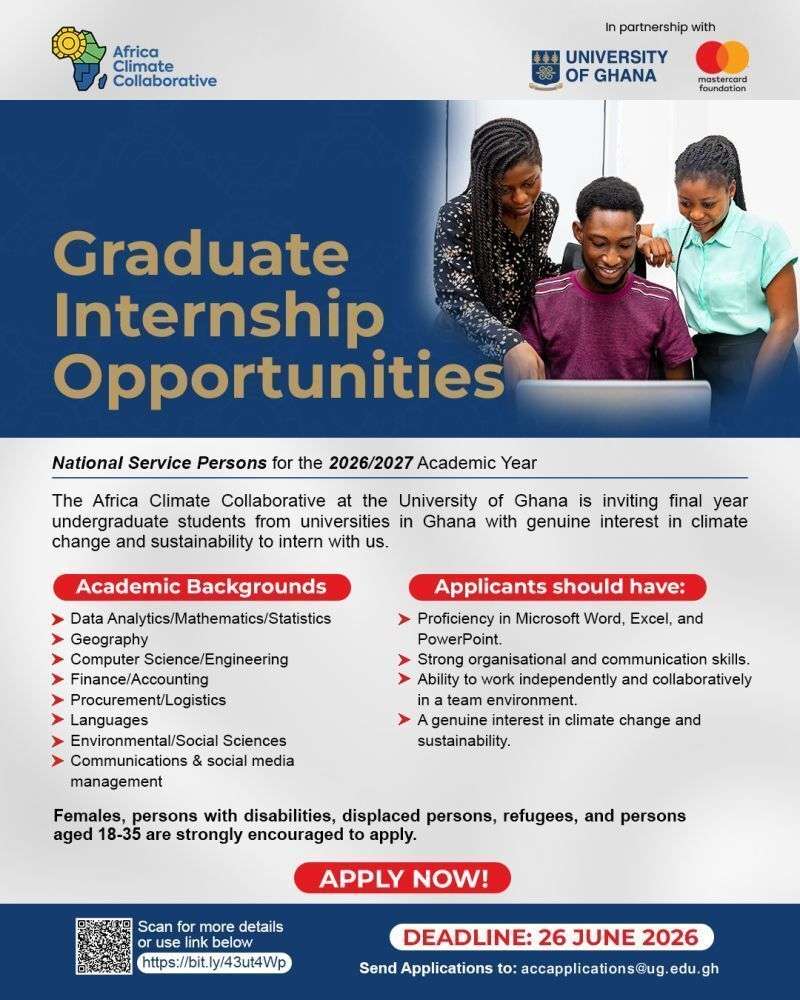
University of Ghana Africa Climate Collaborative Project Graduate Internship (National Service) Opportunities 2026/2027: Gain Hands-On Experience in Climate Research and Sustainability
University of Ghana

UNOPS Senior Mediation Adviser Jobs 2026: Multiple Home-Based International Positions for Global Peacebuilding Experts
United Nations Office for Project Services (UNOPS)

11th Call for Proposals for STEG Small Research Grants (SRGs) — Funding Opportunity for Researchers in Structural Transformation and Economic Growth
STEG

AU-EU Youth Voices Grants 2026: Up to €10,000 for Youth-Led Organizations and Groups Across Africa and Europe
EU Youth Voices Grants 2026: Up to €10,000 for Youth-Led Organizations and Groups Across Africa and Europe
Internet Law and Policy Foundry Fellowship 2026–2028: Fully Detailed Guide to the Prestigious Global Professional Development Opportunity
Internet Law and Policy Foundry