
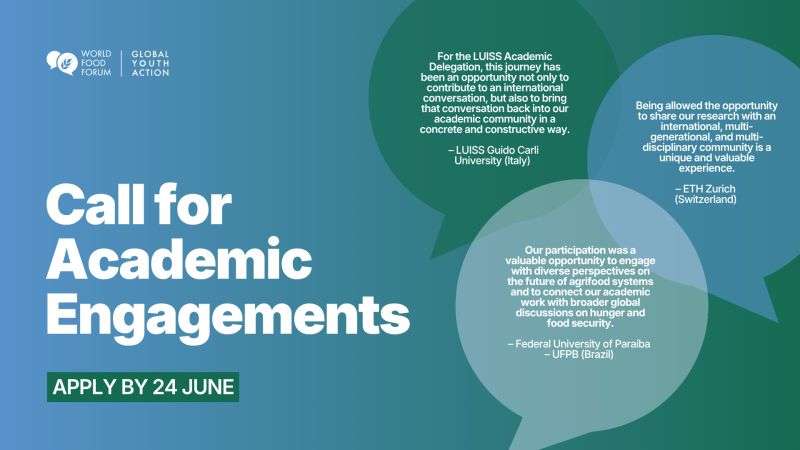
WFF Academic Engagement 2026 Applications Open: Connect Your Research to Global Food Policy and Agrifood Systems Transformation @Unknown
Universities, educators, researchers, and students around the world now have an exciting opportunity to engage directly with global policy discussions and contribute to the future of agrifood systems. The World Food Forum (WFF) Youth Initiative has officially opened applications for the 2026 WFF Academic Engagement Programme, inviting academic institutions and their communities to participate in one of the world’s leading youth-driven platforms for food systems transformation.
The programme offers a unique opportunity for students and faculty members to bridge the gap between academic research and real-world policy impact by engaging with global stakeholders, international experts, and policymakers working to address some of the most pressing challenges facing food systems today.
Whether you are a student seeking to bring your research into international policy conversations, a faculty member interested in connecting classroom learning to practical global challenges, or a university aiming to strengthen its international presence and impact, the WFF Academic Engagement Programme provides a powerful platform for participation.
Application Deadline
Deadline: 24 June 2026
Interested institutions and participants should submit their applications before the closing date.
What is the World Food Forum (WFF)?
The World Food Forum (WFF) is a global youth-led movement and network designed to accelerate action toward transforming agrifood systems. Established as an initiative of the Food and Agriculture Organization of the United Nations (FAO), the WFF serves as a platform where young people, researchers, innovators, policymakers, educators, and development practitioners come together to address global food security and sustainability challenges.
The forum promotes collaboration, innovation, education, and policy engagement to create more sustainable, inclusive, resilient, and equitable agrifood systems worldwide.
Through its various programmes and initiatives, the WFF empowers youth to contribute meaningful solutions to global challenges such as:
- Food insecurity
- Climate change
- Sustainable agriculture
- Rural development
- Agricultural innovation
- Nutrition and public health
- Food systems resilience
- Biodiversity conservation
- Sustainable development
What is the WFF Academic Engagement Programme?
The WFF Academic Engagement Programme is designed to connect higher education institutions with the World Food Forum’s global activities and policy discussions.
The programme enables students and educators to actively engage in international conversations surrounding agrifood systems while applying academic knowledge to real-world challenges.
By participating, universities and academic communities gain opportunities to contribute research, share innovative ideas, and collaborate with global experts working on sustainable food systems transformation.
The initiative strengthens the connection between academia and policy, ensuring that emerging research and youth perspectives help inform decision-making processes at local, national, and international levels.
Why Academic Engagement Matters
Universities play a critical role in generating knowledge, developing innovative solutions, and preparing future leaders.
However, academic research often remains disconnected from policymaking processes and implementation efforts. The WFF Academic Engagement Programme addresses this gap by creating opportunities for students and faculty members to engage directly with global stakeholders and contribute to discussions that influence the future of food systems.
Participation helps transform classroom learning into practical action while providing valuable international exposure.
Participation Opportunities
The 2026 WFF Academic Engagement Programme offers multiple pathways for involvement.
1. Academic Delegations
Universities can form official academic delegations that participate in World Food Forum activities and events.
Academic delegations provide opportunities for:
- Student participation in international discussions
- Faculty engagement with policymakers and experts
- Institutional representation at global events
- Networking with universities worldwide
- Knowledge exchange across disciplines and regions
2. Course-Integrated Participation
Faculty members can integrate WFF activities into academic courses, allowing students to engage directly with real-world agrifood systems challenges as part of their learning experience.
Benefits include:
- Experiential learning opportunities
- Applied research experiences
- Enhanced student engagement
- Global policy exposure
- Practical problem-solving exercises
- International collaboration opportunities
Key Benefits of Participating
The WFF Academic Engagement Programme offers substantial benefits for students, educators, and institutions alike.
Benefits for Students
Students who participate can:
- Engage with global policy consultations
- Connect academic research to real-world challenges
- Gain international exposure
- Build professional networks
- Interact with FAO experts and practitioners
- Strengthen leadership and communication skills
- Explore international career pathways
- Contribute to global food systems transformation
Benefits for Faculty Members
Educators and researchers can:
- Integrate global policy engagement into coursework
- Expand international collaborations
- Connect research outputs with policy discussions
- Engage with multidisciplinary experts
- Increase the visibility of academic work
- Enhance experiential learning opportunities for students
Benefits for Universities
Academic institutions can:
- Strengthen their global reputation
- Demonstrate commitment to sustainability and innovation
- Increase international visibility
- Expand institutional partnerships
- Showcase research excellence
- Position themselves as leaders in agrifood systems transformation
- Create new opportunities for students and faculty
Opportunities to Engage with Global Policy Processes
One of the programme’s most valuable aspects is direct engagement with international policy conversations.
Participants will have opportunities to:
Engage with the WFF Youth Assembly
The WFF Youth Assembly serves as a platform where young leaders discuss challenges and solutions related to food systems transformation.
Participants can contribute perspectives, share research findings, and collaborate with peers from around the world.
Participate in Global Policy Consultations
The programme enables participants to engage with policy discussions addressing critical issues affecting agriculture, food security, sustainability, and rural development.
This exposure helps students understand how research informs policy and decision-making processes.
Collaborate with FAO Experts
Participants gain access to technical experts from the Food and Agriculture Organization and other leading organizations working in agrifood systems.
These interactions provide valuable insights into emerging challenges, best practices, and career opportunities.
Building a Global Network
The programme creates opportunities to join a diverse international community committed to advancing sustainable agrifood systems.
Participants will connect with:
- Students from different countries
- Faculty members and educators
- Researchers and scholars
- Policymakers
- Development practitioners
- Industry leaders
- FAO technical experts
- Youth advocates and innovators
These connections often lead to long-term collaborations, research partnerships, internships, and career opportunities.
Recognition and Visibility
Participation in the WFF Academic Engagement Programme can significantly enhance both individual and institutional visibility.
Benefits may include:
- International recognition
- Showcasing academic projects and research
- Increased exposure to global audiences
- Opportunities to highlight innovative solutions
- Enhanced professional and institutional profiles
For universities seeking to expand their global engagement, participation offers a valuable opportunity to demonstrate leadership in sustainability, innovation, and youth development.
Why Universities Should Apply
The future of food systems will be shaped by today’s researchers, students, educators, and innovators.
By participating in the 2026 WFF Academic Engagement Programme, universities can position themselves at the forefront of agrifood systems transformation while empowering their students and faculty to contribute to meaningful global change.
The programme offers a unique combination of policy engagement, international collaboration, academic enrichment, and professional development that can generate lasting impact for participants and institutions alike.
As food security, sustainability, and climate resilience continue to emerge as global priorities, engaging with platforms such as the World Food Forum allows academic institutions to play a central role in shaping solutions for future generations.
Application Link
Click here for more and to apply
Final Deadline
24 June 2026
Click here for more global fellowship opportunities
WFF Academic Engagement 2026 Applications Open: Connect Your Research to Global Food Policy and Agrifood Systems Transformation
@Unknown
Location
USA / Global
Work Mode
africa
Posted
about 11 hours ago
Beware of scams! When applying for jobs, you should NEVER have to pay anything. Learn about job scams.
Get jobs in your inbox
Join over 10,000 subscribers receiving our weekly newsletter.
You might also like
Inclusive AI Innovations in Africa 2026: Apply for Up to USD Equivalent of KES 5 Million to Scale Disability Inclusion Solutions Across Africa
Unknown

Rockefeller Foundation Bellagio Center Convening Program 2027: Fully Supported Global Convenings for Changemakers Tackling the World’s Biggest Challenges
Unknown

Wang Gungwu Visiting Fellows Programme 2027: Fully Supported Fellowship at ISEAS – Yusof Ishak Institute in Singapore
ISEAS – Yusof Ishak Institute in Singapore
International Elections Researcher
Associated Press
University of Ghana Africa Climate Collaborative Project Graduate Internship (National Service) Opportunities 2026/2027: Gain Hands-On Experience in Climate Research and Sustainability
University of Ghana

UNOPS Senior Mediation Adviser Jobs 2026: Multiple Home-Based International Positions for Global Peacebuilding Experts
United Nations Office for Project Services (UNOPS)