
Do Not Miss Out!! Apply Now for the Fully Funded NEXtra Doctoral Scholarship Programme 2027
Unknown
Job Description
The NEXtra Doctoral Scholarship Programme 2027 invites outstanding graduates to pursue doctoral research within the interdisciplinary field of Resource Nexus and sustainability transformations.
The programme supports innovative research that advances integrated environmental resource management across urban, regional, and global systems.
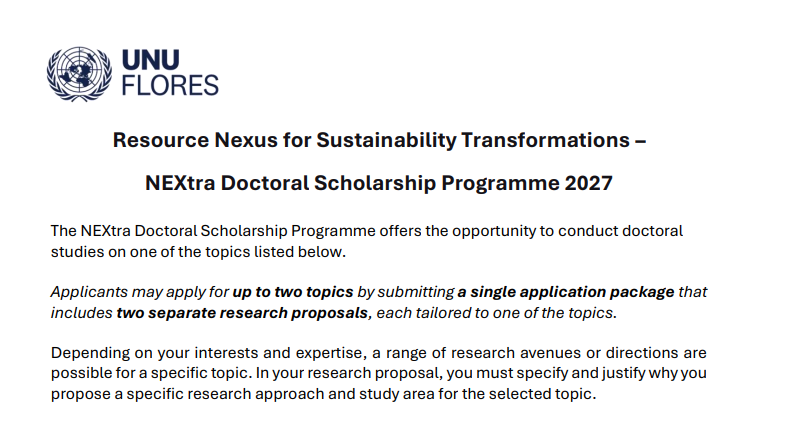
Applicants may apply for up to two topics by submitting:
- One complete application package
- Two separate research proposals
- Each proposal clearly tailored to one selected topic
Each proposal must:
- Define a specific research direction within the topic
- Justify the chosen methodology
- Identify a clear study area or empirical context
- Demonstrate alignment with a relevant UNU-FLORES focus area
The programme promotes interdisciplinary, systems-oriented research to address complex sustainability challenges worldwide.
NEXtra Doctoral Scholarship Programme 2027: Research Topics
1. Building the Circular City: Planning Barriers & Urban Revitalisation
This topic examines how circular economy principles can transform urban development. The construction sector significantly impacts land use, emissions, biodiversity, and water systems. Urban revitalisation offers major circularity potential but faces:
- Economic constraints
- Legal and regulatory barriers
- Technical limitations
- Institutional and cultural resistance
Using a Resource Nexus lens, this research explores how material flows and interconnected urban resources can be managed more sustainably. International comparative case studies will generate actionable recommendations for circular planning.
Ideal Background:
Urban Planning, Architecture, Geography, or related disciplines.
2. Communicating Resource Nexus Indicators Through Persuasive Maps
This topic bridges scientific cartography and persuasive communication. While multi-variate maps effectively communicate resource interdependencies to experts, they often fail to engage the broader public.
The research will:
- Develop guidelines for persuasive scientific mapping
- Translate complex datasets into accessible visual narratives
- Balance credibility, clarity, and emotional engagement
- Contribute to one specific UNU-FLORES focus area
The goal is to improve public understanding of interconnected environmental resources.
Ideal Background:
Cartography, Geoinformatics, Geography, Environmental Science.
3. Resource Nexus Strategies for Urban-Regional Development Minerals
Urbanisation drives resource consumption and greenhouse gas emissions. This project investigates how cities can transition from linear to circular material systems by focusing on development minerals (e.g., sand, gravel, clay, limestone).
Key objectives:
- Assess regional primary and secondary mineral availability
- Integrate recycled materials into supply systems
- Balance quarrying with ecosystem resilience
- Reduce long-distance material transport
The research supports sustainable construction and regional resource security.
Ideal Background:
Urban/Regional Planning, Geography, Geospatial Analysis.
4. Economic Restructuring & Resource Nexus in Developing Countries
This data-driven project analyzes spatial relationships between economic structural change and land/water consumption.
Research focus includes:
- Sectoral shifts and environmental impacts
- Spatially detailed time-series analysis
- Policy influence on land and water use
- Resource governance in the Global South
The goal is to identify causal mechanisms linking economic transformation to environmental pressures.
Ideal Background:
Economics, Economic Geography, Spatial Statistics, GIS.
5. From Nexus Thinking to Action: Systems Thinking & Behavioral Spillover
This project explores how Resource Nexus education fosters long-term pro-environmental behavior in non-formal learning settings.
Research themes:
- Systems thinking development
- Digital tools for citizen science
- Behavioral spillover across sustainability practices
- Agency, identity, and nature connectedness
- Mixed-method longitudinal research
The study contributes to sustainability transformations through participatory education approaches.
Ideal Background:
Psychology, Education, Sustainability Science, Human–Computer Interaction.
6. Geospatial Data Rescue from a Resource Nexus Perspective
Historical geospatial datasets are critical for monitoring long-term environmental change but are increasingly at risk of loss.
This research will:
- Identify priority datasets for preservation
- Assess risks of data loss for nexus analysis
- Develop data governance strategies
- Support evidence-based resource management
The project focuses on a defined nexus and spatial scale.
Ideal Background:
Geoinformatics, Computer Science, Data Governance.
7. Remote Sensing & Post-Mining Land Use
Post-mining landscapes require integrated rehabilitation strategies.
The project will:
- Monitor land recovery using satellite, LiDAR, and hyperspectral data
- Evaluate trade-offs between land-use options
- Develop decision-support tools
- Apply Resource Nexus principles to land transitions
Case studies may include Global South and industrialised regions.
Ideal Background:
Environmental Science, Remote Sensing, GIS.
8. Infrastructure & Land Use Dynamics in the Global South
Large-scale infrastructure often drives environmental degradation.
This project will:
- Conduct multi-level geospatial analysis
- Develop land-use scenarios
- Apply hybrid modeling approaches
- Assess trade-offs between development and carrying capacity
The research supports evidence-based policymaking.
Ideal Background:
Geography, Spatial Planning, Geospatial Modeling.
9. Operationalizing Transformative Capacity in Governance
This topic develops an assessment framework for transformative capacity in urban and regional governance systems.
Key components:
- Spatial indicator development
- Comparative case studies (2–3 city-regions)
- Mixed-method research
- Linking large datasets with qualitative insights
The goal is to improve sustainability transition governance.
Ideal Background:
Social Sciences, Sustainability Studies, Governance Research.
10. Responsible Mobility in Data-Scarce Regions
This project quantifies responsible mobility in transport networks, especially in data-poor Global South contexts.
Research includes:
- Data science and machine learning
- Transport modeling
- Environmental and social impact assessment
- Resource Nexus integration
The aim is to create innovative tools for sustainable transport planning.
Ideal Background:
Civil Engineering, Transport Science, Geoinformatics.
11. Sustainable Value Creation of Seagrass in Coastal Regions
This interdisciplinary project examines seagrass as a renewable material in coastal Global South contexts.
Focus areas:
- Life cycle and material flow analysis
- Carbon sequestration and ecosystem services
- Competing uses and conflicts
- Sustainable bioeconomy development
The research integrates materials science with socio-economic analysis.
Ideal Background:
Materials Science, Sustainability Science, Engineering.
12. Sustainable Resource Governance in Peri-Urban Areas
This project investigates how socially embedded land rights influence sustainable resource management in informal settlements.
Research includes:
- Mixed methods data collection
- Stakeholder engagement
- Governance transition pathways
- Resource Nexus integration
Ideal Background:
Geography, Environmental Sciences.
13. Translating Resource Nexus Science into Policy
This topic evaluates how Nexus research informs United Nations policy implementation.
The research will:
- Compare scientific evidence with UN policy documents
- Analyze implementation gaps
- Conduct case-based policy assessments
- Develop guidance for science-policy integration
Ideal Background:
Political Science, International Relations, Development Studies.
Why Apply?
The NEXtra Doctoral Scholarship Programme 2027 offers:
- Interdisciplinary supervision
- International research collaboration
- Focus on Global South sustainability challenges
- Opportunities to shape future Resource Nexus policy and practice
Prospective applicants are encouraged to develop innovative, systems-oriented research proposals that contribute meaningfully to global sustainability transformations.
SEE FULL TEXT & APPLY
For more opportunities such as these please follow us on Facebook, Instagram , WhatsApp, Twitter, LinkedIn and WPChannel
Disclaimer: Global South Opportunities (GSO) is not the organization that is offering this scholarships. For any inquiries, please contact the official organization directly. Please do not send your applications to GSO, as we are unable to process them. Due to the high volume of emails, we receive daily, we may not be able to respond to all inquiries. Thank you for your understanding.