
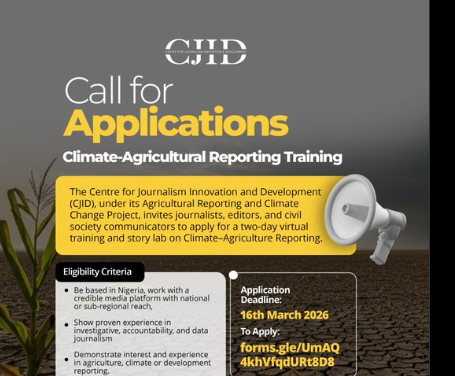
Call for Applications: The Centre for Journalism Innovation and Development (CJID) Climate–Agricultural Reporting Training 2026
Agricultural Reporting Training 2026
Job Description
The Centre for Journalism Innovation and Development (CJID), under its Agricultural Reporting and Climate Change Project, is inviting journalists, editors, and civil society communicators to apply for a two-day virtual training and story lab focused on climate–agricultural reporting.
As climate change continues to reshape agricultural systems across Nigeria and the wider region, the need for accurate, data-driven, and solutions-oriented journalism has never been more urgent.
Flooding, prolonged droughts, desertification, pest outbreaks, and rising food prices are placing immense pressure on farmers and food systems. Smallholder farmers, who produce an estimated 60–70 percent of Nigeria’s food supply, remain particularly vulnerable to climate shocks.
This training programme is designed to strengthen reporting at the intersection of climate change, agricultural productivity, and public policy through investigative and community-centered approaches.
The Centre for Journalism Innovation and Development (CJID) Climate–Agricultural Reporting Training 2026: Objectives
The Climate–Agricultural Reporting Training aims to:
- Strengthen journalists’ capacity to report on climate impacts affecting agriculture
- Promote investigative and accountability journalism in climate and food systems
- Encourage data-driven storytelling and evidence-based reporting
- Support public interest journalism that highlights policy gaps and solutions
- Build a network of reporters focused on climate and agricultural resilience
Participants will engage in a structured story lab designed to refine pitches and improve reporting strategies, ensuring their final stories meet high editorial standards.
The Centre for Journalism Innovation and Development (CJID) Climate–Agricultural Reporting Training 2026: Who Can Apply
The call is open to:
- Reporters
- Editors
- Media-focused civil society organisations (CSOs)
- Freelance journalists with proven public interest reporting experience
Joint applications are welcome, with a maximum of three applicants per team. However, for successful team applications, only the lead applicant will attend the virtual training.
Applications from newsroom-based journalists must be submitted through an editor or newsroom manager. Freelance applicants must provide links to previously published work demonstrating relevant experience in investigative, accountability, or data journalism.
The Centre for Journalism Innovation and Development (CJID) Climate–Agricultural Reporting Training 2026: Eligibility Criteria
Applicants must meet the following requirements:
- Be based in Nigeria
- Work with a credible media platform with national or sub-regional reach
- Demonstrate proven experience in investigative, accountability, and data journalism
- Show interest and prior experience in agriculture, climate, or development reporting
- Commit to producing and publishing their stories within the agreed timeline
CJID strongly encourages female journalists and Persons with Disabilities (PWDs) to apply in order to promote inclusive representation in climate reporting.
The Centre for Journalism Innovation and Development (CJID) Climate–Agricultural Reporting Training 2026: Application Requirements
Interested applicants must:
- Submit a climate–agriculture story pitch using the official CJID pitch template
- Complete the official application form
- Provide required professional details and supporting materials
The story pitch is a critical component of the selection process. Applicants are expected to propose well-researched, impactful story ideas that explore the intersection of climate change and agriculture in Nigeria. Pitches should demonstrate originality, feasibility, public interest value, and potential for measurable impact.
Applicants are advised to carefully review the pitch template before submission to ensure all required elements are addressed.
The Centre for Journalism Innovation and Development (CJID) Climate–Agricultural Reporting Training 2026: Benefits of Participation
Selected participants will receive:
- Participation in a two-day intensive virtual climate–agriculture reporting training
- Mentorship from experienced investigative journalism experts
- Editorial support to refine and publish their stories
- Commissioning grants for selected investigative reports
- Access to CJID’s Climate–Agriculture Reporting Network
The combination of training, mentorship, and financial support is designed to help journalists produce high-quality investigative stories that can influence public discourse and policy.
Application Deadline
All applications must be submitted on or before 16 March 2026. Late submissions will not be considered.
Only shortlisted candidates will be contacted, and successful applicants will be notified via email.
Why This Training Matters
Climate change poses significant risks to food security, rural livelihoods, and economic stability in Nigeria. Strong journalism plays a crucial role in holding institutions accountable, amplifying the voices of affected communities, and informing evidence-based policy responses.
Through this training initiative, CJID seeks to equip journalists with the tools, networks, and support needed to produce impactful reporting that advances transparency, resilience, and sustainable agricultural development.
Interested applicants should download the official CJID Story Pitch Template and complete the application form before the deadline to be considered for this opportunity.
VISIT OFFICIAL WEBSITE HERE
For more opportunities such as these please follow us on Facebook, Instagram, WhatsApp, Twitter, LinkedIn and WPChannel
Disclaimer: Global South Opportunities (GSO) is not the organization offering the fellowship For any inquiries, please contact the official organization directly. Please do not send your applications to GSO, as we are unable to process them. Due to the high volume of emails, we receive daily, we may not be able to respond to all inquiries. Thank you for your understanding.