
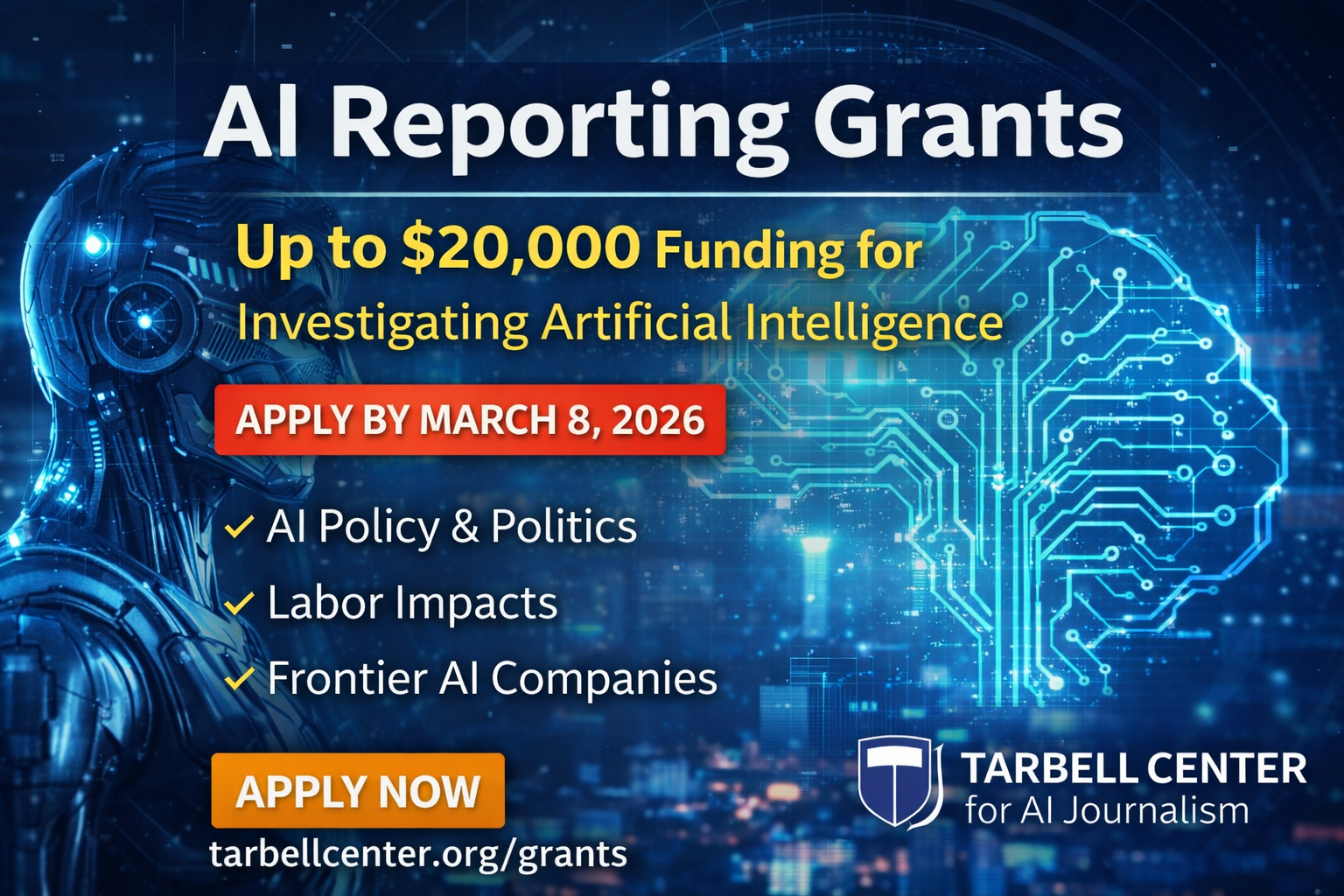
AI Reporting Grants 2026: Up to $20,000 Funding for Journalists Investigating Artificial Intelligence
Unknown
Job Description
Artificial intelligence is transforming industries, governments, and societies around the world. From shaping public policy to influencing labor markets and geopolitical competition, AI technologies are advancing at a pace that raises critical questions about accountability, transparency, and societal impact. To support rigorous journalism that explores these questions, the Tarbell Center for AI Journalism has launched the AI Reporting Grants program, offering funding of up to $20,000 for journalists producing original reporting on artificial intelligence and its real-world consequences.
This initiative aims to strengthen independent journalism that investigates how AI systems are built, deployed, and regulated. By supporting journalists and media creators, the program encourages deeper reporting that can inform the public, influence policymakers, and shed light on the technological forces shaping the modern world.
Applications for this grant round close on March 8, 2026, and journalists from around the globe are encouraged to apply.
Purpose of the AI Reporting Grants Program
The AI Reporting Grants program was established to ensure that the growing influence of artificial intelligence receives the scrutiny and public-interest journalism it deserves. As AI systems become increasingly powerful and widely deployed, the organizations building them and the institutions regulating them require careful and independent oversight.
Journalism plays a vital role in demystifying complex technologies and ensuring transparency. The Tarbell Center supports reporting that examines AI developments critically, follows financial incentives behind technological decisions, and documents how AI systems impact people, communities, and institutions in the real world.
Through this grant, journalists can pursue ambitious reporting projects that would otherwise be difficult to fund. The program allows reporters to dedicate time and resources to investigative journalism, data-driven reporting, and deep analysis related to artificial intelligence.
Grant Funding and Support
Selected journalists may receive grants ranging from $1,000 to $20,000 depending on the scale, complexity, and ambition of the reporting project.
These funds can be used for a wide range of reporting-related expenses, including:
-
Time and labor spent researching and producing the story
-
Travel costs for interviews or on-the-ground reporting
-
Data acquisition and analysis
-
Access to research tools or APIs
-
Investigative expenses required to complete the reporting project
Both freelancers and journalists working at established publications are eligible to apply. The grant primarily supports written journalism but also considers exceptional proposals in other journalistic formats, including podcasts, newsletters, and documentary storytelling.
Key Focus Areas for the 2026 Grant Round
For this funding cycle, the Tarbell Center has identified six priority reporting areas that reflect some of the most pressing issues in the global AI ecosystem.
1. Accountability Reporting on Frontier AI Companies
Major AI companies such as OpenAI, Google DeepMind, Anthropic, Meta, and xAI are developing increasingly powerful systems that influence economies and societies. Yet these organizations often operate with limited regulatory oversight.
Journalists are encouraged to investigate questions such as:
-
Whether AI companies follow through on their public safety commitments
-
How corporate governance decisions shape AI development
-
How user harm is addressed in cases such as algorithmic bias or deepfakes
-
Transparency around training data, environmental impact, and monitoring systems
2. AI Policy and Politics
The rapid development of AI technologies has sparked global debates about regulation and governance. Governments, advocacy groups, and industry actors are competing to shape policy frameworks that determine how AI is used and controlled.
Reporting proposals may examine:
-
Lobbying efforts by AI companies and industry groups
-
Legislative initiatives related to AI regulation
-
International negotiations and regulatory competition between nations
-
Political influence networks surrounding AI governance
3. AI Explainers and Analytical Journalism
The pace of AI development has made it difficult even for experts to keep up with technological progress. Strong explanatory journalism can help bridge this gap by translating complex research into accessible analysis.
Journalists may propose stories that explore:
-
How AI models are evaluated for safety and reliability
-
The capabilities and limitations of emerging AI systems
-
Environmental impacts of AI infrastructure
-
The economic dynamics shaping AI companies and their investments
4. AI in Government and Military Institutions
Artificial intelligence is increasingly integrated into public-sector operations, including defense, intelligence, law enforcement, and administrative governance.
Investigative reporting in this category could explore:
-
Government procurement of AI technologies
-
Military applications of AI and their ethical implications
-
Partnerships between defense agencies and AI startups
-
Surveillance technologies and their societal consequences
5. AI Labor and Workforce Impacts
Debates about AI and employment are widespread, yet concrete evidence about how automation affects jobs remains limited.
Reporting in this area may focus on:
-
Industries experiencing measurable workforce changes due to AI tools
-
Workers involved in training AI models and their working conditions
-
Corporate claims about productivity improvements from AI adoption
-
Professions where AI adoption has been slower than expected
6. AI Developments in China
China plays a major role in the global AI landscape, yet its ecosystem is often poorly understood outside the country.
The Tarbell Center encourages nuanced reporting that explores:
-
Chinese AI research and commercial ecosystems
-
Government deployment of AI technologies in cities or provinces
-
AI policy debates within China
-
Expansion of Chinese AI companies into global markets
Possible Reporting Directions
Journalists applying for the grant may also consider broader investigative or analytical topics, such as:
-
Comparing public perceptions of AI capabilities with the reality of current technology
-
Investigating third-party organizations responsible for evaluating AI systems
-
Documenting emerging AI behaviors such as deceptive reasoning or “sandbagging”
-
Examining differences between benchmark test performance and real-world usefulness
-
Exploring uneven AI performance across different tasks and industries
These topics highlight how AI development intersects with policy, society, economics, and human behavior.
Selection Process and Judging Panel
Applications are evaluated by an independent panel of experienced journalists and editors with expertise in technology reporting and investigative journalism.
Members of the judging panel include respected media professionals from outlets such as The Wall Street Journal, Axios, The Verge, and leading technology publications.
Applications are assessed based on several criteria:
-
Potential societal impact of the proposed reporting
-
Likelihood that the story will reach a wide or influential audience
-
The journalist’s previous reporting experience
-
Feasibility and realism of the reporting plan and budget
Editorial independence is central to the program. The Tarbell Center does not influence the content of funded stories, and donors have no involvement in editorial decisions.
Application Requirements
Applicants must submit their proposals through the official application process. Required materials include:
-
A detailed reporting pitch describing the story idea
-
A proposed budget outlining how grant funds will be used
-
Evidence of previous journalism experience
-
Optional documentation showing interest from a publication editor
Although applicants are encouraged to secure a publication venue beforehand, it is not mandatory during the initial application stage. If selected, grantees may be asked to obtain a letter of interest from a media outlet before funds are distributed.
Journalists may submit up to three different story proposals.
Deadline
The application deadline for the current grant round is March 8, 2026.
Applicants can expect to hear back within approximately four weeks after the deadline.
Why This Opportunity Matters
Artificial intelligence is becoming one of the most influential technologies of the 21st century. Decisions made today about AI development, regulation, and deployment will shape economies, societies, and democratic institutions for decades to come.
High-quality journalism plays a critical role in ensuring that these decisions are transparent and accountable. By funding independent reporters, the AI Reporting Grants program enables investigative journalism that can illuminate the realities behind AI systems and their societal impact.
For journalists interested in covering technology, policy, or global economic change, this grant provides a valuable opportunity to pursue ambitious stories that contribute to public understanding of artificial intelligence.
For more information click here
Discover more opportunities here