
Cybersecurity Programme Initiative @AI Hub for Sustainable Development
Overview of the Cyber4Africa Programme
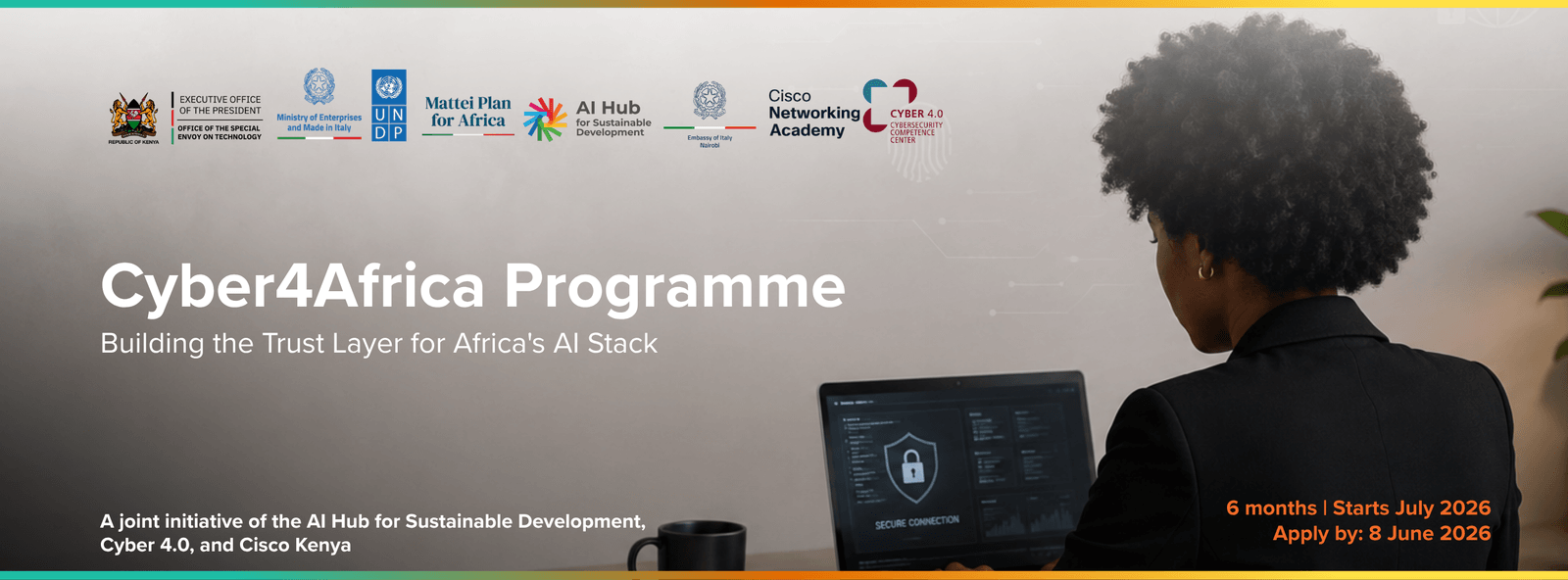
The AI Hub for Sustainable Development has announced the Cyber4Africa Programme, a six-month cybersecurity capacity-building initiative designed to support African AI startups. The programme addresses growing concerns around data security, institutional trust, and digital resilience as artificial intelligence adoption accelerates across the continent.
The initiative is built around a central premise: cybersecurity is not optional infrastructure but a foundational requirement for scalable and trustworthy AI systems.
The programme is implemented in collaboration with Cyber 4.0 and Cisco Kenya, combining expertise in cybersecurity training, infrastructure development, and AI ecosystem support.
The Role of Cybersecurity in Africa’s AI Ecosystem
Across African innovation hubs such as Nairobi, Lagos, Kigali, and Accra, AI startups are increasingly powering critical systems in:
- Healthcare delivery and diagnostics
- Digital financial services
- Government and civic technology platforms
- Energy and climate systems
- Core AI infrastructure and data platforms
However, rapid adoption has exposed a structural gap: cybersecurity systems and institutional support structures have not scaled at the same pace as AI innovation.
The Cyber4Africa Programme identifies this gap as a trust deficit, where lack of security readiness risks undermining adoption, public confidence, and long-term system stability.
Why Trust Infrastructure Determines AI Adoption
The programme highlights that AI diffusion depends not only on technological capability but also on institutional trust.
Key risks identified include:
- Exposure of sensitive personal and financial data
- Loss of institutional credibility following cyber incidents
- Reduced user adoption after security breaches
- Weak accountability systems in AI deployment environments
In sectors such as health and fintech, even minor breaches can have long-term consequences for public trust and market viability.
The initiative emphasizes that cybersecurity must be treated as a system-level requirement rather than a post-deployment fix.
Programme Objectives
The Cyber4Africa Programme is structured to build cyber resilience directly into the AI development lifecycle. Its core objectives include:
- Strengthening cybersecurity capacity among African AI startups
- Embedding security-by-design principles in product development
- Enhancing institutional trust in AI-driven systems
- Building a community of cybersecurity-aware AI founders
- Developing future professionals in AI safety and cyber assurance
The programme also aims to contribute to the development of a new cybersecurity workforce pipeline in Africa, supporting both technical and governance capabilities.
Priority Sectors
The programme focuses on high-risk sectors where cybersecurity failures can have significant social, economic, or institutional consequences.
These include:
- Healthcare and Digital Health: Protection of patient data and diagnostic systems
- Fintech and Financial Services: Safeguarding financial transactions and user trust
- Govtech and Civic Technology: Securing identity systems and public infrastructure
- Energy and Climate Technology: Protecting AI-enabled physical infrastructure systems
- AI Infrastructure and Data Platforms: Securing foundational systems powering AI ecosystems
Programme Structure
The Cyber4Africa Programme runs over six months and is structured into three core workstreams:
Cyber Resilience and Awareness
Startups receive:
- Initial cybersecurity posture assessment
- Guidance on organizational security readiness
- Alignment with global cybersecurity standards
- Risk identification and mitigation recommendations
Training and Capacity Building
Participants benefit from structured learning opportunities, including:
- Remote and in-person cybersecurity training sessions
- AI security fundamentals webinars
- A cybersecurity starter course tailored for startups
- Access to Cisco Kenya’s Cybersecurity Training Centre in Nairobi
Technical and Operational Support
Startups also receive hands-on implementation support:
- Expert-led advisory sessions
- Incident response capability development
- Operational security improvements
- AI Security Quick Scan assessments
- Office hours with cybersecurity specialists
Eligibility Criteria
The programme is open to African AI startups that meet the following conditions:
- Possess an AI-enabled product, platform, or service at MVP stage or beyond
- Operate in environments with meaningful cybersecurity exposure
- Handle sensitive data (personal, financial, or operational)
- Work within priority sectors outlined by the programme
- Are based in Africa or serve African markets
- Can actively participate for the full programme duration
Benefits for Participating Startups
Startups selected for the Cyber4Africa Programme will gain:
- A structured cybersecurity assessment with prioritized action planning
- Improved protection of user data and digital systems
- Enhanced readiness for institutional partnerships and investor requirements
- Access to global cybersecurity expertise and training networks
- Stronger positioning for regulatory and procurement processes
- Membership in a growing African AI security community
The programme also strengthens startups’ ability to scale securely while maintaining trust with users and stakeholders.
Strategic Importance for Africa’s AI Future
The initiative positions cybersecurity as a critical enabler of Africa’s AI transformation. Rather than treating security as a compliance requirement, the programme frames it as a core innovation capability.
By embedding security practices early, African AI startups are expected to:
- Reduce systemic risk across digital ecosystems
- Improve adoption rates of AI solutions
- Strengthen investor confidence
- Enhance resilience of public and private digital infrastructure
- Shape future governance frameworks for AI systems
Application Details
Interested startups can apply for participation in the programme.
- Application Deadline: 8 June 2026
- Programme Start Date: 1 July 2026
- Duration: 6 months
- Contact Email: aihubforsustainabledevelopment@undp.org
Conclusion
The Cyber4Africa Programme represents a structured response to one of the most pressing challenges in Africa’s digital transformation: ensuring that AI systems are secure, trusted, and resilient from the outset.
By combining technical training, operational support, and ecosystem development, the initiative seeks to strengthen the foundation upon which African AI innovation can scale sustainably.
VISIT OFFICIAL WEBSITE TO APPLY
For more opportunities such as these please follow us on Facebook, Instagram, Twitter, LinkedIn and WPChannel
Disclaimer: Global South Opportunities (GSO) is not the organization offering this opportunity. For any inquiries, please contact the official organization directly. Please do not send your applications & CVs to GSO, as we are unable to process them. Due to the high volume of emails, we receive daily, we may not be able to respond to all inquiries. Thank you for your understanding.
Cybersecurity Programme Initiative
@AI Hub for Sustainable Development
Location
Global
Work Mode
fellowship
Posted
2 days ago
Beware of scams! When applying for jobs, you should NEVER have to pay anything. Learn about job scams.
Get jobs in your inbox
Join over 10,000 subscribers receiving our weekly newsletter.
You might also like

PhD in Environmental Economics at University of Augsburg – Apply by June 15, 2026 | Research on Early Warning Systems for Tipping Points
University of Augsburg – Apply by June 15, 2026 | Research on Early Warning Systems for Tipping Points

Senior Visiting Research Fellow
Lagos Africa Multiple Research Centre, University of Lagos
Global Course on Digital Public Infrastructure
International Telecommunication Union (ITU)
DDC x TrygFonden Fellowship Programme
Digital Democracy Centre
Zambia Mining and Local Development Fellowship
Center for Effective Global Action (CEGA)

Richard Rooney Postdoctoral Fellowship in African Studies
University of Toronto