








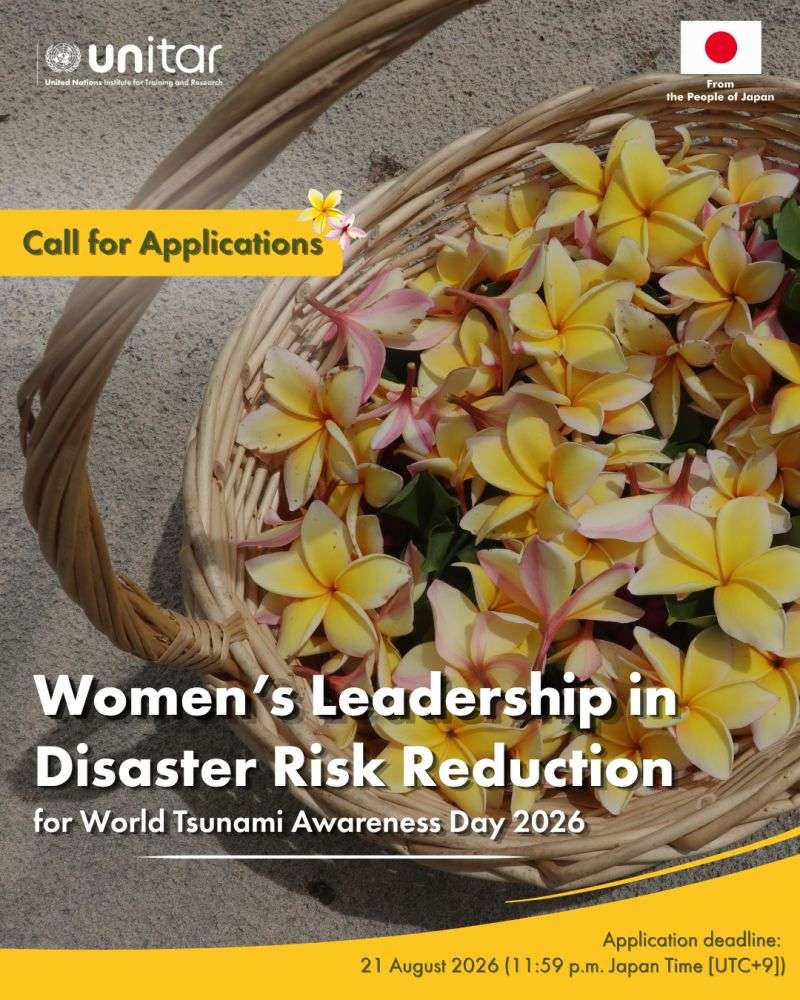
Disaster Risk Reduction Training – UNITAR Women’s Leadership Programme for World Tsunami Awareness Day 2026 ·UNITAR Women’s Leadership Programme for World Tsunami Awareness Day 2026
Introduction
Disasters do not discriminate—but their impacts often do. Across the Asia‑Pacific and Pacific Island regions, women and marginalized communities bear disproportionate burdens when natural hazards strike. From tsunamis and cyclones to floods and earthquakes, the consequences of these events ripple through societies, often exacerbating existing inequalities. Women, in particular, are frequently at the forefront of caregiving, community rebuilding, and resource management, yet their leadership in disaster risk reduction (DRR) has historically been underrecognized and underfunded.
Recognizing this gap, the United Nations Institute for Training and Research (UNITAR) has launched a transformative initiative: the Women’s Leadership in Disaster Risk Reduction Training Programme for World Tsunami Awareness Day 2026, generously funded by the Government and People of Japan. This programme is not just about training—it is about reshaping the narrative of disaster preparedness by centering women’s voices, experiences, and leadership.
The initiative aims to equip 500 participants with lifelong skills in disaster risk reduction and inclusive leadership. It is designed to strengthen resilience, empower women, and promote equitable participation in disaster preparedness and response. By drawing from Japan’s globally respected disaster management expertise and contextualizing lessons within the Asia‑Pacific region, the programme ensures that participants gain both technical knowledge and culturally relevant strategies.
This training is more than an educational opportunity—it is a call to action. It invites motivated individuals to step forward, learn, and lead their communities toward resilience. It underscores the importance of inclusivity, equity, and sustainability in disaster risk reduction, ensuring that no one is left behind when disaster strikes.
Application Deadline: 21 August 2026 (11:59 p.m. JST [UTC+9])
Programme Overview
1. Purpose and Vision
The UNITAR Women’s Leadership in Disaster Risk Reduction Programme seeks to build a generation of leaders capable of transforming how communities prepare for and respond to disasters. It emphasizes gender‑inclusive leadership, community‑based resilience, and the integration of traditional and scientific knowledge.
2. Funding and Support
The programme is fully funded by the Government and People of Japan, allowing participants to access world‑class training free of charge. This support reflects Japan’s commitment to global disaster preparedness and its leadership in tsunami awareness education.
3. Programme Structure
The training unfolds in two distinct phases, combining online learning and specialized workshops:
Phase I: Online Learning (August – November 2026)
- Approximately 500 participants will engage in self‑paced online modules.
- Interactive webinars with experts will explore inclusive disaster risk planning.
- Assignments will include developing an individual DRR plan contextualized to each participant’s community.
Phase II: Specialized Training with Experts
Top performers from Phase I will advance to Phase II, which includes:
- Online workshop (February 2027) for participants from Asia and non‑Pacific countries.
- In‑person workshop (March 2027) for participants from Pacific Island countries. Both workshops will feature lectures, study tours, and discussions with regional and international institutions, academics, and humanitarian experts.
Learning Objectives
By the end of the programme, participants will be able to:
Phase I Objectives
- Develop foundational knowledge of disaster risk reduction concepts.
- Discuss key principles of DRR, focusing on the Sendai Framework for Disaster Risk Reduction and the Sustainable Development Goals (SDGs).
- Understand ecosystem‑based and community‑based DRR approaches.
- Create inclusive country‑specific DRR plans.
- Apply lessons learned from Japan’s experiences with major disasters, including the 2011 Great East Japan Earthquake and Tsunami and the 2018 West Japan Floods.
- Illustrate the importance of gender‑inclusive leadership in DRR.
- Analyze norms, challenges, and best practices in women’s leadership across the Pacific and Japan.
Phase II Objectives
- Demonstrate leadership and management competencies in disaster contexts.
- Develop technical understanding of hazards and assessment tools.
- Communicate effectively with communities and media during crises.
- Address the needs of vulnerable groups, including women, children, and persons with disabilities.
- Integrate nature‑based solutions, Indigenous knowledge, and local resilience strategies.
- Recognize and manage stress and mental health risks associated with disasters.
Assignments and Certification
Participants will complete:
- Phase I: An individual disaster risk reduction plan.
- Phase II: A project presentation demonstrating applied learning.
Those who fulfill all requirements will receive a UNITAR Certificate of Completion, a globally recognized credential that validates their expertise in inclusive disaster risk reduction and leadership.
Eligibility Criteria
The programme welcomes motivated individuals of any gender who are:
- Aged 18 years or older.
- Living in or from Pacific Island countries and territories or the Asia‑Pacific region.
- Passionate about climate change, disaster risk reduction, and community resilience.
- Proficient in English and computer‑literate.
- Committed to completing all phases of the programme.
Eligible Countries
Pacific Island Countries
Cook Islands, Federated States of Micronesia, Fiji, Kiribati, Marshall Islands, Nauru, Niue, Palau, Papua New Guinea, Samoa, Solomon Islands, Tonga, Tuvalu, and Vanuatu.
Asia
Bangladesh, Brunei, Cambodia, India, Indonesia, Iran, Malaysia, Maldives, Myanmar, Pakistan, Philippines, Sri Lanka, Thailand, Timor‑Leste, and Viet Nam.
Applicants from other countries are also welcome, though the content is contextualized to the Pacific and Asia.
How to Apply
Applications must be submitted online through the official UNITAR platform.
Deadline: 21 August 2026 (11:59 p.m. JST [UTC+9]).
Contact for inquiries: UNITAR Hiroshima Project Office Email: DRR‑Prosperity@unitar.org (Applications will not be accepted via email.)
Programme Benefits
- Free participation thanks to Japan’s funding.
- Global networking with experts, academics, and humanitarian leaders.
- Practical learning through real‑world case studies and community‑based projects.
- Certification from UNITAR, enhancing professional credibility.
- Empowerment of women and marginalized groups in disaster leadership roles.
Broader Impact
This initiative contributes directly to the Sendai Framework for Disaster Risk Reduction (2015–2030) and the 2030 Agenda for Sustainable Development. By strengthening women’s leadership, UNITAR promotes equity, resilience, and inclusive governance.
It also aligns with World Tsunami Awareness Day, emphasizing preparedness, education, and community empowerment to reduce disaster losses globally.
Frequently Asked Questions (FAQs)
1. What is the main goal of the programme?
To equip participants with leadership and technical skills for inclusive disaster risk reduction, focusing on gender equity and community resilience.
2. Who funds the programme?
The Government and People of Japan fund the initiative, ensuring free participation for all selected learners.
3. Is the training conducted online or in person?
Phase I is fully online; Phase II includes both online and in‑person workshops depending on participants’ regions.
4. What language is used?
The programme is conducted in English.
5. Who can apply?
Adults aged 18 and above from Pacific Island countries and Asia‑Pacific nations, as well as motivated learners from other regions.
6. What is the deadline?
Applications close on 21 August 2026 (11:59 p.m. JST [UTC+9]).
7. Is there a certificate?
Yes, participants who complete all requirements receive a UNITAR Certificate of Completion.
8. What topics are covered?
Disaster risk reduction principles, leadership, communication, mental health, gender inclusion, and nature‑based solutions.
9. How many participants will be selected?
Approximately 500 participants will join Phase I; top performers will advance to Phase II.
10. Is prior experience required?
No prior professional experience is necessary—only motivation, commitment, and English proficiency.
11. Are men allowed to apply?
Yes. While the programme emphasizes women’s leadership, it welcomes participants of all genders.
12. What are the benefits of completing the training?
Enhanced leadership skills, global networking, and the ability to design inclusive DRR plans for one’s community.
13. Will travel costs be covered for in‑person workshops?
UNITAR typically provides logistical support for Pacific participants invited to the in‑person phase.
14. Can participants from outside Asia‑Pacific apply?
Yes, learners from other regions may apply, understanding that the content is contextualized to Pacific and Asian experiences.
15. How will participants be selected?
Selection is based on motivation, clarity of purpose, and commitment to community impact.
16. What is the expected time commitment?
Phase I runs from August to November 2026 with flexible, self‑paced modules; Phase II lasts several days per workshop.
17. What technical requirements are needed?
Reliable internet access, a computer or mobile device, and basic digital literacy.
18. What happens after completion?
Graduates join UNITAR’s alumni network and may access future learning opportunities.
19. How does this programme support gender equality?
It empowers women to lead disaster preparedness and response efforts, addressing gender‑specific vulnerabilities and capacities.
20. Why is Japan involved?
Japan’s extensive experience with natural disasters and its commitment to global resilience make it a key partner in advancing DRR education.
Conclusion
The UNITAR Women’s Leadership in Disaster Risk Reduction Training Programme for World Tsunami Awareness Day 2026 represents a landmark opportunity to transform how communities prepare for and respond to disasters. By equipping participants with technical expertise, leadership skills, and inclusive strategies, the programme directly contributes to building societies that are more resilient, equitable, and prepared for future shocks.
This initiative is not only about disaster preparedness—it is about empowering women and marginalized communities to lead. It acknowledges that resilience is strongest when leadership is diverse, inclusive, and representative of those most affected by crises. By centering women’s leadership, UNITAR challenges traditional hierarchies and ensures that disaster risk reduction strategies reflect the realities of all community members.
The programme’s dual structure—online learning followed by specialized workshops—provides flexibility, accessibility, and depth. Participants will benefit from Japan’s unparalleled disaster management expertise, while also contextualizing their learning to the unique challenges of the Asia‑Pacific and Pacific Island regions. The UNITAR certificate awarded upon completion further validates participants’ skills, opening doors to future opportunities in disaster management, humanitarian work, and leadership roles.
Ultimately, this training is about more than knowledge—it is about transformation. It is about equipping individuals to become agents of change, capable of designing inclusive disaster risk reduction plans, advocating for vulnerable groups, and leading communities toward resilience. It is about building a future where preparedness is not a privilege but a shared responsibility, and where leadership is inclusive, equitable, and effective.
For those passionate about climate change, disaster risk reduction, and community resilience, this programme is a chance to make a tangible impact. It is a chance to learn, to lead, and to contribute to a global movement for safer, stronger, and more inclusive societies.
To explore and lean more about other grant opportunities, visit the OFY page HERE
Disaster Risk Reduction Training – UNITAR Women’s Leadership Programme for World Tsunami Awareness Day 2026
@UNITAR Women’s Leadership Programme for World Tsunami Awareness Day 2026
Location
USA / Global
Work Mode
grant
Posted
about 4 hours ago
Beware of scams! When applying for jobs, you should NEVER have to pay anything. Learn about job scams.
Get jobs in your inbox
Join over 10,000 subscribers receiving our weekly newsletter.
You might also like

ATCMA-ECCAS Call for Expressions of Interest 2026: EU-Funded Opportunity for Timber, Cocoa, and Cassava SMEs in Central Africa
ECCAS Call for Expressions of Interest 2026: EU-Funded Opportunity for Timber, Cocoa, and Cassava SMEs in Central Africa
Investigative Journalism Grant – IWMF Fault Lines Fund for U.S. Hate Narrative Reporting
IWMF Fault Lines Fund for U.S. Hate Narrative Reporting

ECOWAS Young Graduates Immersion Programme 2027: Fully Paid One-Year Professional Programme for Young Graduates in West Africa
Year Professional Programme for Young Graduates in West Africa
ERC Starting Grant 2027: A Complete Guide to Europe’s Prestigious Research Grant for Early-Career Scientists
Career Scientists
Emerging Reporters Program 2026–2027: Receive a $9,000 Stipend, Professional Mentorship, and Journalism Conference Support from ProPublica
2027: Receive a $9,000 Stipend, Professional Mentorship, and Journalism Conference Support from ProPublica

ECOWAS Young Professionals Immersion Programme 2027
Unknown