








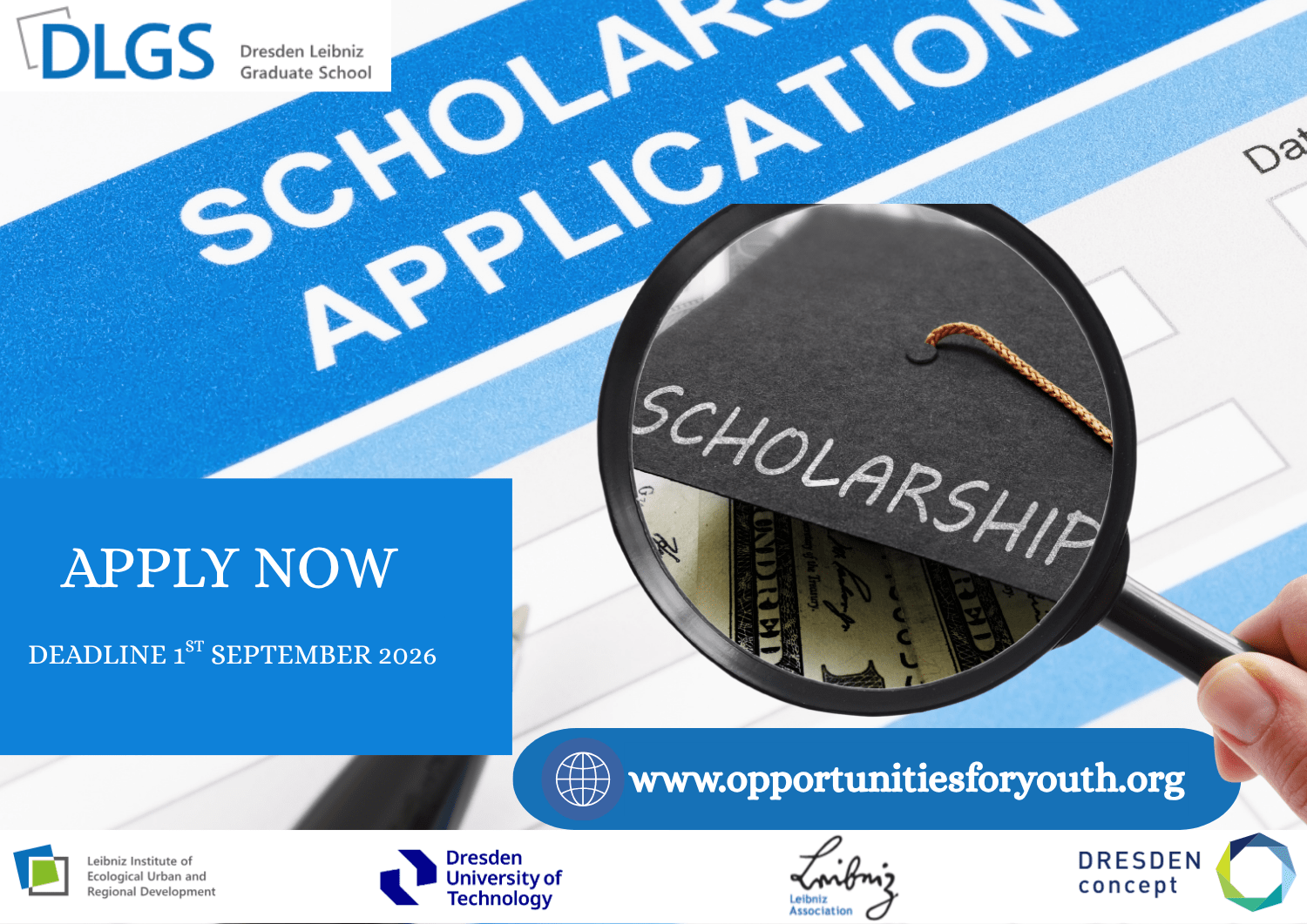
DLGS Call for Applications 2027: Fully Funded International PhD Scholarship in Sustainable Urban Mobility Transformations in Germany ·Unknown
The Dresden Leibniz Graduate School (DLGS) has officially opened applications for its 2027 International PhD Programme, offering fully funded doctoral scholarships for outstanding graduates interested in advancing research on sustainable urban mobility transformations. The programme seeks innovative researchers capable of addressing some of the world’s most pressing urban mobility and sustainability challenges through interdisciplinary and transformative research.
Successful applicants will receive a full-time scholarship for three years, including a monthly stipend of €1,515, together with financial support for research activities and travel. Hosted jointly by the Leibniz Institute of Ecological Urban and Regional Development (IOER) and TU Dresden (Dresden University of Technology), the programme provides an outstanding research environment focused on spatial sustainability science and transformative leadership.
About the Dresden Leibniz Graduate School (DLGS)
The Dresden Leibniz Graduate School (DLGS) is an interdisciplinary graduate school jointly operated by the Leibniz Institute of Ecological Urban and Regional Development (IOER) and TU Dresden.
The graduate school is dedicated to advancing research in:
- Spatial Sustainability Science
- Ecological Urban Development
- Urban and Regional Planning
- Sustainable Transformation
- Transformative Leadership
- Interdisciplinary Research
Its doctoral programme encourages collaboration across disciplines to generate practical solutions for global sustainability challenges while preparing researchers for leadership roles in academia, government, and industry.
Theme of the 2027 Call
Levers for Sustainable Urban Mobility Transformations
The 2027 call focuses on identifying innovative solutions capable of transforming urban mobility systems into more sustainable, inclusive, efficient, and resilient systems.
According to DLGS, modern urban mobility systems face numerous structural sustainability challenges, including:
- Heavy dependence on fossil fuels
- Environmental pollution
- Negative public health impacts
- Accessibility inequalities
- Social inequity
- Road safety concerns
- Fragmented planning systems
- Poor integration between transport planning and land-use development
While digitalization, automation, electrification, artificial intelligence, and new mobility services are transforming transportation systems at unprecedented speed, they also introduce new complexities and unintended consequences.
The programme therefore seeks doctoral research capable of addressing these challenges through integrated and interdisciplinary approaches.
Why This Research Matters
Urban mobility is no longer viewed solely as transportation.
Instead, it has become closely connected with:
- Urban planning
- Environmental sustainability
- Climate action
- Economic development
- Digital innovation
- Public governance
- Social inclusion
- Technological transformation
Current planning approaches often separate transport systems from land-use planning despite their strong interdependence. Existing business models also remain dominated by traditional transport providers, while innovative mobility solutions frequently remain confined to niche applications.
The emergence of spatial data science, artificial intelligence, advanced modelling, and digital technologies presents significant opportunities to rethink how cities are planned and managed.
DLGS therefore encourages research capable of integrating these dimensions into comprehensive mobility transformation strategies.
Key Research Gaps Identified by DLGS
The programme highlights several major research gaps that applicants are encouraged to address.
These include:
1. Integration of Spatial and Mobility Systems
Research is needed to better understand how spatial planning and mobility interact across different geographical scales and contexts.
2. Advanced Models for Dynamic Mobility Systems
Applicants are encouraged to develop models capable of analysing:
- Normal transport operations
- Disrupted mobility systems
- Effects of automation
- Effects of digitalization
- Decision-support systems for planners
3. Combining Data Science with Public Participation
The programme seeks approaches that merge:
- Data-driven analytics
- Participatory planning
- Co-creation
- Inclusive decision-making
4. Future Scenario Development
Researchers should explore mobility futures ranging from:
- Real-time scenarios
- Short-term planning
- Medium-term transitions
- Long-term sustainable futures
while accounting for uncertainty.
5. Governance and Institutional Innovation
The role of institutions, governance systems, and business models in enabling or limiting sustainable mobility transformations remains an important research area.
6. Inclusion of Vulnerable Groups
Projects should consider how mobility systems can better serve vulnerable populations through inclusive design and evaluation.
7. Interdisciplinary Integration
DLGS also identifies insufficient collaboration between disciplines such as:
- Transport research
- Spatial planning
- Spatial data science
- Urban informatics
The programme seeks research that bridges these fields.
Research Topics
Applicants should develop doctoral projects addressing at least one of the following challenge-driven topics.
1. Public Policy
Possible research areas include:
- Governance structures
- Institutional design
- Planning instruments
- Policy implementation
- Planning techniques
2. Business Models
Potential research themes include:
- Sustainable mobility businesses
- Private-sector innovation
- Civil society solutions
- Third-sector organizations
- Non-profit service delivery
- Economic sustainability
3. Integrative Tools
Projects may focus on:
- Data-driven approaches
- Analytical methods
- Computational models
- Decision-support interfaces
- Digital tools
4. Integrated Perspectives
Applicants may also develop interdisciplinary concepts connecting:
- Public policy
- Private sector
- Civil society
- Third-sector organizations
through shared methods, practices, and collaborative frameworks.
Applicant Profile
DLGS is looking for outstanding graduates with strong academic backgrounds and a clear research vision.
Applicants should demonstrate:
- Academic excellence
- Strong analytical skills
- Innovative thinking
- Interest in sustainability research
- Interdisciplinary collaboration
- Commitment to solving complex urban challenges
Eligibility Requirements
Applicants must satisfy all of the following requirements:
- Hold a Master’s degree in a relevant discipline.
- Have obtained their first Master’s degree within the previous three years.
- Demonstrate above-average academic performance.
- Submit an original research proposal aligned with DLGS research priorities.
- Identify potential supervisors at TU Dresden and/or IOER.
- Submit all required application materials before the deadline.
For projects connected to ongoing IOER activities in the Dresden/Saxony region, applicants must also demonstrate German language proficiency at C1 level.
Expectations for the Research Proposal
Applicants are expected to prepare an original doctoral proposal reflecting both their academic expertise and research interests.
Projects may use:
- Qualitative research
- Quantitative research
- Empirical analysis
- Computational modelling
- Conceptual research
- Methodological innovation
Interdisciplinary approaches are expected, while transdisciplinary research designs involving broader stakeholder collaboration are explicitly encouraged whenever feasible.
Scholarship Benefits
Successful candidates will receive:
- Full-time PhD scholarship.
- Funding for three years.
- Monthly scholarship of €1,515.
- Additional financial support for:
- Research activities
- Academic travel
The programme also provides access to an internationally recognized interdisciplinary research environment through DLGS, IOER, and TU Dresden.
Programme Timeline
| Activity | Date |
|---|---|
| Application Deadline | September 1, 2026 |
| Programme Start | March 1, 2027 |
How to Apply
Interested applicants should prepare all required application materials and submit them through the official online application system before the deadline.
Applicants are encouraged to carefully review the detailed application requirements and procedures available on the DLGS website before submitting their applications.
Contact Information
For additional information regarding the programme, applicants may contact:
Scientific Coordinator
Dr. Nora Gortcheva
Email: dlgs@ioer.de
Visit HERE to learn more about the DLGS Call for Applications 2027
Application Deadline
September 1, 2026
Conclusion
The DLGS International PhD Programme 2027 presents an exceptional opportunity for talented graduates seeking to contribute to the future of sustainable urban mobility through cutting-edge interdisciplinary research. By bringing together expertise from transport studies, spatial planning, data science, governance, economics, and related fields, the programme aims to generate innovative solutions to some of the world’s most pressing urban sustainability challenges. With a fully funded three-year scholarship, a competitive monthly stipend, additional research and travel support, and access to internationally recognized research institutions, the programme provides an outstanding platform for aspiring researchers committed to shaping more inclusive, resilient, and sustainable cities. Prospective applicants are encouraged to prepare a strong research proposal aligned with the programme’s priorities and submit their applications before the September 1, 2026 deadline.
For more global schorlarship opportunities visit OFY HERE
DLGS Call for Applications 2027: Fully Funded International PhD Scholarship in Sustainable Urban Mobility Transformations in Germany
@Unknown
Location
USA / Global
Work Mode
scholarship
Posted
about 5 hours ago
Beware of scams! When applying for jobs, you should NEVER have to pay anything. Learn about job scams.
Get jobs in your inbox
Join over 10,000 subscribers receiving our weekly newsletter.
You might also like
Dresden Leibniz Graduate School PhD Programme 2027 – Fully Funded Research Opportunity in Sustainable Urban Mobility Transformations
Fully Funded Research Opportunity in Sustainable Urban Mobility Transformations
France-South Africa Scholarship Programme 2027 Opens Applications | Fully Funded Master’s and PhD Scholarships in France
South Africa Scholarship Programme 2027 Opens Applications | Fully Funded Master’s and PhD Scholarships in France

Applications Open for 2027 KAS-SAIIA Scholarships in South Africa | Fully Funded Master’s and Internship Programme
SAIIA Scholarships in South Africa | Fully Funded Master’s and Internship Programme
Applications Open for the 2027 KAS-SAIIA Scholarships in South Africa: Fully Funded Master’s Scholarship and Internship Programme for Future Leaders
SAIIA Scholarships in South Africa: Fully Funded Master’s Scholarship and Internship Programme for Future Leaders
2026 Monash University Fully Funded PhD Scholarship: Research Intersectional Sexisms in Australian Universities
Unknown
Call for Applications: Human Rights Defender Exchange (HRDx) Mentoring Programme for Early Career Human Rights Scholars 2026
Unknown