








Fully Funded DKFZ PhD Position 2026 in Translational Cancer Biology at LMU Munich ·LMU Munich
The German Cancer Research Center is accepting applications for a fully funded PhD position in Translational Cancer Biology at the German Cancer Consortium partner site in Munich, Germany.
The three-year doctoral position will investigate the molecular mechanisms that drive the progression, metastasis and therapy resistance of small cell lung cancer. The successful candidate will combine experimental cancer biology with functional genomics, advanced disease models and computational analysis of large-scale sequencing data.
The position is located in the Department of Translational Oncology at the DKTK partner site Munich, based at the LMU Klinikum Großhadern. The successful applicant is expected to begin in November 2026 and will become part of the DKFZ International PhD Program.
Applicants should hold a master’s degree in molecular medicine, human biology, biochemistry, biology or another closely related life-science discipline. Practical experience in molecular biology and mammalian cell culture is required.
The application deadline is 11 August 2026.
About the German Cancer Research Center
The German Cancer Research Center, commonly known as DKFZ, is one of Europe’s largest cancer research institutions.
Its mission, “Research for a life without cancer,” reflects its commitment to understanding the causes and biological mechanisms of cancer and translating scientific discoveries into improved prevention, diagnosis and treatment.
DKFZ brings together researchers working across multiple scientific disciplines, including:
- Molecular and cellular biology
- Cancer genetics and epigenetics
- Functional genomics
- Computational biology
- Immunology
- Medical imaging
- Epidemiology
- Translational oncology
- Clinical cancer research
Researchers at DKFZ work within an international scientific environment supported by advanced technologies, specialist infrastructure and global research partnerships.
The institution aims to create conditions in which fundamental scientific discoveries can be transformed into practical benefits for patients and public health.
About the German Cancer Consortium
DKFZ works with selected university medical centres through the German Cancer Consortium, known as DKTK.
DKFZ acts as the core centre of the consortium, while partner sites are located in:
- Berlin
- Dresden
- Essen and Düsseldorf
- Frankfurt and Mainz
- Freiburg
- Heidelberg
- Munich
- Tübingen
The consortium operates joint translational research centres at university medical institutions across these locations.
Its purpose is to narrow the gap between basic laboratory science and clinical cancer care. DKTK researchers develop and evaluate new approaches to personalised oncology, including strategies related to:
- Cancer prevention
- Early diagnosis
- Molecular classification
- Targeted treatment
- Therapy-response prediction
- Drug resistance
- Translational research
- Clinical application
The consortium also supports the education of future medical, clinical and translational scientists and helps establish research pipelines connecting laboratory discoveries with clinical research and wider healthcare innovation.
About the PhD Position in Translational Cancer Biology
The PhD project is based in the Department of Translational Oncology at the DKTK partner site Munich.
The selected doctoral researcher will join a project investigating small cell lung cancer, an aggressive form of lung cancer associated with rapid progression, metastasis and frequent treatment resistance.
The project seeks to understand how molecular and epigenetic regulatory mechanisms influence the behaviour of small cell lung cancer cells.
A particular focus will be placed on MYC-dependent transcriptional and epigenetic regulation of enhancer networks.
Enhancers are regulatory regions of DNA that help control gene expression. Changes in enhancer activity can alter which genes are activated or suppressed in cancer cells. These changes may contribute to tumour development, metastatic behaviour and resistance to treatment.
The project will examine how MYC-dependent enhancer regulation shapes gene-expression programmes associated with:
- Tumour progression
- Metastasis
- Cancer-cell identity
- Therapy response
- Treatment resistance
- Potential therapeutic vulnerabilities
By identifying biological dependencies within these regulatory networks, the research may help reveal new treatment targets for patients with small cell lung cancer.
Translational Focus of the Research
The project is designed to connect mechanistic laboratory research with clinically relevant cancer models.
The doctoral researcher will work with patient-derived systems and preclinical models that more closely reflect the complexity of human disease.
This translational approach is intended to ensure that discoveries made in the laboratory are relevant to future treatment strategies.
The research will combine:
- Molecular biology
- Cell biology
- Biochemistry
- Functional genomics
- Genome engineering
- Three-dimensional cancer models
- Genetically engineered mouse models
- Multi-omics analysis
- Computational interpretation of sequencing data
Although the project includes computational components, its primary focus is experimental laboratory research.
Main Responsibilities
Conduct Molecular and Cellular Experiments
The PhD student will perform molecular biology, cell biology and biochemical experiments using human and murine small cell lung cancer models.
This may involve studying:
- Gene expression
- Protein function
- Cellular signalling
- Cancer-cell proliferation
- Tumour-cell survival
- Metastatic behaviour
- Therapy response
- Molecular resistance mechanisms
The researcher will be expected to design experiments carefully, maintain accurate records, interpret results and troubleshoot technical challenges.
Apply CRISPR-Based Genome Engineering
The successful candidate will use CRISPR-based genome-engineering tools to investigate genes and regulatory elements involved in small cell lung cancer.
CRISPR approaches may be used to:
- Disrupt selected genes
- Modify regulatory regions
- Test gene function
- Identify cancer dependencies
- Examine enhancer activity
- Conduct functional genetic screens
Experience with CRISPR is not explicitly listed as mandatory, but applicants should demonstrate a willingness to develop expertise in genome engineering and functional screening.
Develop Advanced Three-Dimensional Cancer Models
The PhD student will help establish and characterise advanced three-dimensional cancer models.
These models may better reproduce tumour structure and cancer-cell interactions than conventional two-dimensional cell culture.
Relevant systems may include:
- Organoids
- Spheroids
- Patient-derived models
- Other advanced in vitro cancer platforms
The researcher will use these models to investigate tumour biology and treatment response under clinically relevant conditions.
Work With Genetically Engineered Mouse Models
The project includes work with genetically engineered mouse models of small cell lung cancer.
Applicants should therefore be interested in animal-based cancer research and willing to learn the relevant experimental, ethical and regulatory procedures.
Previous experience with mouse models is desirable but is not stated as an absolute requirement.
Analyse Multi-Omics Data
The researcher will help integrate and interpret multiple types of genomic and transcriptomic data.
The datasets may include:
- Bulk RNA sequencing
- Single-cell RNA sequencing
- Spatial transcriptomics
- ChIP sequencing
- ATAC sequencing
Bulk RNA sequencing measures gene-expression patterns across a population of cells, while single-cell RNA sequencing provides information at the level of individual cells.
Spatial transcriptomics helps researchers examine where gene-expression patterns occur within tissues. ChIP sequencing and ATAC sequencing can provide information about protein-DNA interactions, chromatin accessibility and regulatory activity.
The PhD student is not necessarily expected to enter the project as an advanced computational scientist. However, interest in learning computational methods is important, and basic experience in genomic-data analysis would strengthen an application.
Present and Publish Research Findings
The doctoral researcher will be expected to communicate findings through:
- Research-group meetings
- Departmental seminars
- National conferences
- International conferences
- Scientific manuscripts
- Collaborative publications
The successful candidate will contribute to high-impact scientific publications and participate in collaborations with leading cancer-research groups.
Required Academic Qualifications
Applicants must hold a master’s degree in a relevant life-science field.
Suitable disciplines include:
- Molecular medicine
- Human biology
- Biochemistry
- Biology
- Molecular biology
- Biomedical sciences
- Cancer biology
- Biotechnology
- A closely related life-science discipline
The master’s qualification should provide sufficient preparation for experimental doctoral research in molecular and translational cancer biology.
Required Research Experience
Applicants should have practical experience in:
- Molecular biology
- Mammalian cell culture
- Laboratory-based experimental research
Candidates should clearly describe the techniques they have used during their degree, thesis, research assistantship or previous employment.
Relevant experience may include:
- DNA and RNA extraction
- PCR or quantitative PCR
- Cloning
- Western blotting
- Immunofluorescence
- Gene-expression analysis
- Cell viability assays
- Transfection
- Microscopy
- Protein analysis
- Mammalian cell-line maintenance
The vacancy does not state that applicants must already be experts in every method used by the project.
Desired Skills and Interests
The ideal candidate will demonstrate:
- Strong interest in translational cancer research
- Interest in molecular mechanisms of gene regulation
- Curiosity about cancer progression and treatment resistance
- Willingness to work with mouse models
- Interest in computational analysis of genomic datasets
- Ability to work independently
- Strong motivation
- Collaborative and team-oriented behaviour
- Excellent written and spoken English
Basic computational or bioinformatics experience is desirable but not mandatory.
Candidates should be prepared to work in an interdisciplinary environment where experimental and computational researchers collaborate closely.
DKFZ International PhD Program
The successful candidate will join the DKFZ International PhD Program.
The programme provides structured doctoral training alongside the candidate’s research project.
Support may include:
- Scientific mentoring
- Professional-development opportunities
- Transferable-skills training
- Career guidance
- Research seminars
- International networking
- Access to DKFZ Career Service activities
- Opportunities to engage with doctoral researchers from different disciplines
The programme is intended to help candidates develop both as independent scientists and as professionals capable of pursuing careers in academia, healthcare, biotechnology or related fields.
Research Environment in Munich
The position is based at the Department of Translational Oncology at LMU Klinikum Großhadern in Munich.
The successful candidate will work in a collaborative environment with access to facilities and expertise at both:
- The German Cancer Research Center
- Ludwig-Maximilians-Universität Munich
This arrangement provides access to basic, translational and clinical research communities.
The doctoral researcher will benefit from:
- Modern laboratory infrastructure
- Advanced imaging technologies
- Genome-engineering platforms
- Next-generation sequencing
- Organoid and three-dimensional model systems
- Specialist core facilities
- Computational expertise
- Clinical research connections
- International collaborations
Funding and Employment Conditions
The position is fully funded for an initial period of three years.
The selected candidate will receive a doctoral salary together with the usual applicable social benefits.
The exact salary amount is not specified in the vacancy information provided.
Additional employment conditions include:
- Thirty days of annual vacation
- Flexible working hours
- Possible mobile-working arrangements where compatible with the role
- Possible part-time arrangements
- Family-friendly working conditions
- A subsidised Germany job ticket for public transport
- Access to international research networks
- Training and mentoring
- Career-development support
- Corporate health-management services
Because the project is primarily laboratory-based, any mobile-working arrangement will necessarily depend on experimental responsibilities.
Expected Start Date and Duration
The position is expected to begin in:
November 2026
The appointment is initially limited to:
Three years
Applicants should be available to relocate to, or work in, Munich for the duration of the doctoral project.
Diversity and Equal Opportunity
DKFZ welcomes applications from talented candidates regardless of:
- Gender
- Cultural background
- Nationality
- Ethnicity
- Sexual identity
- Physical ability
- Religion
- Age
Candidates with severe disabilities will receive preference where they have equal suitability for the position.
The vacancy does not state any nationality restriction, meaning international applicants may apply subject to the relevant admission, visa and employment requirements.
Measles-Immunity Requirement
DKFZ is subject to the German Infection Protection Act.
All employees must therefore provide proof of immunity against measles.
Applicants should be prepared to submit the required medical or vaccination documentation if selected.
How to Apply
Applications must be submitted through the official DKFZ online recruitment system.
Applications sent by email will not be accepted.
DKFZ also states that application documents submitted by post cannot be returned.
Applicants should prepare materials that clearly demonstrate:
- Their relevant master’s degree
- Laboratory experience in molecular biology
- Mammalian cell-culture experience
- Interest in translational cancer research
- Motivation to study small cell lung cancer
- Ability to work independently and collaboratively
- English-language proficiency
- Any experience with CRISPR, mouse models or genomic-data analysis
The vacancy information does not list every required application document. Candidates should consult the official online portal for the complete submission requirements.
APPLY HERE
Contact Information
Questions about the scientific project may be directed to:
Dr Lisa Fröhlich
Telephone: (0)89 4400-43962
Applications should not be sent to this contact by email.
Application Deadline
Applications must be submitted by:
11 August 2026
Candidates should complete the online application before the final day to avoid technical problems.
Conclusion
The DKFZ PhD position in Translational Cancer Biology offers a fully funded opportunity to investigate the molecular mechanisms driving small cell lung cancer progression, metastasis and therapy resistance.
The project combines experimental molecular biology with CRISPR genome engineering, advanced cancer models, functional genomics and multi-omics analysis. Its translational focus provides the opportunity to connect fundamental discoveries with clinically relevant questions and potential treatment strategies.
The successful candidate will join the DKFZ International PhD Program and work at the DKTK partner site Munich within LMU Klinikum Großhadern. They will receive structured supervision, access to advanced research infrastructure, a doctoral salary, social benefits and opportunities for international scientific collaboration.
Applicants should hold a relevant master’s degree, possess practical molecular-biology and mammalian cell-culture experience, and demonstrate excellent English and a strong commitment to cancer research.
The position is expected to begin in November 2026 and is funded for three years. Applications must be submitted through the online recruitment system by 11 August 2026.
For more information about this opportunity, CLICK HERE.
To discover more opportunities, VISIT HERE.

Fully Funded DKFZ PhD Position 2026 in Translational Cancer Biology at LMU Munich
@LMU Munich
Location
USA / Global
Work Mode
grant
Posted
about 3 hours ago
Beware of scams! When applying for jobs, you should NEVER have to pay anything. Learn about job scams.
Get jobs in your inbox
Join over 10,000 subscribers receiving our weekly newsletter.
You might also like
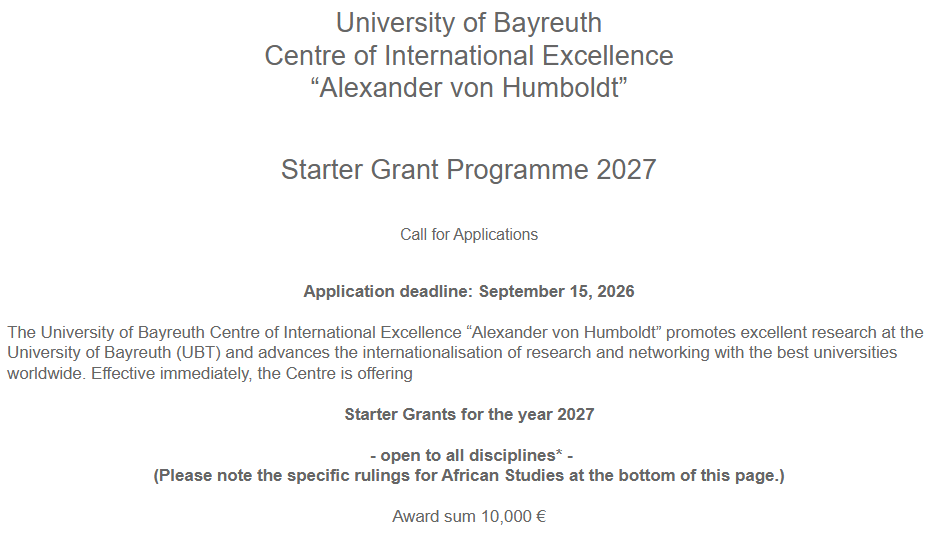
University of Bayreuth Alexander von Humboldt Starter Grant Programme 2027 in Germany: €10,000 Research Funding for International PhD Holders
Unknown

TNE Exploratory Grants 2026 | Up to £25,000 for Higher Education Partnerships
Unknown

Strong Women Grant Programs 2026: Apply for Up to $90,000 in Funding, Mentorship, and Global Network Opportunities
Unknown

One Acre Fund Hiring 9+ Positions in Kenya 2026: Apply for Careers in Agriculture, Climate, Finance, Technology and Operations
Unknown

Canadian Red Cross Resilience Fund 2026 in Canada | Up to $5,000 for Youth-Led Community Projects
Led Community Projects

Good Business Lab Research Fellow Jobs 2026: Remote Research Opportunity in India for PhD Holders
Unknown