
Fully Funded PhD Position in Just and Inclusive Urban Mobility Transition at Delft University of Technology (TU Delft), Netherlands 2026 @Delft University of Technology (TU Delft), Netherlands 2026
Explore How Sustainable Urban Mobility Can Be Made Fair, Inclusive, and Accessible for All
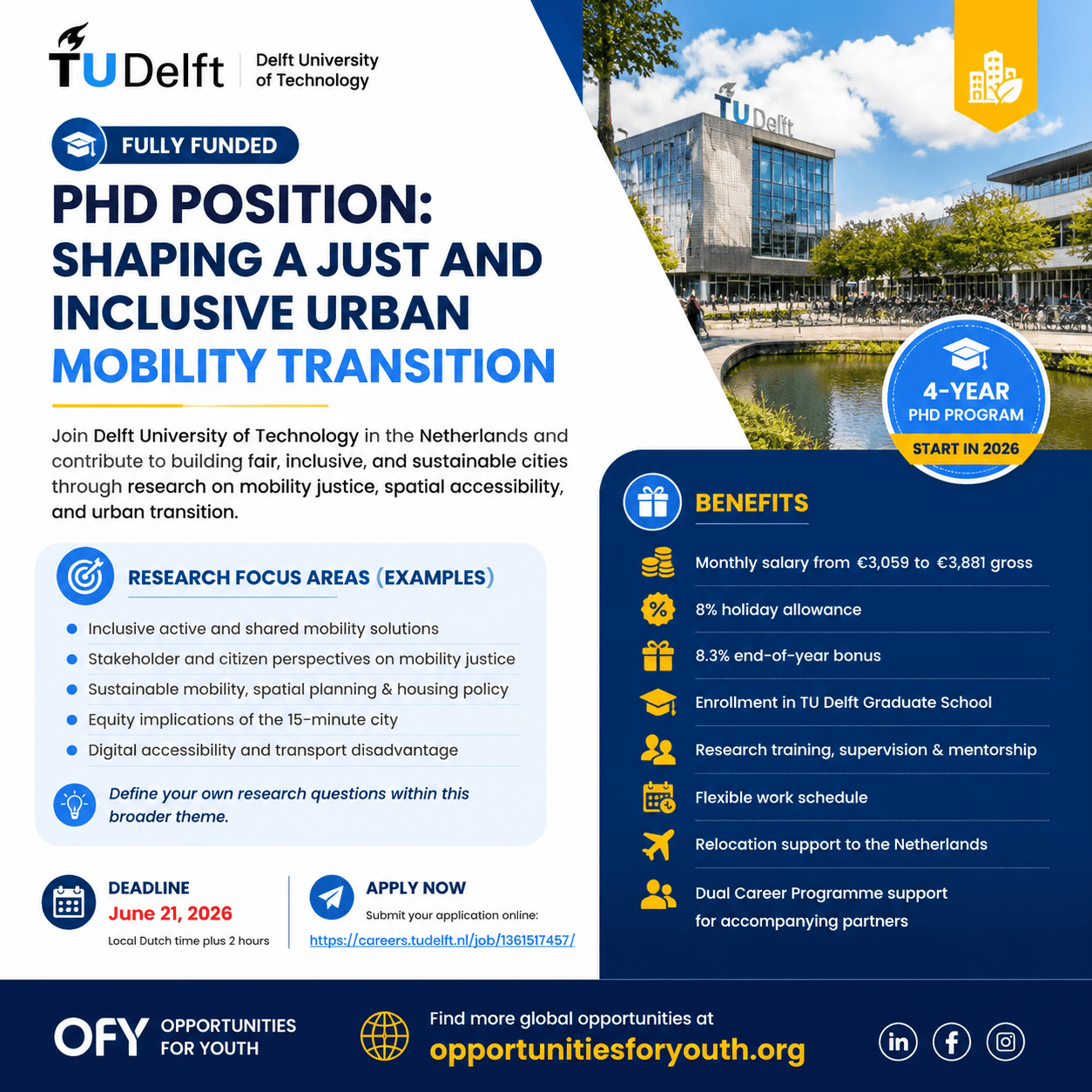
Applications are now open for an exciting fully funded PhD position at Delft University of Technology (TU Delft) in the Netherlands. The doctoral research project, titled “Shaping a Just and Inclusive Urban Mobility Transition,” offers a unique opportunity for aspiring researchers to contribute to one of the most pressing challenges facing cities today: creating sustainable mobility systems that are socially equitable and spatially inclusive.
As cities around the world grapple with climate change, urban congestion, environmental degradation, and increasing social inequalities, the need for sustainable transportation solutions has become more urgent than ever. However, mobility transitions are not merely technological transformations. They also involve important questions about fairness, accessibility, housing, spatial planning, and social justice.
This PhD project seeks to address these challenges by exploring how principles of mobility justice and spatial accessibility can guide future urban mobility transitions, ensuring that both the benefits and burdens of sustainable mobility are distributed fairly across different communities and geographic areas.
About the Research Project
Urban mobility plays a critical role in everyday life. It determines how people access:
- Employment opportunities
- Educational institutions
- Healthcare services
- Public facilities
- Social networks and recreational activities
Despite its importance, access to transportation and mobility opportunities is not equally distributed. Many communities face barriers due to:
- Geographic location
- Economic circumstances
- Limited transportation infrastructure
- Social inequalities
- Housing and land-use patterns
As governments and cities increasingly promote sustainable transportation solutions such as active mobility, shared mobility, public transportation, and digital accessibility, concerns regarding fairness and inclusivity become increasingly important.
The PhD project aims to investigate how mobility transitions can be designed and implemented in ways that ensure equitable outcomes for all population groups.
Why This Research Matters
Current mobility policies often focus on environmental sustainability and technological innovation. However, they sometimes overlook the social consequences of these transitions.
For example:
- Who benefits from new mobility policies?
- Which communities may be disadvantaged?
- How do planning decisions affect vulnerable populations?
- Can sustainable mobility solutions be equally accessible across different neighborhoods?
- How can digital accessibility reduce transportation disadvantages?
These are the types of critical questions that this doctoral research seeks to answer.
The project will contribute to both:
- Academic knowledge on mobility justice and spatial accessibility.
- Practical tools and strategies for planners, policymakers, designers, and municipalities.
Potential Research Themes
The successful PhD candidate will enjoy substantial flexibility in shaping their own research agenda within the broader theme of mobility justice and sustainable urban transitions.
Possible research directions include:
1. Inclusive Active and Shared Mobility Solutions
Research may examine how active transportation and shared mobility services can be adapted to different social and spatial contexts.
Potential areas include:
- Cycling infrastructure
- Walking accessibility
- Shared mobility systems
- Micromobility solutions
- Community-based transportation initiatives
2. Citizen and Stakeholder Perspectives
The project may explore how residents, communities, and stakeholders perceive justice and fairness in mobility transitions.
Research topics may include:
- Public participation
- Community engagement
- Decision-making processes
- Perceptions of transportation equity
3. Mobility, Housing, and Spatial Planning
Mobility systems are deeply connected to urban development and housing policies.
Potential research areas include:
- Land-use planning
- Affordable housing accessibility
- Urban expansion
- Transit-oriented development
- Spatial inequalities
4. Equity Impacts of the 15-Minute City Concept
The increasingly popular 15-minute city model seeks to ensure that essential services can be reached within a short distance.
Research may investigate:
- Accessibility benefits
- Equity implications
- Social inclusion outcomes
- Spatial distribution of services
5. Digital Accessibility and Transport Disadvantage
Digital technologies are increasingly changing how people access services and opportunities.
Potential research topics include:
- Remote work
- Online public services
- Digital inclusion
- Transport disadvantage reduction
- Hybrid accessibility models
Research Methodology
The project is expected to employ a mixed-methods research approach, combining qualitative and quantitative techniques.
Methods may include:
- Case studies
- Stakeholder interviews
- Community engagement workshops
- Participatory research methods
- Surveys
- Accessibility analysis
- Spatial analysis
Fieldwork will be conducted in one or more locations across the Netherlands.
The research may focus on:
- Urban areas
- Suburban environments
- Metropolitan regions
- Peri-urban communities
What TU Delft Is Looking For
TU Delft is seeking a highly motivated and critically engaged researcher who is passionate about creating sustainable and inclusive mobility futures.
Applicants should possess:
- A Master’s degree in a relevant discipline.
- Interest in sustainable mobility transitions.
- Commitment to social and spatial justice.
- Strong analytical and research skills.
- Interest in participatory and community-engaged research.
- Excellent communication abilities.
- Strong English language proficiency.
- Dutch language proficiency at CEFR B2 level or higher.
Funding and Benefits
The selected PhD candidate will receive a fully funded four-year employment contract.
Employment Structure
The appointment includes:
- Initial 1.5-year contract
- Progress evaluation after 15 months
- Additional 2.5-year contract upon successful evaluation
Salary
The monthly gross salary increases throughout the PhD trajectory:
- First Year: €3,059 per month
- Fourth Year: €3,881 per month
Additional Benefits
Successful candidates will also receive:
- 8% holiday allowance
- 8.3% end-of-year bonus
- Enrollment in the TU Delft Graduate School
- Access to doctoral training programs
- Professional development opportunities
- Flexible working arrangements
- Health insurance discounts
- Monthly work-cost contributions
- Academic mentorship and supervision
Relocation Support
International candidates relocating to the Netherlands will benefit from:
- Relocation guidance
- Settlement support services
- Networking events
- Dual Career Programme support for accompanying partners
About Delft University of Technology
Delft University of Technology (TU Delft) is among Europe’s leading universities in science, engineering, design, and innovation.
The university is internationally recognized for its contributions in areas such as:
- Climate action
- Sustainable energy
- Urban development
- Mobility innovation
- Digital technologies
- Biotechnology
The Faculty of Architecture and the Built Environment is globally renowned for its excellence in design-oriented research and interdisciplinary collaboration.
The successful candidate will join the Urban Studies section within the Department of Urbanism, where researchers investigate the interactions between people, urban environments, and societal transformations.
Application Requirements
Applicants must submit the following documents:
1. Detailed Curriculum Vitae (CV)
A comprehensive CV in English.
2. Motivation Letter
A cover letter in English outlining:
- Motivation for applying
- Research interests
- Suitability for the position
Maximum length: 2 pages.
3. Research Proposal
Maximum 700 words (excluding references).
The proposal should include:
- Problem statement
- Research questions
- Research design
- Methodology
- Expected outcomes
4. Academic References
Names and contact information of two academic referees.
Reference letters are not required at the application stage.
Important Dates
Application Deadline
21 June 2026 (Local Dutch Time)
Interview Date
9 July 2026
For aspiring researchers interested in sustainable cities, mobility justice, urban planning, and inclusive transportation systems, this fully funded PhD position at TU Delft presents an outstanding opportunity to conduct impactful research while contributing to more equitable and sustainable urban futures.
For more information about this opportunity, visit here.
Discover more Global Job Opportunities on OFY here.
Fully Funded PhD Position in Just and Inclusive Urban Mobility Transition at Delft University of Technology (TU Delft), Netherlands 2026
@Delft University of Technology (TU Delft), Netherlands 2026
Location
USA / Global
Work Mode
unknown
Posted
about 3 hours ago
Beware of scams! When applying for jobs, you should NEVER have to pay anything. Learn about job scams.
Get jobs in your inbox
Join over 10,000 subscribers receiving our weekly newsletter.
You might also like

Emory University Careers: Explore Faculty, Staff, Temporary, and Internal Employment Opportunities at Emory University
Emory University
AI Hub for Sustainable Development Cyber4Africa Programme 2026: Fully Supported Cybersecurity Capacity Building Opportunity for African AI Startups
Unknown

Azadi Summer Leadership Program 2026
The Azadi Project

EduSpots Head of Education Job Opportunity in Ghana 2026: Lead Transformative Community-Based Learning and Educational Innovation
Based Learning and Educational Innovation

Campus Ambassador
Commonwealth Students’ Association
The Economic, Social and Cultural Council Registration 2026–2027: How African Civil Society Organizations Can Gain African Union Recognition and Participate in Continental Policy Dialogue
African Union