








Journalists for Human Rights Capacity Building Program 2026: Training, Coaching and Small Grants for Journalists ·Unknown
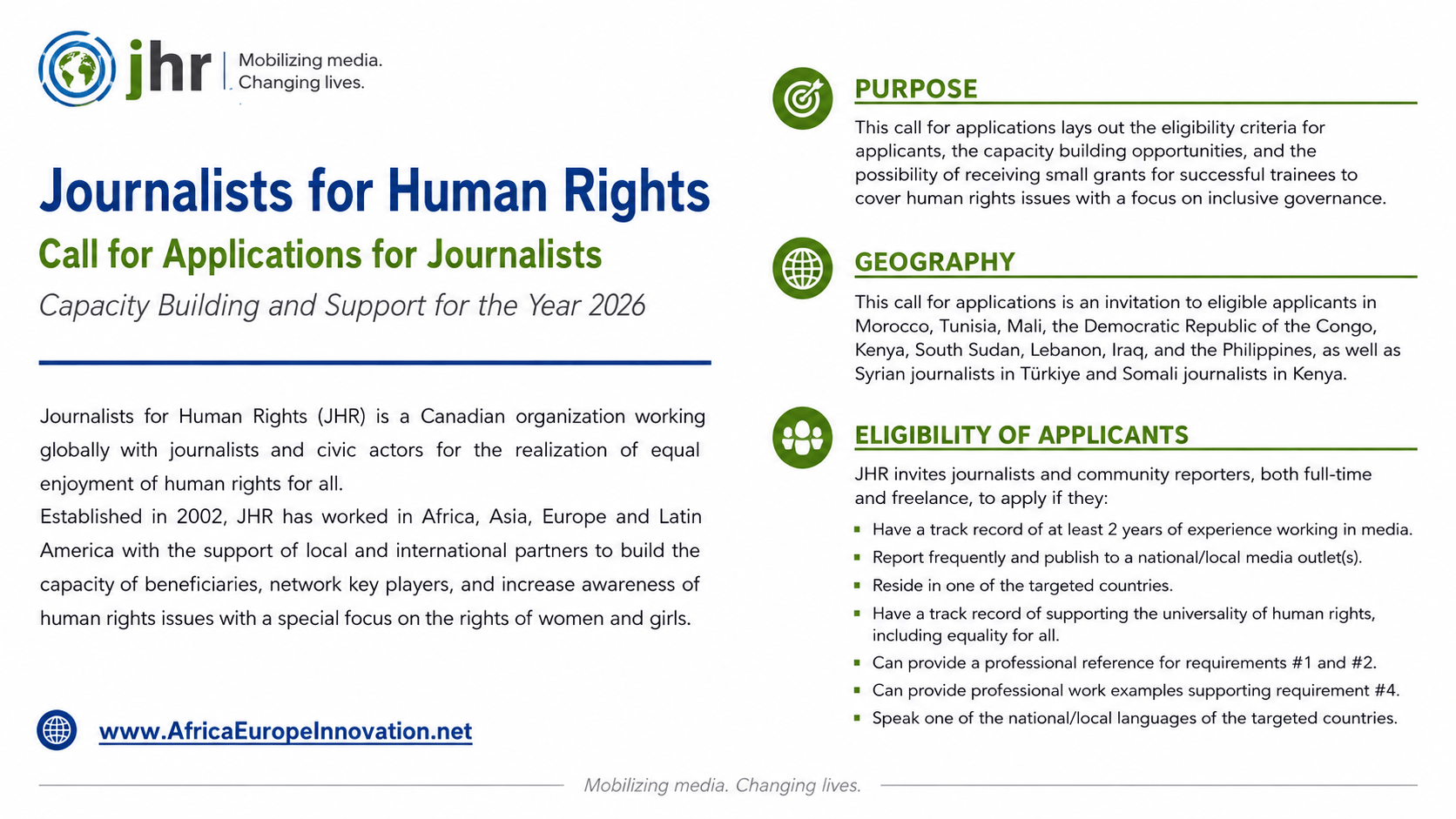
Applications are open for the Journalists for Human Rights Capacity Building and Support Program 2026, an international professional development opportunity for journalists and community reporters working in selected countries across Africa, the Middle East, North Africa and Asia.
Organised by Journalists for Human Rights, the programme seeks to strengthen journalists’ ability to report safely and effectively on human rights, inclusive governance, gender equality, misinformation and disinformation.
Selected applicants will participate in specialised training workshops and capacity-building activities. Journalists who successfully complete the required training may become eligible to apply for small grants supporting human rights reporting. Some participants may also receive on-the-job coaching.
The application deadline is 10 August 2026.
About Journalists for Human Rights
Journalists for Human Rights, commonly known as JHR, is a Canadian organisation that works with journalists and civic actors to promote the equal enjoyment of human rights.
Established in 2002, JHR has implemented programmes in Africa, Asia, Europe and Latin America with support from local and international partners.
Its work focuses on:
- Strengthening the capacity of journalists and civic actors
- Building professional and civil society networks
- Increasing public awareness of human rights issues
- Supporting inclusive and responsible journalism
- Promoting the rights of women and girls
- Improving coverage of governance and public-interest issues
The 2026 call reflects JHR’s wider effort to help journalists report on sensitive human rights and governance matters with greater accuracy, safety and professionalism.
Purpose of the 2026 Capacity-Building Program
The programme is designed to provide eligible journalists with practical training and professional support.
It aims to improve participants’ ability to:
- Report safely on human rights issues
- Apply gender-sensitive approaches to journalism
- Identify and respond to misinformation and disinformation
- Cover governance-related issues effectively
- Produce reporting that supports equality and universal human rights
- Strengthen professional reporting skills through coaching
- Develop stories that may qualify for small-grant support
The programme is particularly relevant to journalists working in environments where human rights reporting may involve political sensitivity, security concerns, unequal access to information or risks to vulnerable communities.
Countries and Journalists Covered by the Call
Applications are invited from eligible journalists residing in the following countries:
- Morocco
- Tunisia
- Mali
- Democratic Republic of the Congo
- Kenya
- South Sudan
- Lebanon
- Iraq
- Philippines
The call also includes:
- Syrian journalists residing in Türkiye
- Somali journalists residing in Kenya
Applicants must reside in one of the specified locations or fall within one of the two specially identified journalist groups.
Journalists living outside the listed countries are not included in the stated geographic scope.
Who Can Apply?
The programme is open to both:
- Full-time journalists
- Freelance journalists
- Community reporters
Applicants must demonstrate that they are actively involved in journalism and regularly produce work for a recognised local or national media outlet.
The opportunity is not limited to journalists employed under permanent contracts. Freelancers and community reporters may apply if they meet the professional-experience and publication requirements.
Eligibility Requirements
Applicants must satisfy all of the following conditions.
At Least Two Years of Media Experience
Candidates must have a track record of at least two years of work in journalism or media.
This experience may include reporting, writing, broadcasting, multimedia journalism, community reporting or other relevant media work.
Regular Publication With a Media Outlet
Applicants must report frequently and publish or broadcast their work through one or more national or local media outlets.
The call does not state that applicants must work exclusively for one organisation. Freelancers may therefore present evidence from multiple outlets where relevant.
Residence in an Eligible Country
Applicants must live in one of the countries or locations included in the call.
Nationality alone may not be sufficient if the applicant does not currently reside in an eligible location.
Commitment to Universal Human Rights
Candidates must demonstrate a record of supporting the universality of human rights, including equality for all.
Applicants should be prepared to show that their reporting, professional conduct or previous work reflects respect for human dignity, inclusion and non-discrimination.
Professional Reference
Applicants must provide a professional reference confirming:
- Their media experience
- Their regular reporting or publication record
A suitable referee may be an editor, newsroom manager, media organisation representative, producer or another professional familiar with the applicant’s work.
Relevant Work Samples
Applicants must provide professional examples demonstrating their support for universal human rights and equality.
Suitable examples may include:
- Published news articles
- Investigative reports
- Radio or television segments
- Multimedia stories
- Podcasts
- Photojournalism
- Community reporting
- Human rights features
- Governance-related reporting
Work samples should be relevant, accessible and clearly attributable to the applicant.
Local or National Language Ability
Applicants must speak at least one national or local language used in the country where they work.
This requirement supports effective reporting and engagement with local communities, sources and audiences.
Training and Capacity-Building Opportunities
Selected journalists will be invited to participate in several professional development activities.
Safe Human Rights Reporting
Participants will receive training on the safe coverage of human rights issues.
This may help journalists consider:
- Risks to reporters and sources
- Ethical interviewing
- Protection of vulnerable individuals
- Confidentiality
- Informed consent
- Responsible use of sensitive information
- Conflict-sensitive reporting
- Digital and physical safety
Gender-Sensitive Reporting
The programme will introduce approaches to reporting that recognise how issues affect women, men, girls, boys and marginalised communities differently.
Gender-sensitive reporting may involve:
- Avoiding stereotypes
- Including diverse sources
- Identifying unequal power relationships
- Reporting responsibly on gender-based violence
- Protecting survivors and vulnerable sources
- Examining the gendered effects of policies and conflict
Combating Misinformation and Disinformation
Journalists will receive training on identifying and responding to false or misleading information.
This may include practical skills related to:
- Source verification
- Fact-checking
- Digital verification
- Evaluating online content
- Recognising coordinated disinformation
- Preventing the amplification of harmful claims
- Communicating verified information clearly
Governance Reporting
The programme will also strengthen participants’ ability to cover governance-related issues.
Relevant topics may include:
- Accountability
- Public institutions
- Elections
- Public services
- Transparency
- Citizen participation
- Inclusive governance
- Human rights protections
- Public decision-making
On-the-Job Coaching
Selected participants may receive practical coaching while developing or producing journalism.
Coaching can provide tailored feedback on story ideas, research, sourcing, interviewing, structure, safety and publication.
The call does not state that every trainee will receive individual coaching.
Small Grants for Human Rights Reporting
Journalists who successfully complete the training and fulfil the programme requirements will become eligible to apply for JHR’s small grants for human rights reporting.
The grants are intended to support reporting on human rights issues, particularly those connected to inclusive governance.
However, participation in the training does not automatically guarantee funding.
The process involves two stages:
- Selection and successful completion of the capacity-building programme
- A later application for small-grant support
The call does not state the value, number or detailed conditions of the small grants. Applicants should therefore avoid assuming that all trainees will receive financial support.
How to Prepare a Strong Application
Applicants should present clear evidence that they satisfy every eligibility requirement.
A strong submission should include:
- A concise description of at least two years of media experience
- Links or attachments showing regular publication
- A professional reference from an editor or media supervisor
- Strong work samples related to human rights or equality
- A clear explanation of interest in inclusive governance
- Evidence of commitment to ethical and responsible journalism
- Accurate information about residence and language ability
Candidates should select work examples that demonstrate both journalistic quality and a meaningful connection to human rights.
How to Apply
Applicants must complete the official online application form through the link provided by Journalists for Human Rights.
Before submitting, candidates should ensure that they have prepared:
- Personal and contact information
- Details of their media experience
- Information about the outlets where they publish
- A professional reference
- Relevant work samples
- Evidence that they live in an eligible country or location
- Information about the languages they speak
JHR will contact only applicants selected for the 2026 cohort.
Applicants who do not receive a response should not assume that they have been selected.
APPLY HERE
Application Deadline
Applications must be submitted by:
10 August 2026
Conclusion
The Journalists for Human Rights Capacity Building and Support Program 2026 offers experienced journalists and community reporters an opportunity to strengthen their skills in human rights reporting, gender-sensitive journalism, governance coverage and the fight against misinformation.
The programme combines professional training with possible on-the-job coaching and a pathway to small-grant support for journalists who successfully complete the required activities.
Eligible applicants must have at least two years of media experience, publish regularly through local or national outlets, provide a professional reference and submit relevant work samples demonstrating a commitment to universal human rights and equality.
Applications must be submitted by 10 August 2026.
For further information and application requirements, CLICK HERE.
To discover more grant opportunities, VISIT HERE.
Journalists for Human Rights Capacity Building Program 2026: Training, Coaching and Small Grants for Journalists
@Unknown
Location
USA / Global
Work Mode
grant
Posted
about 24 hours ago
Beware of scams! When applying for jobs, you should NEVER have to pay anything. Learn about job scams.
Get jobs in your inbox
Join over 10,000 subscribers receiving our weekly newsletter.
You might also like
Blue Ambition Fund 2026 Call for Applications: Grant Funding for Youth Employment and Sustainable Job Creation in Uganda, Ethiopia, and South Africa
Unknown

Adidas Foundation Moving for Change 2026: Up to €700,000 for Gender Equality Through Sport in Eastern Africa
Unknown

Vacancy with Vantage Education and Peace Development Initiative (VEPDI)
Unknown

Vacancies at Green Habitat Initiative (GHI)
Green Habitat Initiative (GHI)

Game On-Community Places to Play Initiative 2026: Grants of $50,000–$100,000 Available for Youth Sports Facility Renovation Projects in the United States
Community Places to Play Initiative 2026: Grants of $50,000–$100,000 Available for Youth Sports Facility Renovation Projects in the United States

Capacity Building Grants 2026: Apply for Up to $250,000 to Strengthen Your Nonprofit Organization
Unknown