








Levine Impact Lab 2027 – Transformative Operational Support Grants for Environmental Organizations ·Transformative Operational Support Grants for Environmental Organizations
The Levine Impact Lab (LIL) Operational Support Program is a high‑engagement, 18‑month partnership designed to help environmental organizations strengthen their operational capacity, financial sustainability, and strategic growth. Applications for the 2027 cohort are now open, and this article provides a detailed, SEO‑optimized overview of the program, including eligibility, benefits, commitments, application timeline, and frequently asked questions.
The introduction of the Operational Support Program reflects a recognition that many environmental nonprofits face a critical growth stage. They are past the startup phase, with proven models and measurable impact, but they often lack the operational infrastructure to expand effectively. Challenges such as financial planning, board governance, and earned revenue development can stall progress. LIL steps in as a thought partner and operational ally, working side‑by‑side with organizational leaders to overcome these barriers.
This program is not a one‑size‑fits‑all solution. Each participating nonprofit brings a unique project or challenge to the table, whether it is strengthening financial infrastructure, diversifying revenue streams, or planning for geographic expansion. LIL’s team collaborates directly with senior staff to design tailored strategies, ensuring that solutions are practical, actionable, and aligned with the organization’s mission.
Another defining feature of the program is its peer learning community. By joining the cohort, organizations gain access to a network of like‑minded nonprofits tackling similar challenges. This community fosters collaboration, knowledge sharing, and mutual support, creating an environment where organizations learn not only from LIL but also from each other.
In essence, the Levine Impact Lab Operational Support Program is more than a grant—it is a partnership for transformation. It empowers nonprofits to move beyond survival mode and into a phase of strategic growth, scale, and sustainability.
1. Program Overview
- Category: Grant + Operational Partnership
- Duration: 18 months
- Format: Hands‑on operational support combined with funding and peer learning
- Deadline: Preliminary application due July 31, 2026
- Focus: Driving progress on critical organizational projects such as financial infrastructure, earned revenue, or growth planning
At the core of the program is hands‑on operational support. LIL’s team works side‑by‑side with organizational leaders to accelerate progress on strategic priorities. This is not a passive grant; it is a working partnership where funding, mentorship, and peer learning are combined to help nonprofits achieve scale and sustainability.
2. Who Should Apply
The program is best suited for organizations that:
- Operate at the intersection of environmental impact and social enterprise.
- Are past the startup phase but still in a critical growth stage.
- Seek a thought partner to unlock strategy, scale, and sustainability.
- Have clear goals and a commitment to moving the work forward.
3. Eligibility Criteria
3.1 Organizational Requirements
- Must be a U.S.‑based 501(c)(3) nonprofit.
- Mission must relate to:
- Environmental justice
- Climate solutions
- Sustainability
- Annual operating budget between $500,000 – $3.5 million.
- Preferred: Social enterprise or earned revenue model in place (products, services, fee‑for‑service).
- Must be midsized: beyond early‑stage but still growing.
- Must have a governance structure, including an active Board of Directors that reflects the mission and community.
- Staff capacity: At least 8–10 full‑time staff to fully engage in operational projects.
- Organizations rooted in and serving Indigenous communities within the U.S. or U.S.‑affiliated territories are encouraged to apply.
3.2 Leadership Requirements
Each organization must commit two senior staff members who:
- Have clear decision‑making authority or strong backing from the Executive Director/CEO.
- Are directly involved in the project or challenge being addressed.
- Can commit time, energy, and focus throughout the 18 months.
Additional staff may be included depending on the project (e.g., Finance Director, Operations Lead, Marketing Manager).
4. What is Operational Support?
Operational support means direct collaboration with LIL’s team to tackle a specific project or challenge. Organizations must come prepared with a defined workstream.
Potential Areas of Support
- Financial strategy and planning
- Fundraising and donor engagement strategy
- Cost structure analysis
- Program development or expansion
- Corporate partnership strategy
- New location or geographic expansion
- RFP support/capital planning
- Strategic planning
- Board engagement
Past cohorts have worked on projects ranging from building earned revenue models to strengthening governance structures.
5. Program Benefits
- Hands‑on partnership: LIL staff work directly with organizational leaders.
- Grant funding: Financial support accompanies operational guidance.
- Peer learning community: Connect with other environmental nonprofits facing similar challenges.
- Strategic acceleration: Move forward on critical priorities with expert support.
- Capacity building: Strengthen internal systems for long‑term sustainability.
6. Application Timeline
- Preliminary Application Period
- Eligible nonprofits complete a short preliminary application.
- Deadline: July 31, 2026.
- Informational Calls
- Sessions to answer questions and clarify program expectations.
- Formal Application Period
- Selected organizations invited to submit a full application.
- Follow‑up Calls
- Deeper conversations with LIL staff to assess fit.
- Decisions Announced
- Final cohort selected.
- Program Begins
- 18‑month engagement starts.
7. Participation Commitments
Organizations must:
- Dedicate senior leadership time and focus.
- Engage actively in operational projects.
- Participate in peer learning sessions.
-
Provide transparency in financial and strategic planning.
Preliminary Application Deadline: July 31, 2026 Program Start: January 2027
Apply HERE today!
8. Frequently Asked Questions (FAQ)
Q1: What types of organizations are eligible? A: U.S.‑based 501(c)(3) nonprofits with missions in environmental justice, climate solutions, or sustainability.
Q2: What is the budget requirement? A: Annual operating budget between $500,000 – $3.5 million.
Q3: Do organizations need a social enterprise model? A: Preferred but not required. Earned revenue models strengthen sustainability.
Q4: How many staff are required? A: At least 8–10 full‑time staff to ensure capacity for operational projects.
Q5: Who should represent the organization? A: Two senior staff with decision‑making authority and direct involvement in the project.
Q6: What is the time commitment? A: Active engagement over 18 months, including regular collaboration with LIL staff.
Q7: What kinds of projects are supported? A: Financial planning, fundraising, program expansion, corporate partnerships, governance, and more.
Q8: Is funding included? A: Yes, grant funding accompanies operational support.
Q9: Are Indigenous organizations eligible? A: Yes, organizations rooted in and serving Indigenous communities are encouraged to apply.
Q10: How is the grant funding structured? A: Funding is distributed in alignment with project milestones. This ensures that organizations remain accountable and that resources are tied directly to progress. LIL’s approach emphasizes sustainability, meaning funds are not simply given upfront but are strategically allocated to support operational growth.
Q11: What reporting requirements exist? A: Organizations are expected to provide regular updates on project progress, financial management, and outcomes. These reports are not intended to be burdensome but are designed to help both the nonprofit and LIL track success and identify areas for additional support.
Q12: How does the peer learning community function? A: The peer learning community is a structured network where participating organizations engage in workshops, roundtables, and collaborative discussions. This community allows nonprofits to share challenges, exchange solutions, and build solidarity. Many past participants have found that peer learning was as valuable as the operational support itself.
Q13: What role does the Board of Directors play? A: Boards are expected to remain actively engaged throughout the program. LIL encourages organizations to involve their boards in strategic discussions, governance improvements, and financial oversight. Strengthening board engagement is often a key outcome of the program.
Q14: Can organizations apply if they are smaller than the budget threshold? A: No, the program is designed for midsized nonprofits. Smaller organizations may not have the staff capacity to fully benefit from the operational support model. However, LIL often shares resources and guidance for early‑stage organizations outside of the program.
Q15: What happens after the 18‑month program ends? A: Organizations leave the program with strengthened systems, clearer strategies, and enhanced capacity. While direct operational support concludes, the peer learning community and connections built during the program often continue informally. Many alumni organizations remain in touch, sharing updates and collaborating on new initiatives.
Q16: How competitive is the application process? A: The program is highly selective. LIL reviews each application carefully to ensure alignment with program goals. Organizations that demonstrate clear strategic priorities, strong leadership commitment, and readiness for operational growth are most likely to be selected.
Q17: What distinguishes LIL from other grant programs? A: Unlike traditional grants that provide funding without operational guidance, LIL embeds its team directly into the organization’s workflow. This hands‑on approach ensures that funding is paired with expertise, making it more impactful and sustainable.
Q18: How do informational calls help applicants? A: Informational calls provide clarity on program expectations, eligibility, and commitments. They also allow applicants to ask questions directly to LIL staff, ensuring that organizations understand the program before submitting a full application.
Q19: Can organizations propose multiple projects? A: No, each organization must focus on one primary project or challenge. This ensures that resources and attention are concentrated, leading to meaningful progress. However, related workstreams may be integrated if they support the main project.
Q20: What qualities does LIL look for in organizational leaders? A: Leaders must demonstrate decisiveness, commitment, and the ability to drive implementation. They should be deeply involved in the project and capable of dedicating time and energy to the partnership. Strong leadership is often the determining factor in program success.
9. Why This Program Matters
Environmental nonprofits often face challenges in scaling operations, diversifying revenue, and strengthening governance. The Levine Impact Lab addresses these challenges by combining funding with hands‑on operational expertise. This dual approach ensures that organizations not only receive financial support but also build the capacity to sustain impact long‑term.
10. Conclusion
The Levine Impact Lab Operational Support Program 2027 is a rare opportunity for midsized environmental nonprofits to receive both funding and operational guidance. By committing to an 18‑month partnership, organizations can strengthen financial infrastructure, expand programs, and build sustainable models for growth.
With a focus on environmental justice, climate solutions, and sustainability, the program empowers nonprofits to scale their impact while remaining rooted in community values. The combination of grant funding, peer learning, and hands‑on support makes this program uniquely positioned to help organizations overcome operational challenges and achieve long‑term success.
The conclusion of this program overview must emphasize that participation in LIL is not simply about receiving financial support—it is about building resilience and capacity. Many nonprofits struggle with the tension between mission delivery and organizational sustainability. The Levine Impact Lab bridges this gap by embedding operational expertise directly into the organization’s workflow.
For leaders, this program represents an opportunity to step back from day‑to‑day firefighting and focus on long‑term strategy. With LIL’s guidance, organizations can clarify priorities, strengthen governance, and develop financial models that support growth. This shift from reactive management to proactive planning is often the turning point that allows nonprofits to scale their impact.
The peer learning community further enhances the experience, offering a space where leaders can share challenges, exchange solutions, and build solidarity. In a sector where collaboration is essential, this network becomes a lasting resource that extends beyond the 18‑month engagement.
Ultimately, the Levine Impact Lab Operational Support Program is about unlocking potential. It invites organizations to envision what is possible when operational barriers are removed and strategic priorities are fully supported. For nonprofits committed to environmental justice, climate solutions, and sustainability, this program is a pathway to greater impact, stronger resilience, and enduring success.
Apply now to join a cohort of organizations dedicated to advancing environmental justice and sustainability through strategic operational growth.
Levine Impact Lab 2027 – Transformative Operational Support Grants for Environmental Organizations
@Transformative Operational Support Grants for Environmental Organizations
Location
USA / Global
Work Mode
fellowship
Posted
about 7 hours ago
Beware of scams! When applying for jobs, you should NEVER have to pay anything. Learn about job scams.
Get jobs in your inbox
Join over 10,000 subscribers receiving our weekly newsletter.
You might also like

The Earth Prize Mentors Program 2026 – A Global Call to Guide and Inspire Youth for Sustainability
A Global Call to Guide and Inspire Youth for Sustainability
GIFTS Fellowship 2026–2027: Apply for the Global Institute Fellowship for Transforming Education Systems
2027: Apply for the Global Institute Fellowship for Transforming Education Systems
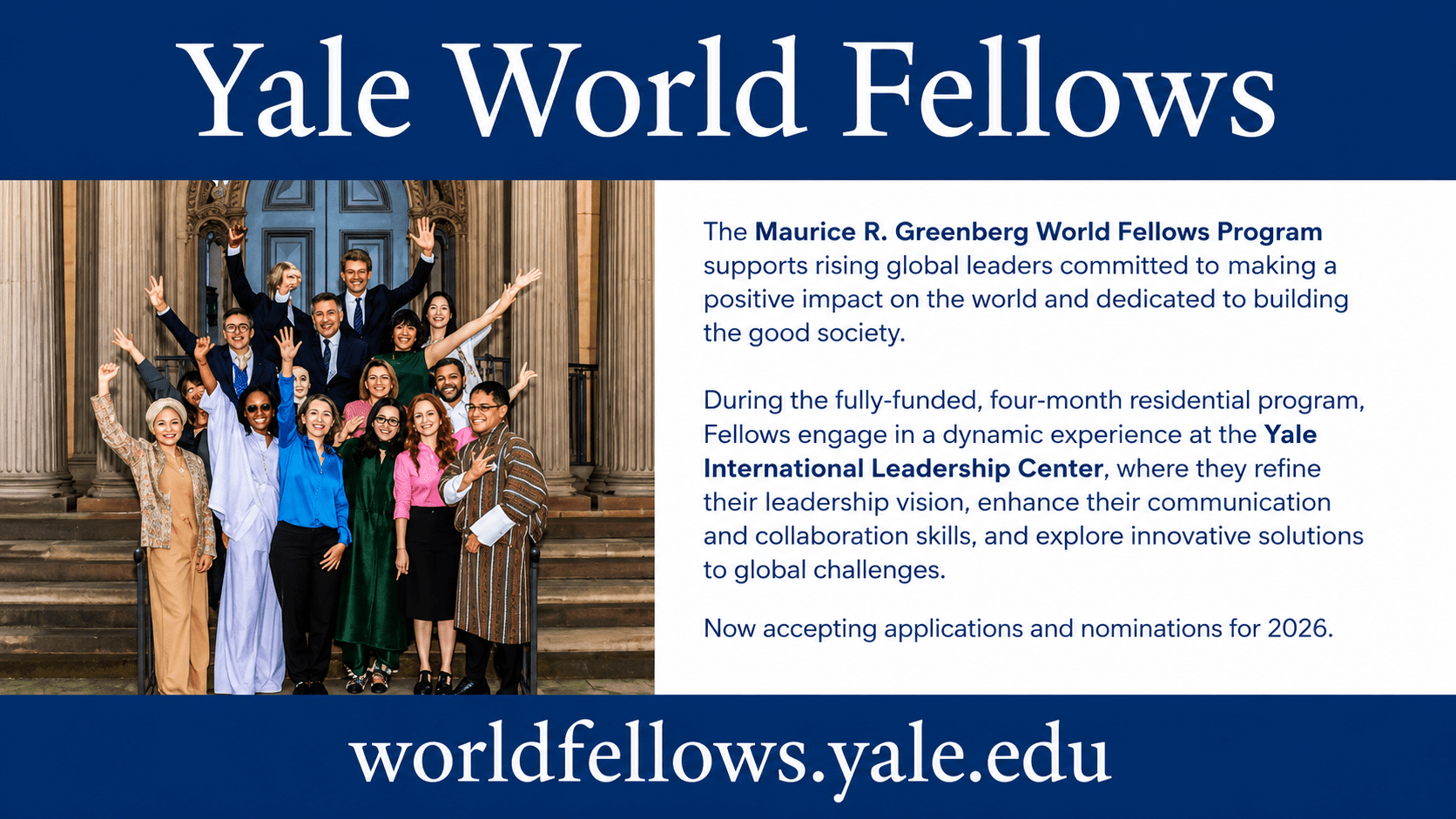
Yale Maurice R. Greenberg World Fellows Program 2027: Nominate Outstanding Global Leaders for One of Yale University’s Prestigious Leadership Programmes
Unknown
UNESCO/Japan Young Researchers’ Fellowships Programme (UNESCO/Keizo Obuchi Research Fellowships Programme)
Unknown
RMIT Vice-Chancellor’s Research Fellowships 2026: Apply for Prestigious Research Positions in Australia
Chancellor’s Research Fellowships 2026: Apply for Prestigious Research Positions in Australia

European Commission OCT Youth Network 2026–2027: Fully Funded One-Year Leadership Opportunity for Young People from Overseas Countries and Territories
2027: Fully Funded One-Year Leadership Opportunity for Young People from Overseas Countries and Territories