








Marcellus Policy Fellowship Fall 2026: Fully Funded U.S. Foreign Policy Fellowship with $750 Stipend for Students and Early-Career Professionals ·Career Professionals
The Marcellus Policy Fellowship is an exceptional opportunity for aspiring foreign policy professionals seeking to develop the analytical, writing, and communication skills needed to shape the future of U.S. national security and foreign policy. Organized by the John Quincy Adams Society, the Fellowship equips emerging leaders with the knowledge, mentorship, and practical experience required to succeed in government, think tanks, academia, media, advocacy, and other policy-related careers.
Inspired by the early career of John Quincy Adams, one of America’s most influential diplomats and statesmen, the Marcellus Policy Fellowship provides a rigorous educational experience where participants produce policy analyses, policy memoranda, and opinion articles while engaging with experts in foreign policy.
Applications are now open for the Fall 2026 Marcellus Policy Fellowship cohort, making this an excellent opportunity for undergraduate students, graduate students, and early-career professionals interested in shaping U.S. foreign policy.
About the John Quincy Adams Society
The John Quincy Adams Society (JQAS) is dedicated to cultivating thoughtful discussion and scholarship on American foreign policy and national security.
Through educational programs, fellowships, campus chapters, publications, and professional development initiatives, the Society helps prepare the next generation of foreign policy leaders who will contribute to informed and responsible American statecraft.
One of its flagship initiatives is the Marcellus Policy Fellowship, which reflects the Society’s commitment to developing future policymakers through intellectual engagement and practical policy writing.
The History Behind the Marcellus Policy Fellowship
The Fellowship draws inspiration from an important moment in American diplomatic history.
In 1793, a young John Quincy Adams anonymously published a series of essays using the pseudonym “Marcellus.”
These essays argued that the newly formed United States should maintain neutrality during the conflict between France and Great Britain.
The essays attracted national attention.
Even President George Washington sought to identify the mysterious author known only as “Marcellus.”
Only one year later, Washington appointed John Quincy Adams as the United States Ambassador to the Netherlands, launching a diplomatic career that would leave a lasting impact on American foreign policy.
The Marcellus Policy Fellowship is modeled after this remarkable beginning, helping today’s emerging policy thinkers develop the same combination of:
- Intellectual rigor
- Policy expertise
- Effective writing
- Public communication
- Strategic thinking
that helped launch Adams’ distinguished career.
What is the Marcellus Policy Fellowship?
The Marcellus Policy Fellowship is a competitive professional development program designed for individuals interested in careers involving U.S. foreign policy and national security.
Over the course of several months, Fellows participate in an intensive learning experience that combines:
- Foreign policy education
- Policy analysis
- Writing instruction
- Mentorship
- Public policy communication
Participants explore important ideas influencing modern American foreign policy while strengthening the practical skills needed to communicate policy recommendations effectively.
Fellowship Objectives
The Fellowship aims to help participants:
- Deepen their understanding of U.S. foreign policy.
- Explore major national security issues.
- Develop high-quality policy writing skills.
- Learn how to communicate policy ideas effectively.
- Prepare for careers in public policy.
- Build competitive credentials for future employment.
- Receive mentorship from experienced policy professionals.
What Fellows Will Do
Throughout the Fellowship, participants complete several substantial policy writing projects under expert supervision.
These include:
1. Foreign Policy Research
Fellows engage with important questions surrounding American foreign policy and national security.
They study ideas that contribute to developing prudent and effective foreign policy strategies.
2. Policy Paper
Participants produce a detailed policy paper exploring a significant issue in foreign policy.
This serves as the Fellowship’s primary research project.
3. Policy Memorandum
Each Fellow prepares a professional policy memorandum.
This exercise teaches participants how policymakers communicate recommendations within government and policy institutions.
4. Opinion Editorial (Op-Ed)
Participants also write an opinion article designed for public audiences.
This helps Fellows learn how to communicate complex foreign policy ideas in an accessible manner.
5. Writing Mentorship
Throughout the Fellowship, participants receive expert guidance to improve:
- Research techniques
- Analytical thinking
- Policy writing
- Persuasive communication
- Editorial skills
Fellowship Benefits
Participants receive numerous academic and professional benefits, including:
Professional Development
- Intensive policy writing experience
- Expert mentoring
- Practical policy analysis training
- Improved communication skills
- Exposure to foreign policy debates
Career Preparation
The Fellowship strengthens candidates for careers in:
- Government
- Public service
- Think tanks
- International affairs
- National security
- Research institutions
- Academia
- Journalism
- Public policy organizations
- Advocacy organizations
Financial Support
Each Fellow receives a $750 stipend to support participation in the program.
Networking Opportunities
Participants become part of a network of emerging foreign policy professionals and experts.
Fellowship Structure
The Marcellus Policy Fellowship operates through:
- Two cohorts each year
- 8–12 Fellows selected per cohort
- Several months of structured learning
- Virtual sessions conducted via Zoom
Weekly sessions take place:
- Tuesday evenings
- Thursday evenings
- 7:00 PM–8:00 PM Eastern Time (ET)
The online format allows participants to engage remotely.
Who Can Apply?
The Fellowship welcomes applicants from several educational and professional backgrounds.
Eligible applicants include:
Current Undergraduate Students
Students currently pursuing bachelor’s degrees.
Graduate Students
Students enrolled in master’s or doctoral programs.
Early-Career Professionals
Individuals with 0–2 years of employment in the foreign policy field.
Employment Eligibility Rules
The Fellowship uses specific rules to determine professional experience.
Employment That Counts
- Employment directly involving foreign policy.
- Certain military roles requiring extensive foreign policy expertise.
Employment That Does Not Count
The following do not count toward the two-year limit:
- Internships
- Paid internships
- Employment outside foreign policy
- Time spent in jobs only partially related to foreign policy (only the foreign-policy portion counts)
Military service counts only when daily duties required extensive foreign policy expertise, such as:
- Foreign Area Officers (FAOs)
- Certain intelligence positions
Applicants uncertain about their eligibility are encouraged to contact the Fellowship organizers.
Career Interests the Fellowship Supports
The Fellowship is intended for individuals who are:
- Pursuing careers in U.S. foreign policy.
- Planning careers in national security.
- Interested in shaping American statecraft.
Career pathways include:
- Government service
- Think tanks
- Academia
- Journalism
- Media
- Policy advocacy
- Research organizations
- National security institutions
Is U.S. Citizenship Required?
No.
One of the Fellowship’s most notable features is that U.S. citizenship is not required.
This allows talented applicants from around the world who wish to pursue careers related to U.S. foreign policy to apply.
Previous Fellowship Cohorts
The John Quincy Adams Society has published information from previous Fellowship cohorts, including:
- Spring 2026 Fellows
- Fall 2025 Policy Analyses
- Spring 2025 Policy Analyses
- Fall 2024 Policy Analyses
- Spring 2024 Policy Analyses
- Fall 2023 Policy Analyses
- Spring 2023 Policy Analyses
- Fall 2022 Policy Analyses
- Spring 2022 Policy Analyses
- Fall 2021 Policy Analyses
- Spring 2021 Policy Analyses
- Fall 2020 Policy Analyses
These publications demonstrate the Fellowship’s ongoing commitment to developing thoughtful policy research and supporting emerging foreign policy professionals.
How to Apply
Interested applicants should:
- Visit the official John Quincy Adams Society website.
- Review the Fellowship information and eligibility requirements.
- Prepare the required application materials.
- Submit an application for the Fall 2026 cohort.
- Contact Adam Abdel-Qader via email if they have eligibility questions or require additional information.
Frequently Asked Questions (FAQs)
How many Fellows are selected?
Each cohort selects approximately 8–12 Fellows.
Is the Fellowship paid?
Yes. Every Fellow receives a $750 stipend.
Is the Fellowship online?
Yes. Sessions are conducted via Zoom.
When do sessions take place?
Sessions are held:
- Tuesdays
- Thursdays
- 7:00–8:00 PM Eastern Time
Is U.S. citizenship required?
No. U.S. citizenship is not required.
Who can apply?
- Undergraduate students
- Graduate students
- Early-career professionals with 0–2 years of foreign policy experience
Is the application open?
Yes. The application window for the Fall 2026 cohort is currently open.
What is the application deadline?
The source confirms that applications for the Fall 2026 cohort are open, but no specific application deadline is provided. Applicants are encouraged to apply as early as possible.
Why You Should Apply
The Marcellus Policy Fellowship is more than a writing program—it is a comprehensive professional development experience for future foreign policy leaders. Through mentorship, rigorous policy analysis, and practical writing assignments, Fellows gain the skills and credentials needed to succeed in one of the world’s most competitive career fields.
Whether you aspire to work in government, academia, think tanks, journalism, advocacy, or national security, this Fellowship provides valuable experience that can strengthen your professional profile while connecting you with a network of emerging policy experts.
Click HERE to learn more about the Marcellus Policy Fellowship Fall 2026.
Conclusion
The Marcellus Policy Fellowship Fall 2026 offers a unique opportunity for students and early-career professionals to develop expertise in U.S. foreign policy, national security, and policy writing while receiving mentorship from experienced professionals. With a $750 stipend, virtual learning format, small cohort sizes, and a curriculum focused on research, policy papers, memoranda, and public communication, the Fellowship equips participants with the skills needed to influence American statecraft in the twenty-first century.
Since the application window is currently open and no closing date has been announced, interested candidates should prepare their application materials and apply as early as possible to maximize their chances of selection.
Discover more global Fellowship and Policy Development opportunities on OFY.

Marcellus Policy Fellowship Fall 2026: Fully Funded U.S. Foreign Policy Fellowship with $750 Stipend for Students and Early-Career Professionals
@Career Professionals
Location
USA / Global
Work Mode
fellowship
Posted
about 15 hours ago
Beware of scams! When applying for jobs, you should NEVER have to pay anything. Learn about job scams.
Get jobs in your inbox
Join over 10,000 subscribers receiving our weekly newsletter.
You might also like
Fellowship Program 2026: Apply for the Six-Month Paid Academic Talent Development (ATDP) Fellowship in Accra
Month Paid Academic Talent Development (ATDP) Fellowship in Accra

Partnerships Fellow at Catalyst Now | Closing Date: August 3, 2026 | 6-Month Full-Time Fellowship with $750 USD Monthly Stipend
Catalyst Now | Closing Date: August 3, 2026 | 6-Month Full-Time Fellowship with $750 USD Monthly Stipend

Girls in Biotech Fellowship 2026 – Free Virtual Bioinformatics Training for African Women Scientists
Free Virtual Bioinformatics Training for African Women Scientists
ICANN Fellowship Program 2027: Fully Funded Opportunity to Attend ICANN88 Community Forum in Lisbon, Portugal
Unknown

Big Loud 2026 Creative Strategy Internship: Launching Careers in Music, Culture, and Digital Engagement
Unknown
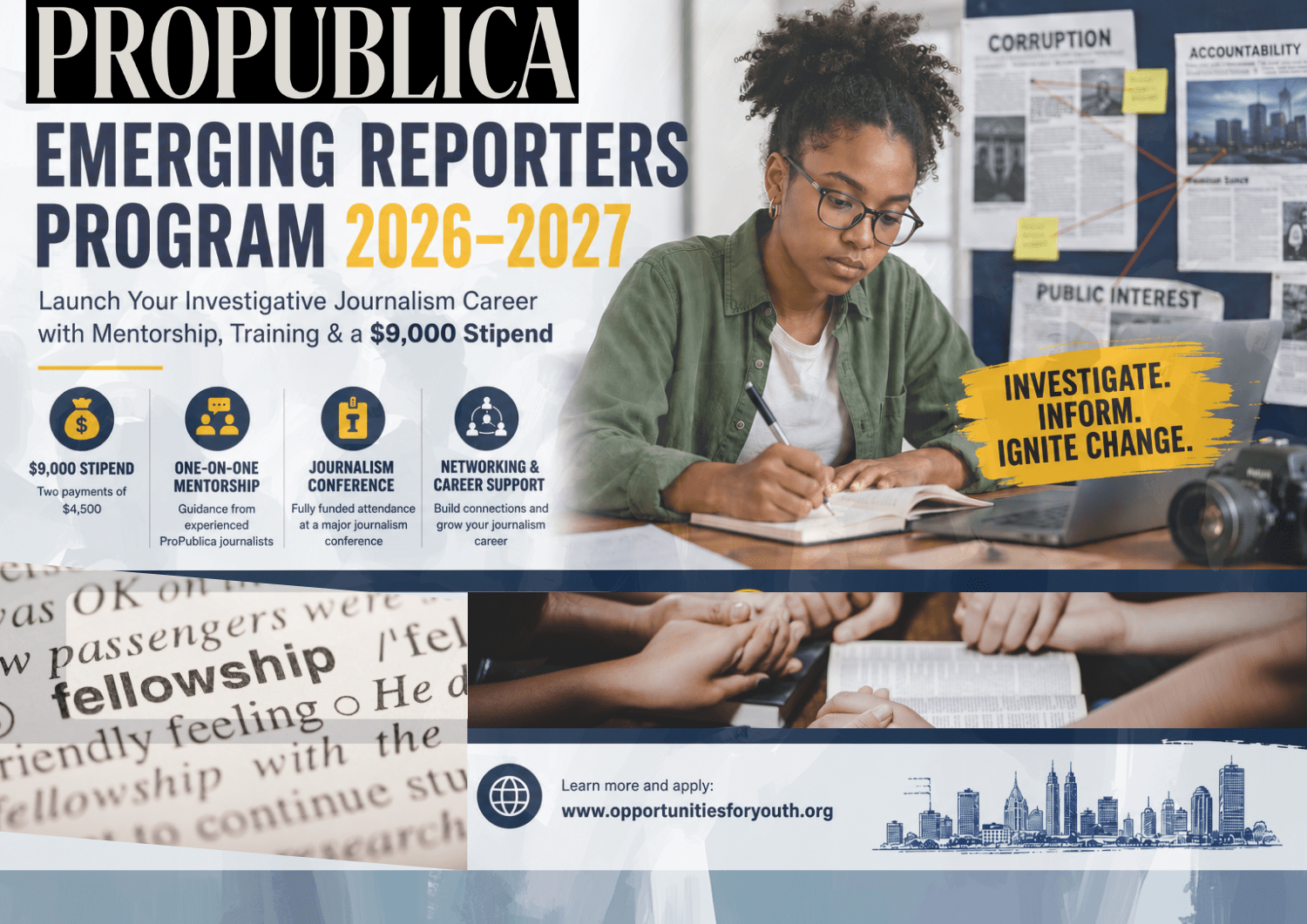
ProPublica Emerging Reporters Program 2026–2027: Receive a $9,000 Stipend, One-on-One Mentorship, and Investigative Journalism Training in the United States
2027: Receive a $9,000 Stipend, One-on-One Mentorship, and Investigative Journalism Training in the United States