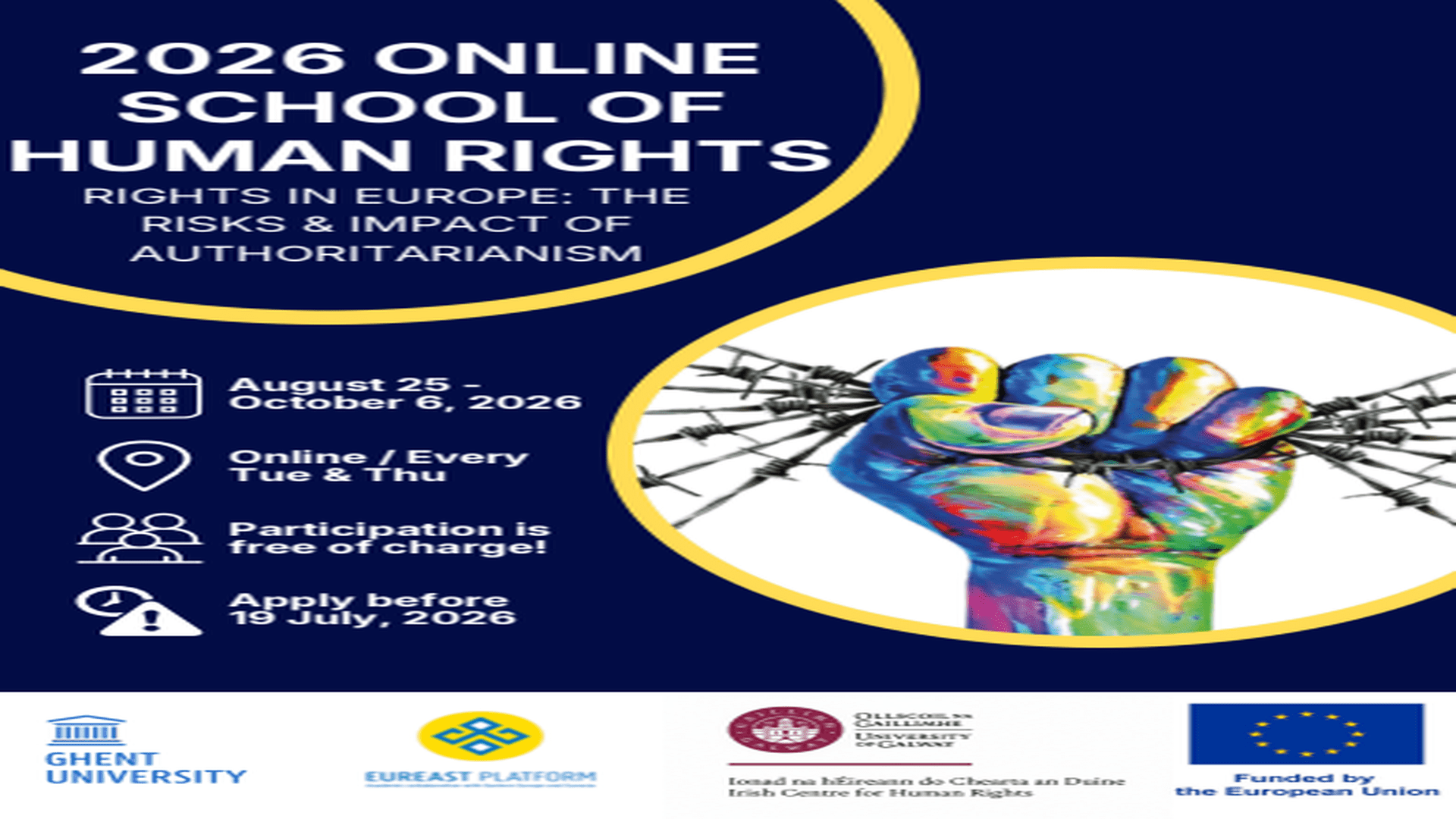
Are you a student or emerging scholar passionate about human rights, democracy, international law, political systems, and social justice? The Online School on Human Rights 2026 offers a unique opportunity to deepen your understanding of contemporary human rights challenges while engaging with leading academics, researchers, and peers from around the world.
Organized by prominent European universities and human rights institutions, the third edition of the Online School on Human Rights will focus on the timely and critically important theme: “Rights in Europe: The Risks and Impact of Authoritarianism.”
This fully online and free-of-charge academic program provides participants with the opportunity to critically explore the relationship between human rights, political institutions, democratic backsliding, digital transformation, migration, armed conflict, and emerging authoritarian trends across Europe and beyond.
Applications are now open for the 2026 cohort, with the program running from 25 August to 6 October 2026.
Application Deadline
19 July 2026
Interested applicants are encouraged to submit their applications before the deadline.
About the Online School on Human Rights 2026
The Online School on Human Rights is an international academic initiative designed to equip participants with advanced knowledge and practical skills to understand, analyze, and advocate for human rights in increasingly complex political and social environments.
The 2026 edition will explore how institutions, governments, and political systems shape the protection and enjoyment of human rights, particularly during periods of democratic erosion, authoritarianism, global instability, and normative contestation.
Participants will engage in interdisciplinary discussions that connect law, politics, governance, social sciences, public policy, and international relations.
The program seeks to help students and future professionals develop the analytical tools needed to critically examine human rights issues while strengthening their advocacy, research, and policy engagement skills.
Organizing Institutions
The Online School on Human Rights 2026 is organized through a collaboration of leading European universities and research networks, including:
- Ghent University’s Eureast Platform
- Irish Centre for Human Rights, University of Galway
- University of Groningen
- Uppsala University
- UGent Human Rights Research Network
The program is funded through the European Union-supported project:
The Eastern Partnership Civil Society Facility
This collaboration ensures participants benefit from diverse academic perspectives and expertise across multiple disciplines.
Program Objectives
The School aims to provide participants with the ability to:
- Understand human rights within different legal, political, and social contexts
- Analyze contemporary challenges to democracy and human rights
- Critically assess narratives and discourses surrounding human rights
- Examine how authoritarian regimes use and manipulate human rights language
- Develop effective advocacy strategies
- Conduct interdisciplinary human rights research
- Strengthen analytical and policy-oriented thinking skills
- Understand human rights issues during conflict and crisis situations
By the end of the program, participants will have gained a deeper understanding of the complex realities affecting human rights protection in Europe and beyond.
Program Format
The Online School on Human Rights 2026 will run for six weeks.
Program Dates
25 August – 6 October 2026
Delivery Mode
- Fully online
- Conducted in English
Academic Workload
- 30 academic hours
- Equivalent to 3 ECTS credits (subject to recognition by participants’ home institutions)
Weekly Schedule
Participants will attend:
- Interactive lectures twice per week
- Tuesdays and Thursdays
- 18:00 CET
The program also includes:
- Methodological workshops
- Collaborative group projects
- Research activities
- Networking sessions
- International peer engagement
Participants will interact with students and scholars from:
- Europe
- The Caucasus
- Belarus
- Ukraine
- Moldova
- Central Asia
- Other regions worldwide
Program Structure
The School is organized into four major thematic blocks, a methodological workshop, and a final project presentation.
Block 1: The Mechanisms of Human Rights and Its Interaction with Institutions
This section explores how institutions influence the realization and protection of human rights.
Topics include:
- Human Rights and Democratic Backsliding: Comparative Constitutionalism Approach
- The Implementation Gap: Challenges in Realising Human Rights
- Human Rights as Peer Review: International Institutions and Accountability Mechanisms
Block 2: New Frontiers of Human Rights in a Contested Context
Participants will examine emerging human rights challenges in contemporary society.
Topics include:
- Digital Rights in the Era of Post-Truth
- Women’s and LGBTQI+ Rights versus Traditional Values
- Human Rights Aspects of International Migration Flows to Europe
This block explores ongoing debates regarding gender, sexuality, migration, and digital governance.
Block 3: Human Rights Appropriation and Early Warning Systems
This thematic section focuses on authoritarianism and threats to democratic governance.
Topics include:
- How to Anticipate Authoritarian Backsliding? Emergency Governance and Human Rights Implications
- Critical Approaches to Human Rights: Appropriation and Abuse of Human Rights by Authoritarian Regimes
Participants will critically assess how governments may use human rights rhetoric for political purposes.
Block 4: From Theory to Practice
The final block focuses on practical advocacy and civic engagement.
Topics include:
- Grassroots Politics and the Ghosts of the Soviet Past
- Human Rights Advocacy: Citizen Participation in Human Rights Promotion and Accountability
Participants will explore how communities, activists, artists, and civil society organizations contribute to advancing human rights.
Methodological and Practical Components
Interdisciplinary Research Workshop
Participants will receive training on:
- Human rights research methods
- Documentation techniques
- Monitoring frameworks
- Data collection approaches
- Policy analysis tools
Collaborative Group Project
Throughout the program, participants will work in small international teams.
Each group will:
- Research a human rights issue covered during the School
- Analyze key challenges and solutions
- Present findings at the final closing ceremony
The project offers practical experience in collaborative research and policy communication.
Certificate and Academic Recognition
Participants who successfully complete the program will receive certificates jointly issued by all partner universities.
To qualify for certification, participants must:
- Attend and actively participate in all ten lectures
- Engage in program activities
- Complete the collaborative group project
The program workload corresponds to:
3 ECTS Credits
Recognition of credits is subject to the policies of participants’ home universities.
Benefits of Participating
Participants will gain numerous academic and professional advantages.
Academic Benefits
- Learn from leading human rights scholars
- Explore current global human rights challenges
- Develop interdisciplinary research skills
- Strengthen policy analysis capabilities
Professional Benefits
- Build international networks
- Enhance advocacy skills
- Improve critical thinking and communication abilities
- Gain valuable credentials in human rights studies
Certification Benefits
- Receive certificates from multiple European universities
- Earn a program equivalent to 3 ECTS credits
- Strengthen graduate school and career applications
Networking Opportunities
- Connect with participants from multiple regions
- Engage with researchers and practitioners
- Join a growing international human rights community
Eligibility Criteria
The Online School on Human Rights welcomes applications from:
- Final-year undergraduate students
- Graduate students
- Emerging researchers
- Individuals interested in human rights and social justice
Applicants should have a strong interest in:
- Human rights
- International law
- Political science
- Public policy
- Democracy and governance
- Social justice issues
The program particularly welcomes applicants from:
- Europe
- The Caucasus
- Belarus
- Ukraine
- Moldova
- Central Asia
- Other countries worldwide
Application Requirements
Applicants must submit:
1. Curriculum Vitae (CV)
- Maximum two pages
2. Motivation Letter
- Maximum one page
The motivation letter should explain:
- Why you want to participate
- Your academic and professional background
- Your interest in human rights issues
- How the School aligns with your goals
Participation Fee
Participation in the Online School on Human Rights 2026 is completely free of charge.
There are no tuition fees for selected participants.
How to Apply
Applicants must submit their applications through the official registration form.
Application Deadline
19 July 2026
Final Thoughts
The Online School on Human Rights 2026 presents an exceptional opportunity for students and emerging scholars to engage with some of the most pressing human rights issues facing the world today. Through expert-led lectures, collaborative projects, international networking, and interdisciplinary learning, participants will gain the knowledge and practical skills necessary to become effective advocates, researchers, and leaders in the field of human rights.
For anyone seeking to understand the impact of authoritarianism, democratic backsliding, digital transformation, migration, and global conflict on human rights, this fully funded international program offers a valuable and enriching learning experience.
For more information, visit the official website.
Discover more global fellowship opportunities on OFY, VISIT HERE