
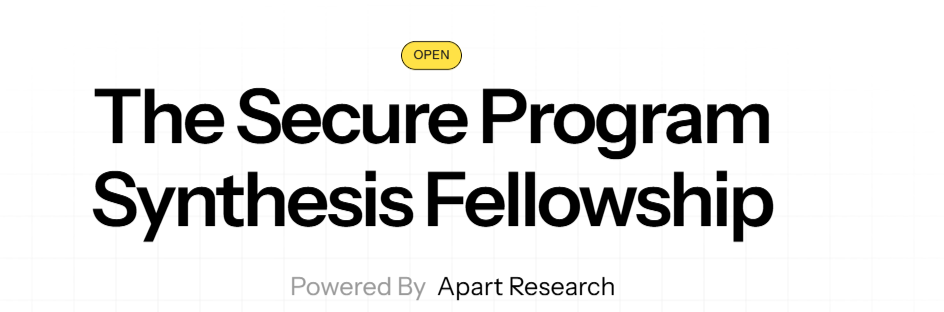
Secure Program Synthesis Fellowship @Led Opportunity: Apply Now for the Apart Research Secure Program Synthesis Fellowship 2026 on AI Safety and Formal Verification
Apart Research, in collaboration with Atlas Computing, has announced the Secure Program Synthesis Fellowship, a remote, mentor-led research programme scheduled to run from June to September 2026.
The fellowship focuses on advancing research at the intersection of artificial intelligence systems, formal methods, and software security, with the aim of improving the reliability and correctness of AI-generated code.
The programme responds to growing concerns about the rapid increase in AI-generated software, highlighting the need for stronger verification methods to ensure that code produced by large language models behaves as intended.
Overview of the Apart Research Secure Program Synthesis Fellowship Programme
The Secure Program Synthesis Fellowship is designed as a part-time, research-intensive programme that brings together mentors and participants to explore foundational challenges in AI-assisted software development. The initiative is grounded in the field of secure program synthesis, which applies formal verification techniques to ensure correctness in machine-generated code.
The fellowship is powered by Apart Research and is intended to support small collaborative teams working on open-ended research problems in specification, validation, and adversarial robustness.
The programme runs for approximately four months, from June to September 2026, and is conducted entirely remotely.
Apart Research Secure Program Synthesis Fellowship Programme: Core Research Focus Areas
The fellowship is structured around four primary research themes, each addressing key challenges in AI-driven software development and verification.
Specification Elicitation
This area focuses on translating ambiguous or informal system requirements into formal specifications. Researchers will explore methods for extracting structured representations from documentation, legacy systems, or human input.
Key objectives include:
- Designing tools for formal specification extraction
- Developing structured editors and specification interfaces
- Building pipelines to convert natural language requirements into formal models such as Lean
This research area addresses the challenge that many software systems lack clearly defined specifications, making correctness difficult to guarantee.
Specification Validation
This focus area investigates methods for verifying whether extracted specifications accurately represent intended system behaviour. It explores techniques for improving the completeness and correctness of formal specifications.
Research activities include:
- Cross-checking specifications against intended system behaviour
- Testing validation pipelines for formal models
- Developing verification tools for specification accuracy
The goal is to ensure that specifications themselves are reliable before being used for software generation or verification.
Spec-Driven Development and Evaluation
This stream explores development workflows where formal specifications are used to generate multiple candidate implementations. These implementations are then evaluated based on correctness, performance, and robustness.
Key research directions include:
- Building infrastructure for specification-based code generation
- Comparing multiple implementations derived from a single specification
- Evaluating system performance under different constraints
This approach aims to improve the reliability of AI-generated software by introducing structured comparison and evaluation mechanisms.
Adversarial Robustness for Formal Methods and QA Systems
This area focuses on identifying vulnerabilities in formal methods pipelines and AI-assisted reasoning systems. Researchers will examine how adversarial inputs can disrupt automated verification and reasoning processes.
Key objectives include:
- Studying failure modes in formal verification systems
- Testing robustness of LLM-assisted tooling
- Developing safeguards against adversarial inputs in AI systems
The goal is to strengthen the resilience of automated reasoning systems used in software verification.
Programme Structure and Format
The Secure Program Synthesis Fellowship is structured as a collaborative research programme involving mentors, project managers, and research participants working in small teams.
Key programme features include:
- Duration: 3 to 4 months (June–September 2026)
- Format: Remote participation
- Team structure: Mentor, Apart Research Project Manager, and mentees
- Time commitment: 8 to 30 hours per week per participant
- Output: Research papers, prototypes, and demo-day presentations
The programme is designed to support rapid iteration and exploratory research, with an emphasis on producing meaningful intermediate outputs even in highly complex or open-ended problem domains.
Key Dates and Timeline
The fellowship follows a structured application and project timeline:
- 28 April – 9 May 2026: Mentor applications open
- 19 May 2026: Mentors announced and participant applications open
- 31 May 2026: Participant application deadline
- 9 June 2026: Participants announced
- 15 June 2026: Project commencement
- July–August 2026: Mid-project presentations and milestone submissions
- August–September 2026: Final submissions
- September–October 2026: Demo day and presentations
Apart Research Secure Program Synthesis Fellowship Programme: Participation and Mentorship Structure
The fellowship is built around mentor-led research teams. Mentors define the research direction, while participants contribute to implementation, experimentation, and analysis under guidance from both mentors and Apart Research project managers.
Each team receives:
- Dedicated project management support
- Access to compute resources and API credits
- Research guidance and community support
- Opportunities for conference participation and demo-day funding
- Potential prizes for outstanding contributions
Mentors are typically researchers or practitioners in formal methods, AI safety, or related technical fields, while participants may come from diverse academic and technical backgrounds.
Eligibility and Required Skills
The programme does not require a specific academic background, encouraging applications from a broad range of technical disciplines.
Useful skill sets include:
- Formal proof engineering and theorem proving
- Penetration testing, fuzzing, and reverse engineering
- SMT solving and model checking
- Secure systems design
- Machine learning evaluation and benchmarking
- AI agent development and tool-building
The fellowship is designed to be accessible to both experienced researchers and early-career contributors with strong technical interest in AI safety and verification.
Research Vision and Motivation
The fellowship is motivated by the increasing reliance on AI systems for software generation. As AI tools become more capable, the challenge of ensuring correctness shifts from coding itself to the specification and validation of system requirements.
The programme highlights a key concern: without reliable specifications and verification methods, AI-generated software may behave unpredictably or introduce hidden vulnerabilities.
By focusing on secure program synthesis, the fellowship aims to strengthen the foundations of trustworthy AI systems through improved formal methods, adversarial testing, and specification engineering.
Programme Support and Outputs
Participants will work in structured teams designed to balance research exploration with practical output delivery. Each project is expected to produce:
- Workshop-quality research papers or equivalent outputs
- Prototype tools or systems
- Final presentations during demo day
- Potential contributions to academic conferences
The programme emphasizes both theoretical and applied contributions, with a focus on generating research that can influence future AI safety and software engineering practices.
Call for Action
The Secure Program Synthesis Fellowship represents a focused initiative in AI safety research, bringing together experts and emerging researchers to address fundamental challenges in software correctness and specification design. By combining formal methods, machine learning, and adversarial robustness research, the programme seeks to improve the reliability of AI-generated code in increasingly complex software ecosystems.
Researchers and practitioners interested in AI systems, formal verification, and secure software design are encouraged to apply within the specified timeline for participation in this remote research programme running from June to September 2026.
CLICK HERE TO LEARN MORE
For more opportunities such as these please follow us on Facebook, Instagram, Twitter, LinkedIn and WPChannel
Disclaimer: Global South Opportunities (GSO) is not the organization offering this opportunity. For any inquiries, please contact the official organization directly. Please do not send your applications & CVs to GSO, as we are unable to process them. Due to the high volume of emails, we receive daily, we may not be able to respond to all inquiries. Thank you for your understanding
JOIN GSO WHATSAPP CHANNEL NOW
Secure Program Synthesis Fellowship
@Led Opportunity: Apply Now for the Apart Research Secure Program Synthesis Fellowship 2026 on AI Safety and Formal Verification
Location
Global
Work Mode
fellowship
Posted
4 days ago
Beware of scams! When applying for jobs, you should NEVER have to pay anything. Learn about job scams.
Get jobs in your inbox
Join over 10,000 subscribers receiving our weekly newsletter.
You might also like

PhD in Environmental Economics at University of Augsburg – Apply by June 15, 2026 | Research on Early Warning Systems for Tipping Points
University of Augsburg – Apply by June 15, 2026 | Research on Early Warning Systems for Tipping Points
FCDO Senior Research Fellowships 2027: Fully Funded Two-Year Fellowship Opportunities Across 11 Global Research Areas
Year Fellowship Opportunities Across 11 Global Research Areas

Senior Visiting Research Fellow
Lagos Africa Multiple Research Centre, University of Lagos
Global Course on Digital Public Infrastructure
International Telecommunication Union (ITU)
DDC x TrygFonden Fellowship Programme
Digital Democracy Centre
Zambia Mining and Local Development Fellowship
Center for Effective Global Action (CEGA)