








The Fall 2026 Iliad Fellowship : Advancing Mathematical Frontiers for AI Alignment and Global Safety ·Unknown
Introduction
Artificial Intelligence (AI) is no longer a distant concept confined to research labs—it is now embedded in everyday life, powering search engines, medical diagnostics, financial systems, and even creative tools. Yet, as AI systems grow more powerful and autonomous, the question of how to ensure they remain aligned with human values has become one of the most urgent scientific challenges of our time. This challenge, known as AI alignment, seeks to guarantee that advanced AI systems act in ways that are beneficial, predictable, and safe for humanity.
The difficulty lies in the fact that AI alignment is not simply a matter of programming rules or setting boundaries. It requires a deep understanding of mathematics, theoretical computer science, physics, and philosophy. Researchers must grapple with questions about induction, abstraction, causality, and decision theory—questions that cut to the very foundations of knowledge and reasoning. In short, AI alignment is a frontier science, and it demands the intellectual rigor of those trained in the most abstract and precise disciplines.
To address this need, Iliad, in collaboration with PrincInt, has created the Iliad Fellowship in Applied Mathematics for AI Alignment. This fellowship is designed as a research residency, bringing together PhD students, postdoctoral researchers, and experienced academics to work intensively on mathematical approaches to AI alignment. Hosted at the London Initiative for Safe AI (LISA), the fellowship provides not only financial support but also mentorship, community, and a structured pathway into the growing ecosystem of AI safety research.
Over three months, fellows will immerse themselves in cutting-edge projects, ranging from the study of simplicity and degeneracy in learning systems to the exploration of universal predictors, causal structures, and reward learning. The fellowship is not merely about producing academic papers—it is about equipping researchers to launch long-term careers in AI alignment, whether through academic positions, independent research, or philanthropic funding. By the end of the program, fellows will have developed a detailed research proposal, positioning them to secure funding and continue their work in this vital field.
The Iliad Fellowship is more than an opportunity; it is a call to action. It invites researchers to step into one of the most consequential scientific conversations of the 21st century, to apply their mathematical expertise to questions that will shape the trajectory of AI and, by extension, the future of humanity. This article provides a comprehensive overview of the fellowship, its structure, its goals, and the opportunities it opens for those ready to take on the challenge of AI alignment.
Fellowship Overview
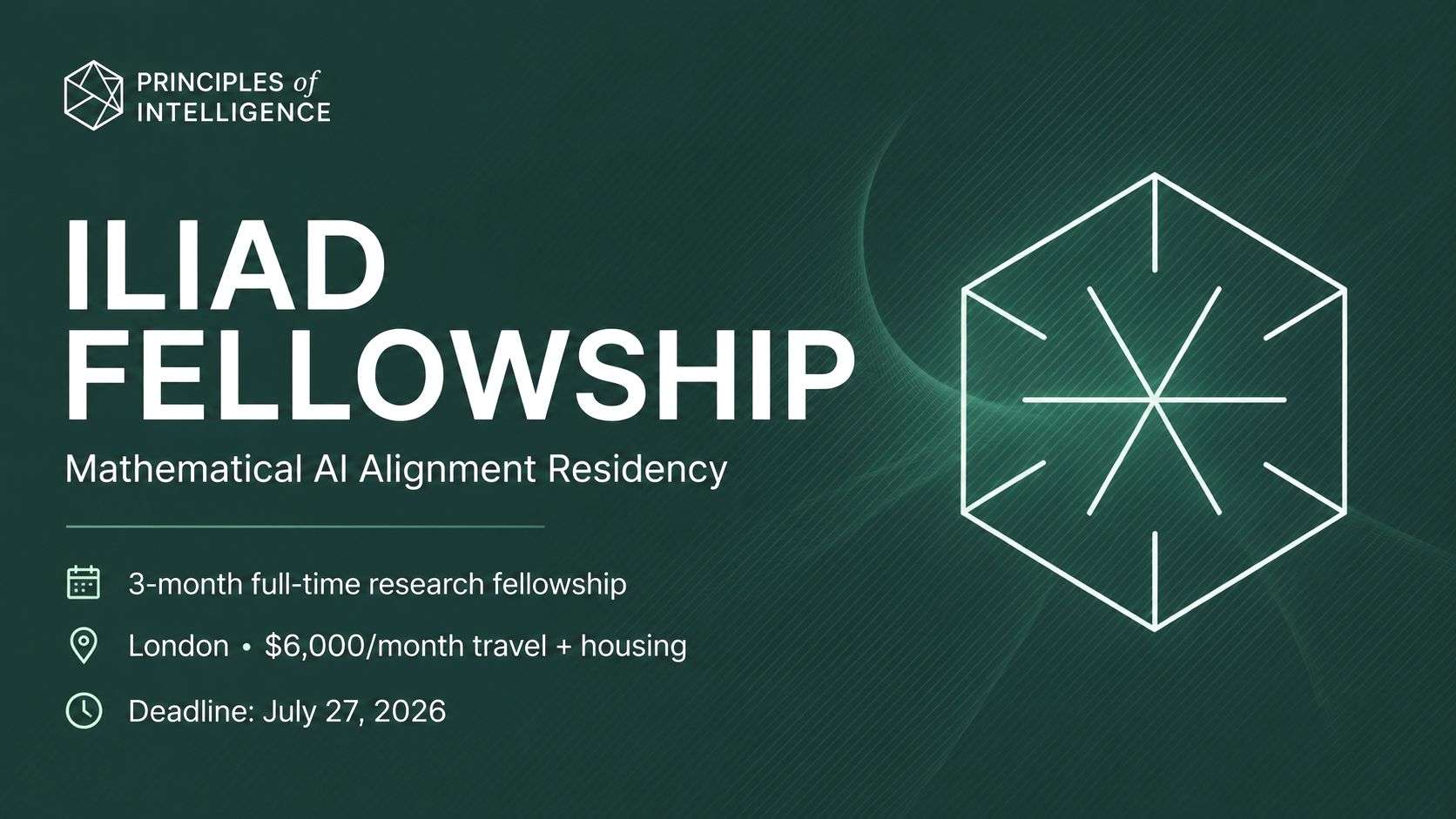
- Duration: 3 months, full-time
- Dates: September 7 – December 4, 2026
- Location: London Initiative for Safe AI (LISA), London, UK (in person, with limited remote flexibility)
- Allowance: $6,000 USD per month (travel and housing)
- Application Deadline: July 27, 2026 (End of Day, Anywhere on Earth)
The fellowship is structured as an immersive residency. Fellows will spend three months working closely with mentors, attending speaker events, and engaging with the broader AI alignment community. The program is designed to be intensive, with fellows expected to dedicate themselves full-time to their research projects.
What You’ll Be Doing
The core of the fellowship is mathematical research in AI alignment. Fellows will:
- Collaborate with mentors – Established researchers with expertise in mathematics and AI alignment will guide fellows in developing their projects.
- Work on individual projects – Each fellow will pursue a project tailored to their background and interests. Projects may involve theoretical analysis, toy models, or connections to empirical machine learning.
- Develop a research proposal – The fellowship’s intended deliverable is a detailed research proposal that can be submitted to funders or serve as the basis for future academic work.
- Engage with the community – Fellows will participate in seminars, workshops, and discussions, building connections with other researchers in the field.
- Prepare for future opportunities – At the end of the fellowship, Iliad will support fellows in seeking funding, academic positions, or collaborations to continue their research.
Projects
The fellowship offers a wide range of potential project directions, including but not limited to:
- Simplicity and Degeneracy – Exploring how modern large language models approximate Solomonoff induction and the role of degeneracy in learning.
- Universal Predictors – Investigating predictors that generalize across domains.
- Causality – Studying causal structures in AI systems.
- Abstractions and Coarse-graining – Understanding how AI systems form abstractions.
- Lossy Compression and Sparse Coding – Examining compression techniques in learning.
- Computational Mechanics – Applying computational mechanics to AI alignment.
- Algorithmic Statistics – Using statistical frameworks to analyze AI behavior.
- Training Dynamics (SGD) – Studying stochastic gradient descent and its implications for alignment.
- Renormalization and Interpretability – Applying renormalization techniques to interpretability.
- Reward and Value Learning – Investigating how AI systems learn values and rewards.
- Debate and Scalable Oversight – Exploring mechanisms for oversight and control.
These projects are not rigid assignments; fellows are encouraged to develop their own directions based on their expertise and interests.
About You
The fellowship is aimed at:
- PhD students in mathematics, physics, computer science, or related fields.
- Postdoctoral researchers with experience in theoretical or applied mathematics.
- Experienced academics considering a transition into AI alignment.
- Independent researchers with substantial prior experience in mathematical research.
Applicants should have a strong background in rigorous mathematical thinking and a genuine interest in contributing to AI alignment. Formal credentials are not strictly required; equivalent research experience is valued.
About Iliad
Iliad is a research organization dedicated to advancing AI alignment. Its founders have previously established other alignment research groups, including Timaeus and Simplex. Iliad organizes the ILIAD Conference on AI Alignment and runs the Iliad Intensive, a taught course providing an overview of technical AI alignment.
The Iliad Fellowship is part of Iliad’s broader mission to grow AI alignment into a fully developed scientific field. By connecting academics with mentors, funders, and collaborators, Iliad aims to accelerate progress in this crucial area.
Application Process
- Deadline: July 27, 2026 (End of Day, Anywhere on Earth)
- Apply Online: Applications are submitted through Iliad’s website.
- Selection Criteria: Applicants are evaluated based on their research background, potential to contribute to AI alignment, and fit with the fellowship’s goals.
- Outcome: Selected fellows will be notified and invited to participate in the Fall 2026 cohort.
Applicants are encouraged to apply early to maximize their chances of selection.
Frequently Asked Questions (FAQs)
1. Who is eligible to apply for the Iliad Fellowship? The fellowship is open to PhD students, postdoctoral researchers, experienced academics, and independent researchers with strong backgrounds in mathematics, theoretical physics, theoretical computer science, or related fields. Equivalent research experience is valued even if formal credentials are not present.
2. Is the fellowship limited to applicants from certain countries? No. The fellowship is open to applicants worldwide. Researchers from all countries and continents are encouraged to apply.
3. What is the duration of the fellowship? The fellowship runs for three months, full-time. The Fall 2026 cohort will take place from September 7 to December 4, 2026.
4. Where will the fellowship be held? The fellowship will be hosted at the London Initiative for Safe AI (LISA) in London, UK. Fellows are expected to attend in person, although limited remote flexibility may be considered for exceptional applicants.
5. What financial support is provided? Fellows receive a $6,000 USD monthly travel-and-housing allowance for the duration of the program.
6. What is the main deliverable of the fellowship? Each fellow is expected to produce a detailed research proposal in mathematical AI alignment. This proposal can be submitted to funders or serve as the foundation for future academic or independent research projects.
7. What kind of projects will fellows work on? Projects vary depending on the fellow’s background and interests. Examples include:
- Simplicity and degeneracy in learning systems
- Universal predictors and causality
- Abstractions and coarse-graining
- Training dynamics of stochastic gradient descent
- Reward and value learning
- Debate and scalable oversight These projects are flexible, and fellows are encouraged to develop their own directions.
8. What happens after the fellowship ends? Iliad will support fellows in seeking funding, academic positions, or collaborations to continue their research. Fellows may submit proposals to organizations such as Open Philanthropy, the Survival and Flourishing Fund, Schmidt Sciences, and the UK AI Security Institute (AISI).
9. Do I need prior experience in AI research to apply? No. A strong mathematical background is sufficient. The fellowship is designed to help researchers pivot into AI alignment, even if they have not previously worked in AI.
10. How competitive is the fellowship? The fellowship is highly competitive. Applicants are evaluated based on their research background, potential to contribute to AI alignment, and alignment with the fellowship’s goals. Early applications are encouraged to maximize chances of selection.
11. Will fellows have mentors? Yes. Each fellow will work closely with established researchers in mathematics and AI alignment who will provide guidance, feedback, and support throughout the program.
12. What is the application deadline? The deadline for the Fall 2026 cohort is July 27, 2026 (End of Day, Anywhere on Earth).
13. Can experienced academics with many years of research apply? Yes. The fellowship welcomes applicants with substantial research experience and can tailor scope and compensation to suit their background.
14. How does the fellowship connect to the broader AI alignment ecosystem? The fellowship is designed to bridge academics into the AI alignment community. Fellows will gain exposure to funders, conferences, and collaborations, positioning them to contribute long-term to the field.
15. What is the role of Iliad in AI alignment research? Iliad is a research organization dedicated to advancing AI alignment. It organizes the ILIAD Conference, runs the Iliad Intensive course, and supports researchers in developing proposals and securing funding. The fellowship is part of Iliad’s mission to grow AI alignment into a fully developed scientific discipline.
Visit HERE to learn more about the Fall 2026 Iliad Fellowship.
Conclusion
The Iliad Fellowship in Applied Mathematics for AI Alignment represents a rare and transformative opportunity for researchers at the intersection of mathematics and artificial intelligence. In a world where AI systems are rapidly advancing, the need for rigorous, principled approaches to alignment has never been greater. This fellowship is designed to meet that need by providing a structured environment in which researchers can explore foundational questions, develop new lines of inquiry, and connect with mentors and funders who share the vision of safe and beneficial AI.
By participating in the fellowship, researchers will not only gain the chance to work on intellectually challenging projects but also position themselves within a growing global community dedicated to AI safety. The deliverable—a detailed research proposal—is more than an academic exercise; it is a bridge to future opportunities, whether in academia, independent research, or collaborations supported by philanthropic organizations. Iliad’s commitment to guiding fellows beyond the residency ensures that the impact of the program extends well beyond its three-month duration.
The fellowship is also a statement of belief: that the tools of mathematics, physics, and theoretical computer science are essential to solving the alignment problem; that researchers with high academic standards are indispensable to building AI alignment into a mature scientific discipline; and that by investing in these researchers, we invest in the safety and stability of our technological future.
For those who are ready to take on this challenge, the path begins here. The application deadline for the Fall 2026 cohort is July 27, 2026 (End of Day, Anywhere on Earth). Successful applicants will spend three months at the London Initiative for Safe AI, working alongside mentors and peers to push the boundaries of what is known about AI alignment. The journey will be demanding, but the rewards—both intellectual and societal—are profound.
In conclusion, the Iliad Fellowship is not simply a program; it is an invitation to join a movement. It is an opportunity to contribute to the foundations of a field that will shape the future of AI and, ultimately, the future of humanity. For researchers with the courage, curiosity, and commitment to engage with these questions, the Iliad Fellowship offers a platform to make a lasting impact. Apply now, and take your place in the effort to align the most powerful technologies of our age with the values that matter most.
The Fall 2026 Iliad Fellowship : Advancing Mathematical Frontiers for AI Alignment and Global Safety
@Unknown
Location
USA / Global
Work Mode
fellowship
Posted
3 days ago
Beware of scams! When applying for jobs, you should NEVER have to pay anything. Learn about job scams.
Get jobs in your inbox
Join over 10,000 subscribers receiving our weekly newsletter.
You might also like
ICANN Fellowship Program 2027: Fully Funded Opportunity to Attend ICANN88 Community Forum in Lisbon, Portugal
Unknown

Big Loud 2026 Creative Strategy Internship: Launching Careers in Music, Culture, and Digital Engagement
Unknown
ProPublica Emerging Reporters Program 2026–2027: Receive a $9,000 Stipend, One-on-One Mentorship, and Investigative Journalism Training in the United States
2027: Receive a $9,000 Stipend, One-on-One Mentorship, and Investigative Journalism Training in the United States
Partnerships Fellow
Unknown

Fully Funded AfriMAB GRÓ-LRT Land Restoration Fellowships 2027 in Iceland – Applications Open
LRT Land Restoration Fellowships 2027 in Iceland – Applications Open

UNESCO/Japan Young Researchers’ Fellowships Programme 2026: Up to US$10,000 for Research in Japan
Unknown