








The Sexual Violence Research Initiative (SVRI) Lauches New Call for Proposals: the Data to Evidence Grant 2027 ·Unknown
SVRI’s New Data to Evidence Grant Pays Researchers to Unlock Evidence Already Sitting in Existing Datasets
What if the next big breakthrough on ending violence against women isn’t in new data — but in data that’s already been collected and never fully analyzed? SVRI is funding researchers in LMICs to find out.
The Sexual Violence Research Initiative (SVRI) has launched a new call for proposals: the Data to Evidence Grant 2027 — Knowledge for Action to End Violence Against Women and Child Sexual Violence. This grant takes a different approach from typical research funding — instead of financing new data collection, it pays researchers to dig deeper into data that already exists.
Here’s everything you need to know before applying.
Quick Overview
- Organization: Sexual Violence Research Initiative (SVRI)
- Grant: Data to Evidence Grant 2027
- Grant Value: USD 30,000–50,000 per grant
- Total Funding Envelope: USD 400,000 (expecting 8–13 grants)
- Grant Period: Up to 12 months from the signed grant agreement
- Applications Open: 17 July 2026, 11:59 pm (South African time)
- Applications Close: 17 September 2026, 11:59 pm (South African time)
- Languages Accepted: English, French, and Spanish
What Is the Data to Evidence Grant?
Since 2014, SVRI has supported close to USD 11 million in research across low- and middle-income countries (LMICs), building a global network tackling violence against women (VAW), child sexual violence (CSV), and gender-based violence more broadly.
This new grant recognizes something important: a lot of relevant data — from surveys, evaluations, and research studies — already exists but remains unanalysed for what it could reveal. Using this existing data is both good science and good ethics: it respects the time and trust of people who took part in the original research, avoids asking communities to share their stories again, and frees researchers to focus on analysis, interpretation, and dissemination rather than new data collection.
What Can You Propose?
Applicants may propose analysis of any dataset relevant to VAW and CSV, provided it has been ethically sourced and the applicant can demonstrate they have the necessary approval to use it. SVRI maintains a list of existing relevant datasets on its website, though using a dataset not on that list is equally welcome, as long as it meets the ethical and approval requirements.
What Must Every Proposal Include?
All proposals must:
- Be led by a researcher or research team based in an LMIC, per World Bank classifications
- Propose a focused, well-defined research question answerable through secondary analysis of an existing dataset
- Confirm the applicant has the necessary approval and permission to access and use the dataset
- Demonstrate familiarity with secondary data analysis methods, including the dataset’s scope, structure, and limitations
- Clearly articulate the evidence gap the analysis will address, referencing SVRI’s research agendas where relevant
- Show how findings will contribute to policy, practice, or the broader evidence base on VAW and/or CSV
Bonus points if your proposal:
- Is led by, or meaningfully involves, early-career researchers from LMICs
- Includes a clear knowledge output or product with a dissemination plan
- Demonstrates ethical awareness around handling sensitive violence-related data
- Outlines a realistic budget and timeline within the 12-month grant period
Who Is Eligible to Apply?
- The lead applicant must be based at an LMIC-based university, research institution, or NGO — independent consultants and for-profit affiliates are not eligible
- The proposed dataset must be ethically sourced, with confirmed approval for its use
- The lead applicant must not hold another active SVRI grant or have previously received one (though institutions with a past, now-inactive SVRI grant may apply — preference goes to organisations that haven’t received one yet)
- Researchers from any low- or middle-income country are eligible, with no further country restrictions
How Much Funding Is Available?
- Individual grants range from USD 30,000 to USD 50,000
- SVRI’s total funding envelope for this round is USD 400,000
- Expected number of grants: 8 to 13, depending on requested budgets
What Can the Grant Actually Cover?
Eligible costs include:
- Researcher time (salary/costs for lead researcher and co-investigators)
- Data access or data cleaning costs, where applicable
- Statistical or analytical software — open-source tools like R or Python are encouraged; licensed software is capped at USD 1,000 for a single-user licence
- Research assistance or support staff directly engaged in the analysis
- Dissemination costs — policy briefs, presentations, or translation
- Institutional overhead, capped at 15% of the total budget
Not covered: primary data collection, travel or conference costs unrelated to disseminating the grant’s findings, non-essential equipment purchases, and overhead above the 15% cap.
How to Apply
- All applications must be submitted through Proposal Central
- First-time users must register before applying
- Applications are accepted in English, French, or Spanish
- Questions: svri@svri.org
Applications Open: 17 July 2026, 11:59 pm (South African time) Applications Close: 17 September 2026, 11:59 pm (South African time)
Early submission is strongly encouraged. Late applications, or those submitted outside the online portal, will not be considered and SVRI is not responsible for connectivity issues or technical problems with the form.
What Happens After You Apply?
Applications are first checked for eligibility and completeness, then reviewed by an independent panel of experts. Shortlisted applicants will be invited to an online discussion with the panel. To avoid conflicts of interest, SVRI does not engage with individual applicants while a call is open and cannot provide individual feedback at any stage. All applicants will be notified of the final outcome.
Why This Grant Stands Out
- It funds secondary analysis, not new data collection a genuinely different and resource-efficient model
- It comes with technical assistance and mentorship, strengthening researchers’ skills for future work
- It’s built specifically for LMIC-based researchers, with real preference given to first-time SVRI grantees and early-career researchers
Final Thoughts
For LMIC-based researchers sitting on or aware of a rich, underused dataset related to VAW or CSV, this grant offers a genuinely efficient path to new evidence: funded analysis, mentorship, and a direct line to policy and practice impact.
Applications Close: 17 September 2026, 11:59 pm (South African time)
VISIT OFFICIAL WEBSITE HERE
For more opportunities such as these please follow us on Facebook, Instagram, Twitter, LinkedIn and WPChannel
Disclaimer: Global South Opportunities (GSO) does not take ownership or credit for the opportunities shared on this platform. All opportunities are sourced from official announcements and external sources for informational purposes only. Applicants are encouraged to verify all details, deadlines, and eligibility requirements from the official source before applying. Opportunities may be updated or changed by the providing organisations.
JOIN GSO WHATSAPP CHANNEL NOW
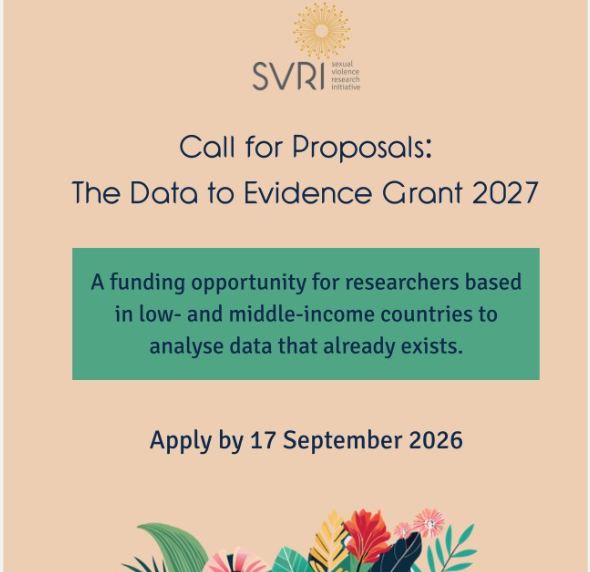
The Sexual Violence Research Initiative (SVRI) Lauches New Call for Proposals: the Data to Evidence Grant 2027
@Unknown
Location
USA / Global
Work Mode
grant
Posted
about 21 hours ago
Beware of scams! When applying for jobs, you should NEVER have to pay anything. Learn about job scams.
Get jobs in your inbox
Join over 10,000 subscribers receiving our weekly newsletter.
You might also like
University of Vienna University Assistant (Postdoctoral Researcher) 2026: Fully Funded Academic Career Opportunity in Political Science – Apply by 20 August 2026
Apply by 20 August 2026
The Pollination Project Seed Grant 2026: Apply for Up to $500 in Rolling Funding for Grassroots Changemakers Worldwide
Unknown
Global Voices for Peace Small Seed Grants 2026: Up to US$15,000 for Grassroots Peace, Democracy and Justice Initiatives
Unknown

Sweden Offers SEK 2 Million to Recruit International Researchers: Grant for Recruiting International Visiting Researchers to Sweden 2026
Unknown
Call for Applications: 12 Fully Funded PhD Positions at the University of Bonn – Study Reconciliation Across Cultures and Centuries
the University of Bonn – Study Reconciliation Across Cultures and Centuries

European Commission Blue Book Traineeship Programme 2027: The Complete Guide to Europe’s Most Prestigious Paid Traineeship in EU Policymaking and Administration
Unknown