
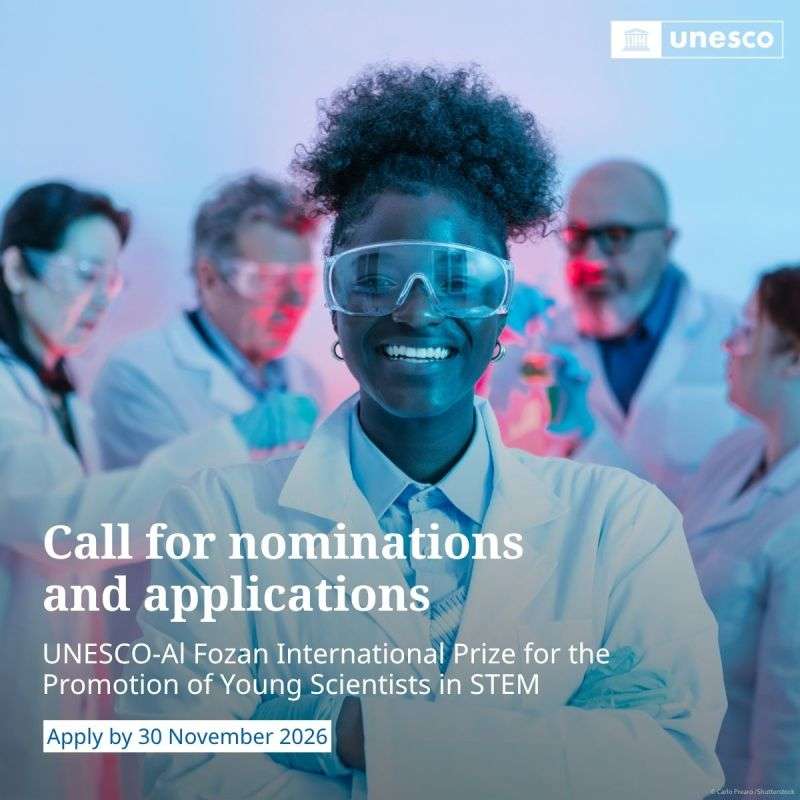
UNESCO-Al Fozan International Prize 2026: Win USD 50,000 for Outstanding Achievements in STEM Research, Innovation, and International Cooperation @Al Fozan International Prize 2026: Win USD 50,000 for Outstanding Achievements in STEM Research, Innovation, and International Cooperation
Young scientists and innovators around the world now have an exceptional opportunity to gain international recognition for their contributions to science, technology, engineering, and mathematics (STEM). UNESCO has officially launched the call for nominations and applications for the third edition of the UNESCO-Al Fozan International Prize for the Promotion of Young Scientists in STEM.
This globally recognized biennial prize celebrates outstanding young researchers, innovators, educators, and scientific leaders whose work contributes to advancing scientific knowledge, strengthening STEM education, promoting innovation, and fostering international cooperation in support of the Sustainable Development Goals (SDGs).
Five outstanding laureates from different regions of the world will each receive a monetary award of USD 50,000, in addition to a medal and diploma recognizing their achievements and contributions to society.
Application Deadline
Deadline: 30 November 2026 (Midnight UTC+1)
Applicants and nominators are strongly encouraged to begin the application process early to allow sufficient time for account verification, nomination submission, and document preparation.
About the UNESCO-Al Fozan International Prize
The UNESCO-Al Fozan International Prize for the Promotion of Young Scientists in STEM was established to strengthen scientific research, improve STEM education, encourage innovation, and enhance international scientific cooperation.
The Prize supports UNESCO’s broader mission of promoting science as a driver of sustainable development and recognizes young scientists whose work addresses some of the world’s most pressing challenges, including climate change, sustainable development, technological innovation, education, public health, environmental sustainability, and socio-economic advancement.
Through this initiative, UNESCO seeks to inspire the next generation of scientists while encouraging governments, institutions, and communities to invest in scientific excellence and innovation.
The Prize also places a strong emphasis on gender equality by encouraging the participation and recognition of women and girls in STEM disciplines.
Prize Benefits
Selected laureates will receive:
Financial Award
- USD 50,000 for each laureate
International Recognition
- UNESCO international recognition
- Global visibility among scientific communities
- Increased opportunities for collaboration and networking
- Enhanced professional credibility
Official Honors
- UNESCO-Al Fozan Prize Medal
- UNESCO-Al Fozan Prize Diploma
Career Advancement Opportunities
- Increased exposure to global scientific networks
- Opportunities for international partnerships
- Recognition from leading scientific institutions worldwide
Number of Awards Available
The Prize is awarded to five laureates every two years, representing the following geographical regions:
- Africa
- Arab States
- Asia and the Pacific
- Europe and North America
- Latin America and the Caribbean
This regional representation ensures global inclusion and recognizes scientific excellence across diverse communities and research environments.
Objectives of the Prize
The UNESCO-Al Fozan International Prize aims to:
- Promote excellence in STEM research
- Encourage innovation and scientific discovery
- Support STEM education and knowledge dissemination
- Strengthen international scientific cooperation
- Advance progress toward the Sustainable Development Goals
- Increase participation of women and girls in STEM
- Inspire future generations of scientists and innovators
Who Can Apply?
The Prize is open to young scientists, researchers, innovators, educators, and STEM professionals who have demonstrated exceptional contributions in their respective fields.
Candidates must have achieved significant recognition for their work and demonstrate measurable impact within their area of expertise.
Eligibility Criteria
Age Requirement
Applicants must:
- Be under 40 years of age on the application deadline date (30 November 2026)
Achievement Requirement
Candidates must have demonstrated significant achievements or contributions in one or more of the following areas:
1. STEM Research
Including:
- Scientific research
- Applied research
- Emerging technologies
- Breakthrough discoveries
- Innovative scientific solutions
2. STEM Education and Innovation
Including:
- STEM teaching and learning initiatives
- Science communication
- Dissemination of research findings
- Educational innovation
- Creativity and technological innovation
3. International or Regional Cooperation
Including:
- Cross-border scientific collaboration
- Regional research partnerships
- International STEM initiatives
- Scientific diplomacy
- Knowledge-sharing programmes
Focus on Gender Equality
UNESCO strongly encourages nominations of young women scientists.
The Prize seeks to address gender disparities in STEM by recognizing female scientific leaders and inspiring more girls and young women to pursue careers in science, technology, engineering, and mathematics.
Application Process
Applicants must complete an online application dossier.
Step 1: Create an Online Account
Candidates must:
- Register online
- Verify their email address
- Complete their profile information
Step 2: Complete the Application Dossier
Applicants must provide detailed information about:
- Educational background
- Professional achievements
- Scientific contributions
- Research impact
- Innovation activities
- International collaboration experience
Step 3: Upload Supporting Documents
Required documents include:
- Description of background and achievements
- Summary of research work and publications
- Evidence of significant contributions
- Statement explaining contribution to the Prize objectives
- Additional supporting documentation
Step 4: Secure a Valid Nomination
Applications are only valid if accompanied by an eligible nomination.
Candidates must ensure their nominator submits the nomination before the application deadline.
Step 5: Submit Before the Deadline
Both the application and nomination must be completed by:
30 November 2026 (Midnight UTC+1)
Nomination Requirements
A nomination is mandatory.
Applications submitted without an eligible nomination will not be considered.
Who Can Nominate?
Eligible nominators include:
Government Institutions
- Governments of UNESCO Member States
- National Commissions for UNESCO
UNESCO Partners
- UNESCO Chairs
- Category 2 Institutes and Centres under UNESCO
Scientific Organizations
- International scientific unions
- Relevant scientific bodies
Non-Governmental Organizations
- NGOs maintaining official partnerships with UNESCO
- Organizations active in STEM-related fields
Universities
Eligible university representatives include:
- Department Heads
- Deans
- University management officials
Individual faculty members and staff members are not eligible to submit nominations independently.
What Must a Nomination Include?
A nomination should contain:
Candidate Background
- Professional profile
- Educational background
- Major achievements
Scientific Contributions
- Publications
- Research outputs
- Innovation achievements
- Major accomplishments
Contribution to Prize Objectives
- Impact on STEM advancement
- Educational contributions
- Innovation and scientific leadership
- International cooperation efforts
Important Application Notes
Applicants should carefully note the following:
- Self-nominations alone are not accepted
- Applications must be completed in English or French
- Nominations must be completed in English or French
- Incomplete submissions will be rejected
- Late applications will not be accepted
- Account verification may require additional time
- Each nominating institution may nominate up to three candidates
- Supporting documents must be submitted before the deadline
Why This Prize Matters
The UNESCO-Al Fozan International Prize is one of the world’s most prestigious recognitions for emerging scientific leaders.
Beyond the financial award, the Prize provides recipients with international visibility, global recognition, and access to influential scientific networks that can accelerate their careers and amplify the impact of their work.
For young researchers and innovators dedicated to solving global challenges through science and technology, this Prize represents a powerful platform for showcasing excellence and contributing to sustainable development worldwide.
How to Apply
Click here for more and to apply
Interested candidates should begin preparing their applications and securing eligible nominators as early as possible to ensure successful submission before the deadline.
Final Thoughts
The UNESCO-Al Fozan International Prize for the Promotion of Young Scientists in STEM offers an extraordinary opportunity for young scientists, researchers, innovators, and educators to gain international recognition for their contributions to science and society.
With five awards of USD 50,000 each, global visibility, and recognition from UNESCO, the Prize celebrates the next generation of scientific leaders working to advance knowledge, innovation, education, and sustainable development around the world.
Eligible candidates are encouraged to prepare their applications and nominations well ahead of the 30 November 2026 deadline.
Click here for more global award opportunities
UNESCO-Al Fozan International Prize 2026: Win USD 50,000 for Outstanding Achievements in STEM Research, Innovation, and International Cooperation
@Al Fozan International Prize 2026: Win USD 50,000 for Outstanding Achievements in STEM Research, Innovation, and International Cooperation
Location
Global
Work Mode
continent
Posted
about 2 hours ago
Beware of scams! When applying for jobs, you should NEVER have to pay anything. Learn about job scams.
Get jobs in your inbox
Join over 10,000 subscribers receiving our weekly newsletter.
You might also like

United Nations ESCAP Jobs 2026: 4 International Career Opportunities Open Across Asia-Pacific | Apply Before the Deadlines
Pacific | Apply Before the Deadlines

Global Research Fellowship for Emerging Scholars in MENA Studies
Social Sciences Lab MENA
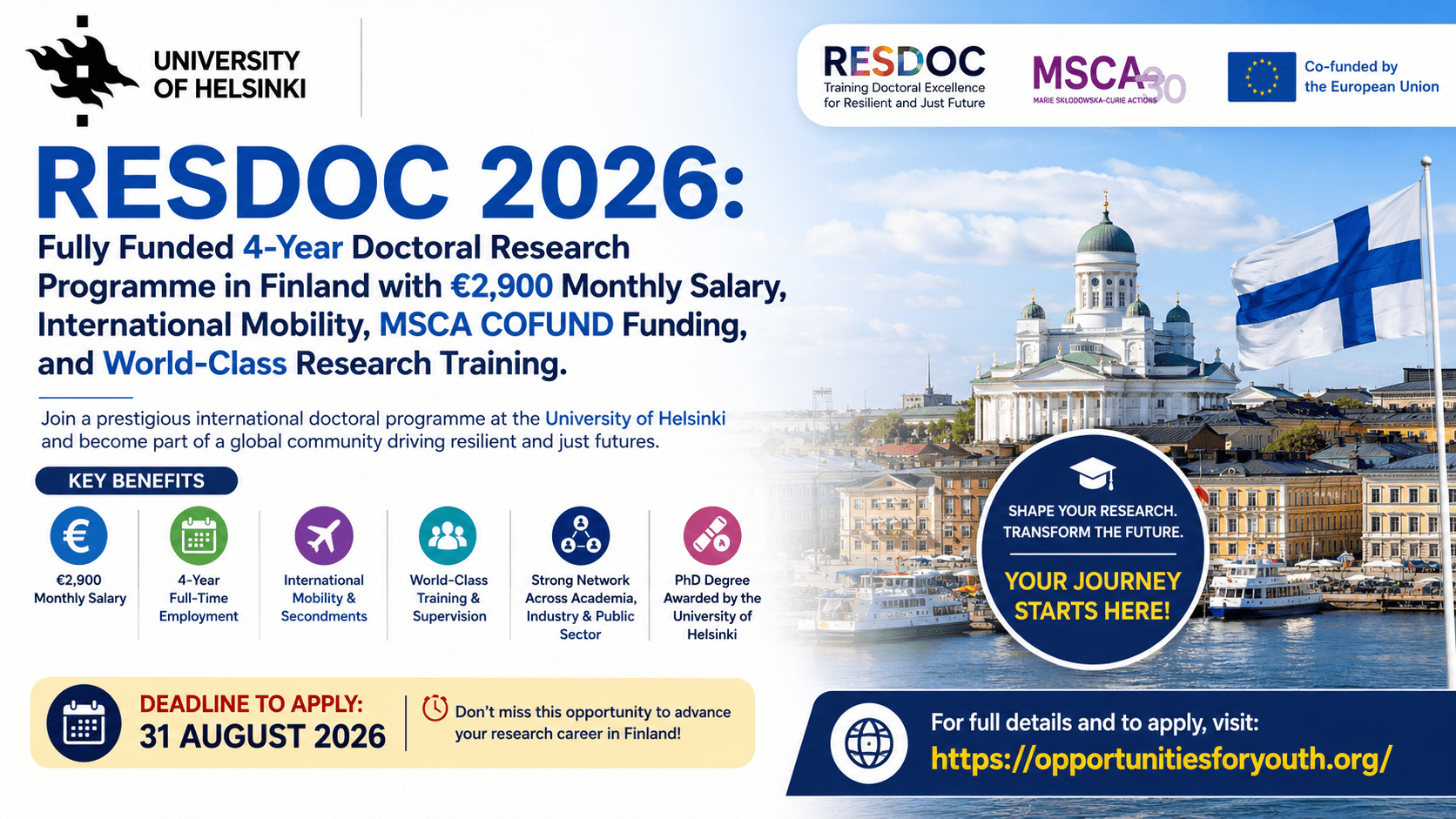
University of Helsinki RESDOC 2026: Fully Funded 4-Year Doctoral Research Programme in Finland with €2,900 Monthly Salary, International Mobility, MSCA COFUND Funding, and World-Class Research Training
Year Doctoral Research Programme in Finland with €2,900 Monthly Salary, International Mobility, MSCA COFUND Funding, and World-Class Research Training

Internships
International Organization for Migration (IOM), United Nations Development Programme (UNDP), United Nations Office for Project Services (UNOPS)

Women 4 Water Swarovski Foundation Scholarships 2026 for Female Water Professionals to Study Master of Science in Water and Sustainable Development at IHE Delft Institute for Water Education
IHE Delft Institute for Water Education
Digital Minds Career Development Fellowships
Longview Philanthropy