
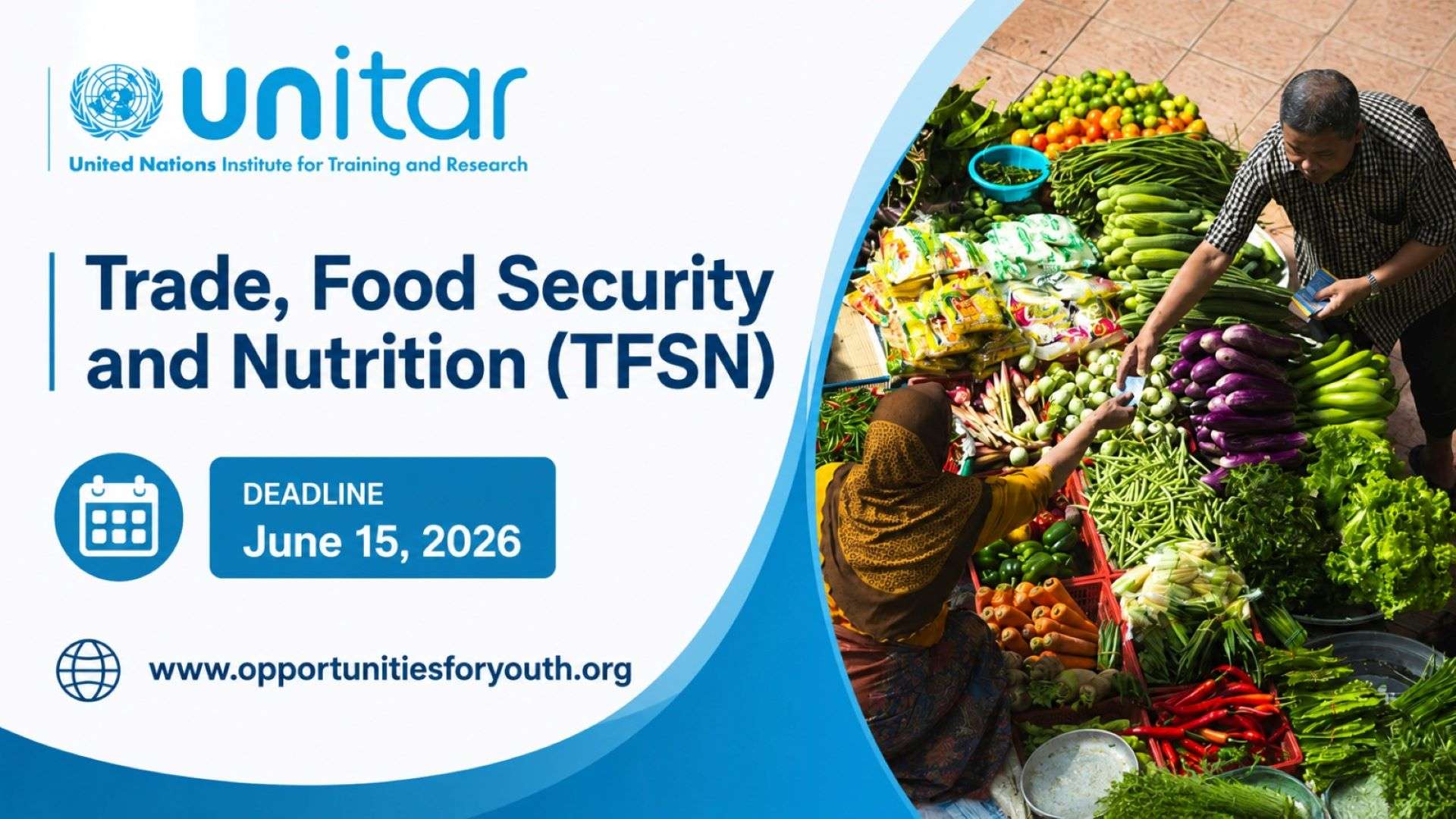
UNITAR–FAO Trade, Food Security and Nutrition (TFSN) Course 2026: Free Online Training Opportunity for Policymakers, Researchers, and Agricultural Trade Professionals in Africa @FAO Trade, Food Security and Nutrition (TFSN) Course 2026: Free Online Training Opportunity for Policymakers, Researchers, and Agricultural Trade Professionals in Africa
The United Nations Institute for Training and Research (UNITAR), in partnership with the Food and Agriculture Organization of the United Nations (FAO), is offering a fully funded online training programme titled Trade, Food Security and Nutrition (TFSN). This highly specialized course is designed to strengthen the capacity of policymakers, government officials, researchers, and agricultural trade professionals across Eastern and Southern Africa.
Scheduled to run from 13 July 2026 to 14 August 2026, this five-week e-learning programme provides participants with a unique opportunity to deepen their understanding of the complex relationship between agricultural trade, food security, nutrition, and sustainable development.
The course is offered completely free of charge and is delivered online, making it accessible to professionals across multiple African countries without the need for travel. Successful participants will receive a certificate of completion from UNITAR and FAO.
Interested applicants are encouraged to submit their applications early as places are limited and participation is subject to a competitive selection process.
Why This Course Matters
Food security remains one of the most pressing development challenges facing Africa. At the same time, trade is increasingly recognized as a powerful tool for promoting economic growth, agricultural transformation, and poverty reduction.
The relationship between trade and food security has become a major focus of global development discussions, particularly as countries work toward achieving the Sustainable Development Goals (SDGs), including the goal of ending hunger by 2030.
Through the 2014 Malabo Declaration, African governments committed to increasing intra-African agricultural trade and leveraging regional and international markets to stimulate agricultural development.
However, expanding trade alone does not automatically improve food security. Policymakers must carefully design trade policies that enhance agricultural productivity while ensuring access to nutritious food and supporting vulnerable populations.
This course addresses these critical issues by helping participants understand how trade policies can support food security, nutrition, and sustainable development.
About the Trade, Food Security and Nutrition Course
The Trade, Food Security and Nutrition (TFSN) Course aims to strengthen institutional and individual capacity across Eastern and Southern Africa.
Participants will learn how to:
- Analyze the relationship between trade and food security
- Understand the effects of agricultural trade on nutrition outcomes
- Evaluate trade policy measures
- Formulate evidence-based trade policies
- Negotiate trade agreements effectively
- Assess food security implications of trade liberalization
- Understand international trade governance frameworks
- Promote policy coherence between trade and nutrition objectives
The course combines theoretical foundations with practical regional experiences and case studies relevant to Africa’s agricultural and economic realities.
Learning Objectives
By the end of the programme, participants will be able to:
1. Assess Trade and Food Security Challenges
Participants will gain the ability to:
- Identify opportunities created by trade liberalization
- Evaluate risks associated with increased market openness
- Analyze food security outcomes resulting from trade policies
2. Understand Trade Policy Measures
Learners will explore:
- Different types of trade interventions
- Agricultural support policies
- Trade facilitation mechanisms
- Policy design considerations
- Implementation challenges
3. Examine Global Trade Governance
Participants will study:
- The World Trade Organization (WTO) Agreement on Agriculture
- Global trade governance systems
- Sustainable Development Goals (SDGs)
- International food security frameworks
4. Evaluate Trade and Nutrition Linkages
The course will help participants understand:
- How trade influences food prices
- The impact of trade on dietary diversity
- Nutrient availability and food imports
- Policy coherence between nutrition and trade agendas
Course Structure and Curriculum
The programme is divided into four comprehensive units.
Unit 1: Introduction to Trade and Food Security
Lesson 1.1: Definitions and Linkages Between Trade and Food Security
Topics include:
- Trade fundamentals
- Food security concepts
- Economic linkages
- Agricultural market dynamics
Lesson 1.2: Impacts of Trade on Food Security
Participants will examine:
- Positive and negative impacts of trade
- Household food access
- Agricultural productivity
- Market integration
Unit 2: Trade Policy Supportive of Food Security
Lesson 2.1: Trade Policy Measures and Agricultural Development
Areas covered include:
- Tariffs
- Trade restrictions
- Agricultural support measures
- Market interventions
Lesson 2.2: Design and Implementation of Trade Policy Measures
Participants will learn:
- Policy formulation approaches
- Implementation frameworks
- Monitoring and evaluation mechanisms
Unit 3: Governance of Trade and Food Security
Lesson 3.1: Introduction to the Multilateral Trading System
Topics include:
- WTO fundamentals
- Global trade agreements
- International trade governance
Lesson 3.2: Policy Space for Food Security in the Multilateral Trading System
Participants will explore:
- National policy flexibility
- Trade obligations
- Food security safeguards
Lesson 3.3: Towards Improved Governance for Trade and Food Security
Focus areas include:
- Institutional coordination
- Governance reforms
- Regional cooperation
Unit 4: Trade and Nutrition – Policy Coherence for Healthy Diets
Lesson 4.1: Trade and Nutrition Linkages
Participants will study:
- Food systems
- Nutrition outcomes
- International food trade
Lesson 4.2: Trade in Food and Nutrients
Topics include:
- Food diversity
- Nutrient availability
- Food affordability
- Market access
Lesson 4.3: Strengthening Policy Coherence for Trade and Nutrition
Participants will learn strategies for:
- Integrating nutrition objectives into trade policies
- Supporting healthier diets
- Aligning national development priorities
Course Delivery Method
The programme is delivered entirely online through UNITAR’s e-learning platform.
Duration
- Five weeks
- 13 July 2026 – 14 August 2026
Language
- English only
Learning Format
Participants will engage in:
- Self-paced learning
- Reading assignments
- Interactive discussions
- Case study exercises
- Assessment quizzes
- Expert-led webinars
The course is facilitated by international experts with extensive practical experience in agricultural trade, food security, and development policy.
Benefits of Participating
Participants will gain numerous professional and technical benefits, including:
Professional Development
- Enhanced trade policy expertise
- Improved understanding of food security issues
- Practical knowledge of agricultural trade governance
- Increased capacity for policy formulation
Networking Opportunities
- Interaction with professionals across Africa
- Access to international experts
- Exposure to regional perspectives and experiences
Career Advancement
- Strengthened policy analysis skills
- Greater capacity to influence trade and food security decisions
- Enhanced professional credentials
Certification
Participants who successfully complete all assignments and assessments will receive an official Certificate of Completion from UNITAR and FAO.
Selection Process
Because the course is offered free of charge, spaces are limited.
Selection will be conducted by FAO based on:
- Relevance of applicant’s professional role
- Geographic representation
- Gender balance considerations
- Potential impact of acquired knowledge
Priority will be given to professionals who influence agricultural trade policies and food security programmes at regional, national, or sector levels.
Applicants selected for participation may also be required to obtain approval from their direct supervisors before receiving final confirmation.
Application Deadline
Deadline: 15 June 2026
Why You Should Apply
Trade and food security are increasingly interconnected issues shaping the future of agriculture, economic development, and nutrition across Africa.
This UNITAR–FAO programme offers a rare opportunity to learn directly from leading international experts while gaining practical skills that can immediately be applied within government institutions, research organizations, development agencies, and the private sector.
With no participation fee, expert-led instruction, flexible online learning, and an internationally recognized certificate, the Trade, Food Security and Nutrition Course is an outstanding professional development opportunity for anyone working at the intersection of agriculture, trade, food systems, and public policy.
For more information, visit the official website
Discover more global training opportunities on OFY, VISIT HERE
UNITAR–FAO Trade, Food Security and Nutrition (TFSN) Course 2026: Free Online Training Opportunity for Policymakers, Researchers, and Agricultural Trade Professionals in Africa
@FAO Trade, Food Security and Nutrition (TFSN) Course 2026: Free Online Training Opportunity for Policymakers, Researchers, and Agricultural Trade Professionals in Africa
Location
Global
Work Mode
continent
Posted
about 4 hours ago
Beware of scams! When applying for jobs, you should NEVER have to pay anything. Learn about job scams.
Get jobs in your inbox
Join over 10,000 subscribers receiving our weekly newsletter.
You might also like

Researcher
Mo Ibrahim Foundation

Public Tech Media Lab Fellowship and Research Community at the University of Wisconsin–Madison: Join a Global Network Advancing Media, Technology, and Democracy
the University of Wisconsin–Madison: Join a Global Network Advancing Media, Technology, and Democracy
General Internship
The Hague Centre for Strategic Studies

Fully Funded UNU-WIDER & African Union Winter School 2026 in Ethiopia for African Researchers and Policy Analysts
UNU-WIDER & African Union
Journalism Grant Opportunity
Balkan Investigative Reporting Network (BIRN)

Women, Business and the Law (WBL) 2026 Course: Advancing Global Gender Equality Through Legal Reform and Data-Driven Policy
Women, Business and the Law (WBL)