








United Nations Fund for Population Activities (UNFPA): APRO Technology-Facilitated Gender-Based Violence Partnership Call 2026 ·Facilitated Gender-Based Violence Partnership Call 2026
Background of the UNFPA Asia-Pacific Regional Programme (APRO)
UNFPA is launching a new Asia and Pacific Regional Programme covering the period from 2026 to 2029. The programme is aligned with the UNFPA Strategic Plan for the same period and the Programme of Action of the International Conference on Population and Development.
The regional programme is intended to accelerate progress toward UNFPA’s three transformative results:
- Ending the unmet need for family planning
- Ending preventable maternal deaths
- Ending gender-based violence and harmful practices
The programme also seeks to strengthen responses to demographic change while ensuring that no one is left behind. This includes promoting accessible, inclusive and rights-based programming for persons with disabilities and other populations facing exclusion.
Its implementation covers the humanitarian-development-peace continuum, recognizing that sexual and reproductive health, gender equality and protection needs must be addressed in development settings, emergencies and fragile or conflict-affected environments.
Why UNFPA Is Prioritizing Technology-Facilitated Gender-Based Violence
Technological innovation and digitalization have created important opportunities to improve access to services, information, education and communication. However, digital platforms have also become environments in which violence against women and girls can be committed, intensified or extended.
UNFPA’s approach recognizes an online-offline continuum. This means that violence occurring through digital technologies cannot always be separated from violence occurring in homes, workplaces, schools, communities or public spaces.
Technology-facilitated abuse may affect survivors’ safety, privacy, dignity, access to services and participation in public life. Effective programming therefore requires more than isolated online-safety activities. It demands coordinated work involving survivor-centred services, legal and policy systems, digital security, technology design, evidence, ethical data management and prevention.
UNFPA APRO is seeking partners that can contribute specialized knowledge and operational capacity to strengthen both the prevention of TFGBV and the response available to survivors across Asia and the Pacific.
Purpose of the UNFPA Expression of Interest
The purpose of the call is to identify qualified organizations that can collaborate with UNFPA APRO in delivering the Asia-Pacific Regional Programme.
Selected partners may support activities involving:
- Specialized technical assistance
- Capacity-strengthening and professional training
- Survivor-centred support services
- Prevention and response programming
- Digital safety and security
- Legal and policy advice
- Research and evidence generation
- Monitoring and evaluation
- Technology-sector engagement
- Evidence-based advocacy
- Innovation and service delivery
Eligible entities selected through the process will sign an Implementing Partnership Agreement with UNFPA APRO. This agreement will regulate the technical collaboration and partnership arrangement.
Subject to the availability of funds, UNFPA APRO will subsequently work with successful implementing partners to agree on a work plan and enter into a funded collaboration. Selection through the Expression of Interest process therefore creates a potential pathway to funded implementation, but the announcement does not guarantee funding or state a predetermined grant amount.
Organizations Invited to Submit an Expression of Interest
UNFPA APRO is inviting Expressions of Interest from several categories of legally registered entities.
Academic and research institutions
Universities, research centres, think tanks and other academic institutions may apply where they possess relevant expertise in areas such as:
- Gender-based violence
- Digital safety
- Technology and society
- Public policy
- Human rights
- Law and justice
- Social research
- Monitoring and evaluation
- Statistical measurement
- Data systems
- Survivor-centred programming
Academic applicants should demonstrate not only theoretical expertise but also their capacity to translate research into practical programming, policy advice, training or evidence-based advocacy.
Civil society organizations
Eligible civil society applicants include local and international NGOs, women-led organizations, youth-led organizations, civil society networks and rights-based organizations.
Such organizations may be particularly relevant where they have direct experience working with:
- Survivors of gender-based violence
- Women and girls in diverse circumstances
- Young people
- Frontline responders
- Human rights defenders
- Women’s rights movements
- Youth rights movements
- High-risk civic actors
- Communities affected by humanitarian emergencies
- People facing digital exclusion or online threats
Professional associations and regional technical bodies
Professional associations and specialized regional institutions may submit an EOI where they can contribute technical knowledge, standards, training systems, practitioner networks or policy support.
These may include associations or technical bodies working in social services, public health, law, justice, policing, digital technology, data governance, cybersecurity, research, evaluation or other relevant areas.
Organizations of persons with disabilities
Organizations of persons with disabilities are expressly included among eligible entities.
Their participation can help ensure that TFGBV prevention and response systems are inclusive, accessible and designed around the rights and lived experiences of persons with disabilities.
Specialized private-sector entities
Private-sector entities may apply where appropriate, particularly when they possess specialized expertise in:
- Technology-facilitated gender-based violence
- Digital security
- Online safety
- Digital evidence
- Information management
- Safe technology development
- Ethical technology design
- Safety-by-design principles
Private-sector participation must be relevant to the workstream proposed and consistent with UNFPA’s rights-based, ethical and survivor-centred requirements.
Four Main TFGBV Workstreams
Organizations may express interest in one or more of four specialized pillars.
Pillar 1: Response
The response pillar focuses on strengthening services, systems and professional capacity to assist survivors of technology-facilitated gender-based violence safely, ethically and confidentially.
Training and capacity building
Selected partners may help adapt and roll out UNFPA’s global TFGBV training package for frontline responders.
Target participants may include professionals working in:
- Social work
- Health services
- Justice systems
- Police and law enforcement
- Local government
- Gender-based violence services
- Humanitarian response
Training may be implemented across priority countries, including humanitarian contexts.
Partners may also support the revision of national gender-based violence referral mechanisms so that they adequately incorporate survivor-centred responses to technology-facilitated abuse.
This work is important because referral systems designed only for conventional forms of violence may not fully address digital evidence, online threats, data privacy, account security or the continuing relationship between online and offline harm.
TFGBV responder support network
UNFPA APRO intends to facilitate a regional support network for TFGBV responders.
The network would allow digital programmers, gender-based violence specialists and frontline responders to exchange:
- Practical experience
- Technical guidance
- Response protocols
- Lessons from implementation
- Emerging risks
- Promising practices
- Referral approaches
- Survivor-safety considerations
Qualified partners may be expected to help establish, coordinate or provide technical support to this network.
Regional survivor-support mechanism
The call includes the potential establishment of a regional mechanism providing safe, ethical and confidential services to survivors of technology-facilitated gender-based violence.
Organizations interested in this area should be able to demonstrate strong safeguards relating to:
- Survivor confidentiality
- Informed consent
- Data protection
- Referral management
- Risk assessment
- Ethical case handling
- Staff training
- Accessibility
- Protection from retaliation or further harm
Digital forensics
Partners may be selected to develop or support digital-forensic protocols for TFGBV cases.
These protocols should ensure that the collection and storage of digital evidence are:
- Safe
- Ethical
- Survivor-centred
- Confidential
- Technically reliable
- Consistent with relevant legal and protection requirements
Digital evidence can be highly sensitive. Poor collection or storage practices may expose survivors to further harm, compromise confidentiality or weaken legal and institutional responses.
Safe digital and information-management systems
The response pillar also covers systems used by GBV service providers to manage digital information.
Partners may support the design or implementation of secure systems that protect data held by organizations managing TFGBV cases.
This may involve reinforcing survivor-centred information-management systems and helping service providers reduce risks such as unauthorized access, insecure storage, inappropriate information sharing or loss of sensitive case information.
Pillar 2: Prevention
The prevention pillar focuses on reducing the risk of TFGBV before harm occurs and strengthening the ability of vulnerable groups and frontline actors to operate safely in digital environments.
Resilience of high-risk actors
Selected partners may strengthen the digital security, safety and operational resilience of groups facing elevated online risks.
These groups may include:
- Frontline responders
- Women’s rights movements
- Youth rights movements
- Human rights and civic actors
- Professionals managing sensitive survivor information
Relevant interventions could include training, risk assessment, security protocols, technical guidance and institutional digital-safety measures.
Diverting young people from harmful online subcultures
The call also seeks support for developing digital-literacy modules and targeted programmes intended to divert young people away from the manosphere and other harmful online subcultures.
This workstream requires organizations capable of developing prevention approaches that are:
- Evidence-based
- Age-appropriate
- Gender-responsive
- Culturally relevant
- Suitable for digital delivery
- Focused on long-term behavioural and social change
Applicants proposing work under this area should clearly explain their experience with young people, online cultures, gender norms, digital literacy or violence-prevention programming.
Pillar 3: Enabling Environment
The enabling-environment pillar addresses the laws, policies, technologies, standards and financial systems that influence how TFGBV is prevented and addressed.
Rights-based laws and policies
Partners may help strengthen the ability of governments and civil society organizations to develop and implement laws and policies addressing technology-facilitated gender-based violence.
Activities may include:
- Specialized legal advice
- Policy analysis
- Drafting support
- Peer learning
- Mentorship
- Institutional capacity development
- Rights-based assessment of existing legislation
The focus should be on legal and policy approaches that protect survivors and promote rights without creating unintended harm, exclusion or excessive restrictions.
Digital governance and technology-industry standards
UNFPA APRO is also seeking expertise related to gender-responsive digital governance and technology-industry practices.
Partners may advocate for or support the implementation of:
- Safety-by-design principles
- Ethical technology development
- Gender-responsive digital governance
- Improved technology-sector standards
- Safer digital products
- Platform policies addressing TFGBV
- Prevention measures built into technology before harm occurs
Safety by design means considering user protection and foreseeable risks during the design and development of digital services rather than responding only after abuse has occurred.
Sustainable financing
Organizations may contribute evidence and investment cases that influence national planning and budgeting.
The objective is to encourage governments to allocate dedicated resources for TFGBV prevention and response rather than treating technology-facilitated violence as an unfunded or temporary policy issue.
This work may involve:
- Costing interventions
- Developing financing cases
- Budget analysis
- Public-finance advocacy
- Evidence-based investment proposals
- Engagement with national planning institutions
Applicants interested in this component should be capable of connecting technical TFGBV programming with national planning, public budgets and sustainable financing mechanisms.
Pillar 4: Research, Data and Evaluation
The fourth pillar focuses on building the evidence, measurement systems and ethical monitoring frameworks needed to improve TFGBV programmes and policies.
Ethical monitoring and evaluation
Partners may support the development of monitoring and evaluation frameworks for TFGBV programmes.
These frameworks should contain appropriate:
- Indicators
- Means of verification
- Data-collection methods
- Progress measures
- Outcome measures
- Impact-assessment approaches
- Ethical safeguards
Monitoring systems must be survivor-centred and should not create additional risks for survivors or expose confidential information.
The resulting evidence should help UNFPA and its partners assess implementation, understand impact and improve future programming and policy.
Evidence generation and knowledge sharing
Selected entities may generate, synthesize and share evidence concerning TFGBV prevention and response at:
- Regional level
- Subregional level
- National level
This may include:
- Trend analysis
- Literature reviews
- Comparative research
- Programme evaluations
- Policy research
- Documentation of promising practices
- Evidence briefs
- Knowledge products
- Regional learning initiatives
Statistical standards and prevalence measurement
The call includes support for developing statistical standards and testing methods for measuring the prevalence of technology-facilitated gender-based violence.
Organizations interested in this work should demonstrate expertise in areas such as survey design, gender statistics, research ethics, measurement, methodology development or sensitive-data collection.
Administrative-data systems
Partners may also help improve existing administrative-data systems by integrating variables that allow reported TFGBV cases to be identified and tracked.
This work must balance the need for accurate information with survivor safety, confidentiality, informed consent and responsible data governance.
Selection Criteria
UNFPA APRO will assess applicants against several technical and institutional requirements.
Legal registration
Applicants must be legally registered entities. Both not-for-profit organizations and, where appropriate, for-profit organizations may be considered.
Applicants should be prepared to provide official registration documents and evidence of their legal status.
Technical capacity
The organization must demonstrate proven experience and expertise in at least one of the four TFGBV pillars.
A strong submission should clearly explain:
- The workstream or workstreams selected
- Relevant previous projects
- Technical methodologies used
- Results achieved
- Populations or institutions supported
- Geographic coverage
- Relevant publications, tools or training materials
- The organization’s comparative advantage
Institutional capacity
Applicants must demonstrate the institutional ability to implement activities effectively.
UNFPA expects evidence of:
- Established internal governance
- Clear operational policies
- Human-resource policies
- Adequate staffing
- Results-based management capacity
- Robust monitoring and evaluation systems
- Suitable implementation and reporting arrangements
Applicants should avoid making unsupported statements about institutional strength. Claims should be backed by policies, organizational structures, previous performance or concrete examples.
Financial capacity
Organizations must have experience managing funds and a sound financial-management system.
The required financial capacity includes:
- Robust internal controls
- Fraud-prevention policies
- Established accounting procedures
- Reliable financial reporting
- Evidence of responsible fund management
The organization’s financial systems must be supported by recent unqualified audit reports, such as audit reports covering the last two years.
An unqualified audit opinion generally means that the external auditor concluded that the financial statements were presented fairly in all material respects under the relevant reporting framework.
Applicants whose latest audit reports contain qualifications should carefully assess whether they meet this criterion before applying.
Ethical standards
Potential partners must demonstrate their commitment to UNFPA policies and ethical standards.
Particular emphasis is placed on UNFPA’s zero-tolerance approach to sexual exploitation, abuse and harassment, commonly addressed through Prevention of Sexual Exploitation and Abuse requirements.
Applicants should be able to demonstrate appropriate safeguarding policies, reporting mechanisms, staff conduct requirements and accountability procedures.
Geographical relevance
The applicant must have a demonstrated track record of successfully managing and implementing programmes in Asia and the Pacific.
The announcement does not expressly require every applicant to be headquartered within the region. However, organizations must provide credible evidence of relevant implementation experience, partnerships, networks or operational capacity in Asia and the Pacific.
Required Expression of Interest Documents
Interested organizations must prepare an Expression of Interest containing the following elements.
1. Cover letter
The cover letter should identify:
- The organization submitting the EOI
- The selected area or areas of interest
- The relevant TFGBV pillar or pillars
- How the organization aligns with the UNFPA Asia-Pacific Regional Programme
- Why the organization is interested in collaborating with UNFPA APRO
- The organization’s principal comparative advantage
The cover letter should be direct, evidence-based and tailored to the specific call.
2. Evidence of technical expertise
Applicants must provide evidence of their technical capacity and record of similar work.
Relevant evidence may include:
- Previous project descriptions
- Completion reports
- Evaluation findings
- Research publications
- Training materials
- Policies or technical tools developed
- Contracts or partnership agreements
- Examples of survivor-centred services
- Digital-safety programmes
- Advocacy outcomes
- Relevant organizational profiles
Experience working with United Nations agencies is considered an advantage, although the announcement does not state that previous UN experience is mandatory.
3. Evidence of partnerships and networks
Applicants must explain their partnerships, networks and comparative advantage within Asia and the Pacific.
This may include relationships with:
- Government institutions
- Civil society networks
- Women-led organizations
- Youth-led organizations
- Research institutions
- Technology-sector actors
- Survivor-service providers
- Organizations of persons with disabilities
- Regional bodies
- International development partners
The submission should explain how these networks would help the applicant deliver regional, subregional or national-level work.
4. Proposed modalities of engagement
Applicants must indicate how they propose to collaborate with UNFPA APRO.
Possible modalities identified in the call include:
- Technical support
- Research
- Advocacy
- Innovation
- Service delivery
Organizations may propose more than one modality where this is consistent with their capacity and the selected workstream.
A strong proposal should explain the proposed approach, expected contribution, institutional role and how the organization would coordinate with UNFPA and other partners.
How to Submit the UNFPA APRO Expression of Interest
Applications must be submitted by email.
Submission email: apro.office@unfpa.org
Required subject line: EOI on TFGBV
Application deadline: 14 August 2026
Applicants should ensure that the correct subject line is used so the submission can be properly identified and routed.
Before sending the email, organizations should verify that:
- The cover letter is signed by an authorized representative.
- The selected TFGBV workstream is clearly identified.
- All supporting evidence is attached.
- The organization’s legal name and contact information are accurate.
- Attached files open correctly.
- File names are clear and professionally formatted.
- The email is sent to the correct address.
- A copy of the complete submission is retained.
- Delivery confirmation or an email record is preserved.
The official announcement does not specify a required application portal or closing time. Applicants should therefore follow the stated email-submission process and send their EOI before the deadline date.
Funding and Partnership Arrangements
The call does not publish a fixed grant amount, budget ceiling or guaranteed level of financial support.
Eligible entities selected through the process will enter into an Implementing Partnership Agreement with UNFPA APRO. Subject to funding availability, UNFPA APRO will then coordinate with successful implementing partners to agree on a work plan and establish a funded collaboration.
Organizations should therefore understand the process as involving two stages:
- Identification of technically and institutionally qualified partners through the Expression of Interest.
- Development of an agreed work plan and funded collaboration, subject to available resources.
Submission of an EOI does not itself guarantee selection, funding or a specific financial award.
Practical Tips for Preparing a Strong Submission
Select only relevant workstreams
Applicants should not claim expertise across all four pillars unless they can provide substantial evidence.
A focused application demonstrating deep experience in one or two areas may be more credible than a broad application containing unsupported claims.
Connect experience directly to TFGBV
General experience in gender equality, gender-based violence or information technology may not be sufficient on its own.
Applicants should clearly demonstrate how their experience relates to the interaction between digital technology and gender-based violence.
Demonstrate survivor-centred practice
Organizations proposing response, data, forensic or information-management activities should explain how they protect:
- Safety
- Privacy
- Confidentiality
- Dignity
- Informed consent
- Accessibility
- Survivor decision-making
Provide evidence, not promotional language
Statements such as “we are a leading organization” or “we have extensive experience” should be supported by:
- Project dates
- Countries covered
- Funding managed
- Outputs delivered
- People or institutions reached
- Evaluations completed
- Policies influenced
- Systems established
Review financial documentation early
Because recent unqualified audit reports are specifically mentioned, applicants should confirm the availability and status of their latest external audits before preparing the complete EOI.
Explain regional value
Applicants should show how their proposed contribution would be relevant beyond a single isolated activity.
This may include regional networks, transferable tools, multilingual capacity, cross-country experience, policy connections or the ability to adapt interventions for different Asia-Pacific contexts.
Submit before 14 August 2026
The official notice does not specify a closing hour. Applicants should not wait until the final day, especially where internal approvals or large supporting documents are involved. APPLY HERE.
Conclusion
The UNFPA APRO Expression of Interest presents a significant institutional collaboration opportunity for organizations working at the intersection of gender-based violence, technology, digital safety, survivor services, public policy, research, data and human rights.
Through the call, UNFPA seeks partners capable of contributing to four major areas: survivor-centred response, prevention, an enabling legal and technological environment, and research, data and evaluation.
Eligible organizations must demonstrate legal registration, relevant technical expertise, institutional governance, sound financial systems, appropriate ethical standards and a record of programme implementation in Asia and the Pacific.
Successful entities may enter into an Implementing Partnership Agreement with UNFPA APRO and subsequently develop a funded work plan, subject to the availability of resources.
Organizations considering an application should identify the workstream that best matches their expertise, assemble strong technical and financial evidence, explain their regional comparative advantage and submit the complete Expression of Interest to apro.office@unfpa.org using the subject line “EOI on TFGBV” no later than 14 August 2026
For more global opportunities, click HERE.
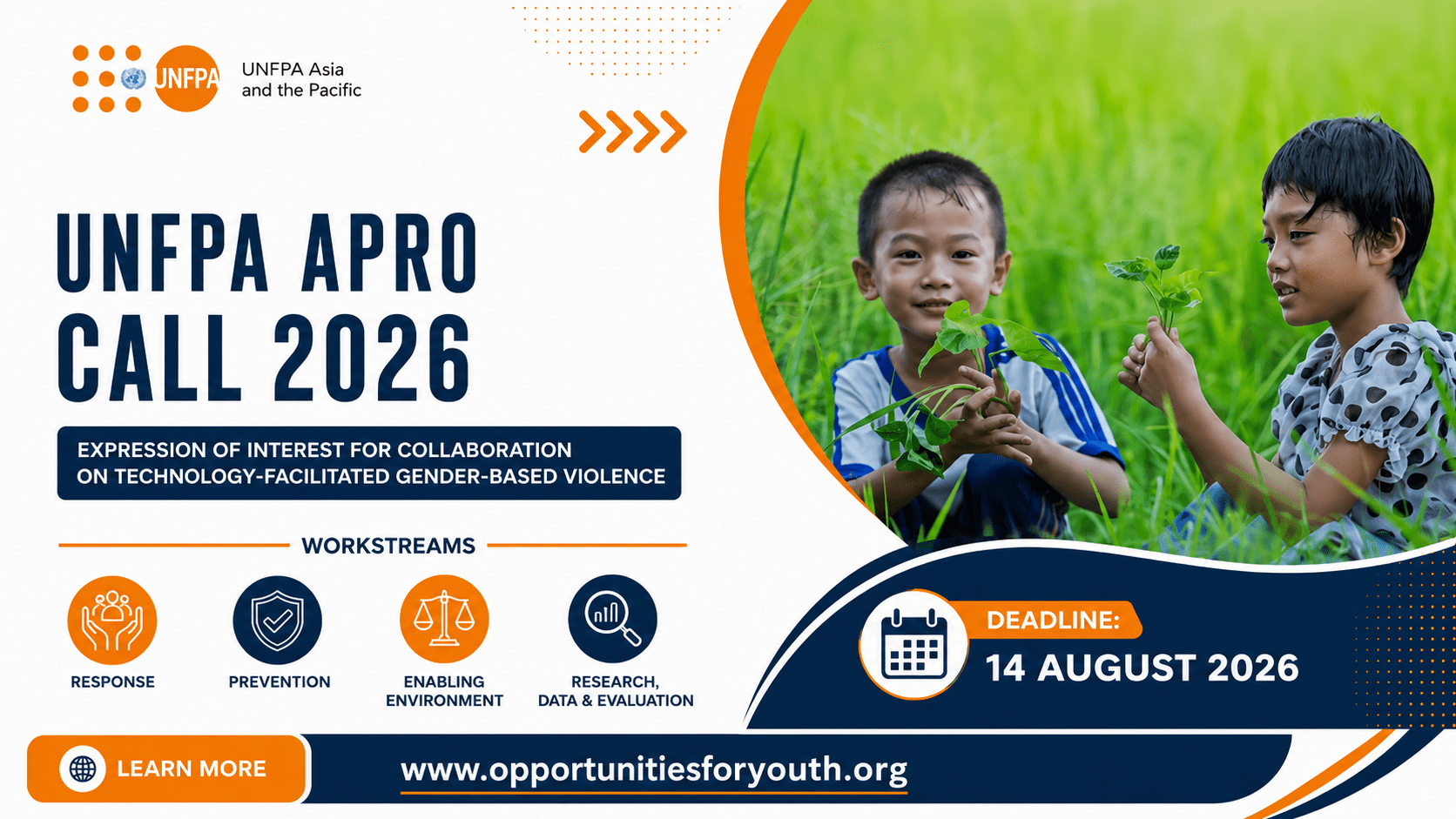
United Nations Fund for Population Activities (UNFPA): APRO Technology-Facilitated Gender-Based Violence Partnership Call 2026
@Facilitated Gender-Based Violence Partnership Call 2026
Location
USA / Global
Work Mode
grant
Posted
about 7 hours ago
Beware of scams! When applying for jobs, you should NEVER have to pay anything. Learn about job scams.
Get jobs in your inbox
Join over 10,000 subscribers receiving our weekly newsletter.
You might also like

2026–2027 United Nations UNSCAR Application Cycle: Apply for Funding to Advance Conventional Arms Regulation and Disarmament Initiatives
2027 United Nations UNSCAR Application Cycle: Apply for Funding to Advance Conventional Arms Regulation and Disarmament Initiatives
Africa Fundraising Incubator (AFI) 2026 for African Organizations: Receive Fundraising Training, Up to $5,000 in Matching Funds, 12 Months of Free Fiscal Sponsorship, and an All-Expenses-Paid Leadership Boot Camp in Kigali
Expenses-Paid Leadership Boot Camp in Kigali

YouthConnekt Africa Export Accelerator 2026: Empowering Young Entrepreneurs to Expand Across African Markets
Unknown
ACU Opens Applications for Global Grants Supporting Undergraduate Students to Study Across the Commonwealth – Apply By 25 August 2026
Unknown
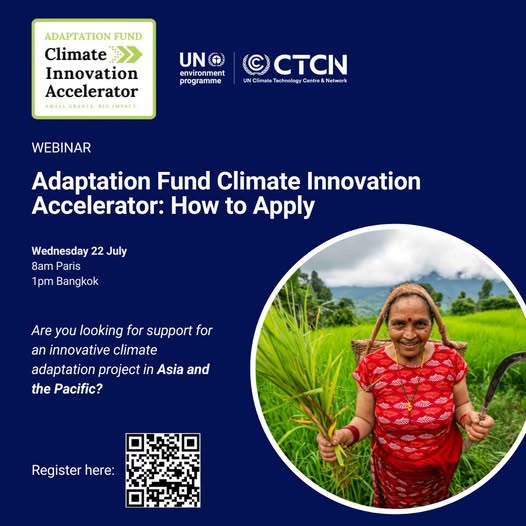
UNEP CTCN Call for Climate Adaptation Innovations in Asia Pacific with Up to USD 150,000 in Technical Assistance
Unknown

Remote Climate Consultancy Opportunity Opens: Concern Worldwide Seeks Expert to Unlock Future Climate Funding Pathways: Apply by 29 July 2026
Unknown