







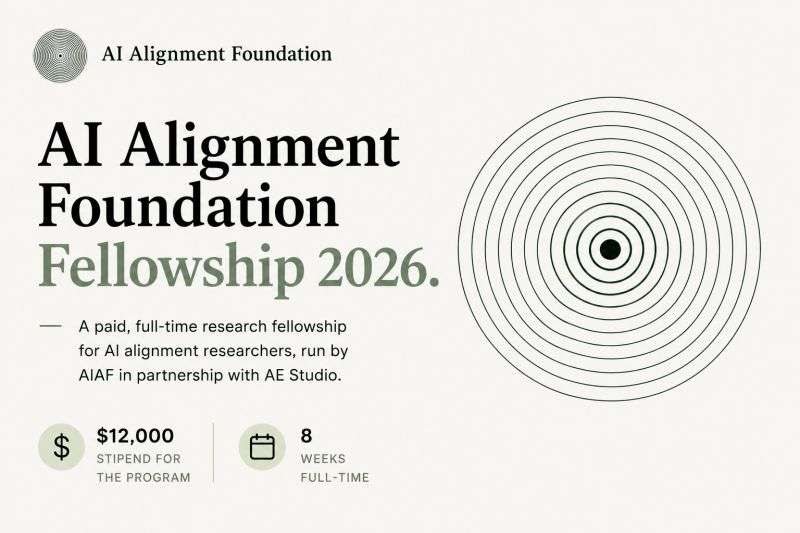
AI Alignment Research Fellowship 2026 – Intensive 8-Week Program for Technical AI Safety Research ·Intensive 8-Week Program for Technical AI Safety Research
The AI Alignment Research Fellowship (AIAF), organized in partnership with AE Studio, is a highly selective, paid, full-time research program designed for individuals passionate about advancing technical solutions to AI alignment. This fellowship offers participants the opportunity to conduct cutting-edge research at industry speed, supported by experienced mentors and research managers, while contributing to projects that directly address alignment challenges.
This article provides a detailed, SEO-optimized overview of the fellowship, covering program structure, benefits, eligibility, application requirements, deadlines, and the selection process.
1. Fellowship Overview
- Category: Fellowship
- Duration: 8 weeks, full-time (40 hours per week)
- Funding: $12,000 stipend for the entire program, paid in installments
- Format: Remote, with optional in-person participation at Demo Day in Los Angeles (travel covered)
- Compute Resources: Cloud GPU access and API credits provided per team
- Selectivity: Only 6 spots available, reviewed individually
- Program Start Date: September 8, 2026
- Application Deadline: August 17, 2026 (Anywhere on Earth time)
2. Program Structure
The fellowship is designed to replicate the speed and rigor of industry-level research. Participants will be embedded in a structured environment with multiple layers of support and mentorship.
2.1 Research Manager – Day-to-Day Support
- Each team is assigned a dedicated research manager.
- Responsibilities include:
- Weekly prioritization of tasks.
- Experiment tracking and documentation.
- Ensuring smooth workflow and progress.
- The research manager serves as the closest point of contact throughout the program.
2.2 AE Researchers – Vision and Direction
- AE Studio researchers act as visionaries for the fellowship projects.
- Fellows will:
- Discuss progress with AE researchers.
- Receive project direction and feedback.
- Align their work with broader research goals.
2.3 Midpoint Check-In – Senior Mentorship
- At the halfway mark, fellows will have a one-on-one session with senior leadership from AIAF or AE Studio.
- This session provides:
- Guidance on research direction.
- Career mentorship and prospects.
- Constructive feedback on ongoing work.
2.4 Research Outputs
- Each team works toward producing:
- A LessWrong post documenting their research.
- A reproducible paper when supported by the research outcomes.
- The program concludes with a Demo Day presentation, offered in hybrid format (remote or in-person in Los Angeles).
3. Research Focus Areas
Fellows will work on projects defined by AIAF in collaboration with AE Studio’s research team. Assignments are tailored to each fellow’s background and the cohort’s collective strengths. Current directions include:
- Modular Pretraining Enables Access Control
- Investigating modular approaches to pretraining that enhance control mechanisms in large models.
- Self-Interpretation in Language Models via Adapter Probes
- Exploring how adapter probes can enable models to interpret their own internal representations.
- Steering Resistance: Self-Correction Circuits in Large Language Models
- Studying mechanisms that allow models to resist steering attempts and self-correct behavior.
4. Fellowship Benefits
The fellowship offers more than just financial support.
- Stipend: $12,000 for the full 8-week program, paid in installments.
- Compute Budget: Cloud GPU access and API credits provided per team, ensuring no out-of-pocket costs for experiments.
- Hybrid Demo Day:
- In-person option in Los Angeles with all travel expenses covered.
- Remote participation available for those unable to attend physically.
- Research Infrastructure: Access to industry-standard tools including Linear, GitHub, Google Drive, and Slack.
- Career Support:
- AIAF collaborates with partner organizations, including AE Studio, to connect fellows with future opportunities.
- Strong fellows may be recommended for roles in partner institutions.
- Publication Opportunities:
- Teams work toward producing reproducible research outputs.
- Potential to publish papers in addition to LessWrong posts.
5. Eligibility Criteria
5.1 Strong Candidates
You are a good fit if:
- You have a strong machine learning background and can run experiments, implement papers, and debug code.
- You have spent significant time thinking about AI alignment, beyond casual reading.
- You have conducted independent research before (e.g., LessWrong posts, hackathon projects, theses, preprints).
- You can work autonomously for a week and demonstrate meaningful progress.
- You are at any career stage: recent PhDs, MSc students, self-taught researchers, or professionals transitioning into AI alignment.
5.2 Not a Good Fit If
This fellowship may not be suitable if:
- You require significant hand-holding to start new problems.
- You have never written code to run experiments.
- You are applying only for credentials without genuine interest in alignment.
- You have a rigid research agenda and are unwilling to explore new directions.
- You are focused on policy or governance aspects of alignment (this program is strictly technical).
6. Application Process
The application process is rigorous and multi-staged.
6.1 Timeline
- July 13, 2026 – Applications open.
- August 17, 2026 (AoE) – Applications close.
- August 18–29, 2026 – Interviews conducted.
- September 8, 2026 – Program begins.
6.2 Steps to Apply
- Submit Application
- Provide CV and a short questionnaire covering:
- Background.
- Current work.
- Links to relevant projects (GitHub, papers, LessWrong posts).
- Submit a short video (max 5 minutes).
- Provide CV and a short questionnaire covering:
- Short Video Requirements
- Answer two key questions:
- Why does AI alignment matter to you?
- After reading about current research directions, pick one that interests you. Provide:
- A critique of it.
- An extension idea.
- What you believe is most promising to explore next.
- Answer two key questions:
- Technical Test
- Shortlisted candidates will complete a technical test to demonstrate their skills.
- Interview
- Finalists will undergo an interview covering:
- Research background.
- Alignment thinking.
- Fit with the cohort.
- Finalists will undergo an interview covering:
Apply HERE today! Be part of a cohort shaping the future of AI safety!
7. Frequently Asked Questions (FAQ)
- Do I need to know which research area I want to work on before applying? No, assignments are made after selection based on background fit.
- Is there a hiring guarantee at the end? No, but strong fellows will be connected with partner organizations for career opportunities.
- Is the fellowship fully remote? Yes, with optional in-person participation at Demo Day.
- Can I apply if I’m not based in the US? Yes, the program is open globally. However, visa sponsorship is not provided for Demo Day.
- What if I’m still finishing a PhD or master’s? You can still apply. The program accepts candidates at various career stages.
- I’m mid-career and transitioning into AI alignment from another field. Should I apply? Yes, the fellowship welcomes career transitioners with strong technical backgrounds.
- How is the stipend paid? In installments throughout the program.
8. The Fellowship in Context – Industry vs. Academia
One of the unique aspects of the AI Alignment Research Fellowship is its industry-speed methodology. Unlike traditional academic research, which often unfolds over months or years, this fellowship compresses the cycle into eight weeks of intensive experimentation.
- Academic Research: Typically involves long timelines, peer review, and incremental progress.
- Industry Research: Focuses on rapid iteration, agile methodologies, and immediate application.
- Fellowship Approach: Combines the rigor of academia with the speed of industry, ensuring that fellows produce tangible outputs within a short timeframe.
This hybrid model prepares participants for both academic careers and industry roles, making them versatile contributors to the alignment field.
9. Global Accessibility and Diversity
The fellowship is open to applicants worldwide, making it a truly global initiative. This inclusivity ensures that diverse perspectives contribute to alignment research.
- No Geographic Restrictions: Applicants from Africa, Asia, Europe, North America, South America, and Oceania are welcome.
- Career Stage Diversity: From recent graduates to mid-career professionals, the fellowship values varied experiences.
- Interdisciplinary Backgrounds: While ML expertise is essential, applicants may come from physics, mathematics, computer science, or other technical fields.
This diversity enriches the research environment, fostering innovative approaches to alignment problems.
10. Detailed Breakdown of Application Components
To maximize chances of selection, applicants should carefully prepare each component of the application:
- Curriculum Vitae (CV)
- Highlight ML experience, coding skills, and prior research.
- Include publications, projects, and independent work.
- Questionnaire
- Provide clear, structured responses about background and current work.
- Link to GitHub repositories, papers, or blog posts.
- Short Video (5 minutes max)
- Speak clearly and concisely.
- Demonstrate genuine interest in alignment.
- Offer thoughtful critique and extension ideas for current research directions.
- Technical Test
- Expect coding challenges or experiment design tasks.
- Showcase ability to debug and implement ML experiments.
- Interview
- Prepare to discuss alignment philosophy, technical background, and collaborative skills.
11. Career Pathways After the Fellowship
While the fellowship does not guarantee employment, it provides strong career support. Graduates of the program may pursue:
- Academic Roles: PhD programs, postdoctoral positions, or faculty roles focusing on AI safety.
- Industry Positions: Research scientist roles at AI labs, startups, or tech companies.
- Independent Research: Publishing papers, contributing to open-source projects, or writing influential posts on platforms like LessWrong.
- Policy Advisory Roles: While the fellowship is technical, graduates may later contribute to policy discussions with a strong technical foundation.
The fellowship acts as a launchpad, connecting fellows with networks and opportunities that align with their career goals.
12. Long-Term Vision of AIAF and AE Studio
The partnership between AIAF and AE Studio reflects a commitment to building sustainable alignment research ecosystems.
- AIAF’s Mission: To accelerate alignment research by training and supporting emerging researchers.
- AE Studio’s Role: Providing infrastructure, mentorship, and industry expertise.
- Future Cohorts: The fellowship is expected to continue annually, expanding its reach and impact.
- Community Building: Fellows become part of a growing network of alignment researchers worldwide.
13. Tips for a Strong Application
Applicants should consider the following strategies:
- Demonstrate Technical Competence: Show coding projects, ML experiments, or published work.
- Show Genuine Interest in Alignment: Reference alignment literature, LessWrong posts, or personal reflections.
- Be Flexible: Emphasize willingness to explore diverse research directions.
- Communicate Clearly: Both in writing and in the video, clarity is key.
- Prepare for Selectivity: With only six spots, competition is intense. Stand out by combining technical skill with alignment passion.
14. Why You Should Apply
The AI Alignment Research Fellowship 2026 is more than a research program—it is an opportunity to contribute to one of the most pressing challenges of our time. With a generous stipend, world-class mentorship, and a structured environment, the fellowship empowers participants to produce meaningful research in just eight weeks.
For those serious about AI alignment, this fellowship offers:
- A chance to work on cutting-edge projects.
- Access to compute resources and infrastructure.
- Career support and networking opportunities.
- The ability to publish and present impactful work.
Deadline: August 17, 2026 (AoE) Program Start: September 8, 2026
Visit HERE to learn more about the AI Alignment Research Fellowship 2026 .
15. Conclusion
The AI Alignment Research Fellowship 2026 is a unique opportunity for researchers to immerse themselves in technical alignment work, guided by experienced mentors and supported by industry-standard infrastructure. With a generous stipend, compute resources, and career support, this fellowship is designed to accelerate research that directly contributes to solving alignment challenges.
Applications are highly competitive, with only six spots available. Interested candidates should prepare thoroughly, ensuring their application demonstrates both technical competence and genuine commitment to AI alignment.
Application Deadline: August 17, 2026 (AoE) Program Start Date: September 8, 2026
To explore and lean more about other fellowship opportunities, visit the OFY page HERE.
AI Alignment Research Fellowship 2026 – Intensive 8-Week Program for Technical AI Safety Research
@Intensive 8-Week Program for Technical AI Safety Research
Location
USA / Global
Work Mode
fellowship
Posted
1 day ago
Beware of scams! When applying for jobs, you should NEVER have to pay anything. Learn about job scams.
Get jobs in your inbox
Join over 10,000 subscribers receiving our weekly newsletter.
You might also like
Levine Impact Lab 2027 – Transformative Operational Support Grants for Environmental Organizations
Transformative Operational Support Grants for Environmental Organizations
The Earth Prize Mentors Program 2026 – A Global Call to Guide and Inspire Youth for Sustainability
A Global Call to Guide and Inspire Youth for Sustainability
GIFTS Fellowship 2026–2027: Apply for the Global Institute Fellowship for Transforming Education Systems
2027: Apply for the Global Institute Fellowship for Transforming Education Systems
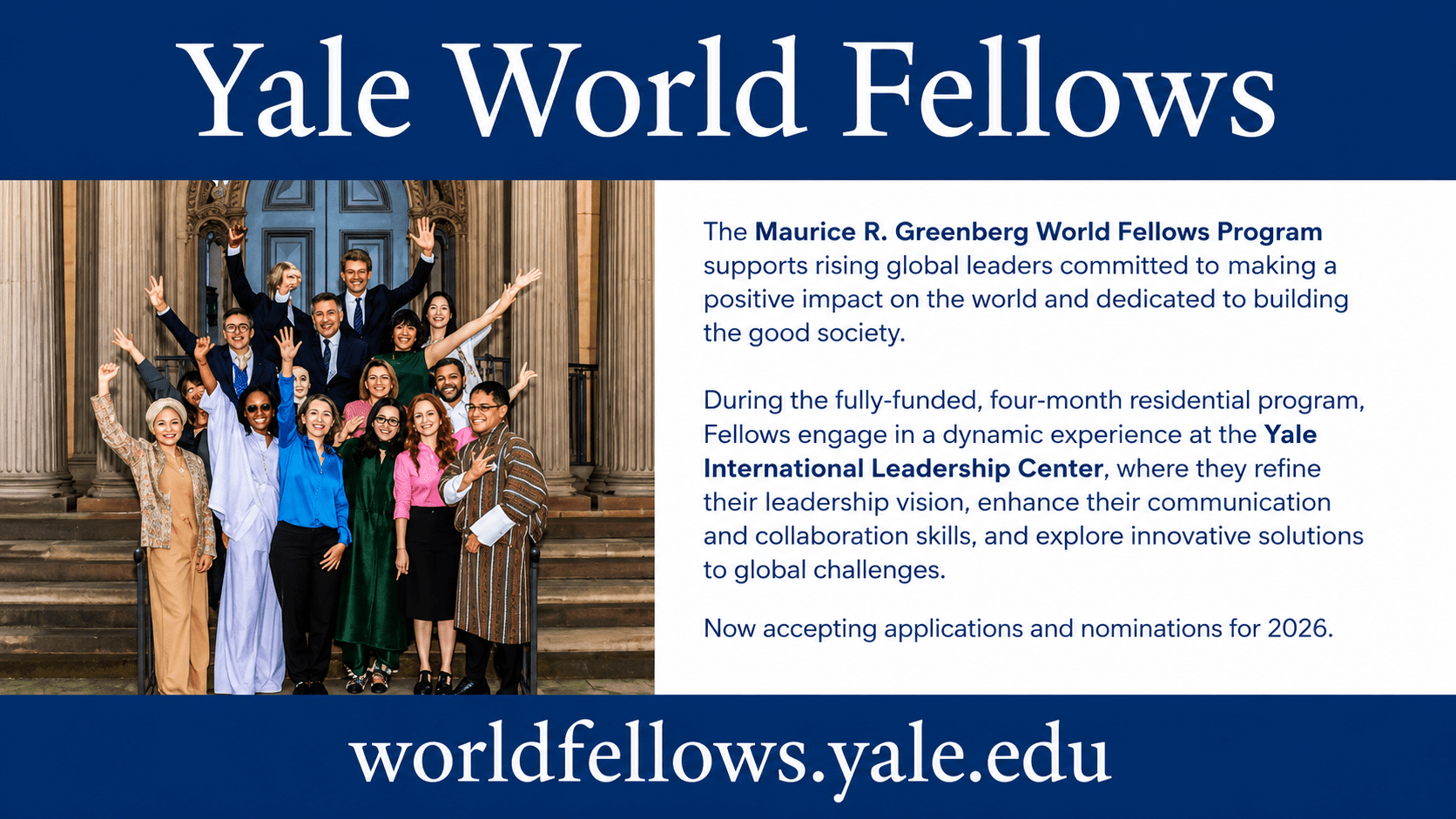
Yale Maurice R. Greenberg World Fellows Program 2027: Nominate Outstanding Global Leaders for One of Yale University’s Prestigious Leadership Programmes
Unknown
UNESCO/Japan Young Researchers’ Fellowships Programme (UNESCO/Keizo Obuchi Research Fellowships Programme)
Unknown
RMIT Vice-Chancellor’s Research Fellowships 2026: Apply for Prestigious Research Positions in Australia
Chancellor’s Research Fellowships 2026: Apply for Prestigious Research Positions in Australia