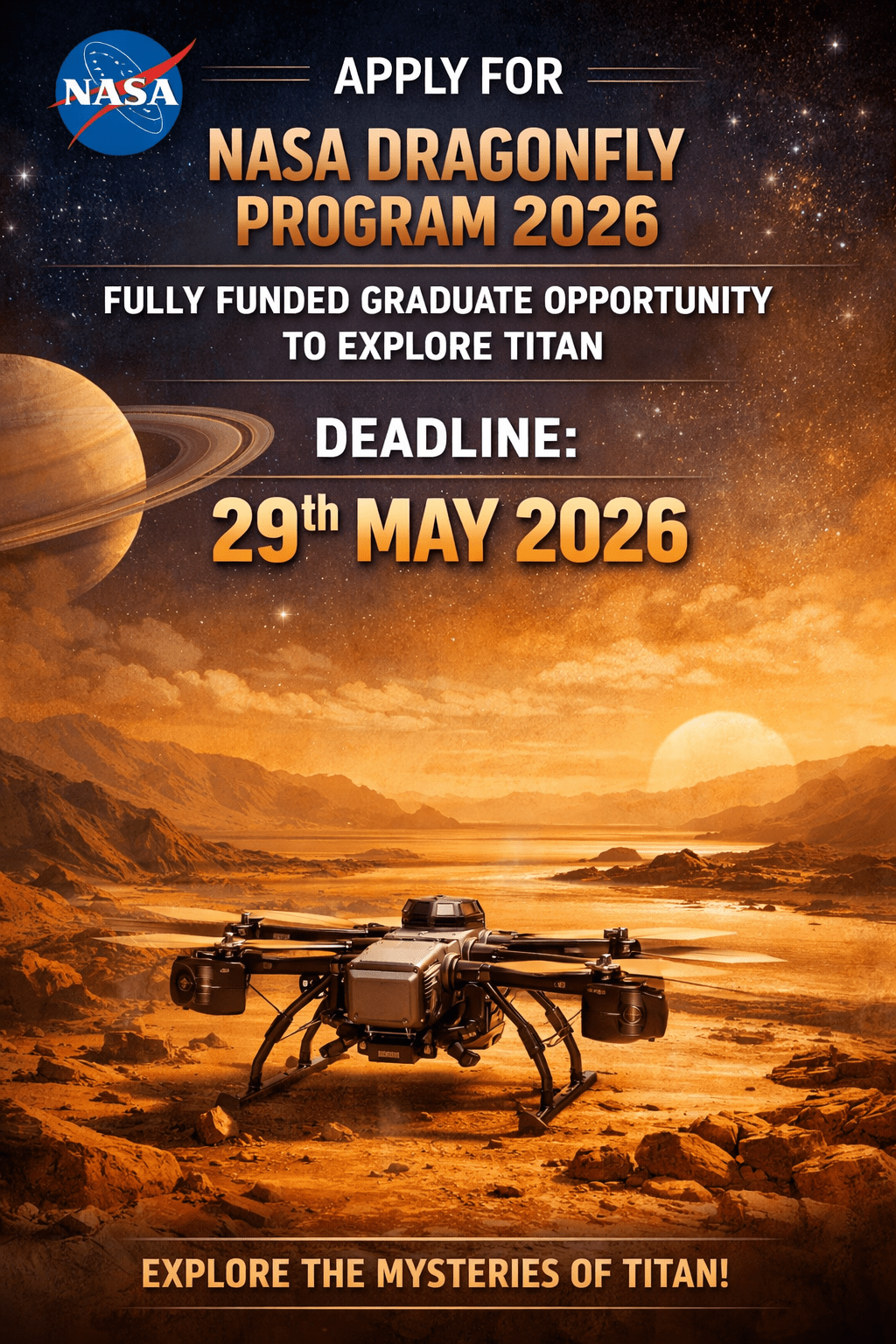
The dream of exploring another world is no longer confined to science fiction. Through the Dragonfly Student & Early Career Investigator Program, graduate students now have a rare opportunity to contribute directly to one of the most ambitious planetary missions ever conceived. Led by NASA and developed by the Johns Hopkins Applied Physics Laboratory, the Dragonfly mission is set to explore Titan—a mysterious and Earth-like world unlike any other in our solar system.
This comprehensive guide explains everything you need to know about the program, including the mission, opportunities available, eligibility requirements, application process, and detailed project tracks.
Understanding the Dragonfly Mission
Dragonfly is not just another space mission—it is a revolutionary leap in planetary exploration. The mission will send a rotorcraft lander (an octocopter drone) to Titan, Saturn’s largest moon, marking the first time such a vehicle will be used on another planetary body.
Titan is scientifically fascinating for several reasons:
- It is the only moon with a dense atmosphere
- It features a methane-based weather cycle, including clouds, rain, rivers, lakes, and seas
- Its surface contains complex organic molecules, similar to those that existed on early Earth before life began
- Beneath its icy crust lies a subsurface ocean of liquid water
Dragonfly is scheduled to launch in 2028 and arrive at Titan in 2034. During its 3.3-year mission, it will travel over 80 kilometers, hopping across the surface every Titan day (approximately 16 Earth days), making it the most mobile robotic lander ever deployed.
About the Student & Early Career Investigator Program
The Dragonfly program is designed to bring fresh perspectives into planetary science by engaging graduate students—especially those without prior experience in space missions.
What Participants Will Do
Selected students will:
- Conduct research related to Titan
- Contribute to mission science and operational planning
- Assist in developing instruments and hardware
- Participate in testing and simulations
Each student collaborates with Dragonfly mission experts and gains hands-on experience in cutting-edge space exploration.
Program Structure and Benefits
The program selects 2–4 graduate students annually for a two-year term.
Key Features
- Students dedicate 30% of their time (primarily during summer and academic breaks)
- Work is conducted at APL and/or the mentor’s institution
- Hybrid format (in-person + remote work)
Benefits Include
- Funding for travel to Dragonfly team meetings
- Support to publish and present research at scientific conferences
- Collaboration with leading scientists and engineers
- Exposure to real-world planetary mission operations
- Faculty mentors receive travel support to attend kickoff meetings
Eligibility Criteria
The program aims to broaden participation, especially among students without prior exposure to planetary science or spacecraft missions.
Basic Requirements
Applicants must:
- Be U.S. citizens
- Be enrolled in a Master’s or PhD program in:
- Physical sciences
- Biological sciences
- Computer science
- Mathematics
- Engineering
- Have a minimum GPA of 3.0
- Demonstrate ability to conduct independent research
- Possess strong communication and organizational skills
- Identify a faculty mentor willing to support them throughout the program
Students without backgrounds in planetary science, geosciences, or atmospheric science are especially encouraged to apply.
Application Requirements
Applicants must submit:
- Cover letter
- Curriculum Vitae (CV)
- Faculty advisor’s name and contact details
- A 2–3 sentence statement from the faculty advisor confirming support
Important Dates
- Application Deadline: May 29, 2026
- Selection Announcement: September 30, 2026
If you experience submission issues, documents can be emailed directly to the program contact.
Specialized Project Opportunities
In addition to the main program, Dragonfly offers Student Guest Investigator roles focused on specific technical and scientific challenges. These projects are also two-year hybrid commitments.
This project focuses on understanding how impact craters form on Titan using high-fidelity simulations.
What You’ll Do
- Model heliocentric and planetocentric impact events
- Analyze crater formation, melt volume, and surface changes
- Develop scripts using Python or MATLAB
- Work with large datasets and simulation outputs
Ideal Candidates
- Strong analytical thinkers
- Experience in coding and modeling
- Interest in planetary surface processes
This hands-on engineering project involves designing a machine to fabricate non-flight cables used in spacecraft testing.
What You’ll Do
- Study existing harness fabrication processes
- Design and build a prototype system
- Conduct testing and validation
- Collaborate with engineers and technicians
Ideal Candidates
- Background in mechanical, electrical, or software engineering
- Experience with prototyping or automation systems
- Strong problem-solving skills
This project explores how seismic waves travel through Titan’s icy crust using computational modeling.
What You’ll Do
- Run simulations using advanced modeling tools
- Analyze seismic wave propagation
- Compare Titan data with Earth, Mars, and Moon models
- Use high-performance computing systems
Ideal Candidates
- Background in physics, mathematics, or engineering
- Experience with coding and simulations
- Knowledge of calculus and wave mechanics
Faculty Mentor Requirement
All applicants must secure a faculty mentor who agrees to:
- Provide workspace and institutional support
- Participate in the Fall 2026 kickoff meeting
- Acknowledge that the project is supplementary, not a replacement for thesis research
Why This Opportunity Matters
The Dragonfly Student & Early Career Investigator Program is more than an academic experience—it is a gateway into the future of space exploration. Participants contribute directly to a mission that could reshape our understanding of how life begins in the universe.
Working on Titan offers a unique perspective on Earth’s early chemistry, making this mission one of the most important astrobiology investigations of our time.
If you are a graduate student eager to apply your STEM skills to real-world challenges and contribute to a historic mission beyond Earth, this program offers an unmatched opportunity. Whether your interests lie in simulation, engineering, or scientific analysis, Dragonfly provides a platform to turn curiosity into discovery.
This is your chance to be part of a mission that will explore one of the most Earth-like yet alien environments in our solar system—and potentially answer one of humanity’s biggest questions: how life begins.