








Call for Applications: Early-Career Researchers Invited to Review the IPCC Seventh Assessment Report AR7 Draft ·Career Researchers Invited to Review the IPCC Seventh Assessment Report AR7 Draft
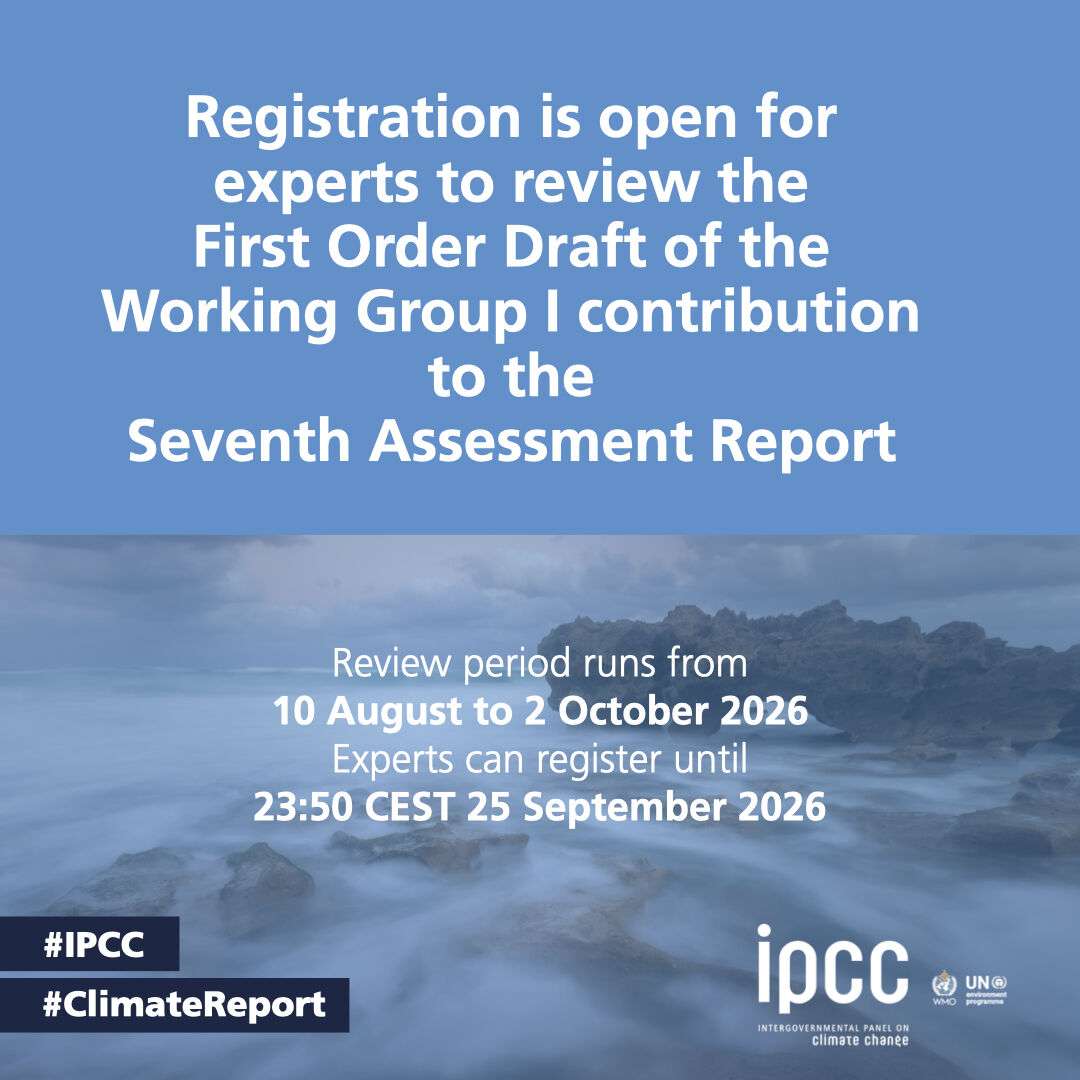
Registration is now open for experts to participate in the review of the First Order Draft of the Working Group I contribution to the Intergovernmental Panel on Climate Change Seventh Assessment Report.
The Working Group I contribution to the IPCC Seventh Assessment Report, commonly referred to as AR7, will assess the latest scientific understanding of the physical basis of climate change. It will examine observed and projected climate changes, climate-system processes and feedbacks, and regional climate information.
Researchers and professionals with relevant expertise are invited to register as expert reviewers and contribute comments during the official review period, which runs from 10 August to 2 October 2026.
The deadline to register as an expert reviewer is 25 September 2026 at 23:50 Central European Summer Time.
Although early-career researchers are encouraged to participate where their expertise is relevant, the updated call is open to qualified experts more broadly and is not limited to a coordinated early-career group-review programme.
About the IPCC Expert Review
The Intergovernmental Panel on Climate Change is the United Nations body responsible for assessing scientific knowledge related to climate change.
Rather than conducting original research, the IPCC evaluates and synthesises the existing scientific literature to provide governments and policymakers with comprehensive assessments of:
- The physical science of climate change
- Climate impacts, adaptation and vulnerability
- Climate-change mitigation
- Scientific uncertainties and knowledge gaps
- Regional and global climate risks
The Seventh Assessment Report is being developed through a structured drafting and review process involving scientists, researchers and experts from around the world.
The First Order Draft is an early version of the Working Group I report. Expert review is an essential part of the IPCC assessment process because it allows specialists to examine the draft, identify gaps or inaccuracies, recommend relevant literature and help ensure that the final report is scientifically rigorous, balanced and transparent.
This is the first of several review stages planned during the preparation of the Working Group I contribution to AR7.
What the Working Group I Report Covers
Working Group I focuses on the physical science basis of climate change.
Its contribution to the Seventh Assessment Report will assess areas including:
- Observed changes in the global climate system
- Projected future climate change
- Large-scale climate patterns and trends
- Climate processes and feedbacks
- Interactions among the atmosphere, oceans, land and cryosphere
- Regional climate information
- Climate variability
- Extreme events
- Scientific uncertainties
- Evidence from observations, modelling and paleoclimate research
Prospective reviewers should consult the official report outline before registering. The outline can help experts determine whether their academic, scientific or professional background is relevant to a particular chapter or topic.
View the Working Group I report outline:
CLICK HERE
Benefits of Participating
Participating in the IPCC expert-review process provides an opportunity to contribute directly to one of the world’s most influential climate-science assessments.
Expert reviewers can:
- Contribute specialist knowledge to the assessment process
- Examine how current climate research is represented in the draft
- Identify missing, outdated or incorrectly interpreted scientific evidence
- Recommend relevant peer-reviewed literature
- Comment on the clarity, balance and scientific accuracy of draft sections
- Gain insight into how major international climate assessments are developed
- Support the production of evidence used in global climate-policy discussions
- Strengthen their understanding of international scientific assessment processes
The review is not a conventional peer-review assignment for a single academic article. Reviewers may be assessing a large, interdisciplinary report intended to synthesise extensive bodies of scientific evidence for policymakers and other users.
Comments should therefore be precise, evidence-based and directly relevant to the text being reviewed.
Who Can Apply?
Registration is open to experts whose knowledge and experience are relevant to the Working Group I assessment.
Potential reviewers may include:
- University researchers
- Independent scientists
- Government researchers
- Specialists from research institutes
- Climate-modelling experts
- Earth-system scientists
- Meteorologists
- Oceanographers
- Cryosphere and polar researchers
- Atmospheric scientists
- Paleoclimate researchers
- Regional climate specialists
- Professionals with relevant technical expertise
- Advanced early-career researchers familiar with current scientific literature
Early-career researchers may register where they possess sufficient expertise to provide substantive comments on the draft. However, applicants should not interpret the updated call as being restricted to master’s students, doctoral candidates, postdoctoral researchers or scientists within a specified number of years after completing a PhD.
The key consideration is whether the reviewer has suitable expertise in topics covered by the Working Group I report.
Prospective reviewers should review the official outline carefully before registering. A title, degree or general interest in climate change is not, by itself, a substitute for relevant knowledge of the scientific literature.
Review Process and Time Commitment
The official expert-review period runs from:
10 August to 2 October 2026
Registered experts will review the First Order Draft and submit comments through the IPCC’s designated review system.
The exact time required will depend on:
- The number of chapters or sections reviewed
- The reviewer’s area of expertise
- The technical complexity of the material
- The amount of supporting literature examined
- The number and detail of comments submitted
Reviewers should allow sufficient time to read the relevant sections carefully, check references and prepare constructive comments.
Strong review comments should:
- Identify the specific chapter, section, paragraph or statement concerned.
- Explain the scientific issue clearly.
- Provide supporting reasoning or evidence.
- Recommend a correction, clarification or relevant source where appropriate.
- Remain professional, concise and focused on improving the report.
The IPCC has also published a mini guide to help expert reviewers understand the process and prepare useful comments.
Read the Mini Guide for Expert Reviewers:
CLICK HERE
Organizations Coordinating the Initiative
The review is part of the formal preparation of the Working Group I contribution to the IPCC Seventh Assessment Report.
The Intergovernmental Panel on Climate Change oversees the global assessment process, while Working Group I is responsible for evaluating the physical science basis of climate change.
The updated registration call is therefore broader than the earlier coordinated early-career initiative led by scientific networks. Researchers who previously encountered information about an APECS-led group review should rely on the current IPCC registration details and deadlines when seeking to participate in the official expert review.
Experts remain responsible for ensuring that participation is consistent with any requirements imposed by their employer, university, research funder, government or institution.
Application Deadline
The deadline to register as an expert reviewer is:
25 September 2026 at 23:50 CEST
The First Order Draft review itself closes on:
2 October 2026
Because registration remains open only shortly before the end of the review period, interested experts should register as early as possible. Waiting until the registration deadline may leave insufficient time to examine the draft and prepare thoughtful, evidence-based comments.
International applicants should carefully convert the deadline from Central European Summer Time to their local time zone.
How to Apply
Interested experts must register through the official expert-review registration portal.
Before registering, prospective reviewers should:
- Consult the Working Group I report outline.
- Identify the chapters or topics most closely aligned with their expertise.
- Confirm that they can participate during the review period.
- Review the expert-review guidance.
- Complete the official registration process.
- Follow the instructions provided for accessing and reviewing the draft.
Register as an expert reviewer:
APPLY HERE
Read the full IPCC press release:
CLICK HERE
Conclusion
The expert review of the First Order Draft of the Working Group I contribution to the IPCC Seventh Assessment Report offers qualified researchers and professionals an important opportunity to strengthen the global assessment of climate science.
Working Group I will examine the latest evidence concerning observed and projected climate change, climate-system processes, feedbacks and regional climate information. Through the expert-review process, specialists can identify scientific gaps, propose corrections and help ensure that the final assessment accurately reflects the available evidence.
The review period runs from 10 August to 2 October 2026, while expert registration closes on 25 September 2026 at 23:50 CEST.
Researchers should consult the official report outline and expert-review guide before registering to ensure that their expertise is relevant and that they can submit a substantive review before the process closes.
Click here for more details about the call for applications.
Discover more of opportunities here.
Call for Applications: Early-Career Researchers Invited to Review the IPCC Seventh Assessment Report AR7 Draft
@Career Researchers Invited to Review the IPCC Seventh Assessment Report AR7 Draft
Location
USA / Global
Work Mode
jobs
Posted
about 3 hours ago
Beware of scams! When applying for jobs, you should NEVER have to pay anything. Learn about job scams.
Get jobs in your inbox
Join over 10,000 subscribers receiving our weekly newsletter.
You might also like

Call for Applications: Regional Coordinators
Unknown
Call for Applications: VACE Project Supports Agri-Food SMEs to Develop New Ginger and Tomato Products in Nigeria (2026)
Food SMEs to Develop New Ginger and Tomato Products in Nigeria (2026)
The Josef Korbel School of Global & Public Affairs at the University of Denver is Recruiting for a Postdoctoral Research Fellow: Apply by 18 August 2026
the University of Denver is Recruiting for a Postdoctoral Research Fellow: Apply by 18 August 2026

Embassy of Ireland in Pretoria Hiring Public Diplomacy and Information Officer – Applications Open Until 31 July 2026
Applications Open Until 31 July 2026

African Youth Co Creators Council Member
United Nations Development Programme (UNDP)

Various Professional Roles in Landscape Restoration and Conservation
Eden: People+Planet