








Fall 2026 Fulcrum Journalism Fellowship Opens Applications for U.S. Journalism Students with $1,000 Stipend ·Unknown
Applications are now open for the Fall 2026 Fulcrum Fellowship, a paid journalism training and mentorship opportunity created for undergraduate and graduate journalism students studying in the United States.
The fellowship is designed to help emerging reporters develop stronger skills in solutions-focused journalism, narrative complexity, civic reporting, climate solutions journalism, and community-centered storytelling. Selected fellows will receive practical training, editorial mentorship, opportunities to produce and publish original journalism, and a $1,000 stipend after successfully completing the program.
The Fall 2026 cohort will run from September 14 to October 20, 2026. Applications must be submitted by August 3, 2026. The official announcement does not specify a deadline time or timezone, so applicants should avoid waiting until the final day to submit their materials.
Fall 2026 Fulcrum Fellowship at a Glance
- Program name: Fall 2026 Fulcrum Fellowship
- Organizing publication: The Fulcrum
- Program initiative: The Fulcrum NextGen
- Fellowship period: September 14 to October 20, 2026
- Application deadline: August 3, 2026
- Financial support: $1,000 stipend upon completion
- Eligible academic levels: Undergraduate and graduate students
- Required field: Journalism
- Geographical eligibility: Students studying in the United States
- Academic requirement: Good academic standing
- Main training areas: Solutions journalism, narrative complexity, civic storytelling, community-centered reporting and climate solutions journalism
- Application method: Submission by email
- Publication opportunities: Original reporting may be published by The Fulcrum and the Latino News Network
What Is the Fall 2026 Fulcrum Fellowship?
The Fulcrum Fellowship is a journalism development program intended to support and train emerging reporters who want to move beyond simplistic, divisive or highly polarized news narratives.
Rather than teaching fellows to report only on problems, conflict or institutional failures, the program introduces them to approaches that examine how individuals, communities and organizations are responding to public challenges. The purpose is not to avoid difficult subjects, but to report on those subjects with greater depth, evidence, context and human understanding.
The Fall 2026 program will focus particularly on solutions-oriented reporting and the practice of “complicating the narrative.” This approach encourages reporters to look beyond two-sided political or social arguments and examine the experiences, motivations, contradictions and perspectives that are often missing from conventional reporting.
Through these methods, fellows will learn how to produce journalism that presents communities as active participants in public life rather than merely as subjects affected by problems.
The fellowship is part of The Fulcrum’s broader NextGen initiative, which seeks to increase opportunities for student journalists and strengthen youth participation in reporting about democracy, public policy, civic engagement and community renewal.
First Fall Cohort of the Fulcrum Fellowship
The 2026 program represents the first time that The Fulcrum is extending its fellowship program into the fall season.
The expansion has been made possible through financial support from the Hortencia Zavala Foundation. The addition of a fall cohort creates another entry point for journalism students who may not have been able to participate in previous program cycles.
The fall fellowship builds upon the experience of earlier cohorts and The Fulcrum’s ongoing work with student journalists. Previous initiatives have focused on preparing young reporters to cover complex social and political issues while avoiding narratives that reinforce polarization or reduce communities to stereotypes.
By expanding the program, The Fulcrum aims to support more emerging journalists and strengthen the pipeline of reporters capable of producing responsible, constructive and community-focused public-interest journalism.
Fellowship Dates and Program Duration
The Fall 2026 Fulcrum Fellowship will take place from:
September 14 to October 20, 2026
This means the program will operate for approximately six weeks.
The announcement does not provide a detailed weekly schedule, session timetable or expected number of hours that fellows must contribute. Applicants with university classes, employment or other obligations should request clarification from the organizers if scheduling information is necessary before they apply.
The relatively concentrated program period is expected to combine training, mentorship, reporting and the preparation of an original journalistic story.
Main Objectives of the Fellowship
The Fall Fulcrum Fellowship is intended to help participants:
- Develop practical skills in solutions-focused journalism.
- Understand how to report on complex political, civic and social issues without relying on oversimplified narratives.
- Produce original, evidence-based and community-centered reporting.
- Improve interviewing, research, writing and narrative-development skills.
- Explore how communities are responding to challenges affecting democracy and civic life.
- Receive professional guidance from experienced editors and journalism trainers.
- Build a stronger portfolio through potential publication.
- Develop experience in climate solutions journalism.
- Report more effectively across political, cultural and social differences.
- Prepare for future careers in newsrooms, nonprofit media, public-interest journalism and civic communication.
Training in Solutions Journalism
Solutions journalism is one of the central components of the fellowship.
Under this approach, journalists investigate responses to social, environmental, political or economic problems. Reporting does not simply celebrate positive initiatives or promote organizations. Instead, it examines how a response works, what evidence supports it, what limitations it faces and whether lessons can be drawn from it.
Fellows will be encouraged to look beyond descriptions of problems and investigate questions such as:
- Who is responding to the problem?
- What strategy or intervention is being used?
- What evidence shows whether the response is working?
- What challenges or limitations remain?
- Can the response provide lessons for other communities?
- Which voices are usually excluded from reporting on the issue?
- How can the story avoid exaggeration while still identifying meaningful progress?
This training can help journalism students produce stories that are more informative and useful to communities while maintaining professional standards of verification and independence.
Learning to “Complicate the Narrative”
The program will also train participants in techniques commonly described as “complicating the narrative.”
Traditional reporting frequently presents difficult public issues as conflicts between two opposing sides. Although this format can make a story appear simple, it may overlook important perspectives, internal disagreements, personal experiences and areas of common ground.
Complicating the narrative involves asking deeper questions and recognizing that people’s beliefs and experiences do not always fit neatly into fixed political, cultural or social categories.
For emerging journalists, this can involve:
- Interviewing people with different experiences and perspectives.
- Avoiding assumptions about communities or political groups.
- Exploring why individuals hold particular views.
- Identifying contradictions and changes in people’s opinions.
- Examining areas of agreement that may exist alongside disagreement.
- Including community voices that are often ignored.
- Reporting on people as individuals rather than political labels.
- Avoiding language that unnecessarily intensifies division.
These skills can be particularly valuable when covering elections, public policy, immigration, education, climate change, local government, social inequality and other sensitive issues.
Climate Solutions Journalism Component
The Fall 2026 fellowship will include a climate solutions journalism component supported through sponsorship from the Solutions Journalism Network.
Participants will receive training in reporting on responses to climate-related challenges and will produce an original story applying the methods introduced during the program.
Climate journalism often focuses on disasters, environmental damage and scientific warnings. These issues remain essential, but solutions-focused reporting can also investigate how communities, institutions, researchers, businesses or governments are attempting to address climate risks.
Potential reporting areas may include local climate adaptation, clean energy, sustainable transportation, water management, environmental justice, disaster preparedness, conservation, resilient infrastructure or community-led environmental initiatives.
The fellowship announcement does not assign a specific climate topic in advance. Participants should therefore be prepared to identify, research and report an appropriate story in consultation with the program’s editors and mentors.
Mentorship and Editorial Support
Fellows will receive mentorship from members of the publication’s editorial team.
Editorial mentorship is an important element of the program because it gives students an opportunity to develop their work with guidance from professionals who understand reporting, story development, verification, structure and publication standards.
Depending on the needs of each story, mentorship may help fellows strengthen areas such as:
- Developing a clear and reportable story idea.
- Identifying relevant sources.
- Preparing effective interview questions.
- Examining evidence behind proposed solutions.
- Organizing complex information.
- Improving narrative flow.
- Distinguishing reporting from advocacy.
- Revising drafts in response to editorial feedback.
- Producing publication-ready journalism.
The fellowship is led by Hugo Balta, publisher of the Latino News Network and executive editor of The Fulcrum. He is also an accredited solutions-journalism trainer with the Solutions Journalism Network and has previously served twice as president of the National Association of Hispanic Journalists.
Opportunity to Publish Original Reporting
Participants will have opportunities to produce and publish original journalism during the fellowship.
The announcement states that fellows may have their work published through The Fulcrum. Their reporting may also appear on the Latino News Network, potentially allowing their stories to reach audiences interested in democracy, civic participation, public policy and community renewal.
Publication can provide substantial professional value for journalism students. A published, professionally edited article can become part of a fellow’s reporting portfolio and may support future applications for internships, newsroom positions, graduate programs or additional fellowships.
Applicants should understand that the opportunity is based on producing work that meets editorial and program requirements. The announcement does not guarantee that every draft will automatically be published without review or revision.
$1,000 Fellowship Stipend
Each fellow who completes the Fall 2026 program will receive a $1,000 stipend.
The wording of the announcement indicates that payment is connected to completion of the fellowship. Participants should therefore be prepared to attend the required sessions, participate in the training process, work with mentors and complete the expected reporting assignment.
The announcement does not provide further information about:
- The exact stipend payment date.
- Whether payment will be made in one installment.
- Tax treatment of the stipend.
- Whether any additional reporting expenses will be reimbursed.
- Whether fellows must provide specific tax or payment documentation.
Applicants who require clarification regarding these financial arrangements should contact the fellowship organizers directly before accepting an offer.
Who Is Eligible to Apply?
The fellowship is open to:
- Undergraduate journalism students studying in the United States.
- Graduate journalism students studying in the United States.
- Students who are in good academic standing.
The announcement does not mention a minimum grade-point average, age limit, graduation year, citizenship requirement or racial or ethnic restriction.
It also does not clarify whether applicants must be enrolled in a degree formally titled “Journalism” or whether students in closely related fields such as communications, media studies or digital media will be considered.
Students in related academic programs should contact the organizers for confirmation rather than assuming that they meet the field-of-study requirement.
Application Documents Required
Applicants must prepare the following four materials:
- Current Résumé
The résumé should provide an updated overview of the applicant’s education, journalism experience, employment, internships, campus activities, volunteer work, technical abilities and relevant achievements.
Students may include experience such as:
- Reporting for a university newspaper.
- Producing content for radio, television or digital media.
- Freelance writing.
- Podcasting.
- Documentary or multimedia production.
- Photography or video journalism.
- Community reporting.
- Journalism-related coursework.
- Research projects.
- Civic or public-policy engagement.
Applicants should ensure that their contact information, educational status and experience are accurate and current.
- Examples of Published or Academic Work
Applicants must submit examples of their work. These may include published journalism or relevant academic assignments.
Suitable examples could include:
- News articles.
- Feature stories.
- Investigative reports.
- Multimedia journalism.
- Audio or video reports.
- University newspaper contributions.
- Class reporting assignments.
- Research-based academic writing.
- Community or civic reporting.
Applicants should select samples that demonstrate clear writing, research ability, accuracy, curiosity and an understanding of journalistic storytelling.
The announcement does not specify the number, length or preferred format of the samples. Applicants should therefore submit a focused selection of their strongest and most relevant work rather than sending an excessive number of documents.
- Cover Letter
A cover letter must explain how participating in the fellowship would support the applicant’s professional and journalistic growth.
A strong letter should directly address:
- The applicant’s interest in journalism.
- Relevant academic or reporting experience.
- Interest in solutions-focused reporting.
- Professional skills the applicant hopes to develop.
- Interest in democracy, civic engagement, public policy, community reporting or climate solutions.
- How mentorship and publication experience would support future goals.
- What perspective or experience the applicant would contribute to the cohort.
The cover letter should be tailored specifically to the Fall Fulcrum Fellowship rather than using a generic internship or employment letter.
- One Letter of Recommendation
Applicants must provide one recommendation letter.
The announcement does not state who must write the recommendation. A suitable recommender may therefore be a journalism professor, academic adviser, editor, newsroom supervisor or another individual familiar with the applicant’s academic work, reporting ability and professional conduct.
Applicants should approach their recommender early and provide sufficient time for the letter to be completed before the August 3 deadline.
How to Apply for the Fall 2026 Fulcrum Fellowship
There is no separate online application form mentioned in the announcement. Applications must be submitted by email. Click HERE.
Follow these steps:
- Prepare an updated résumé.
- Select examples of published or academic work.
- Write a tailored cover letter explaining how the fellowship will support your growth.
- Obtain one letter of recommendation.
- Review all documents for accuracy and completeness.
- Attach the materials to an email.
- Use the required subject line: Fall Fulcrum Fellowship application
- Send the complete application to newsroom@fulcrum.us
- Submit the application no later than August 3, 2026.
Applicants should confirm that all attachments open correctly and use clearly identifiable filenames, preferably including the applicant’s name and the document type.
For example:
- Firstname-Lastname-Resume.pdf
- Firstname-Lastname-Cover-Letter.pdf
- Firstname-Lastname-Writing-Samples.pdf
- Firstname-Lastname-Recommendation.pdf
All application requirements and the required email subject line should be followed exactly.
Important Dates
Application Deadline
August 3, 2026
No submission time or timezone is included in the announcement. Early submission is therefore strongly recommended.
Fellowship Start Date
September 14, 2026
Fellowship End Date
October 20, 2026
Applicants should ensure that they will be available throughout the program period before submitting an application.
Why Journalism Students Should Consider Applying
The Fall 2026 Fulcrum Fellowship offers more than a financial stipend. It provides emerging journalists with an opportunity to develop reporting skills that are increasingly relevant in a divided and rapidly changing media environment.
Participants can benefit from:
- Professional journalism training.
- Direct editorial mentorship.
- Experience producing an original reported story.
- Exposure to solutions journalism methods.
- Training in climate solutions reporting.
- Opportunities for publication.
- Portfolio development.
- Experience covering civic and community issues.
- A stronger understanding of narrative complexity.
- A $1,000 completion stipend.
The program may be especially valuable for students who want to report on democracy, public policy, climate challenges, civic participation and local community responses while avoiding superficial or unnecessarily polarized narratives.
Tips for Preparing a Competitive Application
Applicants should consider the following practical measures:
- Follow every instruction carefully. Missing documents or using an incorrect email subject line may weaken an otherwise strong application.
- Select relevant work samples. Submit pieces that demonstrate reporting, research, interviewing or evidence-based storytelling.
- Write a specific cover letter. Explain precisely how the fellowship connects to your experience and future journalism goals.
- Demonstrate curiosity about communities. The fellowship emphasizes human-centered and community-focused reporting.
- Show openness to editorial feedback. Mentorship and revision are central to professional journalism development.
- Mention relevant interests. Experience or interest in civic affairs, democracy, public policy, climate reporting or solutions journalism can strengthen the application when presented honestly.
- Contact a recommender immediately. Recommendation letters frequently require more time than applicants expect.
- Proofread the complete submission. Check names, dates, links, attachments, formatting and contact details.
- Apply before the deadline. The official announcement specifically encourages interested students to apply early.
Conclusion
The Fall 2026 Fulcrum Fellowship is a valuable paid opportunity for undergraduate and graduate journalism students in the United States who want to strengthen their reporting, writing and storytelling abilities.
Through training in solutions journalism, narrative complexity, climate reporting and community-centered storytelling, participants will gain practical tools for covering difficult public issues with greater evidence, depth and accuracy. Fellows will also receive professional mentorship, produce original reporting, gain potential publication exposure through The Fulcrum and the Latino News Network, and receive a $1,000 stipend after completing the program.
Eligible journalism students should begin preparing their résumé, work samples, cover letter and recommendation letter as soon as possible. Complete applications must be emailed to newsroom@fulcrum.us with the subject line “Fall Fulcrum Fellowship application” by August 3, 2026.
For more global opportunities, click HERE.
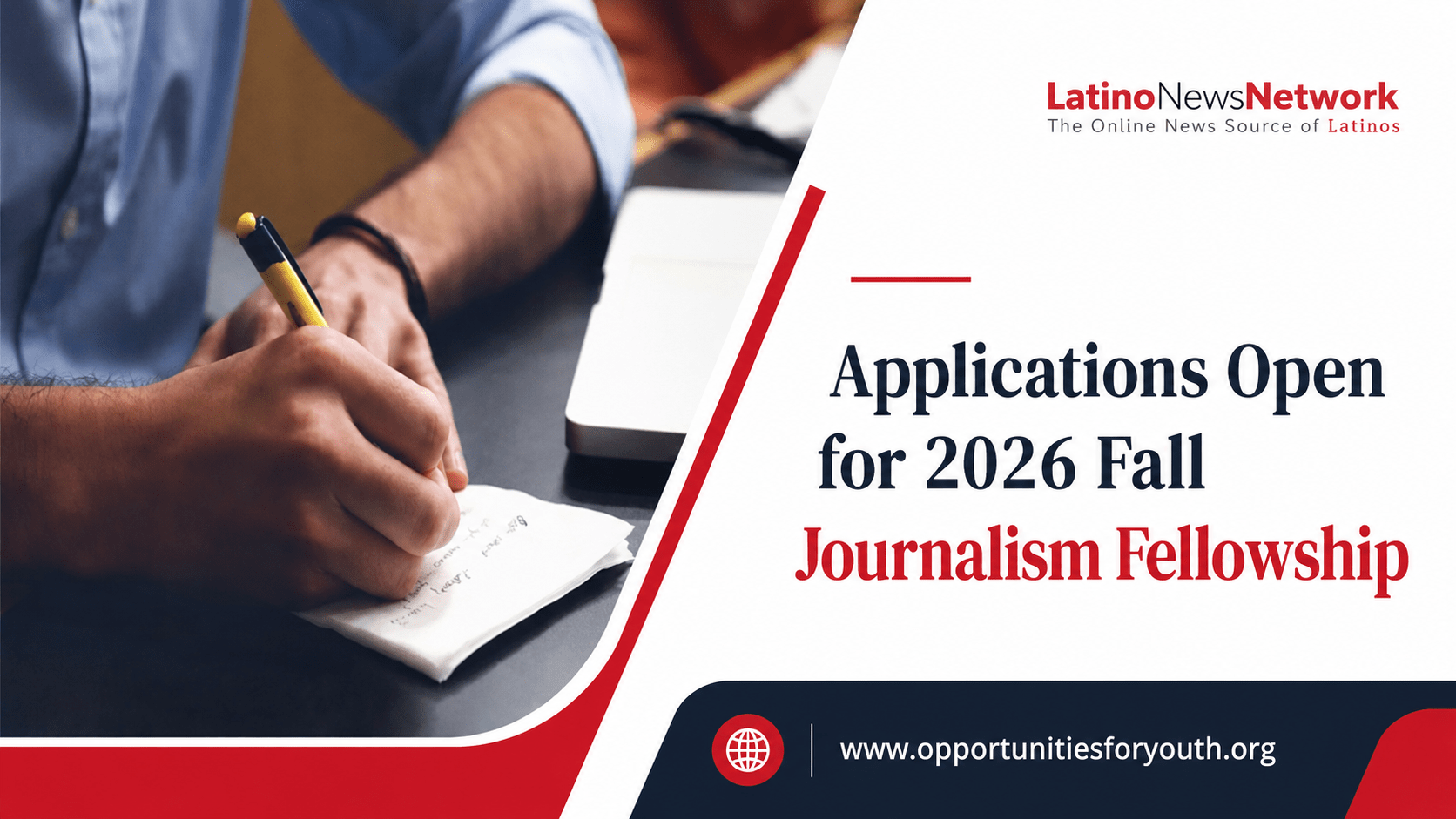
Fall 2026 Fulcrum Journalism Fellowship Opens Applications for U.S. Journalism Students with $1,000 Stipend
@Unknown
Location
USA / Global
Work Mode
fellowship
Posted
about 5 hours ago
Beware of scams! When applying for jobs, you should NEVER have to pay anything. Learn about job scams.
Get jobs in your inbox
Join over 10,000 subscribers receiving our weekly newsletter.
You might also like
Social Video & Design Fellow
Unknown
Influencer & Community Engagement Fellow
Unknown
Encore Fellowships in the United States | $25,000 Paid Fellowship for Experienced Professionals
Unknown

Institute for Youth in Policy Public Policy Fellowship 2026 (Fall Cohort): Apply for a Selective U.S. Leadership Programme in Public Policy, Research & Civic Engagement
Unknown
Levine Impact Lab 2027 – Transformative Operational Support Grants for Environmental Organizations
Transformative Operational Support Grants for Environmental Organizations
The Earth Prize Mentors Program 2026 – A Global Call to Guide and Inspire Youth for Sustainability
A Global Call to Guide and Inspire Youth for Sustainability