








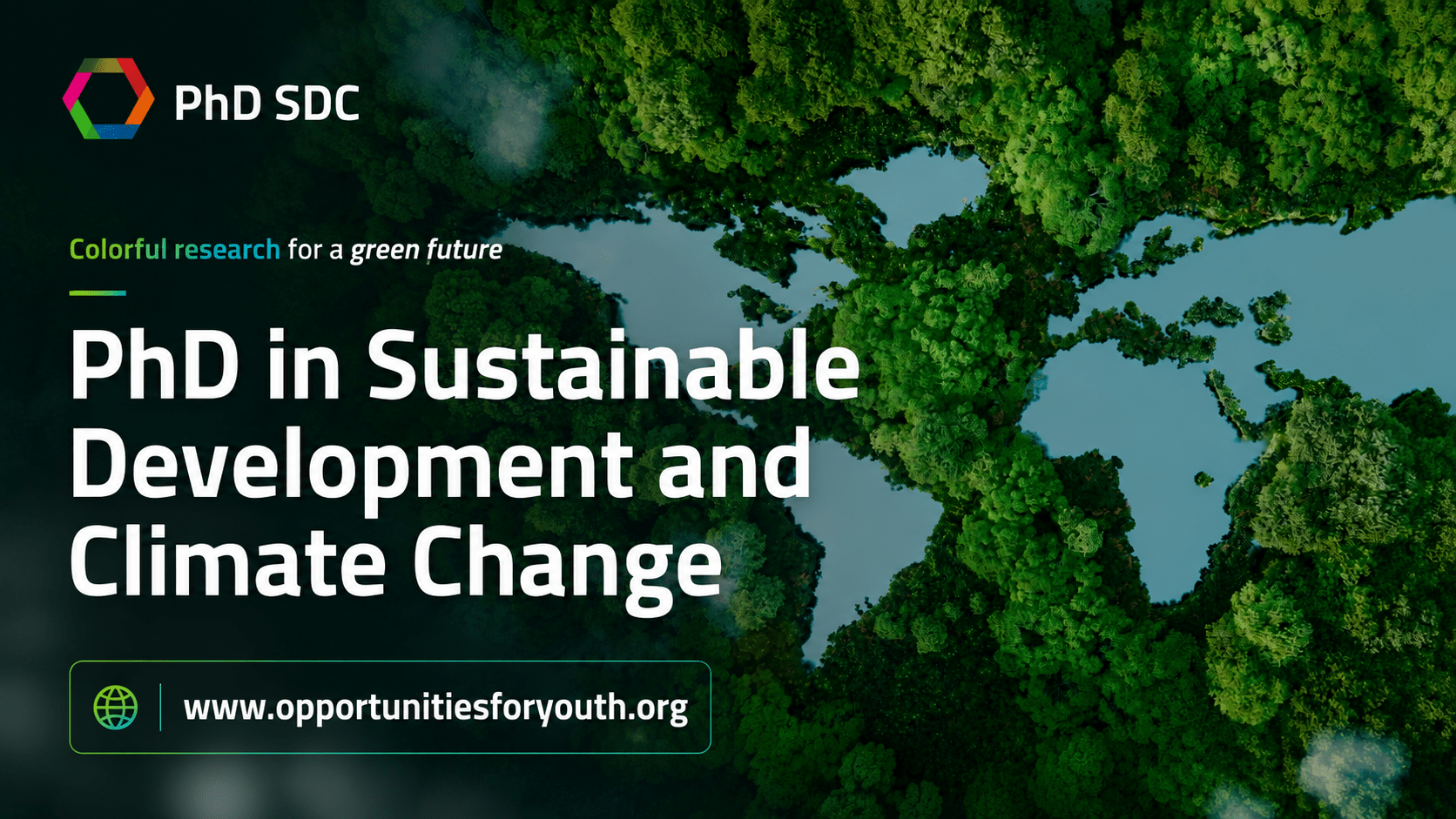
Fully Funded PhD in Sustainable Development and Climate Change 2026–2027 in Italy: 35 Scholarships Available Through IUSS Pavia ·2027 in Italy: 35 Scholarships Available Through IUSS Pavia
Applications are now open for the 42nd Cycle of the National PhD Programme in Sustainable Development and Climate Change for the 2026–2027 academic year.
Coordinated by the Scuola Universitaria Superiore IUSS Pavia in Italy, this three-year doctoral programme brings together universities, public research institutions, professors, researchers and specialized research groups from across Italy. It is designed to train a new generation of researchers, experts and decision-makers capable of addressing the interconnected challenges of climate change, sustainability, technological transition, economic development, health, environmental protection and social transformation.
A total of 35 funded PhD positions are available under the 2026 call. Each position is linked to a specific research project and host institution, meaning applicants must carefully examine the available research topics before choosing the project or projects that best match their academic background, research experience and professional interests.
The application deadline is:
August 26, 2026, at 1:00 p.m. Central European Summer Time
Applications must be completed exclusively through the official online PICA application platform. A non-refundable application fee of €30 must also be paid before the deadline.
About the National PhD Programme in Sustainable Development and Climate Change
The National PhD Programme in Sustainable Development and Climate Change, commonly referred to as PhD-SDC, is an interdisciplinary doctoral programme established to prepare researchers to respond to some of the most complex environmental and societal challenges facing the world.
Rather than treating climate change as an isolated scientific issue, the programme studies the relationships among:
- Climate systems and environmental change;
- Human health and well-being;
- Biodiversity and ecosystems;
- Availability of natural resources;
- Food and water security;
- Technological development;
- Energy transition;
- Migration and human rights;
- Economic and social development;
- Territorial vulnerability;
- Institutions and public policy;
- Sustainable production and consumption;
- Quality of life for present and future generations.
The programme seeks to move beyond traditional single-discipline doctoral education. Its structure combines different scientific languages, research methods and academic disciplines so that doctoral candidates can develop solutions that reflect the complex nature of sustainable development and climate change.
Programme Duration and Language
The PhD programme lasts three years and is taught primarily in English.
All multidisciplinary and curriculum-level educational activities, together with most specialized courses, are conducted in English. The final doctoral thesis must also be written in English.
Candidates are expected to possess a good working knowledge of English. However, a formal English-language certificate is not necessarily required when submitting the application. Successful candidates must obtain a recognized B2-level English-language certificate by October 31, 2027, which is the end of the programme’s first academic year.
Number of Funded PhD Positions
The 2026 call provides 35 PhD positions.
The number may be increased before the programme begins where additional funding becomes available.
Each funded position is connected to:
- A specific research topic;
- A designated host university or research institution;
- One of the programme’s three curricula;
- A research supervisor or reference person;
- Defined research objectives and expected outputs;
- In some cases, a mandatory internship or external placement.
Candidates are not applying for a general, unrestricted PhD position. They must indicate interest in specific research topics, and their research proposal must be prepared around the topic selected as their first preference.
Applicants may be considered only for topics for which the selection committee determines that they possess the necessary academic knowledge, skills and research potential.
Three Research Curricula
The 42nd Cycle of the programme is organized into three broad but interconnected research curricula.
- CU Alpha – One Health: Earth System and Human Life
This curriculum examines the relationship between the Earth’s systems, ecosystems, biodiversity, climate change, human activity, health and well-being.
Research under this curriculum may address areas such as:
- Atmospheric and climate modelling;
- Climate extremes;
- Environmental and human health;
- Ecosystem resilience;
- Biodiversity;
- Earth observation;
- Food and water systems;
- Climate-related health risks;
- Interactions between environmental conditions and human life;
- Planetary health and One Health approaches.
The curriculum is particularly relevant to candidates with backgrounds in environmental science, climate science, Earth science, biology, ecology, medicine, health sciences, agriculture, atmospheric science, environmental engineering or related fields.
- CU Beta – Human Society: Socio-Economic Impacts, Institutions and Theories
This curriculum examines how climate change and sustainability affect communities, institutions, economies, policies and social systems.
Research may focus on:
- Climate-related social and economic risks;
- Environmental policy and governance;
- Sustainable economic models;
- Institutional responses to climate change;
- Social vulnerability;
- Public decision-making;
- Climate adaptation and resilience;
- Sustainable mobility;
- Disaster risk and recovery;
- Urban systems;
- Inequality, justice and migration;
- Behavioural and policy responses under uncertainty.
It may be suitable for candidates in economics, public policy, sociology, political science, international relations, law, governance, development studies, geography, urban planning, disaster management and other social-science disciplines.
- CU Gamma – Technology and Territory: Sustainable Strategies and Solutions for the Transition
This curriculum focuses on technological, engineering, territorial and industrial solutions that can support the transition toward climate-resilient and sustainable societies.
Potential research areas include:
- Renewable energy;
- Building decarbonization;
- Artificial intelligence and sustainability;
- Remote sensing;
- Life-cycle assessment;
- Circular economy;
- Precision agriculture;
- Sustainable food systems;
- Smart and resilient cities;
- Internet of Things technologies;
- Water-resource management;
- Sustainable materials;
- Offshore energy;
- Geothermal resources;
- Sustainable industrial processes;
- Climate-resilient infrastructure.
The curriculum is particularly relevant to candidates in engineering, computer science, energy systems, environmental technology, architecture, agriculture, industrial ecology, materials science, urban planning and related disciplines.
Examples of Research Topics Available in 2026
The complete 2026 research-topic catalogue includes projects covering environmental science, health, economics, public policy, technology, agriculture, energy, artificial intelligence, infrastructure and territorial development.
Examples listed on the official research-topic platform include:
- Lunar infrared observations of the Earth for climate and weather research;
- Climate-smart weed control and microbial biostimulants;
- Global and regional climate modelling;
- Remote sensing and hydrological modelling;
- Life-cycle assessment of biological solutions;
- Artificial intelligence-driven life-cycle assessment;
- Sustainable crop protection;
- Offshore renewable-energy systems;
- Sustainable nutraceutical systems;
- Tropical crop management under climate change;
- Building-sector decarbonization;
- Geothermal energy, carbon capture and critical raw materials;
- Artificial intelligence and Internet of Things solutions for climate-resilient environments;
- Plant adaptation to changing environmental conditions;
- Functional foods and circular-economy models;
- Urban water-footprint reduction;
- Decision-making under deep uncertainty;
- Social impacts of earthquake-related power outages;
- Alpine flood resilience;
- Sustainable transport and mobility.
Applicants must read the description of their preferred project carefully. Each project may specify particular academic skills, methodological competencies, host institutions, supervisors, internship obligations and research expectations.
Participating Universities and Research Institutions
IUSS Pavia serves as the administrative and coordinating institution for the National PhD Programme.
For the 42nd Cycle, the official call identifies the following participating universities and research institutions as operational locations for the programme:
- Politecnico di Milano;
- Politecnico di Torino;
- Scuola Normale Superiore di Pisa;
- Scuola Superiore Sant’Anna;
- University of Bari Aldo Moro;
- Free University of Bozen-Bolzano;
- Università Cattolica del Sacro Cuore;
- University of Insubria;
- Mediterranean University of Reggio Calabria;
- University of Messina;
- University of Naples Federico II;
- University of Naples L’Orientale;
- University of Palermo;
- University of Perugia;
- University of Pisa;
- University of Turin;
- University of Trento;
- National Research Council of Italy.
The exact host institution assigned to a successful candidate depends on the research topic attached to the awarded position. Although the programme is coordinated nationally by IUSS Pavia, candidates will normally perform their primary research activities at the host institution identified in the relevant research-topic description.
Programme Structure
The academic programme operates through three complementary levels of education.
Horizontal or Multidisciplinary Training
Multidisciplinary activities bring together candidates from different curricula and academic backgrounds.
These events help students understand the broader complexity of climate change and sustainability by exposing them to perspectives beyond their immediate research specialization.
Vertical or Curriculum-Based Training
Curriculum activities provide training in the tools, theories, methodologies and research questions relevant to each of the three principal curricula.
These activities allow students working in related fields to exchange ideas and establish interdisciplinary research connections.
Focused and Disciplinary Training
Specialized courses are delivered by the host universities and research institutions.
These courses are intended to provide the technical, theoretical and methodological knowledge required for each candidate’s individual doctoral project.
The programme website highlights more than 160 hours of training and seminars, international research exposure and access to an extensive network of universities, professors and researchers.
Financial Support and Scholarship Value
Each awarded position carries an annual scholarship of:
€18,645.63 per year
This amount includes the social-security contributions charged to the doctoral candidate. It is exempt from Italian personal income tax known as IRPEF, but it is subject to contributions under the Italian INPS separate social-security scheme.
Two-thirds of the applicable social-security contribution is paid by the administration, while one-third is borne by the doctoral candidate. Therefore, applicants should understand that the published annual value is not the same as the final amount received after applicable deductions.
Scholarship Duration
The scholarship covers the full three-year duration of the programme.
It is initially awarded for the first year and renewed annually, subject to a positive assessment of the candidate’s academic and research progress by the programme’s Academic Board.
Increased Funding for Research Abroad
For an approved period of research outside Italy, the scholarship may be increased by 50%.
The international research period is normally around six months, although the increased scholarship may be authorized for a total period of up to 12 months.
Additional Research Budget
Each PhD candidate also receives an annual research budget equal to at least 20% of the scholarship value.
This separate budget may be used to support authorized research expenses in Italy and abroad, according to the programme’s internal rules. It may help cover activities such as research visits, fieldwork, conferences, specialized training or other project-related expenses.
Insurance
Doctoral candidates are insured against accidents and civil liability for the entire duration of the programme.
Eligibility Requirements
Applications are accepted from qualified candidates without restrictions based on age or nationality.
Candidates must possess at least one of the following qualifications:
- An Italian Laurea Magistrale;
- An Italian Laurea Specialistica;
- A degree awarded under Italy’s previous university system;
- An equivalent second-level qualification from an Italian higher artistic, musical or performing-arts institution;
- A foreign qualification comparable in duration and academic content to an Italian master’s degree.
Foreign qualifications are assessed by the selection committee exclusively for admission to the doctoral competition.
Candidates who have not yet completed their qualifying master’s degree may apply conditionally. However, the required qualification must be obtained no later than the programme’s starting date of November 1, 2026.
Is There an Age Limit?
There is no stated minimum or maximum age limit.
The call explicitly welcomes qualified candidates regardless of age. Selection is based on academic qualifications, research potential, the quality of the submitted proposal, the letter of purpose and interview performance.
Is the Programme Open to International Applicants?
Yes. Candidates from both European Union and non-European Union countries may apply.
International applicants must possess a qualification that is academically comparable to an Italian master’s degree. They must provide appropriate degree certificates, transcripts and, where applicable, official translations.
Successful non-EU candidates will also need to complete the required Italian student-visa and residence-permit procedures.
Documents Required for the Application
Applicants must upload all required documents through the official online application portal.
- Valid Identification Document
Applicants must submit a clear scan of both sides of a valid photographic identification document.
Where the document is written in a non-Latin alphabet, an authorized translation is required. Documents without the required translation may not be accepted.
- Curriculum Vitae
The curriculum vitae must:
- Be written in English;
- Contain no more than 2,000 words;
- Describe the applicant’s education and academic training;
- Include relevant employment or research experience;
- List publications, where applicable;
- Present any additional academic or professional qualifications relevant to the selected project.
Applicants should tailor the CV to the research topic rather than submitting an unfocused general résumé.
- Proof of the Qualifying Degree
The degree documentation should include:
- Name of the awarding university;
- Type and title of the degree;
- Academic specialization or major;
- Graduation date or expected graduation date;
- Final grade;
- List of examinations completed;
- Grades awarded for each examination.
Applicants with degrees from universities in EU or non-EU countries should normally provide the degree certificate, academic transcript or Diploma Supplement where available.
- Evidence of Other Academic Qualifications
Candidates may submit supporting records for additional bachelor’s degrees, master’s degrees or other university qualifications.
These documents should provide the same type of information required for the principal qualifying degree.
- Documents for Candidates Awaiting Their Master’s Degree
Candidates who have not completed their master’s degree by the application deadline must provide evidence of the examinations completed and the grades received.
They must subsequently obtain the required degree by November 1, 2026.
- Research Proposal
The research proposal must:
- Be written in English;
- Contain between 1,000 and 2,500 words, excluding the bibliography;
- Address the research topic selected as the applicant’s first preference;
- Include an abstract of no more than 250 words;
- Define the scope of the proposed research;
- Present clear research questions;
- Explain the methodology;
- Identify expected results;
- Describe the anticipated academic, environmental, technological, social or policy impact.
The research proposal is one of the most heavily weighted components of the selection process.
- Letter of Purpose
The letter of purpose must:
- Be written in English;
- Contain no more than 500 words;
- Explain the applicant’s motivation for undertaking the proposed research;
- Focus primarily on the first-preference research topic;
- Explain interest in any other topics selected;
- Connect the applicant’s education, skills and experience to the proposed projects.
Document Language and Translation Requirements
Most application materials must be submitted in English.
Degree certificates, transcripts and similar academic documents may be presented in:
- Italian;
- English;
- French;
- Spanish.
Documents issued in another language must be accompanied by an official translation into either Italian or English. The translation should be prepared by the degree-awarding university, an authorized organization or an authorized translator.
Failure to provide required documents or translations may result in exclusion from the selection process.
How to Apply
Applicants should complete the following steps:
- Open the official PICA application platform for the 42nd Cycle.
- Log in using an existing account or select “New Registration.”
- Enter the required personal and contact information.
- Activate the account through the confirmation email.
- Select the relevant curriculum and preferred research topic or topics.
- Upload the curriculum vitae.
- Upload a valid identification document.
- Upload the degree certificate, transcript or evidence of expected graduation.
- Upload the research proposal.
- Upload the letter of purpose.
- Add any other relevant qualifications or supporting records.
- Save the application and return to the applicant dashboard.
- Use the verification function to check the information entered.
- Pay the €30 application fee through the PagoPA system.
- Sign and formally submit the application.
- Confirm that an application-submission email has been received.
Applicants who do not receive the confirmation email within 24 hours should contact the PICA technical support service. Saving an incomplete application is not the same as formally submitting it. Click HERE to apply.
Selection Process
Selection is based on academic and professional qualifications followed by an online interview.
Candidates can receive a maximum of 100 points.
Stage One: Assessment of Qualifications
The document-assessment stage carries a maximum of 60 points:
- Curriculum vitae and academic qualifications: up to 20 points;
- Research proposal and letter of purpose: up to 40 points.
Applicants must obtain at least 35 points to be invited to the interview.
The committee may determine during this stage that an applicant is not academically suitable for one or more selected research topics.
Stage Two: Online Interview
The interview carries a maximum of 40 points.
It will:
- Be conducted online;
- Be held in English;
- Examine the candidate’s scientific and academic background;
- Discuss the research proposal;
- Examine the letter of purpose;
- Assess suitability for the selected research topic;
- Verify possession of the necessary disciplinary knowledge.
Candidates may use presentation slides and screen-sharing functions during the interview.
A minimum interview score of 25 points is required to remain eligible.
Interviews will be conducted through Microsoft Teams. Candidates must connect with both video and audio and must present valid identification. Failure to attend at the designated time or failure to provide identification will be treated as withdrawal from the competition.
Ranking and Assignment of Positions
Final rankings will be prepared separately for each curriculum.
Candidates will be ranked according to their total scores. In the event of a tie, priority will be given to the younger candidate.
Positions will be offered according to:
- The final ranking;
- The research topics for which the applicant has been declared suitable;
- The applicant’s stated order of preference;
- Availability of the relevant position.
Successful candidates will receive an offer by email and must confirm acceptance within 48 hours.
Applicants who reject an offered position or fail to respond within the required period will lose the position and the right to receive another position under the same selection procedure. The opportunity will then be offered to the next eligible candidate.
Important Dates
The main dates published for the 2026 selection process are:
- Application opening: July 2026;
- Application deadline: August 26, 2026, at 1:00 p.m. CEST;
- Publication of qualification-assessment results: by September 21, 2026;
- Online interviews: beginning September 23, 2026;
- Final ranking: by October 15, 2026 under the formal call;
- Programme commencement: November 1, 2026;
- Deadline for obtaining the B2 English certificate: October 31, 2027.
The programme’s application webpage separately lists October 10, 2026, as the date for final admission results, while the formal call states that the final ranking will be published by October 15, 2026. Applicants should therefore monitor the official IUSS call page for the legally effective result date.
Requirements for Successful International Candidates
Candidates who obtained their master’s degree outside Italy may be required at enrolment to provide:
- A Declaration of Value;
- Evidence that an application for the Declaration of Value has been submitted;
- A Diploma Supplement, where accepted;
- Additional documentation required by the university for recognition of the foreign qualification.
Successful non-EU candidates must apply for a study visa through the Universitaly platform within the period communicated after accepting the funded position.
After arriving in Italy, students must apply for a study residence permit through the appropriate Italian authorities within eight days.
The published call appears to contain an inconsistent year in the stated final-arrival deadline for non-EU candidates, because the date shown predates the programme’s November 2026 starting date. International candidates should confirm the correct arrival deadline directly with IUSS Pavia before making travel arrangements.
Registration Costs and Other Financial Conditions
The €30 application fee is non-refundable, including where an applicant is unsuccessful or does not complete the procedure correctly.
After enrolment, doctoral students are also required to pay the applicable annual regional study tax and stamp duty.
The funded position cannot normally be combined with another scholarship. An exception may apply to funding awarded specifically to support an authorized period of research abroad.
A person who has previously received an Italian doctoral scholarship, even partially, cannot receive another scholarship under this programme.
Full-Time Commitment
Admission requires full-time and exclusive participation in the PhD programme.
Regular outside employment is generally incompatible with the programme. Limited occasional activities may be permitted only under the conditions established by the university’s doctoral regulations.
Applicants who are currently employed should therefore review the applicable rules and assess whether they can commit full time before accepting an offer.
How to Prepare a Competitive Application
Because the research proposal and letter of purpose carry up to 40 of the 60 points available at the first stage, candidates should devote substantial attention to these documents.
A competitive application should:
- Select a research topic that genuinely matches the applicant’s academic training.
- Study the complete project description and the work of the proposed supervisor.
- Prepare a proposal specifically for the first-preference topic.
- Avoid submitting a generic climate-change proposal that does not respond to the advertised project.
- Formulate precise and feasible research questions.
- Explain the proposed methodology clearly.
- Connect expected results with practical sustainability or climate outcomes.
- Demonstrate familiarity with the relevant literature.
- Explain how previous education and experience support the proposed work.
- Follow every prescribed language and word limit.
- Ensure that transcripts and translations are complete.
- Submit the application sufficiently before the deadline to resolve any payment or technical problems.
Conclusion
The National PhD Programme in Sustainable Development and Climate Change 2026–2027 offers a significant opportunity for qualified graduates seeking advanced research training in climate science, sustainability, health, public policy, economics, engineering, technology, agriculture, energy and related disciplines.
With 35 funded positions, a three-year scholarship, an additional research budget, opportunities for international research and access to a nationwide network of Italian universities and research institutions, the programme provides both academic depth and practical exposure.
Applicants should not treat this as a general admission application. Every position is connected to a defined research topic, host institution and disciplinary profile. The strongest applicants will be those who select an appropriate project, prepare a focused research proposal, demonstrate a clear match between their previous experience and the proposed research, and comply precisely with all documentation requirements.
Applications must be submitted online by August 26, 2026, at 1:00 p.m. CEST. Candidates are strongly advised to begin preparing their research proposal, letter of purpose, transcripts and certified translations well before the deadline.
Click HERE for more global opportunities.
Fully Funded PhD in Sustainable Development and Climate Change 2026–2027 in Italy: 35 Scholarships Available Through IUSS Pavia
@2027 in Italy: 35 Scholarships Available Through IUSS Pavia
Location
USA / Global
Work Mode
scholarship
Posted
1 day ago
Beware of scams! When applying for jobs, you should NEVER have to pay anything. Learn about job scams.
Get jobs in your inbox
Join over 10,000 subscribers receiving our weekly newsletter.
You might also like
Fully Funded PhD at the University of Messina 2026: Study Sustainable Urban Water Management in Italy
the University of Messina 2026: Study Sustainable Urban Water Management in Italy

France-South Africa Scholarship Programme 2027: Fully Funded Master’s and PhD Scholarships to Study in France for Students from South Africa, Lesotho, and Malawi
South Africa Scholarship Programme 2027: Fully Funded Master’s and PhD Scholarships to Study in France for Students from South Africa, Lesotho, and Malawi
University of Rwanda Mastercard Foundation Scholarship 2026–2027: 30 Fully Funded Master’s Scholarships for African Students
2027: 30 Fully Funded Master’s Scholarships for African Students
University of Tuscia Announces PhD Admissions Call for 42nd Cycle Programmes 2026/2027
Unknown
International Online School in Forced Migration 2026–2027: Apply for the World-Renowned Refugee Studies Centre Online Programme
2027: Apply for the World-Renowned Refugee Studies Centre Online Programme

Canon Collins Trust Opens Tom Queba and Pegasys Scholarships for Social Change 2027 in South Africa
Unknown