








University of Rwanda Mastercard Foundation Scholarship 2026–2027: 30 Fully Funded Master’s Scholarships for African Students ·2027: 30 Fully Funded Master’s Scholarships for African Students
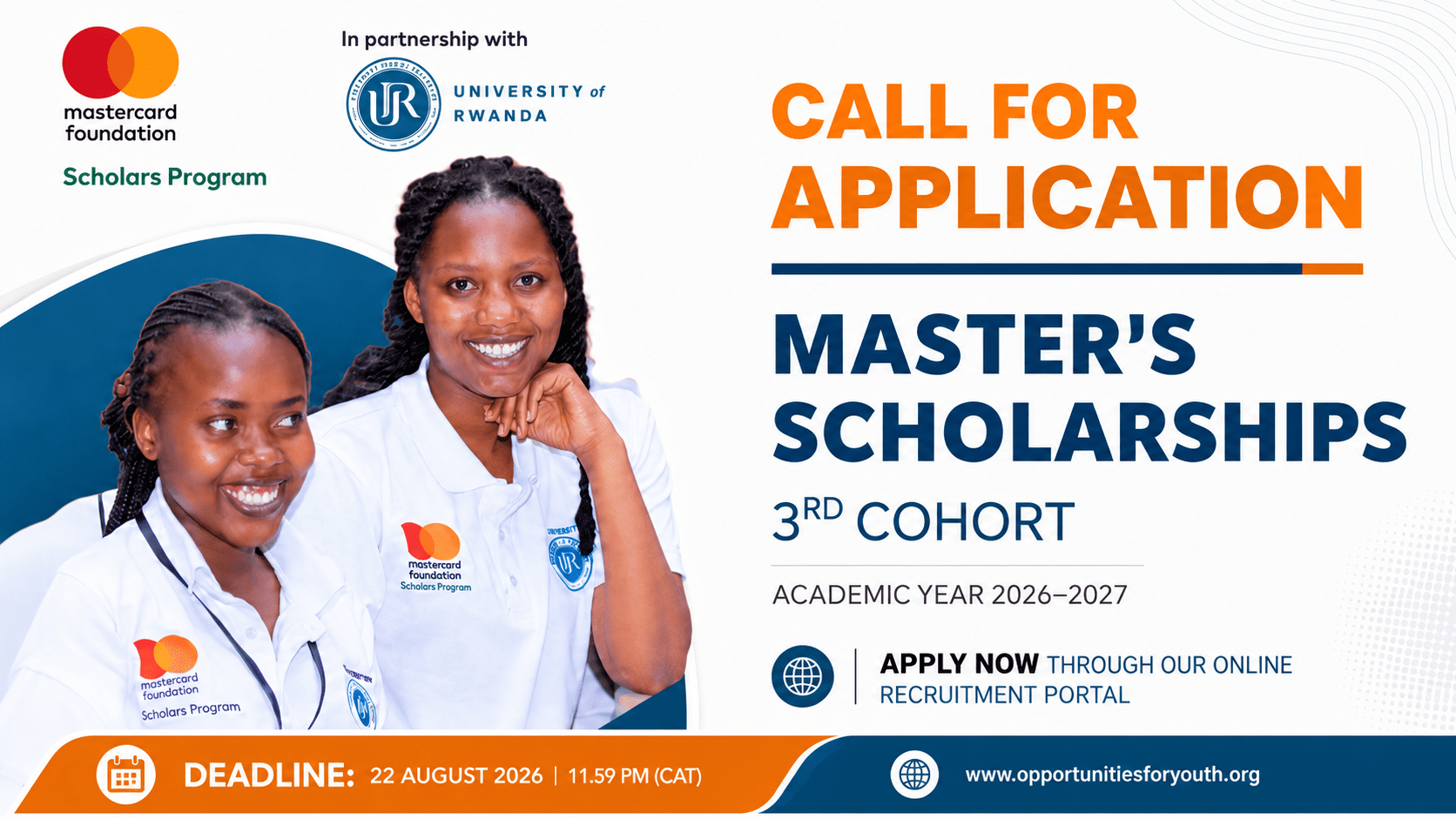
Applications are now open for the third cohort of postgraduate scholars under the Mastercard Foundation Scholars Program at the University of Rwanda for the 2026–2027 academic year.
Through this competitive opportunity, the University of Rwanda will recruit 30 scholars for eligible two-year master’s degree programmes. The scholarship is designed for academically talented African students who demonstrate substantial economic or social disadvantage, leadership potential, commitment to community service, and the ability to contribute positively to their countries and the African continent.
The programme particularly seeks to expand access to postgraduate education for young Africans who face barriers to higher education. Priority groups include women, certified refugees, displaced young people, and persons with disabilities. Candidates enrolling in Science, Technology, Engineering, and Mathematics programmes will also receive substantial consideration during the selection process.
The official application deadline is August 22, 2026, at 11:59 p.m. Central Africa Time.
Overview of the Mastercard Foundation Scholars Program at the University of Rwanda
The Mastercard Foundation Scholars Program at the University of Rwanda is part of a ten-year partnership intended to improve access to inclusive and relevant higher education for talented young Africans facing serious economic and social barriers.
The programme focuses on enabling qualified students to pursue higher education while developing the knowledge, character, leadership capacity, and professional competencies required to secure dignified work and contribute to long-term social and economic transformation.
Its objectives extend beyond paying university expenses. The programme seeks to develop ethical and transformative African leaders who can produce positive, forward-looking change at three interconnected levels:
- Individual level: Supporting scholars to achieve academic success, personal development, employability, and leadership growth.
- Institutional level: Strengthening the University of Rwanda’s capacity to deliver inclusive and supportive tertiary education.
- System level: Contributing to improvements in the broader higher-education ecosystem and the transition of African graduates into dignified employment.
The broader Scholars Program at the University of Rwanda supports academically talented and service-oriented young people from Rwanda and other African countries who continue to face social and economic barriers to opportunity. It aims to prepare scholars for academic achievement, employment, entrepreneurship, leadership, and meaningful community contribution.
Scholarship Information at a Glance
- Scholarship programme: Mastercard Foundation Scholars Program at the University of Rwanda
- Scholarship level: Master’s degree
- Academic year: 2026–2027
- Cohort: Third postgraduate cohort
- Number of scholarships: 30
- Programme duration: Two years
- Host institution: University of Rwanda
- Study location: Rwanda
- Target applicants: Academically talented but economically or socially disadvantaged African students
- Priority academic fields: Science, Technology, Engineering, and Mathematics
- Priority applicant groups: Women, certified refugees, displaced youth, and persons with disabilities
- Application method: Online
- Application deadline: August 22, 2026, at 11:59 p.m. Central Africa Time
- Application fee: No fee
The scholarship call states that 30 scholars will be recruited for two-year postgraduate programmes at the University of Rwanda. It also identifies women, certified refugees, persons with disabilities, and economically disadvantaged applicants as priority groups.
Number of Scholarships Available
For the 2026–2027 academic year, the Mastercard Foundation Scholars Program at the University of Rwanda intends to select 30 postgraduate scholars.
These awards are for eligible University of Rwanda master’s programmes with a normal duration of two years.
The programme establishes several priority targets:
- Approximately 70% of the scholarships are intended for qualified female applicants.
- Approximately 80% of selected scholars are expected to enrol in STEM programmes.
- Certified refugees are identified as a priority group, with a target of approximately 25%.
- Persons with disabilities are identified as a priority group, with a target of approximately 10%.
These categories are not necessarily mutually exclusive. For example, one selected scholar may be a woman, a refugee, and a STEM student at the same time. The percentages should therefore be understood as inclusion and programme-priority targets rather than separate categories that must add up to 100%.
Eligible Fields of Study
The scholarship is available for qualifying two-year master’s programmes offered by the University of Rwanda for the September 2026 intake.
The call does not provide a complete programme-by-programme list. Applicants must therefore first examine the University of Rwanda’s postgraduate admission options and apply for a relevant two-year master’s programme.
Priority will be given to applicants enrolling in:
- Science
- Technology
- Engineering
- Mathematics
The call states that 80% of selected scholars will be drawn from STEM programmes. This does not automatically exclude qualified applicants from other eligible academic disciplines, but it means that most awards are expected to support STEM students.
Admission to the University of Rwanda Is a Mandatory First Step
The scholarship application is not a substitute for admission to a University of Rwanda master’s programme.
Applicants must have separately applied for admission to the University of Rwanda for the September 2026 intake in an eligible programme lasting two years.
Preselection for the Mastercard Foundation scholarship will be conditional upon the applicant obtaining admission to the relevant University of Rwanda master’s programme.
This means that applicants must complete two connected processes:
- Apply for admission to an eligible University of Rwanda master’s programme.
- Apply separately for the Mastercard Foundation Scholars Program scholarship.
An applicant who submits only the scholarship application without applying for University of Rwanda admission may fail to meet the published eligibility conditions.
Who Is Eligible to Apply?
Applicants must satisfy academic, nationality, age, financial-need, leadership, community-service, and admission-related conditions.
Academic Requirements
Applicants must:
- Have successfully completed a bachelor’s degree.
- Hold a bachelor’s qualification in a field related to the University of Rwanda master’s programme for which they are applying.
- Be academically talented and capable of completing postgraduate study.
- Have applied for admission to an eligible two-year University of Rwanda master’s programme for the September 2026 intake.
- Meet the admission requirements of the selected University of Rwanda programme.
Applicants should not assume that scholarship eligibility guarantees university admission. The scholarship and academic admission processes remain connected but distinct.
Nationality Requirements
Applicants must be:
- Citizens of Rwanda; or
- Citizens of another African country.
Refugee applicants must hold appropriate certification or supporting documentation from an authorized organization such as:
- The United Nations High Commissioner for Refugees;
- Rwanda’s Ministry in Charge of Emergency Management; or
- Another legally recognized agency responsible for refugee certification.
The programme is therefore intended for African applicants rather than applicants from all global regions. International applicants from eligible African countries may be required to provide a valid passport and complete immigration requirements for study in Rwanda.
Age Limit
At the time of application:
- Male applicants must not be older than 40 years.
- Female applicants must not be older than 45 years.
Applicants exceeding the relevant age limit would not satisfy the published selection requirements.
Financial and Social Need
Applicants must demonstrate substantial financial, economic, or social barriers affecting their ability to access postgraduate education.
The scholarship is not based only on high academic grades. The programme also assesses the applicant’s level of disadvantage and the extent to which financial constraints would prevent the applicant from pursuing university education without scholarship assistance.
The online portal explains that applications are assessed using the following weighting:
- Economic disadvantage: 45%
- Academic talent: 30%
- Leadership potential: 25%
Economic disadvantage carries the highest weighting, confirming that the scholarship is specifically intended for talented applicants who face significant barriers to educational opportunity.
Leadership and Community Engagement
Applicants must demonstrate:
- A credible record of leadership.
- Participation in community engagement or service.
- Commitment to supporting other people.
- Potential to become an ethical and transformative leader.
- Willingness to contribute to positive change in their community.
- Readiness to participate in “Give Back” or “Go Back” activities after or during their studies.
Leadership evidence does not have to be limited to holding a formal title. Applicants may demonstrate leadership through community initiatives, volunteering, student associations, professional responsibilities, social projects, mentoring, advocacy, entrepreneurship, or other activities that produced meaningful results.
Enrolment Status
Continuing students are not eligible.
Applicants must also not be enrolled at another tertiary institution at the time relevant to the application and selection process.
The programme is intended for newly admitted students who have not already commenced the master’s programme under consideration.
Priority Applicant Groups
The scholarship is designed to promote inclusive access to postgraduate education.
Priority consideration will be given to:
Qualified Women
The programme intends to allocate approximately 70% of its postgraduate scholarships to female scholars.
Eligible women must still satisfy the academic, financial-need, admission, leadership, and community-engagement requirements. Gender priority does not eliminate the need to meet the other selection criteria.
Certified Refugees and Displaced Youth
Certified refugees and displaced young Africans are specifically encouraged to apply.
Refugee applicants must submit valid documentation confirming their status. They may need documentation issued by UNHCR, MINEMA, or another recognized legal authority.
Persons With Disabilities
Applicants with disabilities are strongly encouraged to apply and are identified as one of the programme’s priority groups.
Candidates applying under this category should be prepared to submit an appropriate disability certificate or other recognized supporting document.
Economically Disadvantaged African Students
The scholarship is specifically intended for academically capable young Africans who cannot independently finance postgraduate education.
Applicants should provide complete and truthful information regarding:
- Household income
- Family circumstances
- Employment status
- Sources of financial support
- Dependants
- Education-related expenses
- Social or economic difficulties
- Other circumstances demonstrating financial need
Providing false or misleading financial information may result in disqualification.
What Does the Scholarship Cover?
The Mastercard Foundation Scholars Program offers a comprehensive package managed through the University of Rwanda.
The specific 2026–2027 postgraduate call lists the following support:
Full Tuition Fees
The scholarship covers the scholar’s tuition fees for the approved study period, subject to continued satisfactory academic performance and compliance with programme requirements.
Laptop
Selected scholars will receive a laptop to support academic work, research, virtual learning, communication, assignments, and participation in blended-learning activities.
The recruitment portal encourages applicants to have access to a smartphone for blended learning before the programme-issued laptop becomes available.
Learning Materials
The scholarship provides learning resources and materials required to support the scholar’s postgraduate education.
Monthly Stipend
Scholars will receive a monthly stipend throughout the year. The call does not state the exact value of the stipend.
Annual Return-Ticket Allowance
The scholarship includes an annual return-ticket allowance, particularly relevant to scholars studying away from their country or normal place of residence.
Psychosocial Support
Selected scholars will have access to psychosocial support services intended to promote personal well-being and help them manage academic, social, emotional, and transitional challenges.
Academic Support
The programme provides continuing academic assistance through measures such as:
- Academic mentorship
- Virtual learning support
- Tutoring
- Guidance on academic performance
- Structured scholar-development activities
Internships and Professional Experience
Scholars may access specially sourced industry internships that support professional development and improve their exposure to workplace environments.
Career Development Support
The programme provides career-development services that may include:
- Industrial mentorship
- Career guidance
- Professional development
- Enterprise development
- Employment preparation
- Transition-to-work support
Leadership and Personal Development
Scholars may participate in:
- Leadership congresses
- Community-service activities
- Mentoring programmes
- Give Back initiatives
- Personal-development meetings
- Professional-development meetings
- Activities designed to strengthen social networks and scholar capacity
Global Scholars Community and Alumni Network
Selected students will become part of the Mastercard Foundation Scholars community and may benefit from connections with scholars, graduates, mentors, professionals, and partner institutions across Africa and beyond.
The complete package is intended to help scholars succeed academically, participate in community life, prepare for dignified work, and develop into ethical leaders and changemakers.
Important Condition: Scholarship Renewal Depends on Performance
The scholarship operates on a rolling or annually renewable basis.
Continued funding is subject to:
- Satisfactory academic performance
- Compliance with University of Rwanda regulations
- Compliance with Scholars Program policies
- Appropriate conduct
- Active engagement with scholarship activities
- Continued fulfilment of award conditions
Receiving the initial award does not create an unconditional entitlement to funding regardless of academic performance or conduct.
Required Application Documents
Applicants should prepare their documents before starting the online application.
The official recruitment portal lists the following documents:
- A digital passport-size photograph with a white background
- National identity documentation showing the applicant’s date of birth
- A scanned national identity card
- A scanned passport for international applicants
- Refugee identification or other supporting documents for refugee applicants
- A disability certificate for applicants applying under the disability category
- Leadership certificates, where available
Applicants may also need to provide academic and admission-related documents required by the application form or the University of Rwanda.
The portal permits applicants to save their progress and return before the deadline. However, the scholarship call recommends gathering all supporting documents before beginning the final submission process.
Document Format and File-Size Requirements
The scholarship call provides specific instructions for uploaded documents:
- Documents should be saved in PDF format.
- Each file should be less than 250 KB.
- Applicants should clearly name each document.
- File names should include the applicant’s name where appropriate.
- Scans should be clear and readable.
- Applicants should confirm that the correct document has been uploaded under each section.
Poorly scanned, incorrectly named, incomplete, or unreadable files may make it difficult to verify an applicant’s eligibility.
Foreign Qualification Equivalence
Applicants who obtained academic qualifications outside Rwanda must obtain the necessary equivalence or recognition from the relevant Rwandan authorities.
The recruitment portal identifies:
- Rwanda’s Higher Education Council; and
- The National Examination and School Inspection Authority.
International applicants should begin the equivalence process early, as obtaining recognition of foreign qualifications may take time.
How to Apply for the Scholarship
The scholarship application must be completed through the official University of Rwanda Mastercard Foundation Scholars recruitment portal.
Step 1: Apply for University of Rwanda Admission
Apply separately for admission to an eligible two-year master’s programme for the September 2026 intake.
The bachelor’s degree should be relevant to the intended master’s programme.
Step 2: Prepare the Supporting Documents
Gather all identification, academic, refugee-status, disability, financial-need, leadership, and admission-related documents applicable to your situation.
Convert the required files into PDF format and ensure each is below the specified file-size limit.
Step 3: Create an Online Account
Register on the official postgraduate scholars recruitment portal using an active email address.
Applicants should use an email account they check regularly because important application and selection updates may be communicated electronically.
Step 4: Complete the Application Form
The online application contains seven sections covering areas such as:
- Personal identification
- Education
- Family information
- Socio-economic circumstances
- Leadership experience
- Supporting documentation
- Other eligibility information
Applicants can save their progress and return to the application before the deadline.
Click HERE to Apply.
Step 5: Upload the Required Documents
Attach each document in the correct section and verify that:
- The file is readable.
- The information is complete.
- The file name is clear.
- The correct document has been uploaded.
- The PDF is below the required size limit.
Step 6: Review the Application
Carefully review every answer before submission.
Applicants should ensure that dates, names, academic information, family details, income information, and leadership records are accurate and consistent with the supporting documents.
Step 7: Submit the Application
Click the final submission button only after every required field and attachment has been completed.
Saving the application is not the same as submitting it. Applicants should confirm through their dashboard that the application status shows successful submission.
Step 8: Track the Application
Applicants can use their dashboard to track the status of the submitted application.
Telephone numbers and email addresses entered in the application should remain active throughout the recruitment process.
Application Timeline and Deadline
The official scholarship deadline is:
August 22, 2026, at 11:59 p.m. Central Africa Time
The call document states that the portal receives applications from July 24, 2026, while the recruitment portal displays July 23, 2026, as the opening date. This is a minor one-day discrepancy between the two official sources, but both confirm that applications are open and that the closing date is August 22, 2026.
Applicants should submit well before the deadline to reduce the risk of technical problems, slow internet connectivity, incorrect documents, or incomplete sections.
How Applications Will Be Assessed
The recruitment portal provides a structured selection weighting:
Economic Disadvantage: 45%
This is the largest component of the assessment. Applicants must demonstrate that they face significant financial or social barriers to postgraduate education.
Academic Talent: 30%
Applicants must demonstrate the academic ability required to succeed in a demanding master’s programme.
Leadership Potential: 25%
Applicants must show evidence of leadership, community engagement, service, initiative, and commitment to producing positive change.
The assessment is therefore not based exclusively on examination results or grades. A competitive applicant must demonstrate strength across academic ability, economic need, and leadership potential.
Preselection, Interviews, and Home Visits
The scholarship recruitment process will continue after the online application closes.
Preselection
Applications will first be reviewed against the published eligibility and selection criteria.
Successful preselected candidates will be invited to an oral interview. Applicants who are unsuccessful at a particular stage are expected to be notified.
Interview Process
Interviews will be conducted by independent panels using a predefined interview guide aligned with the programme’s objectives and the University of Rwanda’s expectations.
The Scholars Recruitment Committee will select 30 candidates based on the established criteria.
Unannounced Home Visits
The programme may conduct unannounced on-site validation visits to the homes of selected or shortlisted applicants.
These visits are intended to verify information, particularly claims relating to household circumstances, economic disadvantage, or social vulnerability.
Applicants should therefore ensure that every statement made in the application is complete, accurate, and capable of verification.
Final Approval
Interview and home-visit reports will be submitted through the appropriate university process for approval.
The Scholars Recruitment Committee’s decisions are final.
Publication of Results
The approved list of selected candidates will be published on the University of Rwanda website.
Successful applicants will also receive:
- A scholarship award letter
- A scholarship acceptance form
- Instructions for confirming acceptance
Award letters will be issued through the Office of the Vice Chancellor.
Accepting the Scholarship
Successful candidates must complete and sign the scholarship acceptance form.
The signed form must be returned through the programme email within five working days after receiving the scholarship award letter.
Where a selected candidate declines the offer or fails to confirm acceptance, the scholarship may be awarded to the next highest-performing candidate in the same programme.
The scholarship offer cannot be deferred. A candidate who cannot begin the programme as required should not assume that the award can be transferred to another academic year.
There Are No Application Fees or Authorized Agents
The University of Rwanda clearly states that there are:
- No application charges
- No facilitation fees
- No authorized agents
- No intermediaries required
- No payment required to influence selection
- No payment required for a home visit
Applicants should not pay any person claiming to guarantee selection, accelerate an application, arrange an interview, or influence the scholarship committee.
Any attempt to influence the recruitment process may result in disqualification.
Grounds for Disqualification or Loss of Scholarship
Applicants may be disqualified for:
- Providing false or falsified information
- Submitting fraudulent documentation
- Misrepresenting financial circumstances
- Attempting to influence the selection process
- Offering money or seeking improper assistance
- Violating University of Rwanda rules
- Engaging in examination or academic misconduct
- Participating in riotous or subversive activities
- Engaging in illicit financial activities
- Participating in terrorism
- Denying the 1994 Genocide against the Tutsi
- Breaching Scholars Program policies
- Failing to maintain satisfactory academic performance after selection
The programme’s rules apply both during recruitment and throughout the scholarship period.
Expectations of Successful Scholars
Successful scholars are expected to become:
- High achievers
- Ethical leaders
- Community contributors
- Entrepreneurs
- Professionals
- Change agents
- Mentors
- Supporters of inclusive African development
They must remain engaged with the University of Rwanda and the Scholars Program and are expected to maintain close communication with the University for at least five years after completing their studies.
The programme places strong emphasis on giving back. Scholars should be prepared to use their education, networks, and professional experience to support their communities and contribute to Africa’s transformation.
International Applicant Information
International applicants from eligible African countries should prepare:
- A valid passport
- Foreign-qualification equivalence documents
- Police-clearance documentation where required
- Immigration and study-visa documents
- Refugee documentation, where applicable
The recruitment portal states that international students must apply for a study visa within 15 days of arrival and may need to provide a valid passport and police-clearance documentation.
The portal also states that citizens worldwide may receive an entry visa on arrival at Kigali International Airport. Applicants should nevertheless verify current immigration requirements through the appropriate Rwandan authority before travelling because immigration rules can change.
Scholarship Application Support Contacts
The call document lists the following application-support contacts.
Emmanuel Kamanzi
- University of Rwanda Admission and Registration Specialist
- Telephone: +250 788736530
- Email: e.kamanzi@ur.ac.rw
Dr. Odette Uwizeye
- Registrar, University of Rwanda
- Telephone: As published in the official call document
- Email: registrar@ur.ac.rw
Jean Baptiste Mugiraneza
- Data Analytics and IT, Mastercard Foundation Scholars Program at the University of Rwanda
- Telephone: +250 722016900
- Email: j.b.mugiraneza@ur.ac.rw
Oscar Muvandimwe
- Monitoring and Evaluation Specialist, Mastercard Foundation Scholars Program at the University of Rwanda
- Telephone: +250 788488272
- Email: o.muvandimwe@ur.ac.rw
Applicants should use the contacts only for legitimate application questions and should communicate well before the deadline.
Practical Advice for Preparing a Competitive Application
Begin With University Admission
Do not prepare only the scholarship form. Confirm that you have applied for an eligible University of Rwanda master’s programme.
Demonstrate Financial Need With Evidence
Because economic disadvantage carries 45% of the assessment, provide clear, honest, and verifiable information.
Explain how your financial circumstances have affected your access to education and why the scholarship is necessary.
Use Specific Leadership Examples
Avoid vague statements such as “I am a good leader.”
Instead, explain:
- What problem you addressed
- What role you performed
- Who benefited
- What actions you took
- What measurable result you achieved
- What you learned
- How the experience relates to your future goals
Explain Your Commitment to Giving Back
The programme is looking for applicants who will use their education for wider social benefit.
Describe the community or development challenge you intend to address and explain how the selected master’s programme will improve your capacity to respond.
Keep Information Consistent
Names, dates, qualifications, family details, income information, and leadership records should be consistent across the form and supporting documents.
Prepare for Verification
Assume that information about financial need, residence, family circumstances, refugee status, disability, academic qualifications, and leadership activities may be checked.
Submit Before the Final Day
Early submission provides time to resolve technical problems, replace unreadable files, correct mistakes, and confirm successful submission.
Conclusion
The University of Rwanda Mastercard Foundation Scholarship for the 2026–2027 academic year offers a major postgraduate education opportunity for talented African students who face significant economic or social barriers.
Thirty scholars will be selected for eligible two-year master’s programmes, with strong priority given to women, STEM students, certified refugees, displaced youth, and persons with disabilities.
The scholarship provides far more than tuition assistance. Its comprehensive package includes a laptop, learning materials, a monthly stipend, annual return-ticket support, psychosocial services, academic mentorship, industry internships, career guidance, leadership development, community-service opportunities, and access to the wider Mastercard Foundation Scholars network.
Applicants must already have applied for admission to an eligible University of Rwanda master’s programme, hold a relevant bachelor’s degree, satisfy the applicable age limit, demonstrate financial need, provide evidence of leadership and community engagement, and commit to giving back to their communities.
The deadline is August 22, 2026, at 11:59 p.m. Central Africa Time. Candidates should prepare all documents carefully, submit through the official recruitment portal, and ensure that every statement in the application is truthful and verifiable.
For more global opportunities, click HERE.
University of Rwanda Mastercard Foundation Scholarship 2026–2027: 30 Fully Funded Master’s Scholarships for African Students
@2027: 30 Fully Funded Master’s Scholarships for African Students
Location
USA / Global
Work Mode
scholarship
Posted
about 11 hours ago
Beware of scams! When applying for jobs, you should NEVER have to pay anything. Learn about job scams.
Get jobs in your inbox
Join over 10,000 subscribers receiving our weekly newsletter.
You might also like

France-South Africa Scholarship Programme 2027: Fully Funded Master’s and PhD Scholarships to Study in France for Students from South Africa, Lesotho, and Malawi
South Africa Scholarship Programme 2027: Fully Funded Master’s and PhD Scholarships to Study in France for Students from South Africa, Lesotho, and Malawi
University of Tuscia Announces PhD Admissions Call for 42nd Cycle Programmes 2026/2027
Unknown
Fully Funded PhD in Sustainable Development and Climate Change 2026–2027 in Italy: 35 Scholarships Available Through IUSS Pavia
2027 in Italy: 35 Scholarships Available Through IUSS Pavia
International Online School in Forced Migration 2026–2027: Apply for the World-Renowned Refugee Studies Centre Online Programme
2027: Apply for the World-Renowned Refugee Studies Centre Online Programme

Canon Collins Trust Opens Tom Queba and Pegasys Scholarships for Social Change 2027 in South Africa
Unknown
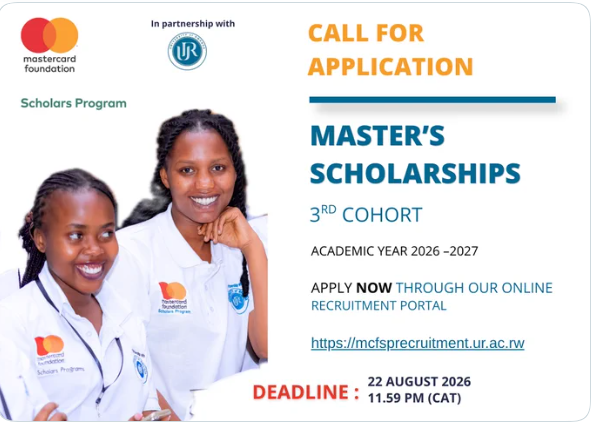
Call for Applications: Mastercard Foundation Scholars Program at University of Rwanda – Postgraduate Scholarships for 2026–2027
University of Rwanda – Postgraduate Scholarships for 2026–2027