








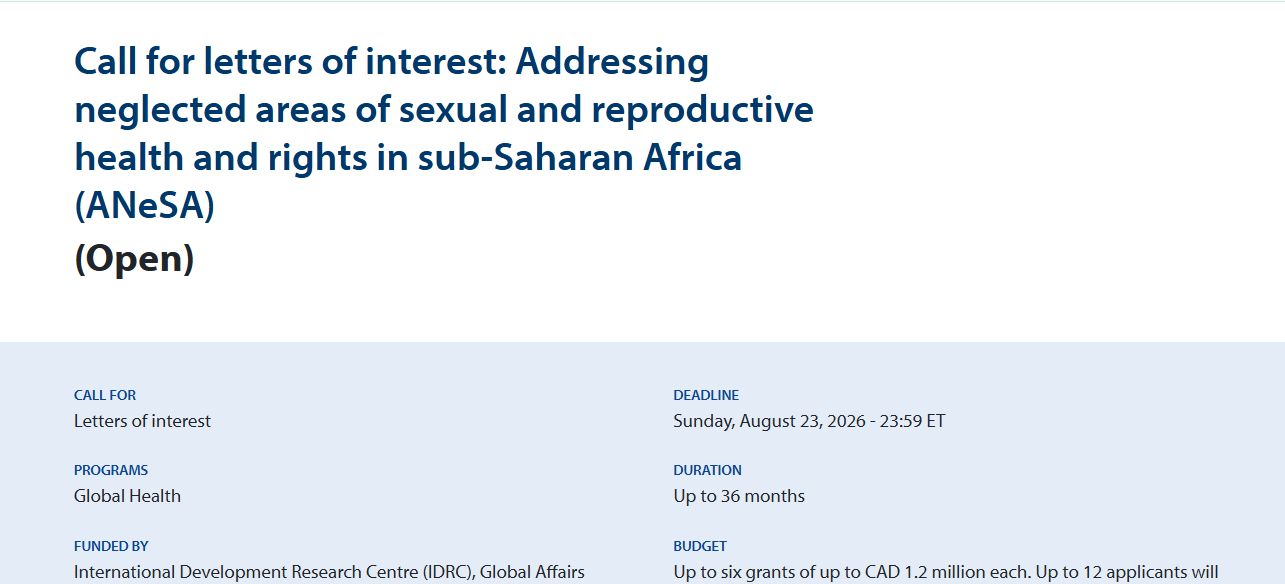
Funding Alert: Up to CAD 1.2 Million Available for Sexual and Reproductive Health Research Projects Across Sub-Saharan Africa ·Saharan Africa
Researchers and institutions across sub-Saharan Africa have a new opportunity to secure major funding for implementation research aimed at improving sexual and reproductive health and rights (SRHR).
The Addressing Neglected Areas of Sexual and Reproductive Health and Rights in Sub-Saharan Africa (ANeSA) initiative has officially opened its latest Call for Letters of Interest, offering up to six grants worth as much as CAD 1.2 million each to support innovative, evidence-based projects.
The funding opportunity is jointly supported by the International Development Research Centre (IDRC), Global Affairs Canada (GAC), and the Canadian Institutes of Health Research (CIHR).
Successful projects will receive funding for up to 36 months, with implementation research designed to strengthen health systems, expand access to essential services, and improve health outcomes for underserved populations across the region.
The current call represents the first stage of a competitive two-stage selection process. Following the evaluation of Letters of Interest, up to 12 research teams will be invited to submit full proposals, from which six projects will ultimately be selected for funding.
Supporting Research in Africa That Delivers Real-World Impact
Unlike traditional academic research, the ANeSA initiative focuses on implementation research—research that identifies practical, sustainable solutions for delivering proven health interventions more effectively in real-world settings.
The programme seeks projects that are:
- Evidence-informed
- Gender-transformative
- Sustainable
- Designed to improve services for underserved populations
- Focused on translating research into policy and practice
Successful teams are expected to generate findings that can directly strengthen healthcare delivery, influence national policies, and improve access to sexual and reproductive health services across sub-Saharan Africa.
Five Priority Research Areas
Applicants must propose research addressing at least one of ANeSA’s five priority themes.
1. Improving Access to Family Planning and Contraceptive Services
Projects may focus on increasing the availability, accessibility, and quality of family planning services while addressing barriers faced by vulnerable populations.
2. Expanding Safe Abortion and Post-Abortion Care
Where legally permitted, researchers may investigate strategies that improve access to safe abortion care and strengthen post-abortion care services.
3. Advancing Adolescent Sexual and Reproductive Health Rights
The initiative seeks research that promotes adolescents’ access to information, rights-based services, and healthcare while addressing social and structural barriers affecting young people.
4. Preventing Sexual and Gender-Based Violence
Research may examine interventions that prevent sexual and gender-based violence (SGBV) and improve services and support systems for survivors.
5. Strengthening Advocacy for Sexual and Reproductive Health Rights
Projects may also focus on policy engagement, community mobilisation, accountability mechanisms, and advocacy approaches that strengthen SRHR across the region.
Who Can Apply?
The call is open to Implementation Research Teams led by researchers based in eligible institutions within sub-Saharan Africa.
To qualify, the Principal Applicant must be affiliated with an eligible organisation located in one of the participating countries listed in the call. Eligible countries include:
Angola, Benin, Botswana, Burkina Faso, Burundi, Cameroon, Central African Republic, Chad, Republic of the Congo, Democratic Republic of the Congo, Equatorial Guinea, Ethiopia, Gabon, Gambia, Ghana, Guinea, Guinea-Bissau, Côte d’Ivoire, Kenya, Lesotho, Liberia, Madagascar, Malawi, Mali, Mauritania, Mauritius, Mozambique, Namibia, Niger, Nigeria, Rwanda, Senegal, Sierra Leone, South Africa, Eswatini, South Sudan, Tanzania, Togo, Uganda, Zambia, and Zimbabwe.
Applicants should carefully review the official call documentation for detailed eligibility requirements, including team composition and institutional criteria.
Funding Available
ANeSA will award:
- Up to six implementation research grants
- Maximum value of CAD 1.2 million per grant
- Project duration of up to 36 months
- Funding for multidisciplinary implementation research teams
This level of investment provides an opportunity for African researchers to undertake large-scale collaborative projects capable of generating lasting improvements in healthcare systems and policy.
Important Dates
Researchers interested in applying should take note of the programme timeline:
- Call launched: 29 June 2026
- Information webinar: 15 July 2026
- Deadline for questions: 9 August 2026
- Letters of Interest deadline: 23 August 2026 (23:59 ET)
- Applicants notified: 18 December 2026
- Proposal Development Workshop: 9–11 February 2027
- Full Proposal call opens: 12 February 2027
- Full Proposal deadline: 2 May 2027
- Funding decisions announced: 21 July 2027
Information Webinar
Prospective applicants are encouraged to participate in an informational webinar scheduled for 15 July 2026, where organisers will explain the application process, eligibility requirements, funding priorities, and answer participants’ questions.
Applicants may also submit questions to the ANeSA team via SRHR-SDSR@idrc.ca until 9 August 2026 to receive responses before the application deadline.
Why This Opportunity Matters
Despite significant progress in recent decades, many communities across sub-Saharan Africa continue to face major challenges in accessing comprehensive sexual and reproductive healthcare. Adolescents, women, survivors of gender-based violence, and other underserved populations often encounter legal, financial, geographic, and social barriers that prevent them from receiving essential services.
By investing in implementation research led by African institutions, the ANeSA initiative aims to bridge the gap between evidence and practice. The programme recognises that improving health outcomes requires not only new knowledge but also practical strategies for delivering effective interventions within diverse local contexts.
For researchers working in public health, medicine, social sciences, policy, implementation science, gender studies, or related disciplines, this funding call represents an opportunity to generate research with direct policy relevance while contributing to stronger and more equitable health systems across the continent.
With grants of up to CAD 1.2 million available, ANeSA offers one of the region’s most significant current funding opportunities for collaborative research focused on advancing sexual and reproductive health and rights in sub-Saharan Africa.
VISIT OFFICIAL WEBSITE HERE
For more opportunities such as these please follow us on Facebook, Instagram, Twitter, LinkedIn and WPChannel
Disclaimer: Global South Opportunities (GSO) is not the organization offering this opportunity. For any inquiries, please contact the official organization directly. Please do not send your applications & CVs to GSO, as we are unable to process them. Due to the high volume of emails, we receive daily, we may not be able to respond to all inquiries. Thank you for your understanding.
JOIN GSO WHATSAPP CHANNEL NOW
Funding Alert: Up to CAD 1.2 Million Available for Sexual and Reproductive Health Research Projects Across Sub-Saharan Africa
@Saharan Africa
Location
USA / Global
Work Mode
funding
Posted
about 3 hours ago
Beware of scams! When applying for jobs, you should NEVER have to pay anything. Learn about job scams.
Get jobs in your inbox
Join over 10,000 subscribers receiving our weekly newsletter.
You might also like

Startup Challenge 2026 Opens Global Call for Impact-Driven Entrepreneurs
Driven Entrepreneurs
Bilateral Research Program Coordinator
Japan Society for the Promotion of Science
Call for Participation: G4CA Movement Opens Call for Membership for Young Eco-Feminist Climate Justice Leaders in Africa
G4CA Movement
Sustainability Accelerator
100+ Accelerator

Undergraduate Neuroscience Researcher Award
Faculty for Undergraduate Neuroscience

Cultural Protection Fund Grants Manager
British Council