
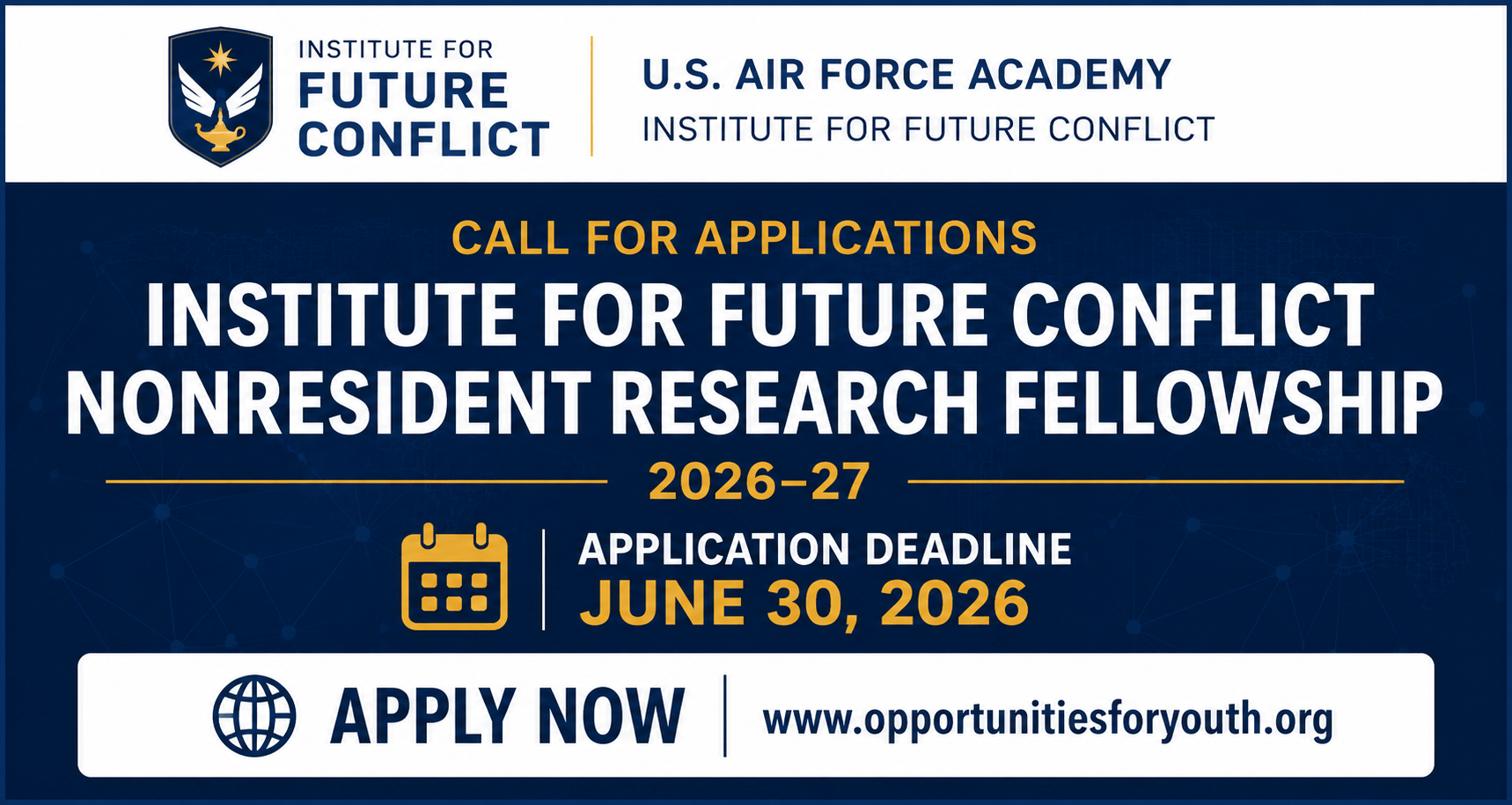
Institute for Future Conflict Nonresident Research Fellowship 2026–2027: Fully Funded Opportunity for Researchers, Scholars, and Strategic Thinkers @2027: Fully Funded Opportunity for Researchers, Scholars, and Strategic Thinkers
The Institute for Future Conflict (IFC) at the United States Air Force Academy (USAFA) has officially opened applications for its highly competitive Nonresident Research Fellowship Program for the 2026–2027 academic year. This prestigious fellowship provides an exceptional opportunity for researchers, academics, military professionals, policy experts, and strategic thinkers interested in the future of warfare, security, technology, and strategic competition.
The fellowship is designed to bring together emerging and established experts whose work contributes to understanding how future conflicts may evolve and how nations can better prepare for rapidly changing security environments. Through research, collaboration, professional engagement, and thought leadership, fellows will play an important role in advancing discussions on future warfare and statecraft.
Applications are currently open and will close on June 30, 2026.
About the Institute for Future Conflict
The Institute for Future Conflict (IFC) is based at the United States Air Force Academy and exists to advance understanding and preparation for future conflict through research, education, leadership development, and external engagement.
The institute focuses on helping develop adaptive military leaders capable of responding effectively to evolving global security challenges. Its work examines a wide range of topics, including:
- Emerging technologies and warfare
- Strategic competition among nations
- Adversary doctrine and military innovation
- Force design and military modernization
- Operational adaptation
- Defense policy and strategy
- The relationship between military power and society
- Future operational environments
- National security challenges
Through its partnerships with government agencies, academic institutions, military organizations, and industry leaders, the institute seeks to develop innovative approaches to future security challenges.
About the Nonresident Research Fellowship
The Nonresident Research Fellowship is an annual program that runs alongside the academic year and lasts for one calendar year.
The fellowship brings together individuals from diverse backgrounds who share a common interest in understanding and shaping the future of conflict and strategic competition.
Rather than following a rigid structure, the fellowship is designed to be flexible and tailored to each fellow’s expertise, research interests, and professional goals.
Successful applicants will work closely with the Fellowship Director to create individualized engagement plans that maximize their contributions while supporting their own professional development.
Fellowship Benefits
Selected fellows will receive several valuable benefits throughout the fellowship period.
$2,000 Honorarium
Each fellow receives a $2,000 honorarium for active participation in the program and contributions to the intellectual life of the Institute for Future Conflict.
Travel Support
The institute covers travel expenses associated with required fellowship events and workshops.
Access to High-Level Networks
Fellows gain access to a unique network of:
- Military leaders
- Government officials
- Policy professionals
- Academic researchers
- Defense experts
- Industry innovators
- Former and current fellows
Research and Publication Opportunities
Participants have opportunities to:
- Publish original research
- Develop policy analysis papers
- Produce strategic commentary
- Contribute to ongoing debates on national security and future warfare
Professional Development
The fellowship provides valuable opportunities to:
- Refine research agendas
- Expand professional networks
- Engage with defense audiences
- Develop publication pipelines
- Collaborate with leading experts
Fellowship Activities
The fellowship offers flexibility in how participants contribute.
Examples of fellowship activities include:
Research and Writing
Fellows may:
- Conduct original research
- Produce policy papers
- Write strategic analyses
- Publish commentary on future conflict topics
Collaborative Projects
Participants can collaborate with IFC-affiliated scholars on:
- Research projects
- Publications
- Applied defense initiatives
- Strategic studies
Presentations and Public Engagement
Fellows may:
- Deliver lectures and presentations
- Engage military audiences
- Brief policymakers
- Speak to industry stakeholders
- Participate in public discussions
Cadet Mentorship
Participants can contribute to educational initiatives by:
- Supporting cadet research projects
- Advising student researchers
- Participating in Future Conflict Minor activities
Workshops and Wargames
Fellows are encouraged to engage in:
- Strategic workshops
- Wargaming exercises
- Speaker series
- Research forums
Required Fellowship Deliverable
Each fellow must produce at least one written product for publication on the Institute for Future Conflict website.
This publication may include:
- Research articles
- Policy analysis
- Strategic commentary
- Defense-focused essays
- Future warfare assessments
Fellowship Timeline
August 21, 2026
Selected fellows will attend a kickoff workshop at the United States Air Force Academy.
This workshop serves as an opportunity to:
- Present project ideas
- Receive feedback from peers and experts
- Establish research goals
- Set publication deadlines
Summer 2027
Fellows will reconvene to present their completed research and share insights gained during the fellowship year.
Who Should Apply?
The fellowship welcomes applicants from a variety of professional backgrounds.
Early-Career Scholars
Doctoral candidates and emerging researchers can use the fellowship to:
- Build academic networks
- Strengthen research portfolios
- Develop publication opportunities
Mid-Career and Senior Scholars
Experienced researchers may use the fellowship to:
- Engage defense audiences
- Influence policy discussions
- Expand professional collaborations
Practitioners and Professionals
Military personnel, government officials, analysts, and industry professionals can leverage the fellowship to:
- Connect practical experience with research
- Contribute operational insights
- Shape future defense thinking
Eligibility Requirements
To qualify for the fellowship, applicants must:
Citizenship Requirement
- Be a United States citizen
Education Requirement
Applicants must possess:
- A master’s degree or higher; OR
- Equivalent professional experience
Research Focus Requirement
Applicants must demonstrate a strong focus on:
- Future conflict
- Strategic competition
- National security
- Defense studies
- Military innovation
- Related fields
Application Requirements
Applicants must submit the following materials:
1. Curriculum Vitae (CV)
A comprehensive CV outlining educational background, research experience, publications, and professional accomplishments.
2. Cover Letter
A one- to two-page cover letter explaining:
- Professional background
- Alignment with the Institute for Future Conflict
- Proposed fellowship project
- Expected contributions to the program
3. Writing Sample
Applicants must provide a previously published writing sample demonstrating their research, analytical, and communication abilities.
The Institute emphasizes originality and expects all submitted materials to accurately reflect the applicant’s own work.
How to Apply
Applications must be submitted via email.
Send application materials to:
Dr. Kerry Chávez
kerry.chavez@afacademy.af.edu
CC:
Dr. Layne Hancock
cary.hancock@afacademy.af.edu
Application Deadline
June 30, 2026
Applicants should ensure that all required documents are submitted before the close of business on the deadline date.
Why This Fellowship Matters
As emerging technologies, geopolitical competition, artificial intelligence, cyber warfare, and evolving military doctrines continue to reshape the global security landscape, understanding future conflict has become more important than ever.
The Institute for Future Conflict Nonresident Research Fellowship offers a unique platform for experts and emerging leaders to contribute meaningful research, influence strategic thinking, and engage directly with military and policy communities shaping the future of national and international security.
For scholars, practitioners, and professionals interested in the future of warfare and strategic competition, this fellowship represents a valuable opportunity to advance both personal expertise and broader discussions on global security.
For more information on this fellowship visit here
For more fellowship opportunities on OFY click here
Institute for Future Conflict Nonresident Research Fellowship 2026–2027: Fully Funded Opportunity for Researchers, Scholars, and Strategic Thinkers
@2027: Fully Funded Opportunity for Researchers, Scholars, and Strategic Thinkers
Location
USA / Global
Work Mode
america
Posted
about 8 hours ago
Beware of scams! When applying for jobs, you should NEVER have to pay anything. Learn about job scams.
Get jobs in your inbox
Join over 10,000 subscribers receiving our weekly newsletter.
You might also like

Canada Postdoctoral Research Award (CPRA) 2026 – Full Guide for Applicants
Full Guide for Applicants

Claude Corps Fellowship 2026–2027: Paid $85,000 AI Fellowship for Early-Career Professionals in the United States
2027: Paid $85,000 AI Fellowship for Early-Career Professionals in the United States
Marshall Memorial Fellowship 2027: Fully Funded Transatlantic Leadership Program for Emerging Leaders
Unknown

Save the Children USP Disability Rights and Inclusion Fellow (Guyer) 2026: Paid Remote Fellowship Opportunity in the United States for Students and Recent Graduates
Unknown
Letters to Strangers Mental Health Scholarships 2026: Win Up to $8,000 for Mental Health Advocacy and Educational Support
Unknown

Citi Foundation Launches $20 Million Housing Supply Grant Program to Accelerate Affordable Housing Development Across the United States
Unknown