








MMoCRA Scholarships 2026: Apply for EU-Funded Master’s and PhD Academic Mobility Opportunities for Climate-Resilient Research Across Africa ·Funded Master’s and PhD Academic Mobility Opportunities for Climate-Resilient Research Across Africa
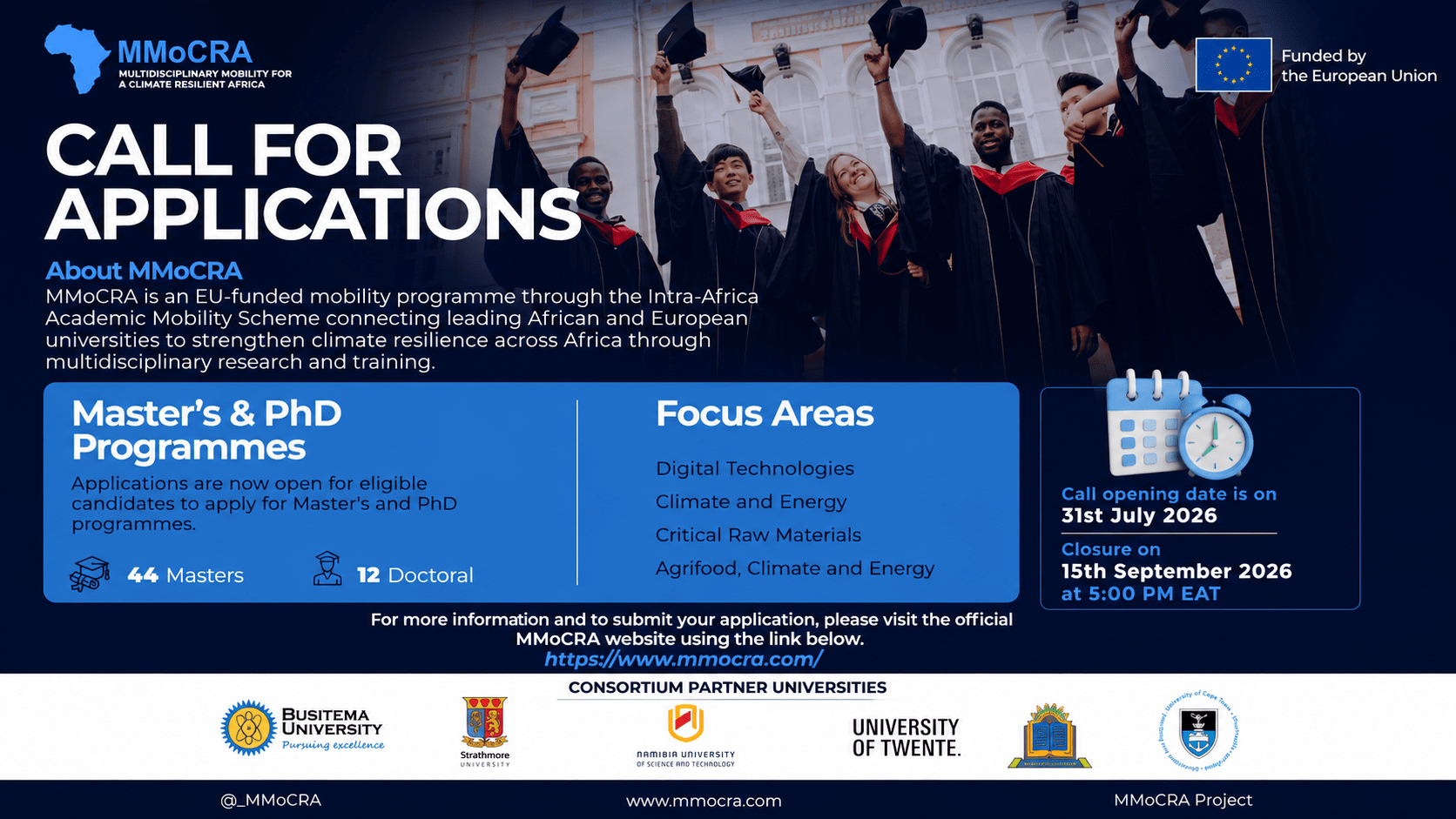
Applications are officially open for the Multidisciplinary Mobility for a Climate Resilient Africa (MMoCRA) Scholarships 2026, an academic mobility initiative funded by the European Union through the Intra-Africa Academic Mobility Scheme.
The MMoCRA programme connects leading African and European universities to strengthen climate resilience across Africa through multidisciplinary education, research, training, academic mobility, and knowledge exchange. Through the programme, students, researchers, trainees, and university staff can participate in mobility opportunities intended to strengthen the continent’s scientific and technical capacity to address climate change and sustainable development challenges.
For the current application round, MMoCRA is accepting applications for Master’s and PhD scholarships, providing successful applicants with opportunities to pursue academic mobility at participating African universities while contributing to research and innovation addressing some of Africa’s most pressing challenges.
The programme covers multidisciplinary areas including Climate and Energy, Digital Technologies, Critical Raw Materials, Agrifood Systems, and broader multidisciplinary climate solutions.
Applications opened on 31 July 2026, and interested candidates must submit their applications by 15 September 2026 at 5:00 PM East Africa Time (EAT).
About the Multidisciplinary Mobility for a Climate Resilient Africa Programme
The Multidisciplinary Mobility for a Climate Resilient Africa, commonly referred to as MMoCRA, is an EU-funded academic mobility programme operating through the Intra-Africa Academic Mobility Scheme.
Its overarching purpose is to strengthen climate resilience across Africa by connecting universities and facilitating multidisciplinary research, training, academic mobility, and knowledge exchange.
Climate change presents complex challenges that cannot be adequately addressed by a single academic discipline. Building climate-resilient societies requires expertise across areas such as energy, agriculture, engineering, digital technologies, natural resources, food systems, environmental science, and other related disciplines.
MMoCRA responds to this need by supporting multidisciplinary academic cooperation and helping develop a new generation of African scientists, researchers, engineers, and professionals capable of designing and implementing innovative climate-resilient solutions.
Through academic mobility and collaboration between participating institutions, the programme seeks to contribute to sustainable development while strengthening the research and human capacity of African universities.
MMoCRA Scholarships 2026: Applications Now Open
The MMoCRA Project has officially announced that applications are open for its Master’s and PhD scholarships under the Intra-Africa Academic Mobility Scheme.
This opportunity is intended for candidates who are ready to take their academic journey beyond national borders and participate in research addressing major development challenges facing Africa.
Successful applicants will have an opportunity to study at leading participating African universities while contributing to research, innovation, and knowledge creation relevant to climate resilience and sustainable development.
Key Application Dates
Applications Open: 31 July 2026
Application Deadline: 15 September 2026 at 5:00 PM EAT
Applicants should ensure that their complete applications are submitted before the stated deadline.
What Is the Intra-Africa Academic Mobility Scheme?
MMoCRA operates within the framework of the Intra-Africa Academic Mobility Scheme and is funded by the European Union.
Within MMoCRA, academic mobility is used as a mechanism to connect universities, researchers, students, trainees, and staff while encouraging the exchange of knowledge and expertise.
The programme’s emphasis on mobility means participants can gain academic and research experience beyond their existing institutional environments while strengthening collaboration between participating universities.
Through this approach, MMoCRA seeks to build stronger academic connections and develop expertise capable of responding to climate and sustainable development challenges across Africa.
95 Mobility Scholarships and Opportunities Under MMoCRA
The overall MMoCRA programme indicates a total of 95 mobility scholarships/opportunities across several categories.
These comprise:
- 44 Master’s opportunities
- 12 Doctoral opportunities
- 20 Trainee opportunities
- 19 Staff opportunities
Together, these amount to 95 mobility opportunities.
This demonstrates that MMoCRA is designed as a broader academic mobility and capacity-building programme involving different levels of the university and research ecosystem.
It is important, however, to distinguish the overall programme structure from the current call described in the supplied announcement.
The current announcement specifically states that applications are open for Master’s and PhD scholarships. Although the MMoCRA website also identifies trainee and staff mobility within the overall programme, the information supplied does not state that trainee and staff applications are included in this particular application round.
Click HERE to learn more
MMoCRA Master’s Scholarships
MMoCRA identifies 44 Master’s mobility opportunities within its overall mobility programme.
These opportunities form the largest component of the 95 mobility places identified by the programme.
The Master’s mobility component provides postgraduate students with opportunities to undertake academic study and engage with research relevant to Africa’s climate resilience and sustainable development needs.
Successful applicants can benefit from exposure to participating universities, multidisciplinary learning environments, and research addressing practical African challenges.
MMoCRA Doctoral Scholarships
The programme also includes 12 doctoral mobility opportunities.
PhD-level mobility is particularly important to MMoCRA’s objective of developing advanced research expertise capable of generating innovative solutions for climate resilience.
Doctoral participants can contribute to the development of knowledge in fields relevant to the programme while strengthening research collaboration between participating universities.
The current application announcement explicitly confirms that applications are being accepted for PhD scholarships.
Trainee Mobility Opportunities
The overall MMoCRA structure identifies:
20 trainee mobility opportunities.
These form another component of the programme’s broader academic and professional capacity-building strategy.
However, the supplied application announcement specifically calls for applications for Master’s and PhD scholarships. It does not provide application instructions, eligibility requirements, or a separate deadline for trainee mobility.
Prospective trainees should therefore consult the official MMoCRA platform for calls specifically applicable to this category.
Staff Mobility Opportunities
MMoCRA also identifies:
19 staff mobility opportunities.
Staff mobility can support institutional knowledge exchange and strengthen connections among participating universities.
Again, the current announcement supplied for this article specifically concerns applications for Master’s and PhD scholarships and does not provide detailed application instructions for the staff category.
Academic and Research Focus Areas
One of the defining characteristics of MMoCRA is its multidisciplinary approach.
The programme website identifies broad focus areas including:
- Climate and Energy
- Agrifood Systems
- Multidisciplinary Climate Solutions
The current scholarship announcement further highlights:
- Climate and Energy
- Digital Technologies
- Critical Raw Materials
- Agrifood, Climate and Energy
Together, these areas reflect the programme’s emphasis on combining different academic and technical disciplines to strengthen climate resilience and sustainable development.
1. Climate and Energy
Climate and energy are central to MMoCRA’s mission.
Africa’s sustainable development is closely connected to its capacity to respond to changing climatic conditions while developing resilient and sustainable energy systems.
Research and academic training within this area can contribute to building expertise relevant to climate resilience, energy systems, environmental sustainability, and related challenges.
MMoCRA provides a platform through which students and researchers can contribute academic knowledge to these broader continental priorities.
2. Digital Technologies
The scholarship announcement specifically identifies Digital Technologies as one of the focus areas.
Digital technologies are increasingly relevant to research, innovation, data-driven decision-making, and the development of solutions to complex environmental and development challenges.
The inclusion of digital technologies reinforces the multidisciplinary nature of MMoCRA and provides opportunities for research that connects technological innovation with climate resilience and sustainable development.
3. Critical Raw Materials
Critical Raw Materials are also identified among the focus areas in the current scholarship announcement.
The inclusion of this field reflects the broader relationship between natural resources, technology, energy systems, economic development, and sustainability.
Students whose academic and research interests connect with critical raw materials and the programme’s wider climate-resilience objectives may therefore find MMoCRA particularly relevant.
4. Agrifood Systems
MMoCRA identifies Agrifood Systems as another major focus area.
Climate change has significant implications for agricultural production and food systems, making climate-resilient agrifood systems an important area of research and innovation.
Through multidisciplinary research and academic mobility, the programme seeks to strengthen expertise capable of contributing to sustainable and resilient solutions.
5. Agrifood, Climate and Energy
The current call also highlights the interconnected area of Agrifood, Climate and Energy.
Rather than approaching these issues independently, MMoCRA’s multidisciplinary framework recognizes the relationships between food production, environmental conditions, energy systems, and sustainable development.
This integrated approach can enable researchers to examine complex challenges through multiple academic perspectives.
6. Multidisciplinary Climate Solutions
Beyond individual fields, MMoCRA places particular emphasis on multidisciplinary climate solutions.
Climate resilience involves interconnected environmental, technological, agricultural, economic, and social challenges.
The programme therefore seeks to encourage research and training capable of crossing traditional disciplinary boundaries and producing innovative approaches relevant to sustainable development in Africa.
Regions Covered by MMoCRA
The programme identifies three major African regions within its geographical coverage:
East and Central Africa
MMoCRA connects institutions and academic communities within East and Central Africa as part of its broader mobility and knowledge-exchange structure.
Indian Ocean Region
The programme also extends its focus to the Indian Ocean region, strengthening opportunities for regional academic collaboration.
Southern Africa
Southern Africa forms the third major regional component of MMoCRA’s geographical scope.
Together, these regions provide the geographical foundation for the programme’s academic mobility and research cooperation.
MMoCRA Partner Universities and Institutions
MMoCRA brings together several universities from Africa and Europe.
The partner institutions identified by the programme are:
Busitema University
Busitema University is one of the African institutions participating in the MMoCRA academic mobility network.
Strathmore University
Strathmore University is another participating institution supporting the programme’s multidisciplinary academic and research objectives.
Kyambogo University
Kyambogo University forms part of the institutional network through which MMoCRA seeks to strengthen academic mobility and knowledge exchange.
Namibia University of Science and Technology
The Namibia University of Science and Technology contributes to the programme’s connection with Southern Africa and its emphasis on science, technology, and multidisciplinary research.
University of Cape Town
The University of Cape Town is also identified as one of the participating African universities.
University of Twente
The University of Twente is the European university identified among the programme’s partner institutions.
Collectively, these institutions form a network intended to strengthen knowledge exchange, academic cooperation, training, and research relevant to climate resilience.
Building a New Generation of African Scientists and Engineers
A central objective of MMoCRA is to contribute to the development of a new generation of African scientists and engineers.
The programme seeks to achieve this through:
- Academic mobility.
- Multidisciplinary education.
- Research collaboration.
- Training.
- Knowledge exchange.
- Institutional cooperation.
- Exposure to different academic environments.
The long-term intention is to equip participants with expertise that can support the development of innovative and climate-resilient solutions for sustainable development across Africa.
Rather than treating academic mobility simply as an opportunity to study abroad, MMoCRA connects mobility to a broader continental objective: strengthening Africa’s capacity to generate knowledge and solutions for its own climate and development challenges.
Click HERE to learn more
Why the MMoCRA Scholarships Matter
The MMoCRA scholarships provide an opportunity for African postgraduate students to combine academic advancement with research relevant to real-world challenges.
Successful applicants will have the opportunity to study at participating African universities while contributing to research in areas connected to climate resilience and sustainable development.
The programme may be particularly attractive to students interested in:
- Climate change.
- Energy.
- Agrifood systems.
- Digital technologies.
- Critical raw materials.
- Sustainable development.
- Multidisciplinary research.
- Climate-resilient solutions.
- Scientific innovation.
- Engineering.
- Academic collaboration.
By participating in academic mobility, students can also experience different university and research environments while expanding their academic networks.
Knowledge Exchange and Academic Mobility
Knowledge exchange is another important feature of MMoCRA.
Academic mobility can allow researchers and students from different universities and countries to interact, exchange expertise, and build collaborative relationships.
Such collaboration can help reduce the isolation of research within individual institutions and encourage the sharing of approaches across different geographical and academic contexts.
Within MMoCRA, this process supports the broader objective of strengthening Africa’s capacity to respond to climate-related challenges through multidisciplinary research.
Sustainable Development at the Heart of MMoCRA
The scholarship announcement specifically encourages applications from individuals passionate about advancing:
- Research.
- Innovation.
- Sustainable development across Africa.
This emphasis means that the programme is not solely concerned with academic qualifications.
Its broader mission is to use academic mobility and knowledge exchange to support research and innovation capable of contributing to Africa’s long-term development and climate resilience.
Students interested in MMoCRA should therefore consider how their academic interests connect with these wider objectives.
Who Should Consider Applying?
Based on the supplied announcement, the current call is particularly relevant to prospective Master’s and PhD students whose academic or research interests align with MMoCRA’s multidisciplinary focus.
Potential candidates may have interests in areas including:
- Climate and energy.
- Digital technologies.
- Critical raw materials.
- Agrifood systems.
- Climate resilience.
- Multidisciplinary climate solutions.
- Sustainable development.
- Research and innovation.
Applicants should consult the official MMoCRA scholarship information for the specific academic, institutional, mobility, and documentation requirements applying to their preferred scholarship.
The supplied announcement does not provide detailed degree-by-degree admission requirements or individual scholarship eligibility conditions, so these should not be assumed.
What Does the MMoCRA Scholarship Cover?
The supplied information confirms that the programme provides mobility scholarships and is funded by the European Union through the Intra-Africa Academic Mobility Scheme.
However, the information provided does not specify the individual financial components of the scholarship, such as exact monthly allowances, travel contributions, insurance, tuition coverage, visa support, or other financial benefits.
Prospective applicants should therefore review the official scholarship call and applicable documents for detailed financial information rather than assuming specific benefits that are not stated in the supplied announcement.
Click HERE to learn more from the official MMoCRA Project post.
MMoCRA Scholarship Application Timeline
Prospective applicants should pay close attention to the current application period.
Applications Open
31 July 2026
Application Deadline
15 September 2026 at 5:00 PM East Africa Time (EAT)
Because the deadline is stated specifically in East Africa Time, applicants in other time zones should carefully convert the closing time and submit well in advance.
Waiting until the final hours could create unnecessary risks involving internet connectivity, document uploads, or other application issues.
How to Apply for the MMoCRA Scholarships 2026
Interested candidates should apply through the Official MMoCRA website.
The programme’s website provides information about the mobility initiative, scholarships, participating institutions, and related programme details.
Before submitting an application, prospective applicants should carefully identify the Master’s or PhD opportunity that aligns with their academic interests and review all applicable eligibility and application requirements.
Candidates should also ensure that they:
- Confirm their eligibility for the specific mobility opportunity.
- Review the academic programme or research area carefully.
- Identify the relevant participating institution.
- Prepare all required academic and supporting documentation.
- Ensure that their proposed academic or research interests align with the relevant MMoCRA focus area.
- Complete all required application sections.
- Submit their application before the deadline.
The application deadline is 15 September 2026 at 5:00 PM EAT.
Tips for Prospective MMoCRA Applicants
Candidates interested in applying should approach the opportunity strategically.
Understand the Multidisciplinary Mission
MMoCRA is explicitly focused on multidisciplinary approaches to climate resilience.
Applicants should therefore understand how their academic interests connect to the programme’s broader objectives rather than focusing solely on obtaining a postgraduate qualification.
Demonstrate Relevance to African Challenges
The programme aims to develop solutions for climate resilience and sustainable development across Africa.
Where the application asks about motivation, research interests, or career goals, candidates should clearly explain how their proposed academic journey could contribute to these objectives.
Research the Participating Universities
Applicants should familiarize themselves with the relevant partner institutions and understand how their academic interests align with available programmes or research opportunities.
Prepare Early
Postgraduate scholarship applications can require multiple documents and institutional information.
Applicants should avoid waiting until September to begin preparing.
Pay Attention to the Time Zone
The application closes at 5:00 PM EAT on 15 September 2026.
Applicants outside East Africa should convert this deadline accurately into their local time.
Key Facts About the MMoCRA Scholarships 2026
For prospective applicants reviewing the opportunity, the major details include:
- Programme: Multidisciplinary Mobility for a Climate Resilient Africa (MMoCRA)
- Funding framework: Intra-Africa Academic Mobility Scheme
- Funding: European Union-funded programme
- Overall mobility opportunities: 95
- Master’s opportunities: 44
- Doctoral opportunities: 12
- Trainee opportunities: 20
- Staff opportunities: 19
- Current announced call: Master’s and PhD scholarships
- Applications opened: 31 July 2026
- Deadline: 15 September 2026 at 5:00 PM EAT
- Major areas: Climate and Energy, Digital Technologies, Critical Raw Materials, Agrifood Systems, Agrifood/Climate/Energy, and multidisciplinary climate solutions
- Regions covered: East and Central Africa, Indian Ocean Region, and Southern Africa
- Partner institutions: Busitema University, Strathmore University, Kyambogo University, Namibia University of Science and Technology, University of Cape Town, and University of Twente
Click HERE to learn more
About the European Union Funding
MMoCRA is funded by the European Union.
The programme’s official disclaimer states that views and opinions expressed by programme authors do not necessarily reflect those of the European Union or the European Education and Culture Executive Agency (EACEA), and neither the European Union nor EACEA can be held responsible for them.
This funding framework supports MMoCRA’s objective of connecting universities and strengthening climate-related academic mobility, research, training, and knowledge exchange.
Conclusion
The MMoCRA Scholarships 2026 under the Intra-Africa Academic Mobility Scheme offer an important opportunity for postgraduate students seeking to advance their education while contributing to research and innovation addressing climate resilience and sustainable development challenges across Africa.
Funded by the European Union, the Multidisciplinary Mobility for a Climate Resilient Africa programme connects leading African and European universities and uses academic mobility, multidisciplinary research, training, and knowledge exchange to strengthen scientific and technical capacity.
Across the overall programme, MMoCRA identifies 95 mobility opportunities, comprising 44 Master’s, 12 doctoral, 20 trainee, and 19 staff opportunities. The current announcement specifically confirms that applications are open for Master’s and PhD scholarships.
With focus areas spanning Climate and Energy, Digital Technologies, Critical Raw Materials, Agrifood Systems, and multidisciplinary climate solutions, the programme is particularly relevant to postgraduate students interested in using research and innovation to tackle major environmental and sustainable development challenges.
MMoCRA’s wider ambition is to help develop a new generation of African scientists and engineers equipped to create innovative, climate-resilient solutions that can contribute to the continent’s sustainable development.
Applications opened on 31 July 2026 and will close on 15 September 2026 at 5:00 PM East Africa Time (EAT).
Prospective Master’s and PhD candidates whose academic and research interests align with the programme should carefully review the official MMoCRA scholarship requirements, identify the most appropriate mobility opportunity, prepare their supporting documents early, and submit their applications before the deadline.
Discover more global Scholarship, African, Doctoral and Master’s opportunities on Opportunities for Youth (OFY).
MMoCRA Scholarships 2026: Apply for EU-Funded Master’s and PhD Academic Mobility Opportunities for Climate-Resilient Research Across Africa
@Funded Master’s and PhD Academic Mobility Opportunities for Climate-Resilient Research Across Africa
Location
USA / Global
Work Mode
scholarship
Posted
about 3 hours ago
Beware of scams! When applying for jobs, you should NEVER have to pay anything. Learn about job scams.
Get jobs in your inbox
Join over 10,000 subscribers receiving our weekly newsletter.
You might also like
Fully Funded PhD Scholarship in Digital Humanities and Cultural Resistance Studies at Vrije Universiteit Brussel (VUB) 2026
Vrije Universiteit Brussel (VUB) 2026

Apply to MMoCRA – Climate Scholarship
Climate Scholarship
CQUniversity Australia Opens Applications for Research Training Program (RTP) Stipend Scholarship 2026
Unknown

Applications are Open: A*STAR ACIS PhD Scholarship for Computing and Information Science Researchers at NUS – Apply by 1 August 2026
NUS – Apply by 1 August 2026
Dresden Leibniz Graduate School PhD Programme 2027 – Fully Funded Research Opportunity in Sustainable Urban Mobility Transformations
Fully Funded Research Opportunity in Sustainable Urban Mobility Transformations
DLGS Call for Applications 2027: Fully Funded International PhD Scholarship in Sustainable Urban Mobility Transformations in Germany
Unknown