
PhD in Political Science @University of Alberta
The PhD Program in Political Science at the University of Alberta offers an intensive and intellectually stimulating pathway for students who wish to pursue advanced research and make meaningful contributions to political knowledge and public affairs. Designed for highly motivated scholars, the program provides extensive training in political science theory, research methodologies, specialized fields of study, and professional development.
Located within the Department of Political Science at the University of Alberta in Edmonton, Canada, this doctoral program is intended for students who are committed to conducting original research and developing expertise in a specific area of political science. The degree typically requires a minimum of four years of study and research, although students have up to six years to complete all degree requirements.
The program emphasizes academic excellence, independent scholarship, and career preparation both within and beyond academia. Graduates are equipped to pursue careers in higher education, government, public policy, international organizations, non-profit institutions, think tanks, research agencies, and private-sector organizations.
Why Choose the University of Alberta PhD in Political Science?
Pursuing a doctoral degree is a significant commitment that requires dedication, intellectual curiosity, and a passion for research. The University of Alberta recognizes this challenge and provides doctoral students with comprehensive academic support throughout their journey.
The department encourages prospective applicants to carefully consider their career goals and evaluate how a doctoral degree aligns with their professional ambitions. At the same time, the program actively supports students pursuing careers both inside and outside traditional academic pathways.
Key strengths of the program include:
- Rigorous doctoral-level training.
- Opportunities for advanced independent research.
- Multiple specialization options.
- Comprehensive examination preparation.
- Flexible dissertation formats.
- Strong faculty supervision.
- Professional development opportunities.
- Career preparation for academic and non-academic sectors.
- Access to a vibrant research community.
Program Duration
The PhD in Political Science is a demanding research degree that generally requires:
- Minimum completion time: 4 years.
- Maximum completion time: 6 years.
- Mandatory residency requirement: 2 academic years of full-time attendance at the University of Alberta.
Students spend much of their doctoral journey conducting self-directed research focused on a specialized political science topic.
Academic Requirements
The doctoral curriculum requires students to complete:
- 18 graduate-level credits.
- Typically equivalent to six 3-credit graduate courses.
Required Course
All doctoral students must complete:
- POLS 680.
This core course is offered annually, usually during the Fall semester.
Students must also participate in:
- Graduate Lab training.
The Graduate Lab is specifically designed to prepare students for their Comprehensive Examinations.
Areas of Specialization
Each PhD student must select two areas of specialization from the following fields:
1. Canadian Politics
Students explore:
- Canadian political institutions.
- Public policy.
- Federalism.
- Political behavior.
- Governance and democratic processes.
2. Comparative Politics
Focus areas may include:
- Comparative political systems.
- Democratization.
- Political development.
- State-building.
- Comparative public policy.
3. Gender and Politics
Students examine:
- Gendered political structures.
- Feminist political theory.
- Representation and participation.
- Public policy and gender equality.
4. International Relations
Research may focus on:
- Global governance.
- International organizations.
- Security studies.
- Diplomacy.
- International political economy.
5. Political Theory
Students investigate:
- Classical political thought.
- Contemporary political philosophy.
- Democratic theory.
- Justice and ethics.
Additional coursework is normally selected from 500-level and 600-level Political Science courses offered by the University of Alberta.
Year-by-Year Program Structure
Year 1
Students complete:
- Required coursework.
- Specialized training.
- Graduate Lab participation.
- Initial supervisory arrangements.
By the end of the first year, students officially designate a supervisor or nominate a new supervisor if appropriate.
Year 2
Doctoral students complete:
- Comprehensive Examination in Specialization Area One.
- Comprehensive Examination in Specialization Area Two.
These examinations evaluate students’ mastery of their chosen fields and readiness for advanced research.
Year 3
After successfully completing comprehensive examinations, students proceed to:
- Dissertation proposal development.
- Oral candidacy examination.
The candidacy examination evaluates the quality and feasibility of the proposed dissertation project.
Before the end of Year 3, students must complete:
- Comprehensive examinations.
- Candidacy examination.
- Language requirement.
- Ethics training requirement.
- All remaining program requirements except the dissertation.
Once these milestones are achieved, students become official PhD Candidates, often referred to as:
ABD (All But Dissertation).
Years 3–6
Students focus primarily on:
- Conducting original research.
- Writing the dissertation.
- Publishing scholarly work.
- Presenting research findings.
- Preparing for career opportunities after graduation.
Dissertation Options
The University of Alberta offers two dissertation pathways.
Option 1: Traditional Dissertation
The traditional doctoral dissertation generally contains:
- 50,000–80,000 words.
- 4–7 integrated chapters.
- Introduction.
- Conclusion.
- Bibliography.
- Appendices and research data where applicable.
The dissertation must:
- Present original research.
- Demonstrate rigorous analysis.
- Contribute substantially to knowledge.
- Meet publication-quality scholarly standards.
Dissertation Examination Process
When the supervisory committee approves the dissertation:
- The dissertation is sent to two independent examiners.
- One examiner must be an external expert from outside the University of Alberta.
- All five examiners participate in the final oral defense.
Option 2: Dissertation-by-Publication
Students may alternatively choose a dissertation-by-publication format.
This format includes:
- An introduction chapter.
- Multiple journal-style research papers.
- A conclusion chapter.
The major difference between the two formats lies in the body of the dissertation:
- Traditional format = integrated monograph chapters.
- Publication format = independent publishable journal articles.
Students are encouraged to discuss dissertation format options with their supervisor early in the program.
The dissertation format must be approved before the candidacy examination.
Language Requirement
Every doctoral student must demonstrate proficiency in a language other than English.
This requirement can be fulfilled through:
Option 1: Previous Coursework
Completion of:
- A second-year undergraduate language course.
- Within the previous five years.
Option 2: Translation Examination
Students may complete:
- Translation of a 400–500-word scholarly text into coherent and grammatically correct English.
Language selection may relate to:
- The geographical area of research.
- The political traditions under investigation.
- Relevant historical or contemporary political literature.
Students specializing in Canadian Politics are typically expected to demonstrate proficiency in French.
Students whose native language is not English may, under certain circumstances, satisfy this requirement automatically if additional language competency is not required for their dissertation research.
Ethics Training Requirement
All graduate students at the University of Alberta must complete:
Graduate Ethics Training (GET)
Total required training:
- 8 hours.
Requirements include:
- 5 hours completed through the Faculty of Graduate and Postdoctoral Studies.
- 3 additional hours through:
- Department seminars on academic integrity.
- Approved university workshops and seminars.
Professional Development Requirement
Students entering graduate programs at the University of Alberta are required to complete a professional development component.
This requirement is designed to strengthen:
- Research skills.
- Leadership abilities.
- Career readiness.
- Communication competencies.
- Professional networking.
Supervision and Faculty Support
Admission to the PhD program is closely connected to faculty supervision.
Students are admitted when:
- Their research interests align with a faculty member’s expertise.
- A faculty member agrees to supervise their proposed project.
This supervisory relationship plays a crucial role in:
- Research design.
- Dissertation development.
- Publication planning.
- Academic mentoring.
- Career preparation.
Students work closely with:
- A primary supervisor.
- Two additional faculty members serving on the supervisory committee.
Career Opportunities After Graduation
Graduates of the PhD in Political Science may pursue careers in:
Academia
- University professor.
- Lecturer.
- Research fellow.
- Academic administrator.
Government and Public Policy
- Policy analyst.
- Government advisor.
- Legislative researcher.
- Public administration specialist.
International Organizations
- Political affairs officer.
- Development specialist.
- Governance consultant.
- International policy advisor.
Non-Profit Sector
- Advocacy specialist.
- Program director.
- Research manager.
- Public policy consultant.
Private Sector
- Political risk analyst.
- Corporate affairs advisor.
- Strategic consultant.
- Research specialist.
Contact Information
Graduate Advisor
Department of Political Science
University of Alberta
Email: psgrad@ualberta.ca
Department Email:
poliscea@ualberta.ca
Phone:
(780) 492-3429
Address:
Department of Political Science
10-16 Henry Marshall Tory Building
University of Alberta
Edmonton, Alberta, Canada T6G 2H4
Deadline
No specific application deadline was provided in the available program information. Applicants should consult the University of Alberta Graduate Studies admissions pages and contact the Graduate Advisor for the latest intake dates, admission cycles, and application requirements.
The University of Alberta PhD in Political Science offers an outstanding opportunity for ambitious researchers to develop advanced expertise, contribute original scholarship, and prepare for impactful careers across academia, government, international organizations, and the broader public policy landscape.
Learn More
- For more information about this opportunity, Click here
- More global PhD opportunities for youth, visit the OFY website: Click here

PhD in Political Science
@University of Alberta
Location
Global
Work Mode
continent
Posted
about 3 hours ago
Beware of scams! When applying for jobs, you should NEVER have to pay anything. Learn about job scams.
Get jobs in your inbox
Join over 10,000 subscribers receiving our weekly newsletter.
You might also like
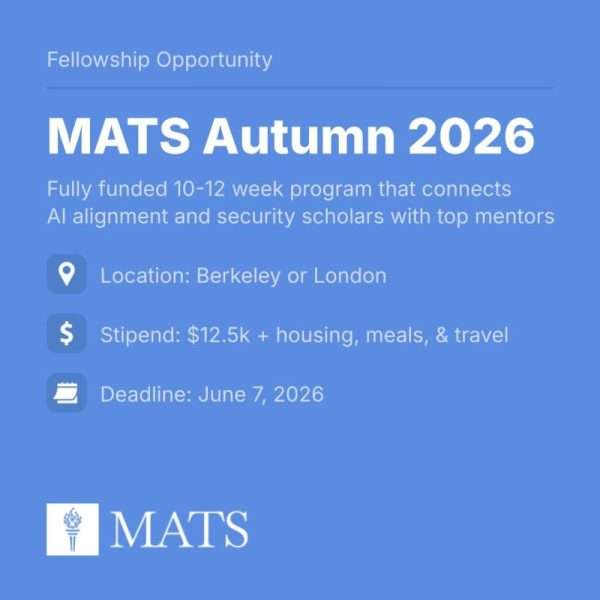
Research Fellow
MATS Research Fellowship

Ocean Nexus International Fellowship
Ocean Nexus

PhD Scholarships at the University of Verona (XLII Cycle, Academic Year 2026/2027): Full Admission Call with 104 Funded Positions
the University of Verona (XLII Cycle, Academic Year 2026/2027): Full Admission Call with 104 Funded Positions

UNITAR–FAO Trade, Food Security and Nutrition (TFSN) Course 2026: Free Online Training Opportunity for Policymakers, Researchers, and Agricultural Trade Professionals in Africa
FAO Trade, Food Security and Nutrition (TFSN) Course 2026: Free Online Training Opportunity for Policymakers, Researchers, and Agricultural Trade Professionals in Africa

Researcher
Mo Ibrahim Foundation

Public Tech Media Lab Fellowship and Research Community at the University of Wisconsin–Madison: Join a Global Network Advancing Media, Technology, and Democracy
the University of Wisconsin–Madison: Join a Global Network Advancing Media, Technology, and Democracy