
Public Contributor in Governance and Policy @Centre for Policy Analysis (CEPA)
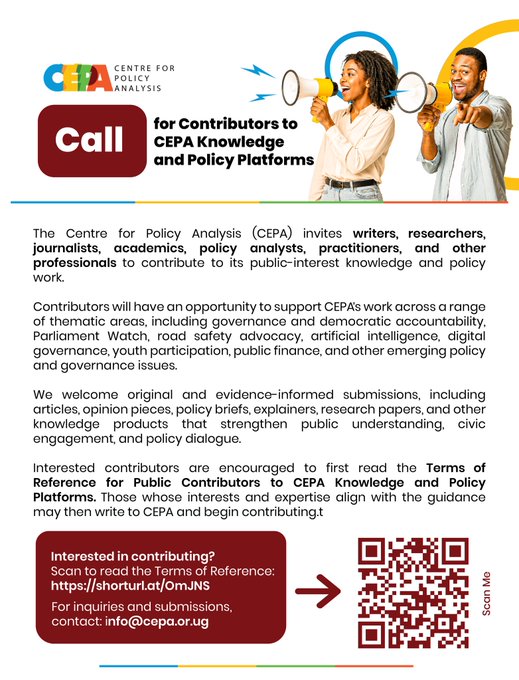
The Centre for Policy Analysis (CEPA), an independent public policy research and governance think tank in Uganda, has issued a call for public contributors to participate in its growing knowledge and policy platforms. Through a newly released Terms of Reference (ToR), the organisation is inviting scholars, researchers, policy practitioners, civil society actors, journalists, students, public officials, and engaged citizens to contribute to evidence-based discussions on governance, democracy, public policy, and development.
The initiative forms part of CEPA’s broader mission to strengthen informed public discourse, democratic participation, accountable governance, and citizen engagement across Uganda. By opening its platforms to a diverse range of contributors, the organisation seeks to expand access to knowledge while promoting constructive dialogue on issues of national and regional importance.
Strengthening Evidence-Based Public Policy Discussions
According to CEPA, the public contribution framework is designed to establish clear standards for quality, professionalism, ethics, and editorial review while encouraging meaningful participation in public policy conversations.
Contributions submitted to CEPA are expected to support several objectives, including:
- Advancing informed debate on governance, democracy, accountability, and human rights.
- Generating evidence-based analysis and practical policy recommendations.
- Enhancing public understanding of governance institutions and policy processes.
- Promoting citizen participation in democratic and development processes.
- Encouraging innovative solutions to socio-economic and governance challenges.
- Supporting knowledge generation on emerging national, regional, and global issues.
- Strengthening CEPA’s position as a leading platform for policy dialogue and research dissemination.
The organisation emphasises that all contributions should contribute positively to public understanding and policy development while maintaining high standards of intellectual rigor and public accountability.
Wide Range of Thematic Areas Open for Contributions
CEPA welcomes submissions across a broad spectrum of governance, development, and public affairs topics. The thematic priority areas reflect some of the most pressing issues facing Uganda and the wider region.
Parliamentary Democracy and Legislative Affairs
Contributors may submit analyses and commentary on:
- Parliamentary performance
- Legislative reforms
- Parliamentary oversight
- Citizen representation
- Political party governance
- Electoral systems and reforms
Governance and Accountability
Topics under this category include:
- Public sector governance
- Transparency initiatives
- Anti-corruption efforts
- Public administration reforms
- Decentralisation
- Open government and access to information
Public Finance and Economic Governance
CEPA is also seeking contributions focused on:
- National budgets
- Public expenditure management
- Taxation policies
- Domestic revenue mobilisation
- Debt management
- Public procurement
- Fiscal governance
Human Rights, Justice and Inclusion
Priority issues include:
- Constitutionalism
- Rule of law
- Human rights protection
- Gender equality
- Youth participation
- Civic freedoms
- Access to justice
Sustainable Development and Public Policy
The organisation encourages submissions addressing:
- Education policy
- Health systems
- Social protection
- Climate change
- Environmental governance
- Agriculture and food security
- Energy policy
- Infrastructure development
- Digital governance
Regional and Global Affairs
Contributors may also explore:
- Regional integration
- Foreign policy
- International development cooperation
- Comparative governance experiences
- Global governance trends
Diverse Contributors Encouraged to Apply
CEPA has adopted an inclusive approach to participation, opening opportunities to a wide range of professionals and citizens.
Eligible contributors include:
- Academics and researchers
- Policy analysts
- Governance practitioners
- Civil society actors
- Journalists and media professionals
- Lawyers and legal scholars
- Development practitioners
- Students and emerging researchers
- Public officials and former public servants
- Interested citizens with relevant expertise, lived experience, or demonstrated interest in governance and public policy
Selection of contributors will be guided by several factors, including subject matter expertise, quality of analysis, commitment to evidence-based discourse, professional integrity, and alignment with CEPA’s thematic priorities.
Multiple Formats Accepted
To encourage diverse perspectives and writing styles, CEPA accepts a variety of contribution formats.
These include:
- Opinion articles (700–1,500 words)
- Policy briefs (1,500–3,000 words)
- Research notes (1,000–2,500 words)
- Feature analyses (1,200–2,500 words)
- Discussion papers
- Governance commentaries
- Explainers and issue briefs
- Case studies
- Research papers
- Interviews and expert reflections
- Blog articles
- Policy memos
- Reflective essays
This flexibility allows contributors to share insights in formats that best suit their expertise and intended audience.
Editorial Standards and Ethical Requirements
CEPA has outlined clear editorial standards to ensure all published content meets professional and ethical expectations.
Submissions must:
- Be original and previously unpublished.
- Be supported by credible evidence and verifiable sources.
- Present clear and balanced arguments.
- Remain accessible to technical and non-technical audiences.
- Distinguish opinion from factual reporting.
- Avoid misinformation, hate speech, defamatory content, and partisan political mobilisation.
Contributors are encouraged to include references, citations, and supporting evidence where appropriate.
In addition, authors must disclose potential conflicts of interest, respect intellectual property rights, avoid plagiarism, and comply with Ugandan laws and internationally recognised ethical standards.
Editorial Review and Publication Process
All submissions will undergo a comprehensive editorial review process before publication.
The review will assess:
- Relevance
- Accuracy
- Analytical quality
- Clarity and readability
- Ethical compliance
- Alignment with CEPA’s mission and values
Editors may request revisions where necessary, and final publication decisions will remain at the discretion of the CEPA Editorial Committee.
Intellectual Property and Submission Guidelines
Authors will retain copyright ownership of their work. However, by submitting content, contributors grant CEPA a non-exclusive, royalty-free licence to publish, reproduce, archive, distribute, and promote the material across its platforms with full attribution.
Interested contributors are required to submit:
- A manuscript or article
- A short author biography (50–100 words)
- Institutional affiliation, where applicable
- Contact information
- A declaration of originality and conflict of interest
Submissions should be sent to CEPA’s editorial team using the subject line format: “Public Contribution Submission – [Type of Contribution] – [Author Name].”
Expanding Public Participation in Policy Development
Through this initiative, CEPA aims to create a vibrant and inclusive knowledge ecosystem that supports democratic engagement, policy innovation, and informed decision-making in Uganda. By welcoming contributions from diverse voices and sectors, the organisation seeks to strengthen public participation in governance while fostering meaningful dialogue on the country’s most pressing policy challenges.
VIEW THE ToR HERE
For more opportunities such as these please follow us on Facebook, Instagram, WhatsApp, Twitter, LinkedIn and WPChannel
Disclaimer: Global South Opportunities (GSO) is not the organization offering this opportunity. For any inquiries, please contact the official organization directly. Please do not send your applications & CVs to GSO, as we are unable to process them. Due to the high volume of emails, we receive daily, we may not be able to respond to all inquiries. Thank you for your understanding.
Public Contributor in Governance and Policy
@Centre for Policy Analysis (CEPA)
Location
USA / Global
Work Mode
fellowship
Posted
about 3 hours ago
Beware of scams! When applying for jobs, you should NEVER have to pay anything. Learn about job scams.
Get jobs in your inbox
Join over 10,000 subscribers receiving our weekly newsletter.
You might also like

Google Career Certificate Scholarship Programme
Wetech

Bolder Futures Fellowship: AI for Social Good
Micron

Executive Leadership Programmes
African School of Governance
Royal Society Wolfson Fellowships
Royal Society

Road Safety Reporting Forum for African Journalists
Centre for Journalism Innovation and Development (CJID) in collaboration with World Health Organization (WHO)

Africa-China Relations Training Workshop for Journalists in West Africa (Fully Funded)
China Relations Training Workshop for Journalists in West Africa (Fully Funded)