




Transfyr AI Fellowship 2026–2027: $125,000 Paid AI Research Fellowship for Graduate Students, PhDs, and Postdoctoral Researchers Worldwide ·2027: $125,000 Paid AI Research Fellowship for Graduate Students, PhDs, and Postdoctoral Researchers Worldwide

    about 3 hours ago·Open application: Transfyr AI Fellowship 2026–2027: $125,000 Paid AI Research Fellowship for Graduate Students, PhDs, and Postdoctoral Researchers Worldwide via 2027: $125,000 Paid AI Research Fellowship for Graduate Students, PhDs, and Postdoctoral Researchers Worldwide·📍 Global
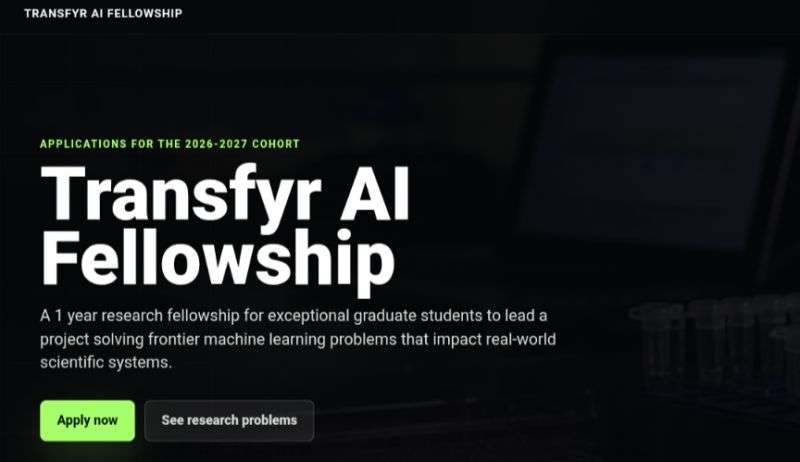
    Applications are now open for the Transfyr AI Fellowship 2026–2027, a prestigious one-year, fully funded research fellowship designed for exceptional graduate students, recent PhD graduates, and postdoctoral researchers who are passionate about advancing frontier machine learning research with real-world scientific impact.

    The fellowship offers an outstanding opportunity to work alongside leading experts in artificial intelligence, biology, robotics, and scientific research while tackling some of the most challenging problems in machine learning and scientific automation.

    Successful fellows will receive $125,000 in annual compensation, comprehensive benefits, access to cutting-edge computational resources, and the opportunity to contribute to groundbreaking research that aims to transform how scientific work is understood, evaluated, and reproduced.

    Based primarily in the Boston/Cambridge area, the fellowship welcomes applications from talented researchers around the world and provides visa support for selected international fellows.

    About the Transfyr AI Fellowship

    The Transfyr AI Fellowship was established to address one of the biggest challenges facing modern science—the absence of a comprehensive observability layer that captures how scientific work actually happens.

    Scientific discovery often involves much more than published papers or laboratory protocols. It includes failed experiments, operator expertise, contextual decision-making, noisy instruments, repeated attempts, and numerous tacit processes that are rarely documented.

    Transfyr is building what it describes as the world’s largest multimodal dataset of scientific execution, allowing artificial intelligence systems to understand science as it is performed in real-world laboratory environments rather than relying solely on polished publications and benchmark datasets.

    The fellowship provides participants with the opportunity to work directly on these frontier challenges.

    Fellowship Overview

    The programme is a full-time research fellowship lasting 12 months.

    Selected fellows will:

    • Lead an independent research project.
    • Work with real multimodal scientific datasets.
    • Collaborate closely with scientists, engineers, operators, and AI researchers.
    • Build prototypes and novel machine learning systems.
    • Design new evaluation frameworks.
    • Produce publishable research or demonstration-quality technical outputs.

    The fellowship is intended for individuals who are interested in pushing the boundaries of machine learning while solving practical scientific problems.

    Research Areas

    Fellows will contribute to one or more frontier AI research challenges.

    1. Multimodal Reasoning

    Researchers will develop AI models capable of integrating multiple sources of scientific information.

    Research topics include:

    • Video understanding
    • Audio analysis
    • Laboratory protocol interpretation
    • Instrument data
    • Temporal reasoning
    • Human activity understanding
    • Cross-modal grounding

    2. Conflicting Evidence

    Scientific environments frequently contain inconsistent observations.

    Projects include:

    • Uncertainty estimation
    • Model calibration
    • Evidence attribution
    • Contradiction-aware reasoning

    3. Long-Context Scientific Memory

    Scientific workflows often extend across days, weeks, or months.

    Researchers will investigate:

    • Long-term memory systems
    • Retrieval over laboratory histories
    • State tracking
    • Failure memory
    • Process compression

    4. Real-World AI Evaluation

    Rather than relying on traditional AI benchmarks, fellows will design evaluation systems measuring real scientific performance.

    Areas include:

    • Benchmark design
    • Laboratory evaluation
    • Process-level metrics
    • Automated execution assessment

    5. Tacit Scientific Expertise

    Many laboratory skills cannot easily be written into protocols.

    Researchers will explore:

    • Expert decision-making
    • Human expertise representation
    • Human-in-the-loop AI
    • Skill modeling
    • Expert-versus-novice comparisons

    6. Physical-World AI

    This research area bridges robotics and artificial intelligence.

    Projects include:

    • Robotics
    • Embodied AI
    • Demonstration learning
    • Policy evaluation
    • Transfer learning

    7. Biosecurity and Bio-Risk Observability

    Fellows may develop AI systems capable of improving laboratory biosecurity through:

    • Workflow monitoring
    • Capability assessment
    • Autonomous vulnerability detection
    • Safety-critical containment systems

    8. Scientific Execution Ontology

    Researchers will build structured representations of experimental workflows including:

    • Protocol metadata
    • Laboratory preparation
    • Concentrations
    • Solubility
    • Plate setup
    • Experimental context
    • Biological variability

    What Fellows Will Do

    Throughout the fellowship, participants will:

    • Define an original research question.
    • Develop machine learning prototypes.
    • Analyze multimodal scientific execution data.
    • Design evaluation methodologies.
    • Produce publishable research.
    • Build technical demonstrations.
    • Develop datasets and benchmarks.

    Outstanding work may be incorporated into real-world scientific products.

    Mentorship and Research Environment

    One of the strongest aspects of the fellowship is direct mentorship.

    Fellows will work closely with:

    • Transfyr founders
    • Machine learning engineers
    • AI researchers
    • Biologists
    • Robotics experts
    • Scientific operators
    • Applied R&D specialists

    This interdisciplinary environment provides exceptional opportunities for learning and collaboration.

    Compensation and Benefits

    Selected fellows receive an attractive financial package that includes:

    Annual Compensation

    • $125,000

    Additional Benefits

    • Employee benefits
    • Access to GPUs
    • Compute resources
    • Scientific datasets
    • Research support
    • Technical infrastructure

    Applicants are encouraged to specify the computational resources required for their proposed research.

    Fellowship Location

    The programme is designed primarily for full-time, in-person participation in:

    Boston/Cambridge, Massachusetts, USA

    Remote participation may be approved only in exceptional circumstances where both the research project and applicant make remote collaboration feasible.

    Visa Support

    International researchers are encouraged to apply.

    Visa sponsorship will be provided to selected fellows requiring authorization to work in the United States.

    Research Outputs

    Participants are expected to produce meaningful research outputs, including:

    • Journal publications
    • Technical reports
    • Benchmarks
    • Datasets
    • Software prototypes
    • Research demonstrations

    While fellows are encouraged to publish their work, Transfyr retains ownership of fellowship work products, with publication subject to confidentiality and intellectual property review.

    Who Should Apply?

    The programme seeks outstanding researchers with strong technical backgrounds and intellectual curiosity.

    Ideal applicants include:

    • Current graduate students
    • Recent PhD graduates
    • Postdoctoral researchers

    Relevant academic disciplines include:

    • Machine Learning
    • Artificial Intelligence
    • Computer Science
    • Computational Biology
    • Robotics
    • Human-Computer Interaction
    • Statistics
    • Related computational disciplines

    Applicants should demonstrate:

    • Strong machine learning expertise
    • Excellent research ability
    • Creativity
    • Curiosity
    • Comfort working on ambiguous research challenges

    Programme Timeline

    Applications are reviewed on a rolling basis.

    Rolling Review

    Applications are evaluated as they are received.

    Full Consideration Deadline

    Applicants are encouraged to submit by:

    15 August 2026

    Decision Timeline

    Selection decisions will be made on a rolling basis through:

    Late August 2026

    Fellowship Start Date

    Selected fellows are expected to begin around:

    September 2026

    Application Requirements

    The application process has been intentionally designed to be concise.

    Applicants must submit:

    • A one-page application.
    • Description of the research project they wish to pursue.
    • Required computational resources.
    • Links showcasing previous work.

    Finalists will later be asked to provide academic references.

                                                                     APPLY HERE

    For More Information

    Interested applicants can learn more about the fellowship and explore the available research problems HERE

    For enquiries regarding the fellowship or application process, applicants may contact:

    Email: ai_fellowship@transfyr.ai

    Applicants are encouraged to submit their applications as early as possible because reviews are conducted on a rolling basis and early submissions receive the greatest consideration.

    Conclusion

    The Transfyr AI Fellowship 2026–2027 represents an exceptional opportunity for graduate students, recent PhD graduates, and postdoctoral researchers who aspire to work at the intersection of artificial intelligence and scientific discovery. Offering a competitive annual compensation of $125,000, world-class mentorship, access to advanced computational resources, and the opportunity to contribute to pioneering research with real-world scientific applications, the fellowship provides an ideal environment for ambitious researchers to make meaningful contributions to frontier machine learning. Interested applicants from around the world are encouraged to submit their applications by 15 August 2026 for full consideration and take the next step toward shaping the future of AI-driven scientific research.

    Discover more global Fellowship opportunities on OFY HERE

    Get jobs in your inbox

    Join over 10,000 subscribers receiving our weekly newsletter.