








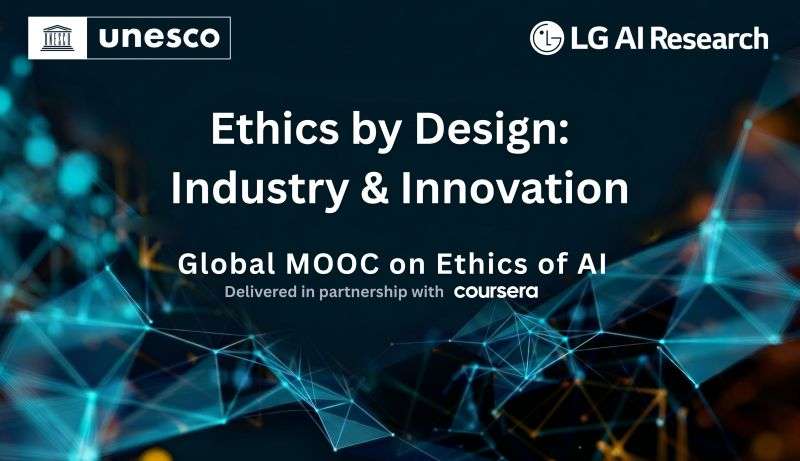
UNESCO and LG AI Research Launch Free Global Ethics of Artificial Intelligence Course on Coursera: Earn a Certificate While Learning ·Unknown
Artificial Intelligence (AI) is transforming every sector of society—from healthcare and education to finance, governance, agriculture, manufacturing, and scientific research. As AI systems become increasingly integrated into everyday life, ensuring that they are developed and used responsibly has become one of the world’s most pressing priorities.
Recognizing this global need, UNESCO, in partnership with LG AI Research and Coursera, has officially launched the Global MOOC on the Ethics of Artificial Intelligence, a free online course designed to help learners around the world understand and apply ethical principles throughout the AI lifecycle.
Announced during the Ethics by Design: Industry and Innovation Conference held in Seoul, Republic of Korea, this globally accessible Massive Open Online Course (MOOC) represents an important milestone in transforming international AI ethics standards into practical knowledge that professionals, students, policymakers, researchers, and organizations can apply in real-world situations.
Hosted on Coursera and available free of charge, the course equips learners with practical frameworks, case studies, and decision-making tools that support the responsible development, deployment, and governance of AI technologies.
About the Global MOOC on the Ethics of Artificial Intelligence
The Global MOOC on the Ethics of Artificial Intelligence has been created to translate the principles contained in UNESCO’s Recommendation on the Ethics of Artificial Intelligence into practical learning experiences.
Rather than simply explaining ethical concepts, the course demonstrates how these principles can be implemented throughout every stage of AI development—from system design and model training to deployment, governance, monitoring, and long-term societal impact.
The course serves as a global public educational resource that allows learners everywhere to develop the practical skills needed to build trustworthy, transparent, fair, and human-centered AI systems.
Official Launch of the Course
The course was officially launched on 20 July 2026 during the Ethics by Design: Industry and Innovation Conference held at the Korean National Commission for UNESCO in Seoul.
The launch ceremony brought together distinguished representatives from international organizations, governments, industry, academia, and AI research communities.
Among those present were:
- Prof. Khaled El-Enany, Director-General of UNESCO
- Dr. Kyung Hoon Bae, Deputy Prime Minister and Minister of Science and ICT, Republic of Korea
- Dr. Woohyung Lim, Head of LG AI Research
The event also welcomed:
- Government leaders
- Technology experts
- University researchers
- Industry professionals
- Members of the International Advisory Group
- Module leaders responsible for developing the course
The gathering reflected the growing international collaboration required to ensure AI technologies remain ethical, inclusive, transparent, and beneficial to humanity.
Built on UNESCO’s Global AI Ethics Recommendation
One of the defining strengths of this MOOC is that it is based directly on the UNESCO Recommendation on the Ethics of Artificial Intelligence, adopted unanimously in 2021 by all 193 UNESCO Member States.
This Recommendation became the world’s first global normative framework dedicated specifically to AI ethics.
Rather than functioning as a theoretical document, the Recommendation establishes internationally agreed principles covering:
- Human rights
- Human dignity
- Fairness
- Transparency
- Accountability
- Privacy
- Environmental sustainability
- Inclusiveness
- Safety
- Responsible governance
The new course helps learners operationalize these principles in everyday professional practice.
Why This Course Matters
Artificial Intelligence is advancing rapidly across industries, creating both tremendous opportunities and significant ethical challenges.
Organizations increasingly require professionals who understand not only how AI systems work but also how they should be designed and governed responsibly.
According to UNESCO, ethical AI cannot be achieved through principles alone—it depends on people who possess the skills to apply those principles during every phase of AI development.
This course bridges the gap between policy and practice by providing learners with practical tools to:
- Build trustworthy AI systems
- Identify ethical risks
- Balance innovation with responsibility
- Protect human rights
- Improve transparency
- Promote accountability
- Support inclusive AI development
- Make informed ethical decisions
Who Should Take This Course?
The MOOC has been designed for a broad global audience.
It is suitable for:
- Artificial intelligence professionals
- Machine learning engineers
- Software developers
- AI researchers
- Data scientists
- University students
- Academic researchers
- Government policymakers
- Public administrators
- Technology executives
- Product managers
- Ethics specialists
- Innovation leaders
- Business professionals
- Anyone interested in understanding responsible AI
No matter the learner’s background, the course provides practical knowledge applicable across multiple industries.
What You Will Learn
Participants will gain practical understanding of responsible AI development through ten comprehensive learning modules.
Learners will understand:
- Ethical AI principles
- Responsible AI design
- Human-centered AI development
- AI governance
- Privacy protection
- Transparency mechanisms
- Risk management
- Accountability frameworks
- Sustainable AI practices
- Fair AI decision-making
The course emphasizes real-world implementation rather than theoretical discussion alone.
Course Structure: Ten Comprehensive Modules
The curriculum is organized into ten carefully designed modules covering the most important dimensions of AI ethics.
Major topics include:
1. Fairness and Inclusion
Learners explore methods for reducing bias in AI systems while promoting fairness and equitable outcomes.
Topics include:
- Algorithmic bias
- Inclusive datasets
- Equal treatment
- Social equity
2. Privacy and Data Governance
This module examines responsible data collection, management, protection, and governance.
Topics include:
- Data privacy
- Consent
- Responsible data use
- Governance policies
- Data security
3. Transparency and Accountability
Participants learn how organizations can make AI systems understandable and accountable.
Key concepts include:
- Explainable AI
- Transparency reporting
- Accountability mechanisms
- Documentation
- Responsible oversight
4. Safety and Security
The course explores methods for designing AI systems that remain safe, secure, and reliable.
Topics include:
- Risk assessment
- AI safety
- Cybersecurity
- System reliability
- Responsible deployment
5. Environmental Sustainability
Learners examine how AI development affects the environment and explore strategies to reduce environmental impacts.
Topics include:
- Energy-efficient AI
- Sustainable computing
- Environmental responsibility
- Green AI practices
6. Global AI Governance
Participants study international governance models and regulatory approaches shaping AI worldwide.
Areas covered include:
- International cooperation
- AI regulation
- Global standards
- Public policy
- Governance frameworks
7–10. Practical Ethics Throughout the AI Lifecycle
Across the remaining modules, learners engage with:
- Practical ethical decision-making
- Everyday AI development trade-offs
- Real-world case studies
- Reflection exercises
- Ethics-by-design methodologies
- Responsible innovation frameworks
Practical Learning Experience
Unlike many introductory AI ethics courses, this MOOC places strong emphasis on application.
Learners will work with:
- Practical scenarios
- Interactive exercises
- Real-world examples
- Reflective learning activities
- Ethical decision-making frameworks
- Industry case studies
The objective is to help participants confidently apply ethical principles in their own organizations and projects.
Developed Through Global Collaboration
The course represents a significant public-private partnership.
It has been co-developed by:
- UNESCO
- LG AI Research
- Coursera
Its curriculum has also been shaped by independent international AI experts representing leading academic and research institutions worldwide.
This diverse collaboration ensures that the examples, perspectives, and case studies reflect different regional, cultural, and professional contexts.
Visit here for more details on UNESCO and LG AI Research Launch Free Global Ethics of Artificial Intelligence Course on Coursera
Expert Perspectives
During the launch, UNESCO Director-General Prof. Khaled El-Enany emphasized that ethical AI depends on people who can translate shared principles into everyday practice.
Dr. Kyung Hoon Bae highlighted the Republic of Korea’s commitment to supporting human-centered AI development and digital inclusion through continued collaboration with UNESCO and the international community.
Dr. Woohyung Lim of LG AI Research stressed that while international consensus on ethical AI already exists, the real challenge is embedding ethics throughout the entire AI lifecycle—from product development to operational deployment.
Coursera Chief Content Officer Marni Baker Stein noted that the platform is proud to host the course, expanding access to high-quality education on responsible AI for learners worldwide.
Industry Dialogue on Ethical AI
The launch event also featured expert panel discussions involving representatives from:
- LG AI Research
- United Nations University Institute in Macau
- University of Toronto
- Korea AI Safety Institute
- Gwangju Institute of Science and Technology
- Kakao
- Naver
- Agence Francophone et Africaine de l’Intelligence Artificielle (AFRIA)
The discussions emphasized several key priorities:
- Building trustworthy AI
- Strengthening AI safety
- Improving fairness and accountability
- Embedding ethics into everyday product development
- Establishing strong governance structures
- Protecting human rights
- Communicating transparently with the public
Certification
Learners who successfully complete the course are eligible to receive a Coursera certificate, demonstrating their understanding of responsible AI and ethical AI principles.
This certificate can strengthen professional profiles for individuals working in technology, public policy, research, education, business, and digital transformation.
Language Availability
The course is delivered primarily in English.
To promote inclusive global participation, translation options are available in 11 languages, enabling learners from diverse linguistic backgrounds to benefit from the program.
Cost
The Global MOOC on the Ethics of Artificial Intelligence is completely free to access through Coursera.
This makes high-quality education on AI ethics accessible to learners regardless of geographic location or financial circumstances.
Application Deadline
There is no application deadline mentioned. The course is freely available on Coursera for learners worldwide.
Why You Should Enroll
This course offers an outstanding opportunity to understand one of the most important dimensions of artificial intelligence in today’s digital world.
Whether you are building AI systems, regulating them, researching new technologies, managing AI projects, or simply seeking to understand responsible innovation, the course provides practical tools grounded in internationally recognized ethical standards.
With AI rapidly transforming industries worldwide, professionals who understand ethical AI principles will be increasingly valuable across both public and private sectors.
Conclusion
The UNESCO and LG AI Research Global MOOC on the Ethics of Artificial Intelligence is more than just an online course—it is a global educational initiative aimed at ensuring AI serves humanity responsibly, fairly, and sustainably. Built upon UNESCO’s internationally recognized Recommendation on the Ethics of Artificial Intelligence, the course transforms global ethical principles into practical skills that learners can immediately apply throughout the AI lifecycle.
Freely available through Coursera and accessible worldwide, the program offers a unique opportunity for students, professionals, policymakers, researchers, developers, and organizations to deepen their understanding of responsible AI while earning a certificate from one of the world’s leading online learning platforms. As artificial intelligence continues to reshape society, this course equips learners with the knowledge and practical frameworks needed to build trustworthy, transparent, human-centered AI systems that align innovation with ethical responsibility.
UNESCO and LG AI Research Launch Free Global Ethics of Artificial Intelligence Course on Coursera: Earn a Certificate While Learning
@Unknown
Location
USA / Global
Work Mode
conference
Posted
about 4 hours ago
Beware of scams! When applying for jobs, you should NEVER have to pay anything. Learn about job scams.
Get jobs in your inbox
Join over 10,000 subscribers receiving our weekly newsletter.
You might also like

UNESCO World Conference on Education for Sustainable Development (ESD) 2027 Call for Proposals: Submit a Parallel Session for the Global Conference in Nairobi, Kenya
Unknown
Council of Europe World Forum for Democracy Youth Delegation 2026 in Strasbourg, France: Fully Funded Opportunity for Young Democracy Leaders Worldwide
Unknown
Call for Speakers at #PAYCON2026: Present Your Research and Shape the Future of Youth Health in Africa
#PAYCON2026: Present Your Research and Shape the Future of Youth Health in Africa
Youth Ambassador at the 8th German-Baltic Conference 2026 in Estonia: Apply to Shape Europe’s Future Through Policy and Leadership
the 8th German-Baltic Conference 2026 in Estonia: Apply to Shape Europe’s Future Through Policy and Leadership
Evidence for Climate Action Opens Its Call for COP31: Calling All Researchers to Get Involved
Unknown
Global Youth Water Envoys Program 2026: Fully Funded Opportunity for 100 Young Leaders to Participate in the UN Water Conference in Abu Dhabi
Unknown