








UNICEF Gender-Responsive Social Protection E-Course: Self-Paced Training for Practitioners and Development Professionals ·Responsive Social Protection E-Course: Self-Paced Training for Practitioners and Development Professionals
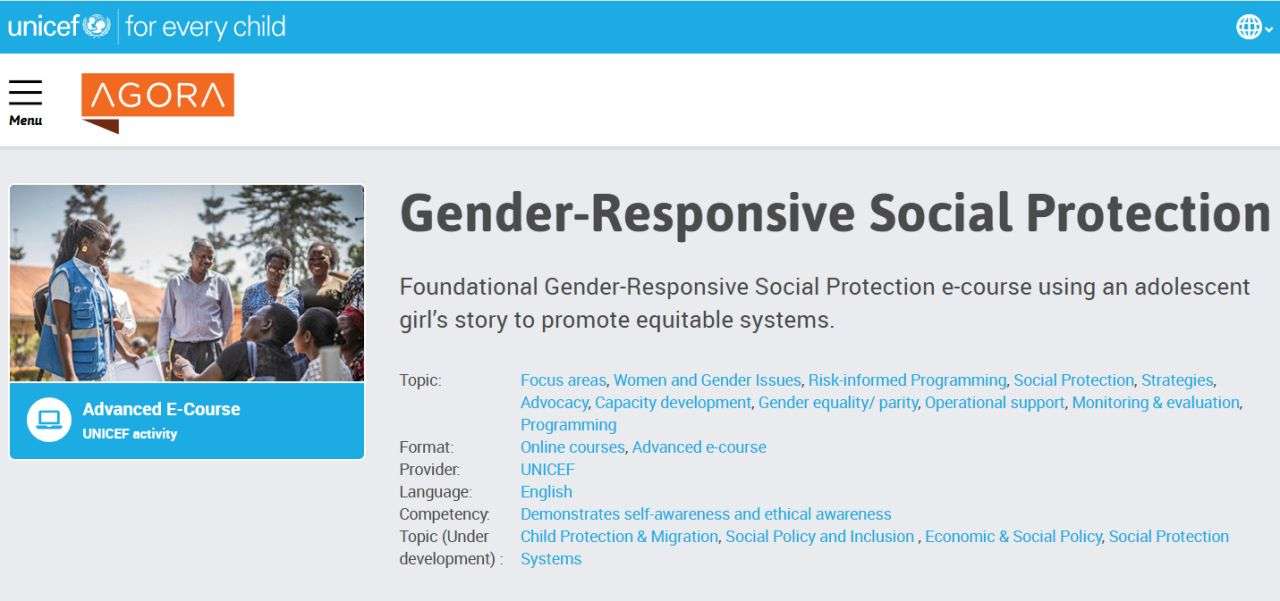
UNICEF is offering a self-paced online course on Gender-Responsive Social Protection, designed to help practitioners, development professionals and government partners understand how gender shapes access to opportunity, security, services and well-being throughout a person’s life.
The course introduces the principles and practical application of Gender-Responsive Social Protection, commonly abbreviated as GRSP. It examines how social protection policies and programmes can be designed, delivered, monitored and improved so that they respond to gender-related risks, prevent exclusion and promote dignity, equality and empowerment.
Through interactive exercises, decision-based scenarios, videos, case studies and reflection activities, learners will explore how gender-responsive approaches can improve social protection systems for women, girls and other groups facing intersecting forms of disadvantage.
The activity is delivered online in English and takes approximately two hours to complete. It is open for self-enrollment, and no application deadline is stated.
About the UNICEF Gender-Responsive Social Protection Course
Gender-Responsive Social Protection is an approach that recognizes that women, men, girls, boys and gender-diverse individuals may experience poverty, vulnerability and access to public services differently.
Gender can affect:
- Who performs unpaid care work
- Who has access to identification documents
- Who controls household income
- Who is able to travel safely to collect payments
- Who receives information about available programmes
- Who is formally registered for benefits
- Who faces discrimination or exclusion
- Who can use grievance and complaints systems
- Who is most exposed to economic, environmental or social shocks
A social protection programme may appear neutral while still producing unequal outcomes. For example, a payment system may technically be open to everyone but remain inaccessible to women who lack bank accounts, identification documents, mobile phones, transport or control over household finances.
The course helps learners identify these barriers and consider how programmes can be adjusted to promote fairer and more effective outcomes.
Although the activity is categorized as an advanced e-course, the description presents it as a foundational introduction to Gender-Responsive Social Protection. It therefore provides core concepts while also introducing practical frameworks and tools that can be applied in programme design, delivery, monitoring and advocacy.
The Story-Based Learning Approach
The course follows the story of Mia, an adolescent girl living in a flood-prone coastal town.
Her daily experiences illustrate how gender roles, safety concerns, time pressures and access to documentation can influence whether someone receives social protection support.
As learners progress through the course, they are encouraged to consider questions such as:
- What barriers make it difficult for Mia to access support?
- How do household and community expectations affect her choices?
- Does she have the documents required for registration?
- Can she safely reach registration or payment locations?
- Does she have access to information about available services?
- Are programme staff aware of the gender-related risks she faces?
- How could the system be redesigned to serve her more effectively?
Mia’s experience provides a practical thread connecting the course modules. It shows that removing barriers for adolescent girls and other excluded groups can improve programme accessibility and effectiveness for the wider population.
Why Gender Matters in Social Protection
Social protection systems are intended to reduce poverty, manage risks and support people during periods of vulnerability. These systems may include cash transfers, social insurance, public employment programmes, food assistance, child benefits, pensions and other forms of support.
However, people do not experience vulnerability in identical ways.
Gender-related inequalities may influence:
- Employment opportunities
- Income security
- Ownership of assets
- Access to education
- Exposure to violence
- Unpaid care responsibilities
- Mobility
- Digital access
- Financial inclusion
- Participation in decision-making
- Access to public institutions
These inequalities can become more severe during crises such as floods, conflict, displacement, economic shocks or public-health emergencies.
A gender-responsive approach does not simply add women or girls to an existing programme. It examines how the entire system operates and whether its design, implementation and monitoring address gender-based barriers.
Course Learning Objectives
By the end of the UNICEF Gender-Responsive Social Protection course, learners should be able to achieve the following objectives.
1. Understand Core Concepts
Participants will learn to define and distinguish concepts including:
- Gender equality
- Gender equity
- Intersectionality
- Social protection
- Gender responsiveness
- Inclusion
- Empowerment
Understanding these terms is important because they shape how programmes identify inequalities and develop appropriate responses.
2. Explain Why Gender Matters
Learners will examine how gender affects risks and vulnerabilities at different stages of life.
These stages may include:
- Childhood
- Adolescence
- Working age
- Parenthood
- Older age
Participants will consider how expectations, discrimination and unequal access to resources can influence a person’s ability to benefit from social protection.
3. Apply Gender Analysis
The course introduces gender-analysis frameworks and tools that can be used to assess whether a social protection programme is responsive to the needs of different groups.
Gender analysis may examine:
- Who has access to resources
- Who participates in decision-making
- Who performs paid and unpaid work
- Who controls income or benefits
- Who faces safety risks
- Who is excluded from registration or payments
- How gender interacts with disability, age, migration status, poverty or location
4. Design Gender-Responsive Interventions
Learners will be introduced to a structured, step-by-step approach for designing or adapting social protection interventions.
This may include:
- Identifying gender-related risks and barriers
- Understanding the affected population
- Reviewing the existing programme design
- Selecting practical adjustments
- Consulting affected communities
- Integrating safeguards
- Developing indicators
- Monitoring results and unintended consequences
5. Improve Delivery Systems
A well-designed policy can still exclude people if its delivery systems are inaccessible or unsafe.
The course examines key delivery stages, including:
- Outreach and communication
- Identification and eligibility assessment
- Registration
- Enrollment
- Payments
- Referral services
- Complaints and grievance mechanisms
Learners will consider how each stage can be improved to promote equity and reduce the risk of exclusion, discrimination or harm.
6. Develop Monitoring, Evaluation and Learning Plans
Participants will learn how to develop a basic gender-responsive monitoring, evaluation and learning plan.
This may involve:
- Selecting measurable indicators
- Collecting gender-disaggregated data
- Monitoring programme accessibility
- Assessing whether benefits reach intended groups
- Identifying unintended harm
- Gathering feedback from participants
- Using findings to improve programme delivery
Gender-responsive monitoring should move beyond counting how many women or girls participate. It should examine whether the programme changes access, safety, decision-making, time use, income security or other relevant outcomes.
7. Advocate for Policy and System-Level Change
The course also helps learners understand how evidence, partnerships and inclusive stakeholder engagement can support broader policy change.
Effective advocacy may involve collaboration among:
- Government ministries
- Social protection agencies
- Civil society organisations
- Women’s rights organisations
- Youth groups
- International organisations
- Donors
- Researchers
- Private-sector partners
- Communities receiving support
8. Demonstrate and Continue Learning
Participants will complete lesson-level knowledge checks and a final assessment.
They will also be introduced to tools and resources that can support continued application after the course.
Course Structure
The UNICEF Gender-Responsive Social Protection e-course consists of five modules.
Module 1: Understanding Gender and Social Protection
The first module introduces the relationship between gender and social protection.
Learners explore concepts such as equality, equity and intersectionality while examining how gender-related inequalities affect vulnerability and access to support.
Module 2: Designing Gender-Responsive Social Protection
This module focuses on programme design.
Participants learn how to apply gender analysis and use a structured approach to develop or adapt social protection interventions.
Module 3: Delivering Gender-Responsive Social Protection
The third module examines delivery systems.
It considers how outreach, registration, enrollment, payment arrangements and grievance mechanisms can either promote inclusion or reinforce existing inequalities.
Module 4: Monitoring, Evaluation and Learning for GRSP
This module introduces gender-responsive monitoring, evaluation and learning.
Learners examine how indicators, data and participant feedback can be used to assess whether a programme is achieving equitable outcomes.
Module 5: Advocacy for Gender-Responsive Social Protection
The final module focuses on advocacy, collaboration and policy change.
It considers how practitioners can use evidence and stakeholder engagement to strengthen gender responsiveness across social protection systems.
Course Methodology
The course uses a self-paced, learner-centred methodology based on modular microlearning.
Learning activities include:
- Story-based scenarios
- Decision-based exercises
- Interactive videos
- Practical case studies
- Reflection activities
- Knowledge checks
- Instant feedback
- A final assessment
- Tools for practical application
The course is grounded in adult-learning principles and has been designed to support inclusive and accessible learning.
Its practical structure allows participants to connect theoretical concepts with real-world social protection challenges.
Course Duration and Format
The estimated completion time is:
Approximately two hours
The course is:
- Fully online
- Self-paced
- Delivered in English
- Open for self-enrollment
- Divided into five modules
Because it is self-paced, learners can progress through the materials according to their schedules.
The listing does not state whether participants must complete all modules in one sitting or whether a certificate is awarded. Learners should confirm certification and completion requirements on the enrollment platform.
Who Is the Course Designed For?
The course has a broad professional audience.
It is suitable for:
UNICEF Personnel
- Country office staff
- Regional office staff
- Headquarters personnel
- Centres of Excellence personnel
- Consultants
- Interns
- Volunteers
- Goodwill ambassadors
- Board members
- National Committee representatives
Government and Public-Sector Professionals
The course may be particularly relevant to officials working in:
- Social protection
- Social welfare
- Gender equality
- Labour
- Finance
- Education
- Health
- Child protection
- Disaster risk management
- Humanitarian response
- Monitoring and evaluation
- Public policy
Civil Society and Development Partners
Non-UNICEF participants may include:
- Civil society organisations
- International NGOs
- Local NGOs
- Foundations
- Donors
- Researchers
- Universities
- Advocacy organisations
- Private-sector partners
- Social-policy professionals
- Gender specialists
The course is especially relevant to people involved in programme design, implementation, delivery, evaluation or policy advocacy.
Areas of Professional Relevance
The e-course may support work in areas including:
- Gender equality
- Social protection systems
- Women’s empowerment
- Adolescent programming
- Child protection
- Migration
- Social inclusion
- Economic and social policy
- Risk-informed programming
- Climate resilience
- Advocacy
- Capacity development
- Monitoring and evaluation
- Programme operations
Professionals working in crisis-prone or climate-vulnerable environments may find the content particularly useful because the course illustrates how shocks can interact with existing gender inequalities.
Competency Developed
The course is connected to the competency:
Demonstrates self-awareness and ethical awareness
This competency is relevant because gender-responsive programming requires practitioners to reflect critically on assumptions, power relationships and the potential unintended consequences of programme decisions.
It also requires professionals to consider:
- Whose voices are included
- Whose needs are overlooked
- How data is collected and used
- Whether interventions create additional risks
- Whether programmes respect dignity and agency
- How affected communities participate in decisions
How to Enroll
The course is open to self-enrollment.
Prospective learners should access the course page and select the enrollment option provided on the platform.
Before beginning, participants may need to create or sign in to a learning-platform account.
The listing does not mention an application form, competitive selection process or enrollment fee.
ENROLL HERE
Application Deadline
No application or enrollment deadline is stated.
The course appears to remain available for self-enrollment. However, course availability can change, so interested learners should register while the activity remains open.
Contact Information
Content-related questions are directed to:
- Shreyasi Jha
- Jessica Owens
- Lauren Whitehead
The course is connected to UNICEF’s Global Programme Division, Climate Resilience for Children and Technical Assistance team in Bangkok.
Course and learner-management inquiries are directed to Shreyasi Jha.
Learners should use the contact options provided on the official course platform when requesting technical assistance or clarification.
Conclusion
The UNICEF Gender-Responsive Social Protection e-course provides a practical introduction to designing and delivering social protection systems that respond to gender-related inequalities.
Through the story of an adolescent girl living in a flood-prone community, learners examine how safety, time, documentation, social expectations and access to services influence whether people receive support.
The course moves from foundational concepts to practical programme design, delivery, monitoring and advocacy. Its five-module structure equips participants to identify barriers, assess programme responsiveness and propose improvements that promote equality, dignity and inclusion.
With an estimated duration of approximately two hours, a self-paced format and open enrolment, the course is accessible to UNICEF personnel, government officials, civil society partners and other professionals working in gender equality, social protection and inclusive policy.
UNICEF Gender-Responsive Social Protection E-Course: Self-Paced Training for Practitioners and Development Professionals
@Responsive Social Protection E-Course: Self-Paced Training for Practitioners and Development Professionals
Location
USA / Global
Work Mode
opportunity
Posted
1 day ago
Beware of scams! When applying for jobs, you should NEVER have to pay anything. Learn about job scams.
Get jobs in your inbox
Join over 10,000 subscribers receiving our weekly newsletter.
You might also like

Google News Initiative AI Skills Program 2.0 Opens Applications for Journalists in India
Unknown

Google Data Analytics Apprenticeship 2027 in India Offers Career Pathway for Aspiring Data Professionals
Unknown

Innovate Africa Challenge 2026: Smart Africa and FAO Launch 3rd Edition for AI-Driven Climate-Smart Agriculture Startups in Ghana, Kenya, Malawi, Rwanda and Uganda
Driven Climate-Smart Agriculture Startups in Ghana, Kenya, Malawi, Rwanda and Uganda

New vacancy with HSDF
Unknown

AEIP Scholars Programme 2026–2027: Fully Sponsored Africa-Europe Research Collaboration Programme for Young Scholars
2027: Fully Sponsored Africa-Europe Research Collaboration Programme for Young Scholars

Skills & Innovation Academy Ghana: Free Pre-Employment Training Connecting Graduates with SME Jobs in Ghana
Employment Training Connecting Graduates with SME Jobs in Ghana