








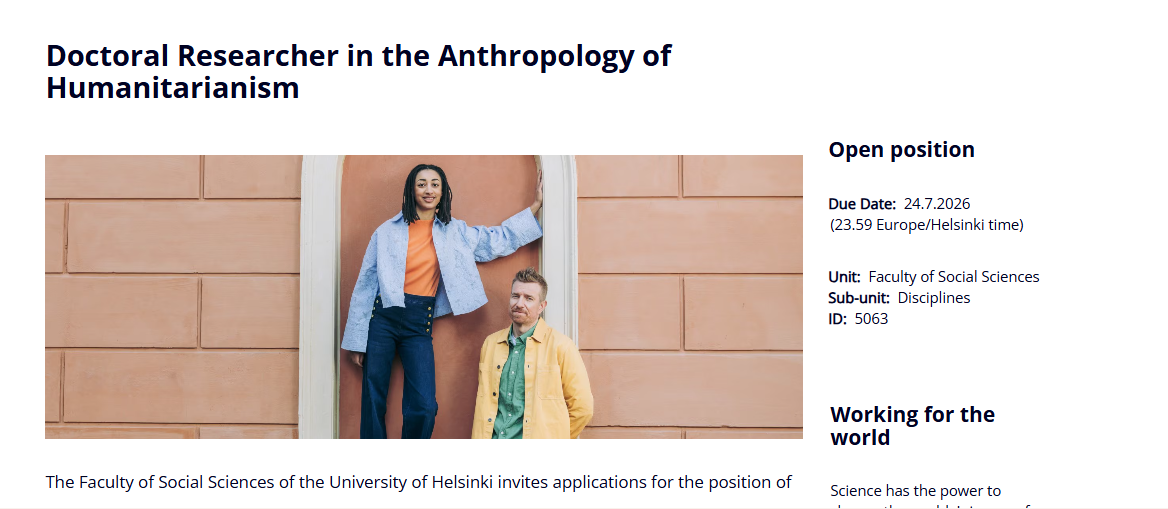
University of Helsinki Doctoral Researcher in the Anthropology of Humanitarianism 2026 in Finland: Fully Funded Four-Year PhD Research Opportunity @Year PhD Research Opportunity
The University of Helsinki has opened applications for a Doctoral Researcher in the Anthropology of Humanitarianism, offering an exceptional four-year funded doctoral research position for aspiring researchers interested in humanitarian systems, refugee studies, development, migration, anthropology, and global social change.
Hosted by the Faculty of Social Sciences, this prestigious doctoral position forms part of the Research Council of Finland-funded project, “New Humanitarian Infrastructures at the End of Aid,” led by Dr. Stefan Millar. The successful applicant will begin the position on 20 November 2026 and undertake cutting-edge research exploring how humanitarian systems are evolving in response to major global shifts in international aid.
The project provides doctoral researchers with the opportunity to conduct original ethnographic research, collaborate with international partners, contribute to academic publications, and complete a PhD at one of Europe’s leading research universities while enjoying the excellent academic and social environment that Finland offers.
Application Deadline: 24 July 2026 (23:59 Helsinki Time).
About the University of Helsinki
The University of Helsinki is one of Europe’s leading multidisciplinary research universities, recognized globally for excellence in research, innovation, and education.
With over:
- 30,000 students
- 8,000 staff members
- Extensive international collaborations
- Strong commitment to diversity, inclusion, and scientific excellence
the university provides an outstanding environment for doctoral education and research.
Its mission is built around four core values:
- Truth
- Bildung (education and intellectual growth)
- Freedom
- Inclusivity
Through interdisciplinary collaboration, the University of Helsinki seeks to generate solutions to some of the world’s most pressing social, environmental, and humanitarian challenges.
About the Research Project
The doctoral researcher will join the project:
New Humanitarian Infrastructures at the End of Aid
The project investigates one of the most important transformations occurring in global humanitarian assistance today.
Following major reductions in international aid—including the withdrawal of USAID support in 2025—the global humanitarian landscape is undergoing profound structural changes.
Rather than viewing humanitarian systems solely as institutional aid organizations, the project conceptualizes humanitarian infrastructures as dynamic assemblages involving:
- Social relationships
- Digital technologies
- Material systems
- Financial networks
- Government institutions
- Refugee-led initiatives
- Private-sector actors
- Diaspora communities
The project seeks to understand how these interconnected systems are evolving as traditional international aid declines.
Research Focus
Although the primary empirical focus is Kenya, applicants may propose research in another relevant humanitarian context if appropriately justified.
The project combines theoretical innovation with practical field research and aims to contribute to wider international debates concerning:
- The future of humanitarianism
- Refugee-led governance
- Alternative aid systems
- Humanitarian innovation
- Global inequality
- Humanitarian infrastructures
- Social transformation
Core Research Themes
Applicants should align their proposed doctoral research with one or more of the project’s major themes.
1. State Infrastructures
Research may examine how governments increasingly shape humanitarian responses by:
- Developing state-led humanitarian programmes
- Expanding social protection systems
- Replacing traditional aid agencies
- Restructuring refugee governance
2. Refugee-Led Infrastructures
This theme investigates how refugees themselves create alternative humanitarian systems through:
- Community-based organizations
- Grassroots leadership
- Political movements
- Local humanitarian initiatives
- Mutual support networks
Applicants interested in participatory research or community-led development are especially encouraged.
3. Transnational Remittance Infrastructures
Researchers may explore how diaspora communities support humanitarian needs through:
- Digital finance
- Mobile money
- Remittance systems
- Cross-border family support
- Alternative aid distribution models
4. Corporate Humanitarian Infrastructures
This research theme focuses on the growing role of:
- Private companies
- Financial technology
- Artificial intelligence
- Digital humanitarian platforms
- Predictive technologies
in shaping humanitarian governance and aid distribution.
Role and Responsibilities
The selected doctoral researcher will undertake independent research while contributing actively to the wider research project.
Responsibilities include:
- Conducting original ethnographic fieldwork
- Designing and implementing a doctoral research project
- Producing a doctoral dissertation (monograph or article-based)
- Publishing research outputs
- Collaborating with project partners
- Organizing academic events
- Supporting project communications
- Participating in interdisciplinary collaboration
- Undertaking teaching duties (up to 5% of annual working hours)
The project also encourages innovative methodologies, including collaborative and participatory research approaches.
Research Location
Primary fieldwork is expected to take place in:
- Kenya
Alternative humanitarian contexts may also be proposed where academically justified.
During employment, the successful applicant is expected to reside in Finland, where the University of Helsinki will provide relocation support through its International Services team.
Qualifications
Applicants must possess:
- A Master’s degree in Social and Cultural Anthropology
or another closely related discipline, including:
- Human Geography
- Development Studies
- Migration Studies
- Refugee Studies
- Sociology
- Public Health
- Political Science
- Peace and Conflict Research
The Master’s degree should normally be completed before employment begins.
Applicants must also demonstrate:
- Strong academic motivation
- Capacity for doctoral research
- Independent analytical thinking
- Excellent academic writing ability
- Commitment to completing a PhD
Additional Qualifications
The selection committee welcomes applicants with:
- Refugee backgrounds
- East African backgrounds
- Experience working in humanitarian settings
- Experience living in humanitarian contexts
- Previous research experience in Kenya or similar contexts
Language skills in any of the following are considered an advantage:
- Swahili
- Somali
- Arabic
- Other languages relevant to humanitarian research
Doctoral Study Requirement
The successful candidate must have secured admission to doctoral studies at the University of Helsinki before employment begins.
If doctoral study rights have not yet been obtained, they must be secured during the six-month probationary period.
Salary and Benefits
The University of Helsinki offers an attractive employment package.
Salary
Annual gross salary ranges approximately between:
- €32,000
- €42,000
depending on qualifications and previous experience.
Employment Benefits
Employees receive:
- Finnish pension benefits
- Occupational healthcare
- Four-year funded employment
- Academic mentoring
- International research environment
- Relocation support
- Professional development opportunities
Why Study and Work in Finland?
Finland consistently ranks among the world’s best countries for:
- Education
- Quality of life
- Work-life balance
- Family wellbeing
- Research excellence
- Innovation
The Helsinki region offers:
- World-class research facilities
- Affordable housing
- Excellent public transportation
- Safe communities
- High-quality healthcare
- Free schooling (including English-language options)
Finland has also been ranked among the world’s best destinations for expatriate families.
Required Application Documents
Applicants must submit the following PDF documents:
1. Motivation Letter
Maximum:
- One page
The letter should explain:
- Interest in the project
- Relevant background
- Suitability for the position
2. Research Plan
Maximum:
- Two pages (including bibliography)
The proposal should clearly explain:
- Research questions
- Theoretical framework
- Methodology
- Fieldwork plans
- Alignment with project themes
3. Curriculum Vitae (CV)
Applicants should prepare a detailed academic CV highlighting:
- Education
- Research experience
- Publications
- Fieldwork
- Relevant professional experience
- Language skills
Recruitment Process
Following application review:
- Shortlisted candidates will be invited to online interviews.
Interviews are expected during:
- First week of August 2026
- Second week of August 2026
Diversity and Inclusion
The University of Helsinki strongly promotes an equitable and inclusive academic community.
Applications are encouraged from candidates of diverse backgrounds, particularly those traditionally underrepresented in higher education and research.
The university places significant value on equality, accessibility, and inclusive excellence.
Important Dates
| Activity | Date |
|---|---|
| Application Deadline | 24 July 2026 (23:59 Helsinki Time) |
| Interviews | First and Second Weeks of August 2026 |
| Employment Begins | 20 November 2026 |
| Employment Duration | Four Years |
Why You Should Apply
This doctoral position offers a rare opportunity to contribute to internationally significant research on the future of humanitarian systems during a period of unprecedented global change. Researchers will investigate real-world humanitarian transformations while working alongside leading scholars in anthropology, migration, development, and humanitarian studies.
Beyond financial support, the position provides access to world-class academic supervision, international collaboration, interdisciplinary research, ethnographic fieldwork, and a vibrant scholarly community at one of Europe’s top universities. Whether your interests lie in refugee-led innovation, humanitarian governance, digital aid systems, or state transformation, this programme offers an outstanding platform to build an impactful research career while earning a fully funded PhD.
Visit HERE to learn more about the University of Helsinki Doctoral Researcher in the Anthropology of Humanitarianism 2026 in Finland.
Click HERE to access the FAQs
Conclusion
The University of Helsinki Doctoral Researcher in the Anthropology of Humanitarianism 2026 presents an exceptional opportunity for aspiring researchers who are passionate about understanding the changing nature of humanitarian action, refugee systems, and global development. Through a fully funded four-year doctoral position, successful candidates will engage in meaningful ethnographic research, contribute to internationally recognized scholarship, collaborate with leading experts, and help shape new knowledge on humanitarian infrastructures in a rapidly changing world. If you have a strong academic background, an interest in humanitarian studies, and a desire to produce research with global relevance, this doctoral position offers an ideal pathway to advance your academic career while making a lasting contribution to society.
Discover more global Scholarship opportunities on OFY HERE.

University of Helsinki Doctoral Researcher in the Anthropology of Humanitarianism 2026 in Finland: Fully Funded Four-Year PhD Research Opportunity
@Year PhD Research Opportunity
Location
USA / Global
Work Mode
scholarship
Posted
about 3 hours ago
Beware of scams! When applying for jobs, you should NEVER have to pay anything. Learn about job scams.
Get jobs in your inbox
Join over 10,000 subscribers receiving our weekly newsletter.
You might also like
Research Assistant in Environmental and Behavioral Economics
University of Warsaw

Communications and Events Officer
London School of Economics and Political Science
Doctoral Researcher in Anthropology of Humanitarianism
University of Helsinki

SRHR Project Officer
Alimat Care Foundation
Early-Stage Researcher
Queen’s University Belfast

Master of Science Research Assistant
Michigan State University