








USDA SUN Grant Program 2026 in the USA | Funding for Bioenergy, Agriculture, and Rural Development Projects ·Unknown
The USDA Sun Grant Program 2026 is now accepting applications from eligible land-grant university consortia across the United States. Administered by the National Institute of Food and Agriculture (NIFA) under the U.S. Department of Agriculture (USDA), the program supports projects that advance bioenergy technologies, strengthen agricultural production systems, promote rural economic growth, and improve collaboration in biomass and bioenergy research.
The Sun Grant Program serves as a national initiative that brings together universities, researchers, policymakers, and stakeholders to develop innovative solutions that address the nation’s energy, agricultural, environmental, and economic challenges.
Organizations selected under this funding opportunity will receive support to implement projects that contribute to the development and adoption of sustainable biobased energy technologies while strengthening rural communities and enhancing national energy security.
About the USDA Sun Grant Program
The Sun Grant Program (SGP) was established to promote research, education, and extension activities related to bioenergy and biobased products. Through partnerships among universities, government agencies, and industry stakeholders, the program seeks to accelerate innovation and practical solutions that benefit the agricultural sector and rural economies.
The initiative supports collaborative efforts that focus on renewable energy development, biomass utilization, sustainable agricultural systems, and economic opportunities generated through biobased technologies.
Under Assistance Listing Number 10.320, NIFA provides funding for projects that align with the program’s strategic objectives and national priorities.
Objectives of the Sun Grant Program
Funded projects should contribute to one or more of the following goals:
1. Enhance National Energy Security
Projects should support the development, distribution, and implementation of biobased energy technologies that reduce dependence on conventional energy sources and strengthen national energy resilience.
2. Promote Agricultural Innovation
The program encourages initiatives that advance diverse agricultural production systems through the use of bioenergy and biobased product technologies.
3. Support Rural Economic Growth
Applicants are encouraged to develop projects that create economic opportunities in rural communities through bioenergy innovation, entrepreneurship, and sustainable agricultural development.
4. Strengthen Research Coordination
The program seeks to improve coordination and collaboration among USDA agencies, federal partners, land-grant institutions, and research organizations working in bioenergy and biomass development.
Funding Areas
Successful proposals may focus on:
* Bioenergy technology development
* Biomass production and utilization
* Renewable energy systems
* Sustainable agriculture
* Rural development initiatives
* Agricultural innovation
* Research collaboration networks
* Extension and education activities
* Biobased product technologies
* Energy security solutions
Eligibility Criteria
Applicants must represent a consortium consisting of:
* One 1862 Land-Grant Institution
* One 1890 Land-Grant Institution
* One 1994 Land-Grant Institution
The consortium must include one university from each Sun Grant region and subregion as required by the funding opportunity guidelines.
Applicants should carefully review the official Notice of Funding Opportunity (NOFO) for complete eligibility requirements and application instructions.
Who Can Apply?
Eligible applicants include:
* 1862 Land-Grant Institutions
* 1890 Land-Grant Institutions
* 1994 Land-Grant Institutions
Applications must be submitted through an approved consortium structure as specified by USDA-NIFA.
Why Apply for the USDA Sun Grant Program?
Participating institutions can benefit from:
* Access to federal funding for innovative projects
* Opportunities to strengthen national research collaborations
* Support for renewable energy and agricultural solutions
* Enhanced capacity for bioenergy research and development
* Contributions to rural economic growth and sustainability
* Increased collaboration among universities and government agencies
Application Process
Interested applicants should:
1. Review the official Notice of Funding Opportunity (NOFO).
2. Confirm consortium eligibility requirements.
3. Develop a proposal aligned with Sun Grant Program objectives.
4. Prepare all required documentation.
5. Submit the application before the deadline.
Applicants requiring accommodations or language assistance should contact NIFA no later than ten days before the application closing date.
Application Link
Apply HERE
Important Dates
Application Opening Date: July 31, 2026
Application Deadline: August 17, 2026
Applicants are encouraged to begin preparations early to ensure timely submission.
Contact Information
Program Contact: Kaushlendra Tingi
Electronic Access Support: grantapplicationquestions@usda.gov (mailto:grantapplicationquestions@usda.gov)
Conclusion
The USDA Sun Grant Program 2026 offers a valuable opportunity for land-grant institutions to collaborate on transformative projects that advance renewable energy, agricultural innovation, and rural development across the United States. By supporting research, education, and extension activities in bioenergy and biobased products, the program contributes to a more sustainable and resilient future. Eligible institutions should take advantage of this funding opportunity and submit competitive proposals before the August 17, 2026 deadline.
Discover more Grants opportunities like this on the OFY webpage.
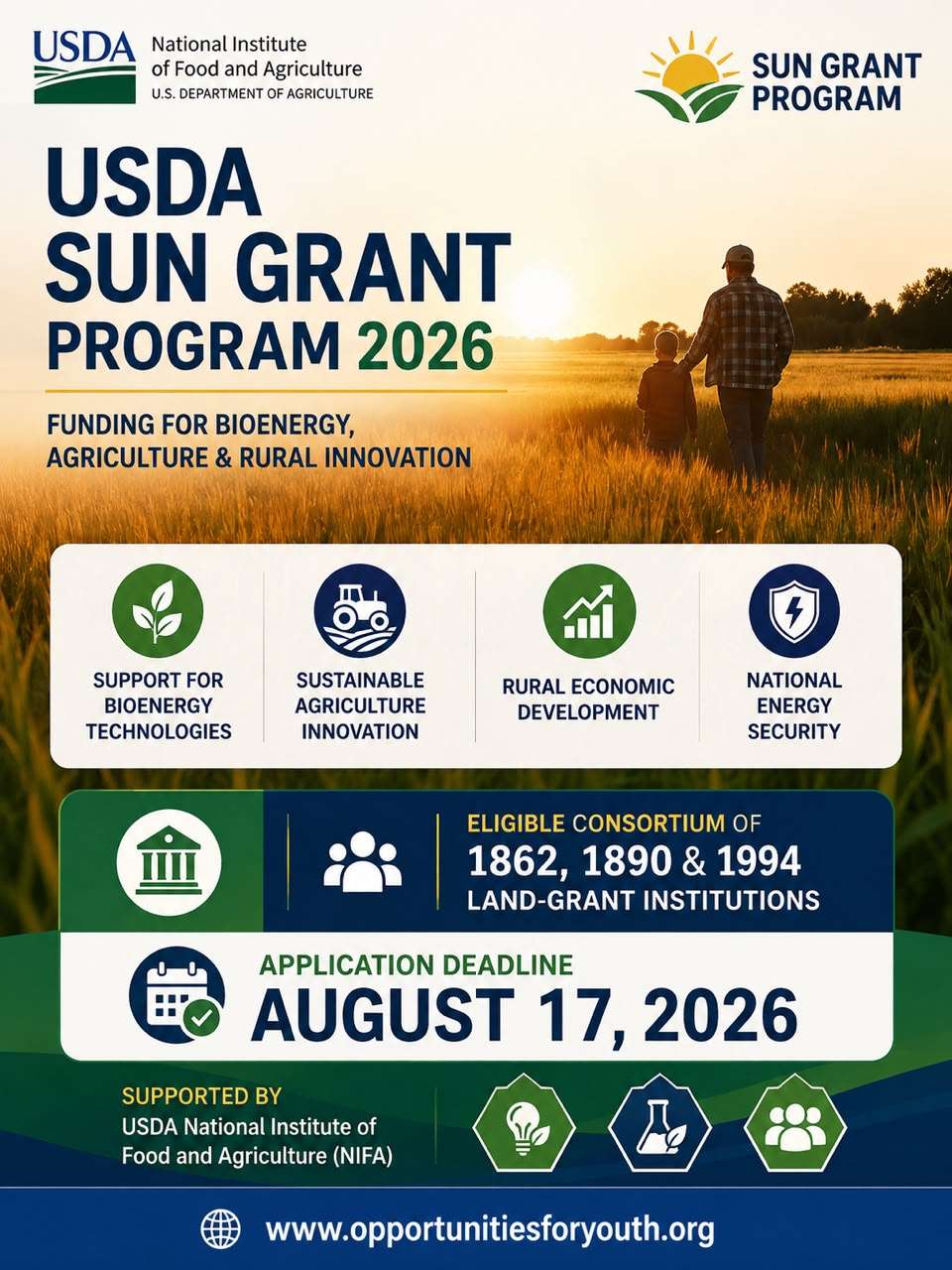
USDA SUN Grant Program 2026 in the USA | Funding for Bioenergy, Agriculture, and Rural Development Projects
@Unknown
Location
USA / Global
Work Mode
grant
Posted
about 4 hours ago
Beware of scams! When applying for jobs, you should NEVER have to pay anything. Learn about job scams.
Get jobs in your inbox
Join over 10,000 subscribers receiving our weekly newsletter.
You might also like

CAPSHA South-South Collaboration Innovation Pitch Challenge 2026: Up to USD 15,000 Grants for Innovative Agricultural Capacity-Sharing Partnerships
South Collaboration Innovation Pitch Challenge 2026: Up to USD 15,000 Grants for Innovative Agricultural Capacity-Sharing Partnerships
SFU Climate Innovation Seed Funds 2026: Up to $100,000 Available to Advance Community-Centred Climate Research and Innovation
Centred Climate Research and Innovation
AWRN Workshop Funding 2026: Apply for Up to £3,000 to Organize Animal Welfare Research Workshops
Unknown

Education Labour Relations Council: Internship Programme 2026
Unknown

COP31 Call for Proposals: Submit Your Climate Research to the Evidence for Climate Action (E4CA) Program Before 31 August 2026
Unknown

Gates Foundation Grand Challenges 2026: Up to US$500,000 for AI-Enabled Family Planning Solutions in Sub-Saharan Africa
Enabled Family Planning Solutions in Sub-Saharan Africa