








COP31 Türkiye 2026: Everything You Need to Know About the Global Climate Conference in Antalya ·Unknown
COP31 Türkiye 2026: A Global Climate Conference Focused on Turning Climate Commitments into Action
The 31st United Nations Climate Change Conference, known as COP31, will take place in Türkiye in 2026, bringing together world leaders, governments, climate experts, scientists, businesses, young people, civil society organisations and other stakeholders to discuss one of the most important challenges facing humanity: climate change.
Hosted in the coastal city of Antalya, COP31 is expected to serve as a major platform for international climate negotiations and global cooperation. Under the central message of moving from dialogue and commitments to practical implementation, the conference aims to strengthen international cooperation and accelerate real-world climate action.
The conference will be held under the framework of the United Nations Framework Convention on Climate Change, commonly known as the UNFCCC. Since the adoption of the UNFCCC in 1992, the annual Conference of the Parties has become the highest-level international platform for countries to negotiate collective responses to climate change.
COP31 will mark the 31st session of this global climate process.
With climate change increasingly affecting communities, economies, food systems, cities, oceans and public health, the conference is expected to focus heavily on implementation, investment, innovation and the delivery of climate solutions.
What Is COP?
COP stands for the Conference of the Parties. It is the annual global climate summit held by countries that are parties to the United Nations Framework Convention on Climate Change.
The conference brings together representatives from nearly every country in the world to negotiate and advance international action on climate change.
Participants at COP may include:
- Heads of state and government
- Ministers and government officials
- Climate negotiators
- Scientists and researchers
- Environmental experts
- Businesses and investors
- International organisations
- Civil society organisations
- Indigenous representatives
- Youth leaders and climate activists
- Academics and educators
- Journalists and media organisations
- Development partners
- Climate finance institutions
COP provides a platform for countries to discuss issues such as:
- Reducing greenhouse gas emissions
- Limiting global temperature increases
- Climate finance
- Renewable energy
- Adaptation to climate change
- Loss and damage
- Food security
- Biodiversity
- Climate-resilient infrastructure
- Sustainable cities
- Green industrialisation
- Ocean protection
- Technology and innovation
- Youth participation in climate action
The process is particularly important because climate change is a global challenge that cannot be addressed by one country acting alone.
The History Behind COP31
COP31 is part of a long history of international climate cooperation.
1992: The United Nations Framework Convention on Climate Change
The UNFCCC was adopted in 1992 and established the foundation for global climate negotiations.
Its purpose is to promote international cooperation to address climate change and reduce the risks associated with rising greenhouse gas emissions.
1997: The Kyoto Protocol
The Kyoto Protocol was adopted in 1997 and introduced legally binding emissions reduction targets for certain developed countries.
It represented one of the earliest major international attempts to create a structured global response to climate change.
2015: The Paris Agreement
The Paris Agreement, adopted in 2015, marked a major turning point in international climate diplomacy.
Countries agreed to work towards limiting the increase in global average temperatures and to strengthen their climate ambitions over time.
COP31 will continue this global climate process, with a strong emphasis on moving from commitments and negotiations to implementation and measurable action.
COP31 Türkiye 2026: A Turning Point for the Planet
Türkiye is positioning COP31 as a major opportunity to accelerate climate action at a time when the consequences of climate change are becoming increasingly visible around the world.
The conference is expected to focus on the need to transform climate commitments into concrete results.
This means moving beyond simply announcing climate targets and focusing on questions such as:
- How will climate commitments be implemented?
- How will climate projects be financed?
- How can countries accelerate the transition to clean energy?
- How can cities become more resilient?
- How can industries reduce emissions while continuing to support economic development?
- How can developing countries access the finance and technology they need?
- How can young people become active participants in climate decision-making?
- How can climate action support food security, health and sustainable development?
The central ambition is to help bridge the gap between climate pledges and practical delivery.
Türkiye’s Vision for COP31
Türkiye is presenting COP31 as a platform for dialogue, cooperation and implementation.
According to the COP31 vision, the world is facing a period of increasing fragmentation and uncertainty. In such an environment, climate action requires international trust, fairness and cooperation.
The conference is therefore expected to place significant emphasis on:
- Dialogue between countries and stakeholders
- International cooperation
- Climate finance
- Technology and innovation
- Implementation of existing commitments
- Inclusive participation
- Climate resilience
- Economic transformation
- Youth and education
- Practical solutions that can be scaled globally
Türkiye’s President, Recep Tayyip Erdoğan, has described COP31 as an opportunity to move from negotiation to implementation.
The overall vision is to encourage countries and stakeholders to strengthen cooperation and convert climate commitments into real action.
COP31 Action Agenda: Major Areas of Focus
The COP31 Action Agenda identifies several important areas where international climate action can be accelerated.
These focus areas cover the environment, energy, food, cities, industry, health, youth, oceans and climate finance.
1. Zero Waste
Waste management is an important part of the global climate challenge.
Poorly managed waste can contribute to greenhouse gas emissions, environmental pollution and the loss of valuable resources.
COP31 will highlight the potential of zero-waste approaches and circular economy solutions.
The focus includes:
- Reducing waste generation
- Reusing materials
- Recycling
- Improving waste management systems
- Reducing methane emissions from waste
- Promoting circular economy models
- Creating more sustainable production and consumption systems
A circular economy aims to reduce the amount of waste generated by keeping materials and products in use for as long as possible.
This can help reduce pressure on natural resources while creating new opportunities for sustainable businesses and innovation.
2. Oceans and Seas
The world’s oceans and seas play a major role in the climate system.
They support marine biodiversity, provide livelihoods for millions of people and help absorb carbon dioxide from the atmosphere.
However, oceans are increasingly threatened by:
- Rising temperatures
- Ocean acidification
- Plastic pollution
- Overfishing
- Coastal degradation
- Rising sea levels
- Loss of marine biodiversity
COP31 will highlight the importance of protecting marine ecosystems and developing solutions based on blue carbon.
Blue carbon refers to carbon captured and stored by marine and coastal ecosystems such as mangroves, seagrass meadows and salt marshes.
Protecting these ecosystems can help strengthen climate resilience while supporting biodiversity and coastal communities.
3. Food Security
Climate change is increasingly affecting agriculture and food systems.
Extreme weather events, droughts, floods, rising temperatures and changing rainfall patterns can affect food production and increase food insecurity.
COP31 will focus on advancing sustainable and resilient food systems.
This includes the need to:
- Improve agricultural resilience
- Support sustainable farming
- Protect food production from climate risks
- Reduce emissions from food systems
- Improve access to food
- Support farmers and rural communities
- Promote climate-smart agriculture
- Reduce food waste
Building climate-resilient food systems is essential to protecting communities and ensuring that populations can access nutritious and affordable food in the future.
4. Climate-Resilient Cities
Cities are at the centre of the climate challenge.
Urban areas are responsible for a significant share of global emissions, but they are also highly vulnerable to climate-related risks.
Climate-resilient cities are designed to withstand and adapt to challenges such as:
- Flooding
- Extreme heat
- Water shortages
- Rising sea levels
- Storms
- Air pollution
- Infrastructure damage
COP31 will promote solutions for creating cities that are more sustainable, resilient and liveable.
This may include:
- Climate-resilient buildings
- Sustainable urban planning
- Public transportation
- Energy-efficient infrastructure
- Green spaces
- Better water management
- Renewable energy
- Sustainable construction
The objective is to ensure that cities remain safe and liveable as climate pressures increase.
5. Climate Implementation Bridge
One of the central concepts of COP31 is the Climate Implementation Bridge, also known as CIB.
The Climate Implementation Bridge is designed to help connect climate commitments with investment, projects and actual delivery.
Many countries have already announced climate targets and policies. However, implementation often faces challenges such as:
- Lack of financing
- Limited technical capacity
- Insufficient technology
- Weak infrastructure
- Gaps between public and private sectors
- Difficulties converting plans into projects
The Climate Implementation Bridge seeks to help address these challenges by connecting priorities with investment and delivery.
The broader objective is to move from:
Commitments → Investment → Implementation → Results
This approach reflects the growing global demand for practical climate action.
6. Youth and Education
Young people are among the most important stakeholders in the global climate movement.
They will live with the long-term consequences of decisions made today.
COP31 aims to position young people not only as individuals inheriting climate risks but also as architects of climate solutions.
Youth participation may involve:
- Climate advocacy
- Innovation
- Education
- Research
- Entrepreneurship
- Policy engagement
- Environmental campaigns
- Community projects
Education is also critical to building climate awareness and preparing future generations to address climate challenges.
The conference’s focus on youth and education reflects the importance of ensuring that young people have access to knowledge, opportunities and platforms to participate in climate action.
7. Green Industrialisation
Industries around the world are under increasing pressure to reduce their environmental impact.
At the same time, industrial development remains important for economic growth, employment and national development.
COP31 will focus on green industrialisation as a way of supporting economic development while reducing carbon emissions.
Key areas may include:
- Clean technologies
- Renewable energy
- Energy efficiency
- Low-carbon manufacturing
- Sustainable production
- Green jobs
- Innovation
- Industrial decarbonisation
The goal is to develop low-carbon industrial pathways that support economic competitiveness while contributing to a just transition.
8. Clean Energy Transition
The transition to clean energy is one of the most important issues in the global climate response.
COP31 will focus on the need to accelerate access to clean, secure and affordable energy.
The clean energy transition includes:
- Renewable energy
- Solar power
- Wind energy
- Energy efficiency
- Modern electricity systems
- Energy storage
- Clean technologies
- Reduced dependence on high-emission energy sources
However, the transition must also ensure that energy remains reliable and affordable.
For many developing countries, increasing access to electricity remains a major development priority.
Therefore, the global energy transition must consider both climate objectives and the need for economic development and energy access.
9. Rio Synergy
Climate change is closely connected to biodiversity loss and desertification.
These challenges are often treated separately, but they are deeply interconnected.
The Rio Synergy approach seeks to promote integrated solutions that address:
- Climate change
- Biodiversity loss
- Land degradation
- Desertification
For example, restoring degraded land can help:
- Capture carbon
- Protect biodiversity
- Improve agricultural productivity
- Support local communities
- Reduce desertification
Integrated environmental solutions can therefore deliver multiple benefits at the same time.
10. Dynamic and Resilient Health Systems
Climate change has serious consequences for public health.
Extreme heat, air pollution, infectious diseases, food insecurity, water shortages and climate-related disasters can all affect human health.
COP31 will focus on the need to build health systems that are:
- Climate-resilient
- Low-carbon
- Equitable
- Prepared for climate-related emergencies
Climate-resilient health systems should be able to continue providing essential healthcare services even during extreme weather events and other climate-related crises.
The focus on health also highlights the fact that climate change is not only an environmental issue. It is also a major social, economic and public health challenge.
COP31 Venues and Participation Areas
COP31 will include different participation areas designed to serve different purposes.
The Blue Zone
The Blue Zone is the official negotiation area managed under the authority of the United Nations.
It is expected to serve as the main area for:
- Official negotiations
- Government delegations
- UN activities
- Diplomatic discussions
- Formal meetings
- Accredited participants
The Blue Zone is generally associated with the formal intergovernmental process of COP.
The Green Zone
The Green Zone is organised under the coordination of the host country.
It is designed to be more inclusive and participatory.
The Green Zone may provide opportunities for:
- Public engagement
- Businesses
- Civil society
- Youth
- Researchers
- Innovators
- Environmental organisations
- Educational institutions
- Climate solution providers
The Green Zone is expected to serve as a space where a wider range of stakeholders can participate in climate discussions and showcase solutions.
COP31 Host City: Antalya, Türkiye
COP31 will be hosted in Antalya, one of Türkiye’s internationally recognised cities.
Antalya is known for its coastal location and connection to the Mediterranean Sea.
The city provides an important setting for discussions about:
- Oceans and marine ecosystems
- Coastal resilience
- Tourism and climate change
- Sustainable cities
- Climate adaptation
- Environmental protection
The COP31 vision presents Antalya as a meeting point for global climate dialogue.
The city is expected to welcome participants from around the world for the major international climate event.
Antalya Airport
Antalya Airport will serve as an important access point for international and domestic visitors attending the conference.
Participants travelling to COP31 will be able to access information about the airport and transportation arrangements through the official COP31 visitor information channels.
Antalya COP31 Venue
The official COP31 venue will host activities connected to the conference.
Participants will be able to access information about:
- The conference areas
- Venue arrangements
- Participation procedures
- Visitor information
- Event locations
- Official programme details
Visitors are encouraged to consult official COP31 information before making travel or participation arrangements.
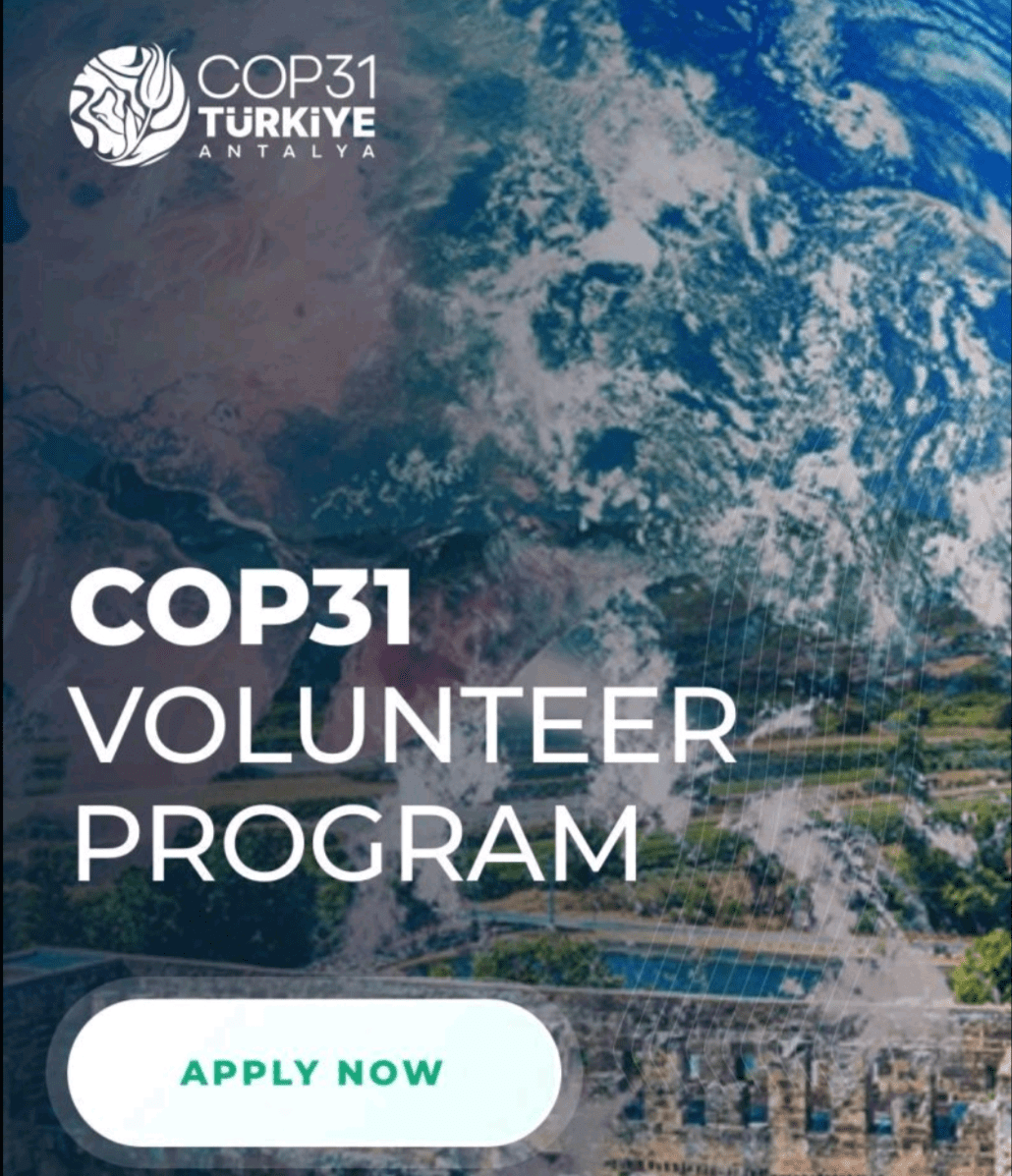
COP31 Volunteer Programme
One of the opportunities connected to COP31 is the Volunteer Programme.
The programme is designed for individuals interested in supporting climate action while gaining experience at a major international event.
The volunteer programme presents an opportunity to:
- Support a major global climate conference
- Gain experience in an international event environment
- Engage with people from different countries and backgrounds
- Learn more about climate action
- Contribute to sustainability-related activities
- Build professional and international networks
The official COP31 platform describes the programme as an opportunity to volunteer for climate action and leave a mark on the future.
Individuals interested in volunteering should review the official requirements and application instructions before submitting an application.
COP31 Academic Engagement and COP-SCIENCE Platform
COP31 is also opening opportunities for members of the academic community.
The COP-SCIENCE platform has been established to strengthen the contribution of academics and researchers to climate action.
Through the platform, academic participants may submit proposals related to:
- Academic events
- Research
- Climate projects
- Collaborations
This initiative is important because scientific research plays a critical role in shaping climate policies and solutions.
Researchers and academic institutions can contribute by:
- Sharing evidence-based findings
- Presenting innovative solutions
- Developing partnerships
- Supporting climate policy
- Engaging with policymakers
- Building international research collaborations
The COP-SCIENCE platform creates an opportunity for the academic community to contribute directly to the wider COP31 climate process.
COP31 Partnerships and Türkiye Pavilion Side Events
The COP31 Presidency has also opened applications for partnerships and Türkiye Pavilion Side Events.
National and international stakeholders may apply through the official application portals.
Eligible organisations and institutions may include stakeholders working in areas such as:
- Climate action
- Sustainable development
- Renewable energy
- Environmental protection
- Climate finance
- Research
- Technology
- Green industry
- Youth engagement
- Food security
- Oceans
- Health
- Sustainable cities
Deadline
Applications for Partnerships and Türkiye Pavilion Side Events are open until 14 August 2026.
Applicants should carefully review the official requirements, application procedures and submission guidelines before applying.
COP31 and Bloomberg Philanthropies Partnership
The COP31 Presidency has also announced a partnership with Bloomberg Philanthropies to advance climate action ahead of the conference.
The partnership is intended to support the COP31 Presidency’s Action Agenda.
Its focus includes:
- Mobilising climate finance
- Bringing together business leaders
- Engaging financial institutions
- Accelerating implementation
- Supporting climate action initiatives
The involvement of philanthropic organisations, businesses and financial institutions highlights the growing importance of partnerships in addressing climate change.
Governments alone cannot solve the climate crisis.
Climate action requires collaboration between:
- Governments
- Businesses
- Investors
- Philanthropic organisations
- Researchers
- Civil society
- Local communities
- Young people
The COP31 Mascot: Caretta
COP31 Antalya has introduced Caretta as its sea turtle mascot.
The mascot is inspired by the Caretta caretta, or loggerhead sea turtle, which is closely associated with the Mediterranean region.
The mascot represents:
- The importance of oceans
- Marine biodiversity
- Coastal ecosystems
- Climate awareness
- Environmental protection
Caretta is presented as an ambassador for climate action and the story of the seas.
The mascot’s interactive experience takes visitors underwater to explore the importance of marine ecosystems and ocean protection.
The initiative also reflects COP31’s focus on making climate information more accessible and engaging for people of different ages and backgrounds.
Who Can Participate in COP31 Türkiye 2026?
COP31 is an international event involving participants from around the world.
Participation opportunities may be available to different groups depending on the specific programme.
Potential participants include:
Governments and Policymakers
Government representatives and national delegations play a central role in the official climate negotiations.
Scientists and Researchers
Researchers can contribute scientific evidence, research findings and climate solutions.
Universities and Academic Institutions
Universities and academic institutions may participate through research, events, collaborations and the COP-SCIENCE platform.
Businesses and Investors
Private-sector organisations can participate in climate partnerships, sustainable business initiatives and investment discussions.
Civil Society Organisations
Environmental and development organisations can contribute to discussions, advocacy and climate initiatives.
Youth
Young people can participate through youth programmes, climate advocacy, education, volunteering and other engagement opportunities.
Climate Activists
Climate activists and environmental advocates may participate through relevant programmes and accredited activities.
Educators
Teachers, trainers and educational institutions can contribute to climate awareness and education initiatives.
International Organisations
International organisations and development partners may participate in climate cooperation and implementation efforts.
Volunteers
Individuals interested in supporting the conference and gaining experience in an international event environment may apply to the Volunteer Programme when eligible.
Media Professionals
Journalists and media organisations may participate through relevant accreditation and media arrangements.
Participation requirements may differ significantly depending on whether an individual is applying as a volunteer, researcher, event organiser, official delegate, media professional or another category of participant.
Is COP31 Open to People from Africa?
COP31 is a global international climate conference.
Climate change affects every region of the world, including Africa.
African governments, organisations, researchers, young people, businesses, civil society groups and climate professionals may participate through relevant official channels and programmes.
Potential areas of interest for African participants may include:
- Climate finance
- Renewable energy
- Food security
- Climate adaptation
- Sustainable cities
- Agriculture
- Green industrialisation
- Youth climate action
- Research
- Climate technology
- Environmental protection
Participation is not limited to one continent or nationality.
However, specific requirements depend on the particular COP31 opportunity being pursued.
Why COP31 Matters for Young People
Young people are increasingly becoming central to global climate action.
Climate change will have long-term consequences for today’s youth and future generations.
COP31’s focus on youth and education creates opportunities for young people to:
- Learn about global climate policy
- Participate in climate discussions
- Connect with international stakeholders
- Develop professional networks
- Explore careers in sustainability
- Participate in climate innovation
- Engage in environmental advocacy
- Gain international experience
Young people interested in climate change, international development, environmental policy, renewable energy, sustainability, research and related fields may find COP31 particularly relevant.
Why COP31 Matters for Students and Researchers
Students and researchers can benefit from the academic and scientific engagement opportunities connected to COP31.
The COP-SCIENCE platform may provide opportunities to submit proposals for academic events, research projects and collaborations.
This could be particularly relevant for individuals working in fields such as:
- Climate science
- Environmental studies
- Political science
- International relations
- Economics
- Energy
- Agriculture
- Public health
- Engineering
- Urban planning
- Technology
- Sustainable development
Academic participation can also help strengthen connections between research and policymaking.
Why COP31 Matters for Professionals and Organisations
COP31 is expected to attract a wide range of professionals and organisations.
For professionals, participation may provide opportunities to:
- Expand international networks
- Meet climate experts
- Explore partnerships
- Learn about global climate policy
- Discover career opportunities
- Engage with investors
- Present ideas and solutions
- Build international collaborations
For organisations, COP31 may provide a platform to:
- Showcase climate solutions
- Build partnerships
- Participate in side events
- Engage with policymakers
- Connect with investors
- Promote sustainability initiatives
Key COP31 Themes at a Glance
The major areas of focus include:
- Zero Waste
- Oceans and Seas
- Food Security
- Climate-Resilient Cities
- Climate Implementation Bridge
- Youth and Education
- Green Industrialisation
- Clean Energy Transition
- Rio Synergy
- Dynamic and Resilient Health Systems
Together, these areas reflect the broad nature of the climate crisis.
Climate change affects the environment, economy, health, food systems, energy, cities and future generations.
COP31 therefore aims to promote solutions that connect different sectors rather than addressing climate issues in isolation.
Important COP31 Deadline
Individuals and organisations interested in COP31-related opportunities should pay close attention to official deadlines.
The deadline specifically stated is:
Partnerships and Türkiye Pavilion Side Events Application Deadline: 14 August 2026
Other programmes, including volunteering and academic submissions, may have separate deadlines or application timelines.
Applicants should always confirm the latest requirements and deadlines through the relevant official COP31 application platform.
How to Prepare for COP31 Opportunities
Individuals interested in participating in COP31 should consider taking the following steps:
1. Identify the Relevant Opportunity
Determine whether you are interested in:
- Volunteering
- Academic engagement
- Partnerships
- Side events
- Climate research
- Youth participation
- Media participation
- Official conference attendance
2. Review the Eligibility Requirements
Different programmes may have different requirements.
Carefully check:
- Age requirements
- Professional requirements
- Academic requirements
- Nationality or residency requirements, where applicable
- Organisational requirements
- Application documents
3. Prepare Your Documents
Depending on the opportunity, applicants may need:
- Curriculum vitae
- Academic proposal
- Project proposal
- Organisation profile
- Partnership concept
- Personal statement
- Identification documents
- References
4. Submit Before the Deadline
Applications should be submitted before the official deadline.
For Partnerships and Türkiye Pavilion Side Events, the deadline is 14 August 2026.
5. Follow Official Updates
COP31 is a major international event, and details may continue to develop as the conference approaches.
Interested participants should follow official updates relating to:
- Applications
- Accreditation
- Programmes
- Travel
- Venue arrangements
- Events
- Participation requirements
For more information, visit COP31 Website HERE
Why COP31 Could Be a Major Opportunity for Climate-Focused Individuals
COP31 offers more than a traditional conference experience.
It represents a major international platform where global climate priorities, policies, investments and solutions come together.
For students and young professionals, participation could provide exposure to:
- International climate diplomacy
- Global policymaking
- Sustainability
- Environmental science
- Renewable energy
- Climate finance
- International development
- Green entrepreneurship
For organisations, it could create opportunities for:
- Partnerships
- Networking
- Visibility
- Investment
- Collaboration
- Knowledge sharing
For governments, COP31 will provide a platform to negotiate and advance international climate action.
For researchers, it offers opportunities to share knowledge and influence policy.
For young people, it provides a platform to participate in shaping the future.
For more global volunteer opportunities visit OFY Website HERE
Conclusion
COP31 Türkiye 2026 is set to bring the global climate community together in Antalya for the 31st session of the Conference of the Parties under the United Nations climate process.
With the central focus on moving from dialogue and consensus to action and implementation, the conference aims to address some of the most urgent challenges facing the planet.
Its broad Action Agenda covers critical issues including zero waste, oceans and seas, food security, climate-resilient cities, youth and education, green industrialisation, clean energy, climate finance, biodiversity, desertification and climate-resilient health systems.
The conference will also create opportunities for researchers, academics, young people, volunteers, businesses, civil society organisations and other stakeholders to contribute to global climate action.
Among the opportunities already highlighted are the COP31 Volunteer Programme, the COP-SCIENCE academic engagement platform, and applications for Partnerships and Türkiye Pavilion Side Events.
The deadline for Partnerships and Türkiye Pavilion Side Events applications is 14 August 2026.
As climate change continues to affect communities and economies across the world, COP31 represents an important opportunity to strengthen international cooperation, promote practical solutions and accelerate the transition from climate commitments to real implementation.
For individuals and organisations interested in climate action, sustainability, environmental protection, research, youth engagement, clean energy and international development, COP31 Türkiye 2026 could provide a valuable platform for learning, networking, collaboration and global impact.
COP31 Türkiye 2026: Everything You Need to Know About the Global Climate Conference in Antalya
@Unknown
Location
USA / Global
Work Mode
conference
Posted
about 17 hours ago
Beware of scams! When applying for jobs, you should NEVER have to pay anything. Learn about job scams.
Get jobs in your inbox
Join over 10,000 subscribers receiving our weekly newsletter.
You might also like

Apply to the African Union Innovation Festival – AU InnoFest’26
AU InnoFest’26
Climate Governance, Diplomacy and Negotiations Leadership Program Call for Applications (Cohort XXI) 2026
Unknown

Global Youth Water Envoys Program 2026
Unknown
UNESCO Announces 2027 World Conference on Education for Sustainable Development in Kenya
Unknown
Business at OECD Policy Administration and Communications Internship 2026 in Paris, France: Paid Six Month Opportunity
OECD Policy Administration and Communications Internship 2026 in Paris, France: Paid Six Month Opportunity

Paid Internship in Thailand 2026: Apply for the Just Transitions Incubator (JUTI) Project Team Internship for Bangkok Climate Action Week (BKKCAW 2026)
Unknown