








FAO and Smart Africa Launch Innovate Africa Challenge 2026 to Scale AI Solutions for Climate-Smart Agriculture ·Smart Agriculture
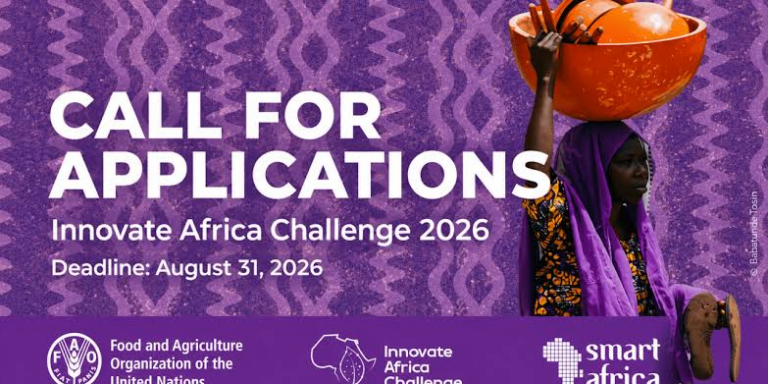
The Food and Agriculture Organization of the United Nations (FAO), in partnership with the Smart Africa Secretariat, has launched the Innovate Africa Challenge (3rd Edition), a continental initiative designed to accelerate the deployment of artificial intelligence (AI) solutions that address climate change and agricultural challenges across Africa.
The 2026 edition is themed “From Ideation to Deployment”, reflecting a shift from developing innovative concepts to implementing scalable AI-powered solutions that generate measurable benefits for farmers and agricultural institutions.
The challenge seeks to identify one proven AI-driven solution for Climate-Smart Agriculture that can be deployed within a Smart Africa Member State in collaboration with national governments, FAO country offices, and key agricultural stakeholders.
By supporting mature AI innovations with real-world deployment opportunities, the initiative aims to strengthen food security, improve agricultural productivity, and enhance climate resilience across the continent.
Addressing Africa’s Agricultural Challenges Through Artificial Intelligence
African agriculture continues to face numerous challenges that threaten food production and rural livelihoods.
Among the key issues are:
• Increasing climate variability and extreme weather events.
• Food insecurity and declining natural resources.
• Limited access to timely agricultural information.
• Low adoption of digital technologies among farmers.
• Fragmented agricultural data systems.
• Skills gaps in digital agriculture.
• Persistent inequalities affecting smallholder farmers, women, youth, and rural communities.
Although artificial intelligence and digital technologies offer significant opportunities to improve agricultural productivity and resilience, many promising innovations remain at the pilot stage and have yet to achieve widespread adoption.
The Innovate Africa Challenge aims to bridge this gap by supporting solutions that have demonstrated technical readiness and are prepared for deployment at scale.
Building on Previous Success
Earlier editions of the Innovate Africa Challenge demonstrated the growing potential of AI within Africa’s agricultural sector.
Previous achievements include:
• Engaging innovators from more than 40 African countries.
• Promoting AI-powered technologies for climate resilience.
• Deploying AI-enabled weather stations that improve farmer decision-making through better climate information.
The third edition seeks to build on these successes by supporting technologies capable of delivering measurable impact in real farming environments.
Objectives of the 2026 Challenge
The initiative aims to identify, validate, and deploy an AI-powered solution that strengthens climate resilience while improving productivity across African agrifood systems.
Its objectives include:
• Identifying mature AI technologies that support climate-smart agriculture using African agricultural and climate data.
• Promoting responsible AI, data governance, and data sovereignty principles.
• Supporting the deployment of one leading AI solution within a Smart Africa Member State.
• Demonstrating measurable improvements in farmer productivity, climate resilience, and decision-making.
• Strengthening collaboration among governments, innovators, research institutions, FAO country offices, private sector partners, and farmer organisations.
• Developing a scalable model that can be replicated across multiple African countries.
Priority Focus Areas
The challenge prioritises AI innovations addressing several strategic areas within climate-smart agriculture.
Solutions may focus on:
• Precision agriculture and input optimisation.
• Crop yield prediction and forecasting.
• Pest and disease surveillance, detection, and early warning systems.
• Climate risk modelling and adaptive decision-support tools.
• Water management and natural resource optimisation.
Selected technologies should integrate effectively with national agricultural information systems, digital extension platforms, and ministry-led agricultural programmes.
Expected Solution Capabilities
Participating startups should demonstrate AI solutions capable of operating effectively in African farming environments.
Expected capabilities include:
• Supporting smallholder and informal farming systems.
• Operating with incomplete or low-frequency datasets.
• Functioning in low-connectivity and mobile-first environments.
• Supporting multiple languages and diverse agricultural contexts.
• Integrating with government extension services and agricultural institutions.
Solutions should provide practical, explainable recommendations that can improve agricultural decision-making by farmers, extension officers, and policymakers.
Deployment Countries
Deployment and validation activities will prioritise selected Smart Africa Member States, including:
• Rwanda.
• Kenya.
• Ghana.
• Malawi.
• Uganda.
Implementation will take place in partnership with national ministries responsible for agriculture, information and communication technology, and innovation, alongside FAO country offices.
Eligibility Requirements
The challenge is open to startups, innovators, and technology developers actively building AI solutions for climate-smart agriculture.
Applicants must:
• Be legally registered entities or teams with a proven record of developing AI solutions.
• Have a minimum team of two people, with at least half of their working time dedicated to the solution.
• Demonstrate a Technology Readiness Level (TRL) between 3 and 6.
• Be at least pre-seed funded and no later than Series A funding stage.
• Have an AI solution that is already working, deployed, or ready for deployment.
• Demonstrate previous pilots, customer engagements, or validated deployments.
• Show the technical capacity to deploy their solution in another African country.
• Comply with responsible AI, privacy, and data protection requirements.
Preference will be given to startups operating within Smart Africa Member States, organisations serving smallholder farmers, women, and youth, and teams with partnerships involving ministries, research institutions, or agricultural extension systems.
Responsible AI and Data Governance
All participating startups must demonstrate responsible use of artificial intelligence.
Applicants are expected to:
• Comply with applicable privacy and data protection regulations.
• Use transparent and explainable AI approaches.
• Identify and mitigate potential bias across gender, geography, and farming systems.
• Respect farmer data ownership and obtain informed consent where required.
• Maintain confidentiality throughout the challenge process.
Participants will retain ownership of their existing intellectual property, while Smart Africa will retain rights over challenge outputs and related implementation frameworks. Any future deployment or scale-up arrangements may be governed by separate contractual agreements.
Driving AI Innovation for Africa’s Food Systems
The Innovate Africa Challenge 2026 represents a significant opportunity for African startups developing AI-powered agricultural technologies to demonstrate their solutions in real-world environments.
By bringing together innovators, governments, FAO, research institutions, and development partners, the initiative seeks to accelerate the adoption of scalable AI solutions that strengthen climate resilience, improve productivity, and support sustainable food systems across Africa.
VISIT OFFICIAL WEBSITE TO APPLY
For more opportunities such as these please follow us on Facebook, Instagram, Twitter, LinkedIn and WPChannel
Disclaimer: Global South Opportunities (GSO) is not the organization offering this opportunity. For any inquiries, please contact the official organization directly. Please do not send your applications & CVs to GSO, as we are unable to process them. Due to the high volume of emails, we receive daily, we may not be able to respond to all inquiries. Thank you for your understanding.
FAO and Smart Africa Launch Innovate Africa Challenge 2026 to Scale AI Solutions for Climate-Smart Agriculture
@Smart Agriculture
Location
USA / Global
Work Mode
grant
Posted
about 3 hours ago
Beware of scams! When applying for jobs, you should NEVER have to pay anything. Learn about job scams.
Get jobs in your inbox
Join over 10,000 subscribers receiving our weekly newsletter.
You might also like
Second Nature Opens Applications for 2026 Catalyst Grants Supporting Campus Climate Action
Unknown

Call for Applications: African Union Peace Fund (AUPF) Programmatic Windows – Funding Cycle 2028
Funding Cycle 2028

CJID AI Newsroom Engagement Programme 2026
Unknown
CGIAR CapSha South–South Collaboration Innovation Pitch Challenge 2026: Win a US$15,000 Grant to Transform Agricultural Research Across the Global South
South Collaboration Innovation Pitch Challenge 2026: Win a US$15,000 Grant to Transform Agricultural Research Across the Global South

Fully Funded PhD Position in Molecular Parasitology at Texas State University (Spring 2027): Research Malaria Pathogenesis in the Mukherjee Lab
Texas State University (Spring 2027): Research Malaria Pathogenesis in the Mukherjee Lab
GovAI Research Scholar Programme 2026 Opens Applications for AI Governance Researchers – Apply By 16 August 2026
Unknown