
Fully Funded Journalism Fellowship 2026 to Cover the Global Environment Facility Assembly in Samarkand, Uzbekistan @Unknown
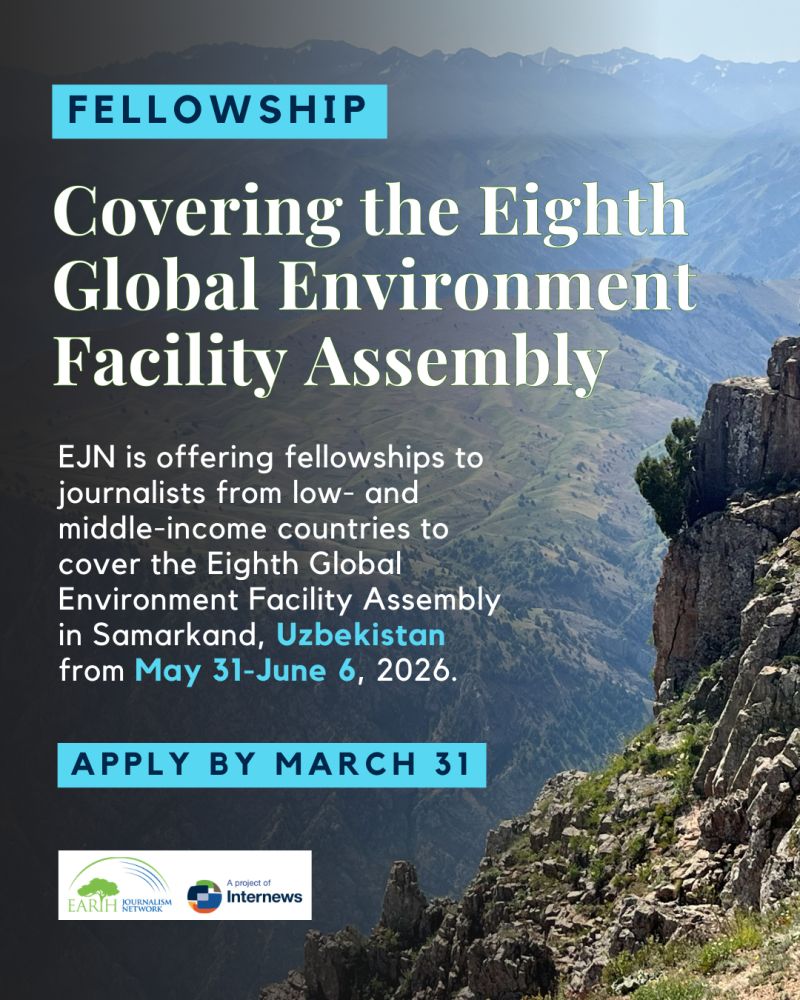
Journalists from low- and middle-income countries have a unique opportunity to report on one of the world’s most significant environmental governance events through a fellowship offered by the Internews Earth Journalism Network (EJN). The program will support selected reporters to attend and cover the Eighth Global Environment Facility (GEF) Assembly in Samarkand, Uzbekistan.
The fellowship is designed to strengthen journalism on environmental finance, climate policy, and global sustainability negotiations by enabling reporters to directly observe and report on high-level discussions shaping the future of global environmental action.
Applications for the fellowship are open until March 31, 2026.
Overview of the Fellowship
Internews Earth Journalism Network is offering fellowships to five journalists from low- and middle-income countries to attend and report from the Eighth Global Environment Facility Assembly, which will take place in Samarkand, Uzbekistan from May 30 to June 6, 2026.
The fellowship aims to improve global reporting on environmental financing and policy decisions by providing journalists with training, mentorship, and direct access to decision-makers attending the Assembly. Participants will gain firsthand insights into negotiations and policies that influence climate action, biodiversity protection, and sustainable development around the world.
Through this initiative, journalists will be able to produce impactful stories that explain how international environmental funding and governance decisions affect their home countries and local communities.
About the Global Environment Facility
The Global Environment Facility (GEF) is a multilateral environmental fund that supports developing nations in meeting the goals of several international environmental conventions.
Since its establishment in 1991, the GEF has provided more than $27 billion in grants and helped mobilize an additional $155 billion for environmental projects worldwide.
These funds support initiatives related to climate mitigation, biodiversity protection, sustainable land use, and pollution control. The GEF works closely with major global agreements such as:
-
Convention on Biological Diversity
-
United Nations Framework Convention on Climate Change
-
Stockholm Convention on Persistent Organic Pollutants
-
United Nations Convention to Combat Desertification
-
Minamata Convention on Mercury
The GEF family of funds includes several specialized financing mechanisms such as:
-
Least Developed Countries Fund (LDCF)
-
Special Climate Change Fund (SCCF)
-
Global Biodiversity Framework Fund (GBFF)
-
Nagoya Protocol Implementation Fund (NPIF)
-
Capacity-building Initiative for Transparency Trust Fund (CBIT)
These funding programs support projects that protect water resources, strengthen agriculture and food security, improve health outcomes, reduce disaster risks, and safeguard fragile ecosystems.
About the Eighth GEF Assembly
The GEF Assembly is the governing body of the organization and includes representatives from 186 member countries. It meets periodically to review and approve major policy decisions, operational strategies, and amendments affecting global environmental funding.
The 2026 Assembly in Samarkand will bring together more than 1,000 delegates, including:
-
Government ministers
-
Environmental leaders and experts
-
Business representatives
-
Civil society organizations
-
Indigenous community leaders
-
Officials from international organizations and GEF agencies
Participants will discuss key issues such as:
-
Climate adaptation strategies
-
Private sector engagement in environmental action
-
Financing mechanisms for sustainable development
-
Partnerships to address global ecological challenges
The Assembly will feature nine high-level roundtables, multiple side events, field trips, and a Civil Society Forum scheduled for June 3.
Fellowship Activities and Training
Selected fellows will receive preparation and mentoring before and during the conference.
Prior to the Assembly, EJN will provide resources and reporting tools to help fellows prepare for the event. Once in Samarkand, fellows will participate in specialized activities designed to enhance their coverage of environmental negotiations.
These activities include:
-
Orientation sessions on key issues discussed at the Assembly
-
Daily briefings on ongoing discussions
-
Interviews with high-level officials and experts
-
Mentorship from an experienced environmental journalist serving as an EJN trainer
-
Collaboration and networking with other international fellows
The trainer will help participants understand complex policy discussions and provide feedback to support high-quality reporting throughout the event.
Story Production and Publication
Fellows may produce stories in several formats, including:
-
Print journalism
-
Online reporting
-
Radio broadcasts
-
Television or multimedia reports
Stories may be published in any language, but fellows must provide an English summary of their work. Additionally, at least one story must be translated into English so it can be shared with a broader international audience.
While fellows maintain full editorial independence, published work must acknowledge support from EJN by including the following statement:
“This story was produced as part of a reporting fellowship to the Eighth GEF Assembly supported by Internews’ Earth Journalism Network.”
Fellows are also free to publish their stories first through their affiliated media outlets. However, EJN and its partners retain the right to edit, republish, broadcast, and distribute the content.
Fellowship Benefits
The fellowship provides comprehensive financial and logistical support for selected journalists.
Covered expenses include:
-
Round-trip economy-class airfare
-
Accommodation in Samarkand
-
Meals during the fellowship period
-
Travel insurance
-
Local transportation
-
Rail transport between Tashkent and Samarkand if necessary
-
Visa fee reimbursement
-
Press accreditation support
-
Logistical assistance throughout the trip
Journalists selected for the fellowship are responsible for arranging their own visas and ensuring they meet all travel and attendance requirements.
Eligibility Criteria
Applicants must meet the following requirements:
-
Be a professional journalist working for or representing an established media organization in a low- or middle-income country
-
Have prior experience reporting on environmental issues
-
Experience covering climate, biodiversity, environmental negotiations, or environmental finance is an advantage
-
Demonstrate strong English language proficiency
-
Be available to arrive in Samarkand by May 31, 2026 and remain for the entire Assembly
-
Provide a letter of support from an editor or supervisor confirming that the outlet will publish or broadcast the resulting stories
-
Submit recent examples of relevant journalistic work
Applicants of all ages are welcome, though preference will be given to journalists aged 35 and under.
Selection Criteria
Applications will be evaluated based on several factors, including:
-
Proven experience reporting on environmental and climate topics
-
A clear and well-developed reporting plan for the Assembly
-
Potential audience reach of the applicant’s media outlet
-
A formal relationship with an established media organization
-
Diversity in geography and media types among selected fellows
Applicants must include a signed letter of support on official media letterhead confirming their outlet’s commitment to publish or broadcast the resulting stories.
Application Process
Interested journalists must complete their application through the fellowship portal.
To apply:
-
Click the Apply Now button on the fellowship page.
-
Log in to your existing account or create a new account if you do not have one.
-
Complete the application form and upload all required supporting documents.
-
Save drafts if necessary and return later to finalize the submission.
Applicants are encouraged to submit their applications at least one day before the deadline to avoid technical issues.
Late submissions will not be considered.
Application Deadline
The deadline to apply for the fellowship is:
March 31, 2026 (11:59 PM Pacific/Niue Time)
Successful applicants will be notified by mid-April 2026.
This fellowship provides a valuable opportunity for journalists to gain direct access to global environmental policy discussions while producing impactful reporting that informs audiences about climate finance, environmental governance, and sustainable development initiatives worldwide.
Discover more Fellowship opportunities here.
Fully Funded Journalism Fellowship 2026 to Cover the Global Environment Facility Assembly in Samarkand, Uzbekistan
@Unknown
Location
Global
Job Type
fellowship
Posted
about 4 hours ago
Beware of scams! When applying for jobs, you should NEVER have to pay anything. Learn more.
You might also like
Expression of Interest for the Youth in Evaluation Forum 2026
Unknown
Call for Applications: Gender Empowerment Now! – Women, Peace and Security Programme (Cycle 6)
Women, Peace and Security Programme (Cycle 6)

Apply to the AIG Public Leaders Programme
Unknown

AstraZeneca Young Health Programme Impact Fellowship 2026
Unknown

The Nestlé Cultivate YOUth Mentorship Program 2026
Unknown
Call for Applications: 12th Youth Leadership Workshop on Global Citizenship Education (GCED)
Unknown