
Funded PhD Studentship in Generative AI and Climate Change Misinformation at UCD 2026 @UCD 2026
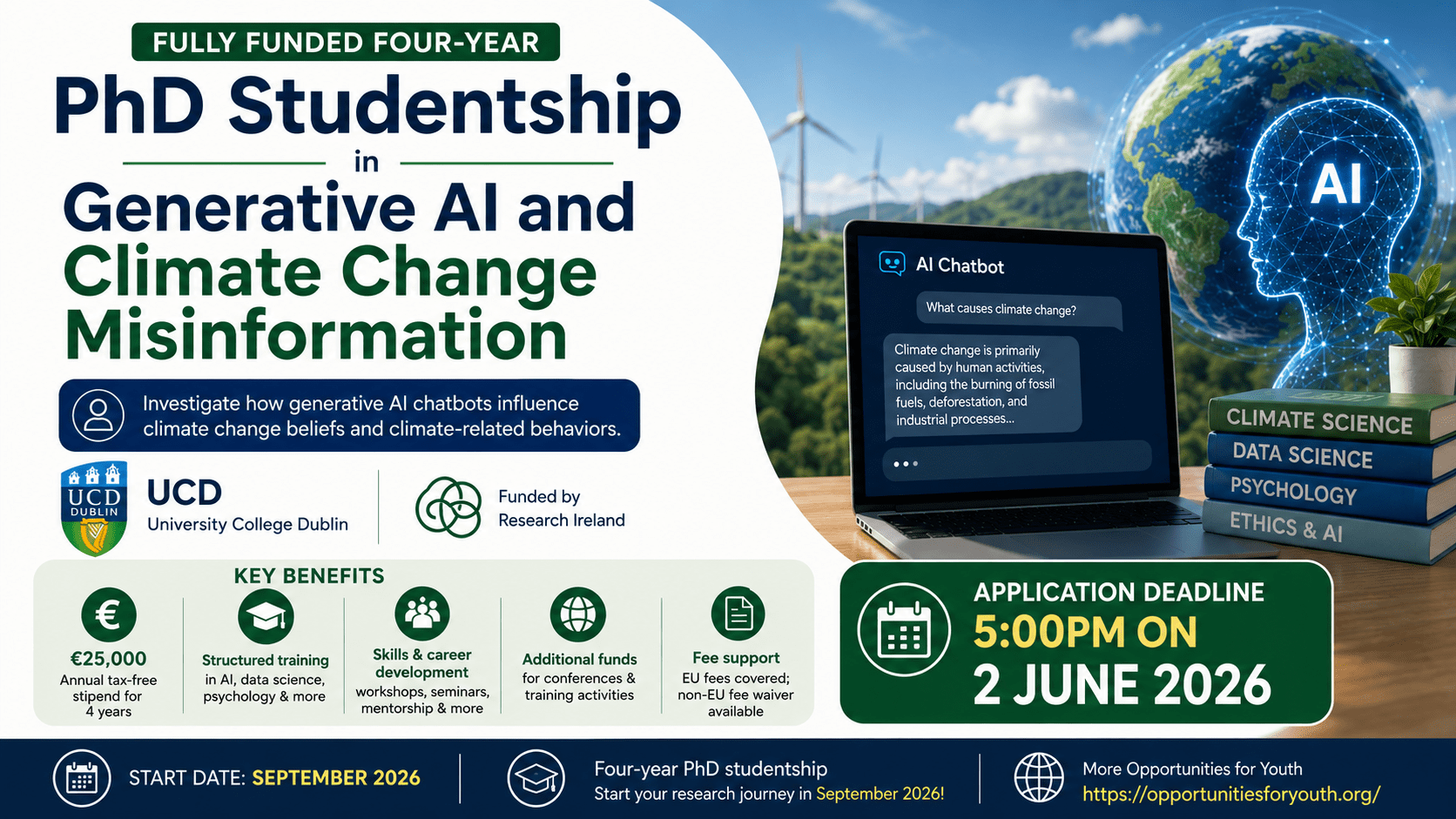
Applications are now open for a fully funded four-year PhD studentship focused on Generative AI and Climate Change Misinformation at University College Dublin (UCD). This research opportunity is part of a wider multi-institutional, interdisciplinary national centre for data science and artificial intelligence funded by Research Ireland.
The studentship will explore one of the most urgent questions of the digital age: how generative AI tools such as ChatGPT, Gemini, and other large language models may influence public understanding, beliefs, and behaviours around climate change. As more people use AI chatbots to search for information about complex topics, the reliability, accuracy, and persuasive power of AI-generated content have become important areas of academic, social, and environmental concern.
The successful applicant will begin the programme in September 2026 and will join a structured, cohort-based PhD training programme that combines individual research with advanced interdisciplinary training, peer learning, professional development, and career-focused support.
Supervisors
The PhD project will be supervised by:
- Prof. Ciara Greene, UCD School of Psychology
- Prof. Andrew Parnell, UCD School of Mathematics and Statistics
The project brings together psychology, statistics, artificial intelligence, misinformation studies, behavioural science, climate communication, and data science. This makes it especially suitable for candidates interested in understanding how emerging technologies shape public opinion and decision-making.
About the PhD Studentship
This funded PhD studentship will investigate the relationship between generative AI and climate misinformation. The project focuses on how large language models respond to climate-related questions, how they may reproduce or challenge misinformation, and how exposure to AI-generated climate content may influence users’ beliefs and behaviours.
Generative AI chatbots are increasingly used as information sources. People ask them questions about science, politics, health, education, finance, and climate change. However, these systems are trained on large datasets that may contain both reliable information and misleading content. This creates an important research question: when users ask AI chatbots about climate change, do these tools provide accurate information, repeat misleading claims, or subtly influence users’ views?
This PhD project will examine both the content produced by AI systems and the effect that content has on human users.
Research Focus: Generative AI, Climate Beliefs, and Climate-Related Behaviour
The project will study how AI-generated responses shape public understanding of climate change. It will examine whether AI chatbots reinforce climate misinformation, correct misleading claims, or influence people’s willingness to take pro-environmental action.
The research will look at two broad areas:
- The content and accuracy of information provided by generative AI chatbots
- The downstream effect of AI-generated content on people’s beliefs and behaviours
This makes the studentship highly relevant to current debates around artificial intelligence, information integrity, climate communication, digital trust, misinformation, and public engagement with science.
Project Objective One: How Do Large Language Models Respond to Climate Change Queries?
The first major objective of the PhD project is to investigate how different large language models respond to user queries about climate change.
The successful candidate will examine whether AI chatbots provide accurate answers, agree with misleading statements, or become vulnerable to leading questions during naturalistic conversations.
For example, the project may explore how chatbots respond to claims such as:
- “The climate has always been changing, so how can humans have had anything to do with it?”
- “Isn’t climate change just part of a natural cycle?”
- “Do scientists really agree that humans are causing climate change?”
These types of questions are important because they resemble real conversations that users may have with AI systems. The research will assess whether AI systems challenge misleading assumptions, provide balanced scientific explanations, or unintentionally validate inaccurate claims.
The project will also investigate whether climate-related misinformation may have been included in the training data of large language models and whether this affects the responses generated by the systems.
Project Objective Two: How Does AI-Generated Climate Information Affect Human Beliefs and Behaviour?
The second major objective is to measure the impact of AI-generated responses on human participants.
Participants will be asked to engage in a conversation about climate change with an “AI chatbot.” During the experiment, they will receive answers that vary in accuracy and bias. The researcher will then examine how this exposure affects participants’ beliefs about climate change and their willingness to engage in climate-friendly behaviour.
The project will focus on questions such as:
- Does AI-generated misinformation change people’s belief in anthropogenic climate change?
- Are people more likely to trust misinformation when it appears to come from an AI chatbot?
- Is AI-generated misinformation more persuasive than misinformation shared through social media posts or plain text?
- Can subtle changes in chatbot responses encourage greener behaviour?
- How do users respond when an AI system presents climate information with different levels of bias or accuracy?
This part of the research will contribute to a better understanding of how AI systems influence public opinion and behavioural choices in relation to climate change.
Comparing AI Chatbots with Other Forms of Misinformation Delivery
A key strength of this PhD project is that it will compare AI-generated misinformation with other forms of misinformation delivery.
The project will examine whether misinformation from AI chatbots is more persuasive than misinformation presented through:
- Social media posts
- Plain text information
- Other non-interactive formats
This comparison is important because AI chatbots are interactive. Unlike a static post or article, a chatbot responds directly to the user, adapts to their questions, and may appear conversational, helpful, or authoritative. This interactive format could make AI-generated misinformation especially influential.
By comparing AI-based misinformation with other formats, the research will help clarify whether chatbot-generated content carries unique persuasive power.
Investigating Behavioural Nudges Toward Greener Choices
The project will also investigate whether subtle changes in chatbot responses can encourage users toward more environmentally friendly behaviours.
This part of the research is especially important because generative AI may not only spread misinformation; it may also be used to support better public understanding and positive behavioural change.
The research may explore how chatbot responses can be designed to:
- Correct misleading claims about climate change
- Improve understanding of human-caused climate change
- Encourage pro-environmental decisions
- Support climate literacy
- Reduce the influence of misinformation
- Promote greener behaviours through carefully designed messaging
This gives the PhD project both a critical and constructive dimension. It examines the risks of AI-generated misinformation while also exploring how AI tools might be used responsibly to support climate action.
Structured Cohort-Based PhD Training Programme
The successful applicant will join a structured cohort-based PhD training programme. This means that, in addition to conducting individual PhD research, the student will be part of a wider learning and research community.
The programme includes transferable skills training, group-based activities, domain-specific learning, peer-led opportunities, and career development support.
Training and Development Opportunities
The successful applicant will benefit from a wide range of training and development activities, including:
Transferable Skills Training
The programme will provide training in areas such as:
- Communication skills
- Ethics
- Entrepreneurship
- Research presentation
- Professional development
- Academic and non-academic career preparation
These skills will help the PhD student communicate research findings clearly, work across disciplines, and prepare for future roles in academia, policy, industry, data science, AI governance, or research communication.
Group Activities
The student will also participate in collaborative activities such as:
- Hackathons
- Spin-out sprints
- Interdisciplinary group projects
- Team-based problem-solving activities
These activities are designed to encourage creativity, innovation, collaboration, and practical application of research ideas.
Domain-Specific Training
The programme will provide training on specialist topics relevant to the student’s research area. These may include subjects connected to:
- Artificial intelligence
- Data science
- Psychology
- Climate misinformation
- Large language models
- Information integrity
- Behavioural science
- Quantitative research methods
- Experimental design
Peer-Led Learning Opportunities
The student will also benefit from peer-led learning, including:
- Research seminars
- Peer-designed workshops
- Reading groups
- Collaborative discussions
- Knowledge-sharing sessions
These activities will allow the student to learn from other researchers, share ideas, and develop within a supportive academic community.
Career and Skills Development
Dedicated career and skills development activities will also be offered. These activities are intended to support the student’s long-term professional growth and prepare them for opportunities after the PhD.
Funding Package
The studentship provides a generous funding package for four years.
The funding includes:
- Annual stipend: €25,000 per year
- Duration: Four years
- Tax status: Tax-free stipend
- Additional support: Funding available for conference attendance and training activities
- Fees: EU student fees are covered automatically
- Non-EU fees: Non-EU students may receive a fee waiver from UCD
This funding structure gives the successful applicant financial support throughout the full duration of the PhD programme. The additional funds for conferences and training activities will also help the student build networks, present research, and access further professional development opportunities.
Application Process
Applications must be submitted through the general cohort-based programme application form.
Applicants interested in this specific PhD project should follow these instructions carefully:
- Use the general cohort-based programme application form.
- Select “Information Integrity” as the first choice theme.
- Select UCD as the first choice institution.
- Specify the particular project on Generative AI and Climate Change Misinformation.
- Applicants are strongly encouraged to contact the primary research supervisor before applying.
The primary research supervisor is:
Prof. Ciara Greene
Email: ciara.greene@ucd.ie
Contacting the supervisor before applying is strongly encouraged because it allows applicants to introduce their background, ask project-specific questions, and confirm that their research interests align with the PhD topic.
Application Deadline
Applications must be submitted by:
5:00pm on 2 June 2026
Interviews will be held later in June 2026, with decisions expected soon after.
Applicants should prepare their materials early and avoid waiting until the final day, especially because this is a competitive funded PhD opportunity with a fixed start date in September 2026.
Ideal Candidate Profile
The ideal candidate will have a strong academic background, excellent quantitative skills, strong communication abilities, and an interest in the intersection of psychology, artificial intelligence, misinformation, and climate change.
The project is especially suitable for applicants who enjoy interdisciplinary research and are interested in both technical and human aspects of AI systems.
Mandatory Requirements
Applicants must meet the following mandatory criteria:
- An honours degree in Psychology or a cognate discipline
- At least upper second class honours, or international equivalent
- Excellent skills in quantitative data analysis
- Excellent communication skills, including oral, written, and presentation skills
- Excellent organisational and administrative skills
- Proven ability to work to deadlines
These requirements reflect the research demands of the project. The successful applicant will need to design studies, analyse data, communicate findings, work independently, and manage a multi-year research project.
Desirable Criteria
The following criteria are desirable but not mandatory:
- A Master’s degree in Psychology, Cognitive Science, or a cognate discipline
- Background in cognitive psychology
- Experience designing and running experiments
- Experience running online experiments
- Strong computer programming skills
- Experience working with large language models
Applicants who meet some or all of the desirable criteria may be especially well-positioned for the project, particularly if they can demonstrate strong research potential and interest in generative AI, misinformation, and climate change.
Why This PhD Opportunity Matters
This PhD studentship addresses a timely and important global issue. Climate change misinformation continues to shape public debate, policy attitudes, and individual behaviour. At the same time, generative AI tools are becoming major sources of information for millions of users.
Understanding how these tools respond to climate-related misinformation is essential for improving information integrity and responsible AI design.
The project is important because it will help answer questions such as:
- Can generative AI systems spread climate misinformation?
- How accurate are chatbot responses to climate-related questions?
- Are AI-generated responses more persuasive than traditional misinformation formats?
- How do users’ beliefs change after interacting with AI-generated climate content?
- Can AI systems be designed to encourage more accurate understanding and greener behaviours?
The findings could be valuable for researchers, policymakers, AI developers, climate communicators, educators, and organisations working on digital trust and information integrity.
Key Benefits of the Studentship
This funded PhD opportunity offers several major benefits:
- Four years of funded doctoral research
- Tax-free annual stipend of €25,000
- Additional funding for conferences and training
- EU student fees covered automatically
- Possible fee waiver for non-EU students
- Supervision from experts in psychology, mathematics, and statistics
- Opportunity to work on a highly relevant AI and climate misinformation topic
- Structured cohort-based PhD training
- Transferable skills development
- Peer-led learning and research community support
- Career and professional development activities
- Interdisciplinary training in data science, AI, psychology, and information integrity
How to Apply
Interested applicants should apply through the general cohort-based programme application form and select:
- Theme: Information Integrity
- Institution: UCD
- Project: Generative AI and Climate Change Misinformation
Applicants are strongly encouraged to contact Prof. Ciara Greene at ciara.greene@ucd.ie before submitting their application.
The deadline for applications is 5:00pm on 2 June 2026.
Conclusion
The Funded PhD Studentship in Generative AI and Climate Change Misinformation at UCD is an excellent opportunity for candidates interested in psychology, artificial intelligence, climate communication, misinformation, behavioural science, and data science.
With a four-year funding package, structured training, expert supervision, and a research topic of major global relevance, this studentship offers a strong pathway for applicants who want to contribute to responsible AI research and the fight against climate misinformation.
The successful candidate will help generate new knowledge about how generative AI systems influence public understanding of climate change and how AI tools might be designed to support more accurate information and greener behaviours.
Application deadline: 5:00 pm on 2 June 2026.
APPLY HERE.
For more information about this opportunity click here.
Discover more scholarship opportunities on OFY click here.
Funded PhD Studentship in Generative AI and Climate Change Misinformation at UCD 2026
@UCD 2026
Location
Global
Work Mode
scholarships
Posted
about 6 hours ago
Beware of scams! When applying for jobs, you should NEVER have to pay anything. Learn more.
Get jobs in your inbox
Join over 10,000 subscribers receiving our weekly newsletter.
You might also like

Feminist Investigative Journalism Scholarship 2026
Institute for Journalism and Social Change (IJSC)

Loughborough University Sanctuary PhD Scholarships 2026/2027: Fully Funded PhD Scholarship for At-Risk Scholars
Loughborough University

SAIL Scholarship 2026
NAPABA Law Foundation

Flight PS752 Commemorative Scholarship Program 2026 in Canada: Funding for Post-Secondary Students Honouring the Victims of Flight PS752
Secondary Students Honouring the Victims of Flight PS752
Clinician PhD Scholarships at Flinders University 2026 in Australia | Fully Funded $50,000 Annual Stipend
Flinders University
Call for Applications: Fully Sponsored McGill University Online Graduate Certificate in Health Data Analytics for Ghanaian Students and Professionals (2026–2027)
McGill University