








GEF SGP Nigeria Call for Proposals 2026: Strategic Grant to Host the Western & Eastern Anglophone Africa Regional Capacity-Building Workshop ·Building Workshop
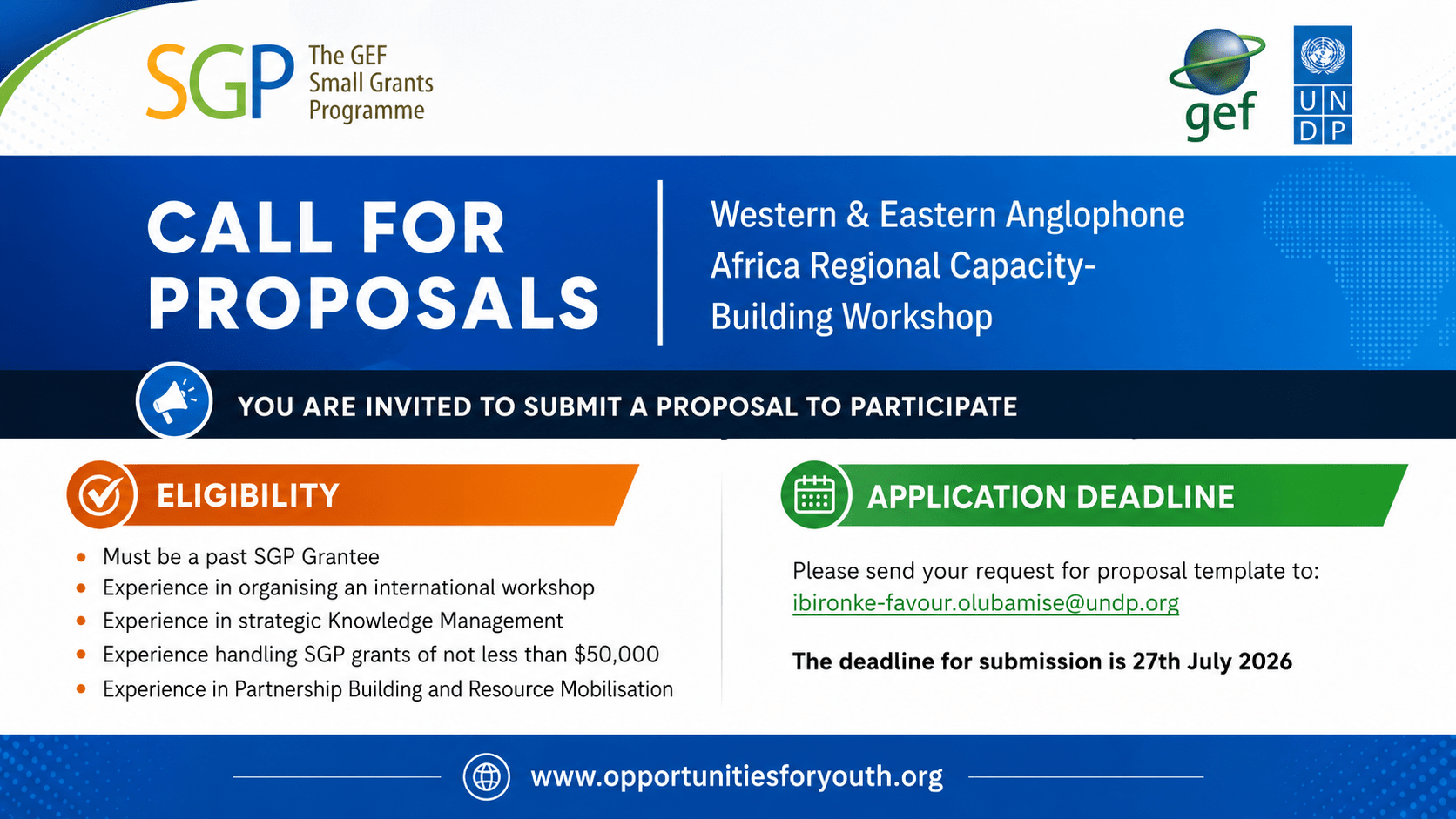
GEF SGP Nigeria is inviting qualified organisations to submit proposals to organise and deliver the Western and Eastern Anglophone Africa Regional Capacity-Building Workshop 2026.
The regional workshop is expected to take place in Abuja, Nigeria, in November 2026 and bring together approximately 35 participants from participating African countries. Attendees are expected to include National Coordinators, former and current grantees, National Steering Committee representatives, UNDP Country Office representatives, the SGP Regional Focal Point and members of the SGP Central Programme Management Team.
The selected organisation will manage the workshop’s travel, accommodation, subsistence, conference arrangements, field visit, visibility materials and knowledge products. The grant provides funding of up to US$100,000, while applicants must demonstrate secured co-financing of at least the same amount in cash or in kind.
The deadline for submitting proposals is 27 July 2026.
About the GEF SGP Regional Workshop
The Global Environment Facility (GEF) Small Grants Programme (SGP) supports community-led initiatives that address environmental challenges while contributing to sustainable development.
The planned workshop will provide a regional platform for countries participating in the Small Grants Programme to examine results achieved during Operational Phase 7 and prepare for continued implementation under Operational Phase 8.
Participants will discuss achievements, challenges, lessons learned, impact stories and future opportunities for collaboration and resource mobilisation.
The call states that participants will come from 12 countries, but the announcement lists 11:
- Cape Verde
- Eritrea
- Ethiopia
- The Gambia
- Ghana
- Liberia
- Nigeria
- Rwanda
- Sierra Leone
- Tanzania
- Uganda
Prospective applicants should consult the official proposal documents for clarification regarding the final list of participating countries.
Main Objectives of the Regional Workshop
The Western and Eastern Anglophone Africa Regional Capacity-Building Workshop is intended to support reflection, learning and future planning across participating GEF SGP country programmes.
Its main objectives include the following.
Review Operational Phase 7 Implementation
Participants will review progress under Operational Phase 7, including:
- Landscape approaches
- Country-level targets
- Results achieved
- Challenges encountered
- Lessons learned
- Good practices developed at country and project levels
- Environmental and community impact stories
This review will help participants identify what worked, what needs improvement and what lessons should guide future programme implementation.
Discuss GEF-8 Priorities
The workshop will create space for National Coordinators and other stakeholders to discuss the strategic objectives and wider vision of GEF-8.
These discussions are expected to help participating countries understand how their national and regional activities connect with the current priorities of the Global Environment Facility.
Assess the Transition to Operational Phase 8
Participants will review progress concerning the transition to UNDP and implementation under Operational Phase 8.
The discussions may cover:
- Operational arrangements
- Administrative processes
- Grant-making procedures
- Common implementation problems
- Potential regional solutions
- Opportunities for improved coordination
Promote Peer Learning
A field visit to a selected SGP-supported project will allow participants to observe community-level implementation and exchange practical experience.
The visit is expected to support peer learning by showing how environmental initiatives are managed in practice and how communities contribute to project results.
Explore Future Resource Mobilisation
The workshop will examine opportunities to strengthen the long-term sustainability of the Small Grants Programme.
Topics are expected to include:
- GEF-9 STAR negotiations at country level
- Partnerships with the private sector
- Resource mobilisation
- Replication of successful initiatives
- Scaling up effective projects
- Transboundary initiatives across the African region
- Sustainability of community-based environmental action
Strengthen Communication of SGP Results
Another major objective is to improve how the programme communicates its results and impact.
The selected organisation will support the production of a documentary and publication highlighting projects from participating countries.
These materials should present:
- Project results
- Impact stories
- Lessons learned
- Good practices
- Community experiences
- Examples of successful environmental interventions
Scope of Work for the Selected Organisation
The successful organisation will be responsible for coordinating the workshop before, during and after the event.
1. Organise the Regional Workshop in Abuja
The organisation will plan and deliver one Africa subregional workshop for approximately 35 participants.
The grant is expected to cover:
- International and domestic airfares
- Accommodation
- Subsistence costs
- Conference packages
- Workshop venue arrangements
- Participant coordination
- Pre-event logistics
- On-site logistical support
- Post-event follow-up
The selected organisation will work with the SGP Nigeria office throughout the planning and implementation process.
2. Organise a Project Site Visit
The organisation must arrange a visit to an SGP-selected project.
Relevant costs may include:
- Transport hire
- Accommodation where required
- Meals and subsistence
- Coordination with the host project
- Participant logistics
- Field-visit documentation
3. Produce a Video Documentary
A video documentary must be produced to record the project site visit and communicate the work and impact of the Small Grants Programme.
The documentary should help present community-level achievements in a format that can be used for learning, visibility and outreach.
4. Produce a Regional Publication
The organisation will prepare a publication featuring projects presented by participating countries.
The publication should document:
- Project results
- Environmental and community impact
- Lessons learned
- Individual project case studies
- Replicable practices
- Examples of innovation
- Regional experiences under Operational Phase 7
5. Produce Workshop Materials
The selected organisation will be responsible for producing relevant workshop and visibility materials, including:
- T-shirts
- Pens
- Jackets
- Reusable or biodegradable bags
- Other approved workshop materials
Where possible, materials should reflect environmental sustainability principles.
6. Prepare the Final Workshop Report
A comprehensive report must be produced following the workshop.
The report should capture:
- Workshop proceedings
- Main discussion points
- Presentations
- Lessons learned
- Recommendations
- Agreements and action points
- Field-visit findings
- Opportunities for future collaboration
Complete reports must be submitted no later than two weeks after the regional workshop.
Expected Outputs
The successful applicant will be expected to deliver the following outputs:
- Africa subregional workshop report
- Regional publication of GEF SGP impact stories
- Individual project case studies
- Video documentary covering the project site visit
- Workshop and visibility materials
- Evidence of successful workshop implementation
- Documentation of lessons, recommendations and follow-up actions
Maximum Grant Amount
The maximum grant available is:
Up to US$100,000
The final amount awarded may depend on the quality of the proposal, approved activities, budget justification and the assessment of the applicant’s capacity.
Applicants should prepare a realistic and detailed budget covering the activities required under the terms of reference.
Co-Financing Requirement
Applicants must provide evidence of secured co-financing worth at least:
US$100,000
The contribution may be provided in:
- Cash
- In-kind support
- A combination of cash and in-kind contributions
Applicants should clearly explain the source, amount and status of each contribution.
In-kind contributions may include eligible staff time, equipment, facilities, services or other resources directly supporting programme delivery, subject to the official rules.
A vague promise of future support is unlikely to be enough. The call specifically requires evidence that commensurate co-financing has been secured.
Project Duration
The project will run for four months, beginning in July 2026.
The regional workshop itself is expected to take place in November 2026.
Final reports must be submitted no later than two weeks after the workshop.
Applicants should provide a practical implementation plan covering:
- Preparatory activities
- Participant and travel coordination
- Workshop delivery
- Field-visit arrangements
- Knowledge-product development
- Reporting and financial closure
Eligibility Criteria
Applicants must satisfy all the stated eligibility requirements.
Eligible organisations must:
- Be previous GEF Small Grants Programme grantees
- Have experience organising international workshops
- Demonstrate experience in strategic knowledge management
- Have experience managing SGP grants valued at no less than US$50,000
- Demonstrate experience in partnership building
- Demonstrate experience in resource mobilisation
- Have sufficient organisational and financial capacity
- Be able to secure the required co-financing
- Be able to complete all activities and reports within the project period
The announcement explicitly advises organisations not to contact the programme unless they meet every listed criterion.
What Could Strengthen an Application?
A competitive proposal should provide strong evidence rather than broad claims.
Applicants should consider including:
- Examples of international workshops previously organised
- References from former partners
- Evidence of completed SGP-funded projects
- Financial records showing experience managing grants above US$50,000
- Examples of publications, documentaries or knowledge products
- A clear logistics plan
- A detailed risk-management strategy
- Confirmed co-financing documentation
- A realistic work plan
- Relevant staff biographies
- Evidence of partnership-building experience
- A clear approach to environmental sustainability
The budget should be consistent with the work plan and should clearly distinguish grant-funded costs from co-financing.
How to Apply
Interested and eligible organisations should request the official proposal template by contacting:
ibironke-favour.olubamise@undp.org
Applicants should use the required template and follow all instructions provided by the GEF SGP Nigeria office.
Only shortlisted organisations will be contacted.
Application Deadline
The deadline for submitting proposals is:
27 July 2026
The announcement does not specify a closing time or time zone. Applicants should submit before the final day to avoid uncertainty or technical delays.
Conclusion
The GEF SGP Nigeria Call for Proposals 2026 offers an experienced former Small Grants Programme grantee the opportunity to organise a major regional capacity-building workshop in Abuja.
The selected organisation will manage a complex assignment involving international travel, accommodation, conference logistics, a field visit, documentary production, regional publication development and final reporting.
With grant funding of up to US$100,000 and a matching co-financing requirement of at least US$100,000, applicants must demonstrate significant institutional experience, financial capacity and knowledge-management expertise.
Eligible organisations should request the official proposal template, prepare a detailed application and submit it by 27 July 2026.
For further information and application requirements, CLICK HERE.
To discover more grants opportunities, VISIT HERE.
GEF SGP Nigeria Call for Proposals 2026: Strategic Grant to Host the Western & Eastern Anglophone Africa Regional Capacity-Building Workshop
@Building Workshop
Location
USA / Global
Work Mode
grant
Posted
about 4 hours ago
Beware of scams! When applying for jobs, you should NEVER have to pay anything. Learn about job scams.
Get jobs in your inbox
Join over 10,000 subscribers receiving our weekly newsletter.
You might also like

Multiple vacancies at The Health Strategy and Delivery Foundation (HSDF)
The Health Strategy and Delivery Foundation (HSDF)

Community Accelerator Grant 2026: Up to $25,000 in Unrestricted Funding for Cultural Nonprofits Across Washington State
Unknown
UNICEF BeGreen Africa 3.0 Green Entrepreneurship Programme 2026: Apply for Green Business Training, Mentorship, Seed Funding of Up to USD 5,000, Incubation, and Market Support in South Africa and Nigeria
Unknown

ABC Initiative Implementation Grants 2026: Up to $150,000 in Funding for Nonprofit VITA Organizations Supporting Child Savings Access
Unknown
Refugees International Careers 2026: Apply for Humanitarian and Advocacy Jobs Supporting Refugees Worldwide
Unknown

Vacancy at LEGEND GOLDEN CARE FOUNDATION (LGCF)
LEGEND GOLDEN CARE FOUNDATION (LGCF)