








Introduction to Sports for Climate Action Online Course 2026: Enroll in the Free UN Climate Change & UNITAR Sustainability Training with Optional Digital Certification ·Unknown
Climate change is reshaping every sector of society, and the world of sports is no exception. From extreme weather disrupting major sporting events to the environmental impact of stadiums, travel, and sporting infrastructure, the sports industry faces significant climate-related challenges. Recognizing both the responsibility and the opportunity that sports have in driving positive environmental change, the United Nations Climate Change (UNFCCC) has launched the Introduction to Sports for Climate Action online course.
Developed under the Sports for Climate Action Initiative, this self-paced online learning program equips sports professionals, organizations, students, policymakers, and climate enthusiasts with practical knowledge about sustainability in sports. The course forms the first part of a two-course learning series and introduces learners to the relationship between sports and climate change while offering practical solutions that can help transform the sector into a more sustainable and climate-resilient industry.
Whether you work in sports management, coach athletes, organize sporting events, study environmental science, or simply have a passion for sustainability, this course provides an excellent opportunity to strengthen your understanding of climate action in sports while earning a United Nations digital certificate.
About the Introduction to Sports for Climate Action Course
The Introduction to Sports for Climate Action is a self-paced online course developed by the UN Climate Change Sports for Climate Action Initiative in technical collaboration with the United Nations Institute for Training and Research (UNITAR) and with financial support from adidas.
The course is designed to increase climate literacy within the sports community and inspire meaningful action toward reducing greenhouse gas emissions while strengthening resilience against climate impacts.
Sports influence millions of people globally. Beyond entertainment, sports have enormous potential to educate communities, inspire behavioural change, and promote sustainable development. However, the sports sector itself contributes significantly to greenhouse gas emissions through transportation, venue operations, construction, energy consumption, waste generation, and event logistics.
At the same time, climate change threatens sporting activities through:
- Rising temperatures
- Heatwaves affecting athletes and spectators
- Flooding of sports facilities
- Wildfires
- Poor air quality
- Water shortages
- Severe storms disrupting competitions
- Environmental degradation affecting outdoor sports
This course explores both sides of this relationship and demonstrates how sports organizations can become leaders in climate action.
Background of the Sports for Climate Action Initiative
The Sports for Climate Action Framework was launched by UN Climate Change in 2018.
Its primary objective is to unite sports organizations, governing bodies, teams, clubs, event organizers, sponsors, and stakeholders around shared climate commitments that contribute to the goals of the Paris Agreement.
The initiative encourages sports organizations to:
- Reduce greenhouse gas emissions.
- Promote environmental sustainability.
- Build climate resilience.
- Raise public awareness about climate change.
- Inspire climate action among fans and communities.
The Introduction to Sports for Climate Action course serves as one of the educational tools supporting this global initiative.
Why This Course Matters
Climate change is one of the defining global challenges of the 21st century. Sports organizations have unique platforms capable of influencing billions of people worldwide.
This course helps learners understand:
- Why sports organizations should become climate leaders.
- How climate change is already affecting sporting events.
- The environmental footprint of sports activities.
- Ways sports can support climate adaptation and mitigation.
- Individual actions everyone can take to make sports more sustainable.
The knowledge gained can support organizations seeking to improve sustainability strategies while helping individuals become advocates for greener sporting practices.
Course Objectives
Upon completing the course, learners will be able to:
- Understand how sports both contribute to and are affected by climate change.
- Explain what is at stake for communities as climate impacts intensify.
- Describe how climate change affects different populations and vulnerable groups.
- Discuss practical climate strategies within the sports industry.
- Recognize opportunities for sports organizations to reduce emissions.
- Identify actions that make sporting activities greener and more resilient.
- Encourage sustainable behaviour among athletes, supporters, and sporting communities.
Course Structure
The learning programme is designed to be completed in approximately 1 hour and 30 minutes.
It includes four comprehensive learning modules followed by a final assessment.
Module 1: Game Changer – The Role of Sports in Climate Action
This introductory module explores:
- The connection between sports and climate change
- The responsibility of sports organizations
- Climate leadership within the sports sector
- Global climate commitments
- Why sports are important drivers of social transformation
Module 2: Greening the Game – Reducing Sports’ Carbon Footprint
This module examines practical methods for reducing emissions generated by sports.
Topics include:
- Carbon emissions in sporting events
- Sustainable event planning
- Energy efficiency
- Transportation solutions
- Waste management
- Sustainable infrastructure
- Resource efficiency
Module 3: The Climate Playbook – Building Sports’ Resilience
Climate adaptation is increasingly important for sports organizations.
Learners explore:
- Climate risk assessment
- Preparing for extreme weather
- Building resilient sports facilities
- Protecting athletes and spectators
- Long-term sustainability planning
Module 4: Playing for the Planet – The Power of Sports
The final learning module highlights the broader influence of sports.
Topics include:
- Public engagement
- Behavioural change
- Climate advocacy
- Community leadership
- Environmental awareness campaigns
- Partnerships for sustainability
Final Quiz
After completing all modules, participants take a final assessment.
To successfully complete the course:
- Achieve a minimum score of 70%.
- Learners receive three attempts to pass the assessment.
Interactive Learning Experience
The course offers an engaging online learning environment that includes:
- Interactive videos
- Knowledge checks
- Practical exercises
- Case studies
- Additional learning resources
- Self-paced progression
Participants can complete the course whenever it suits their schedule.
Digital Certificate
After successfully passing the final quiz, participants become eligible to receive the official UNITAR Digital Certificate of Completion.
Important certification information includes:
- Minimum passing score: 70%
- Maximum quiz attempts: 3
- Certificate fee: USD 30
- Certificate available after successful payment
- Certificate can be downloaded digitally
- Digital certification allows participants to verify and share their achievement professionally.
Course Languages
The course is currently available in:
- English
- Spanish
This allows learners from different regions to participate more easily.
Course Duration
The estimated completion time is:
Approximately 1 hour and 30 minutes
Because the programme is self-paced, learners can complete it according to their own schedule.
Who Should Take This Course?
The course is ideal for a broad audience interested in sustainability and sports, including:
- Sports administrators
- Sports federation staff
- Event organizers
- Coaches
- Athletes
- Environmental professionals
- Climate advocates
- Sustainability officers
- University students
- Researchers
- Policymakers
- NGOs
- Government officials
- Sports clubs
- Volunteers
- Anyone interested in climate action and sustainable sports.
Benefits of Taking the Course
Participants will gain numerous benefits, including:
- Increased understanding of climate change.
- Knowledge of sustainable sports practices.
- Practical tools for reducing environmental impacts.
- Understanding of climate resilience strategies.
- Exposure to United Nations sustainability initiatives.
- Flexible online learning.
- Interactive educational resources.
- Optional internationally recognized UNITAR digital certification.
- Professional development opportunities.
- Improved sustainability leadership skills.
Partners Behind the Course
The programme was developed through collaboration among leading international organizations.
Partners include:
- UN Climate Change (UNFCCC)
- United Nations Institute for Training and Research (UNITAR)
- adidas (Financial Support)
This collaboration combines expertise in climate science, education, sustainability, and sports.
Why Sports Are Critical to Climate Action
Sports have unparalleled global influence.
Millions of people attend sporting events every year, while billions watch competitions through television and digital media. Athletes often serve as role models capable of inspiring environmental responsibility among fans and communities.
By integrating sustainability into sporting activities, organizations can:
- Reduce carbon emissions.
- Promote sustainable lifestyles.
- Inspire behavioural change.
- Support climate education.
- Encourage responsible resource use.
- Build climate-resilient communities.
This course empowers learners to become part of that global movement.
How to Enroll
Interested learners can:
- Visit the official course webpage.
- Create or log into their learning account.
- Enroll in the course.
- Complete all four modules.
- Pass the final quiz.
- Purchase the optional digital certificate after passing.
Deadline
There is no application or enrollment deadline. As a self-paced online course, learners can enroll at any time.
Visit HERE to learn more about the Introduction to Sports for Climate Action Online Course 2026.
Conclusion
The Introduction to Sports for Climate Action provides an excellent opportunity for individuals and organizations to better understand the relationship between sports and climate change while learning practical strategies for building a more sustainable future. Developed by UN Climate Change in partnership with UNITAR and supported by adidas, the course combines expert knowledge with interactive learning to empower participants to become champions of environmental sustainability within the sports sector.
Whether you are a sports professional, policymaker, student, researcher, or climate advocate, this course offers valuable insights into reducing emissions, strengthening resilience, and leveraging the power of sports to inspire climate action. With flexible self-paced learning, multilingual access, and an optional UN digital certificate, it is an ideal opportunity to build knowledge and contribute meaningfully to a low-carbon and climate-resilient future.
For more global training/short courses oppportunity visit OFY HERE
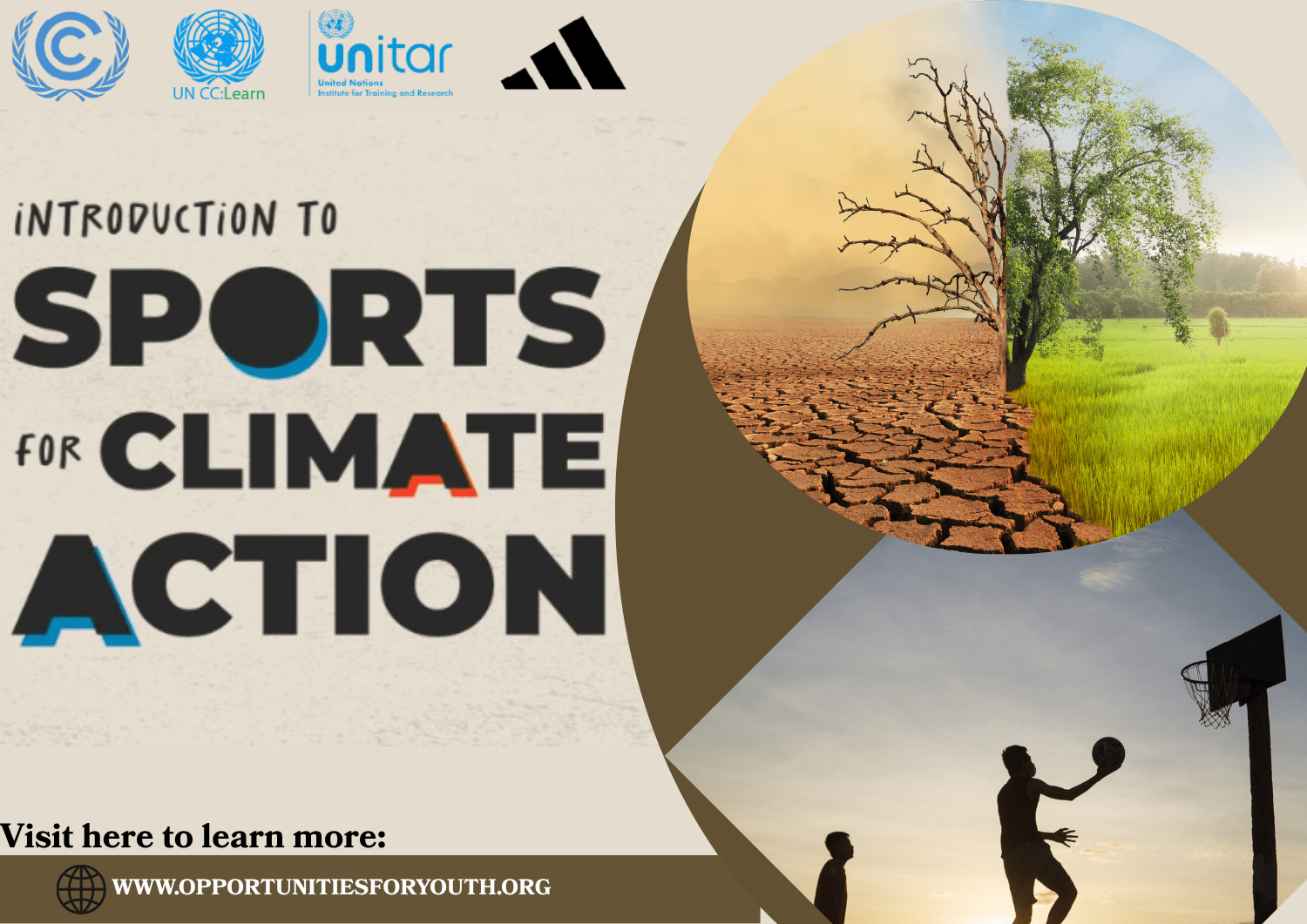
Introduction to Sports for Climate Action Online Course 2026: Enroll in the Free UN Climate Change & UNITAR Sustainability Training with Optional Digital Certification
@Unknown
Location
USA / Global
Work Mode
opportunity
Posted
about 4 hours ago
Beware of scams! When applying for jobs, you should NEVER have to pay anything. Learn about job scams.
Get jobs in your inbox
Join over 10,000 subscribers receiving our weekly newsletter.
You might also like

Free UNICEF Online Courses 2026: Learn Global Development Skills Through the UNICEF Agora Platform
Unknown

Plan International Bangladesh Opens Applications for 14 Positions Under World Bank-Supported EARN Project
Supported EARN Project

Kia South Africa Is Hiring: Apprenticeship Level 1 in Durban
Unknown

Department of Water and Sanitation Vacancies – Apply by 17 August 2026
Unknown

Department of Employment and Labour Announces Multiple Government Vacancies – Apply by 17 August 2026
Unknown

Japan’s FY2026 Mid-Career Course Opens Applications: Fully Funded Peacebuilding & International Development Training for Global Professionals
Career Course Opens Applications: Fully Funded Peacebuilding & International Development Training for Global Professionals