








OpenAI Student Collective 2026–2027: Apply to Become a Campus Lead and Receive Funding, ChatGPT Access, Codex Credits and a Cash Stipend @2027: Apply to Become a Campus Lead and Receive Funding, ChatGPT Access, Codex Credits and a Cash Stipend
Applications are now open for the OpenAI Student Collective 2026–2027, a campus leadership initiative designed to empower undergraduate students to help their peers learn, experiment with, and confidently use artificial intelligence tools such as ChatGPT and Codex.
Through the Student Collective, selected undergraduate students will serve as OpenAI Campus Leads, working in pairs to create active AI learning communities at their colleges and universities. Campus Leads will organize workshops, facilitate weekly project-building sessions, host campus showcases, and help students from different academic disciplines discover practical and creative ways to use AI.
The opportunity comes with substantial support from OpenAI. Campus Leads will receive a ChatGPT subscription, Codex credits, funding and resources for campus events, merchandise, training, guidance from OpenAI, access to a global network of Campus Leads, and a cash stipend each semester in recognition of their time and leadership.
There may also be opportunities for selected participants to visit OpenAI headquarters in June 2027.
The program is initially available to eligible undergraduate students studying in the United States, Canada, United Kingdom, France, Germany, India, Japan, and South Korea. Students studying elsewhere can still submit an application to register their interest for possible future availability.
Applications close on August 10, 2026, at 11:59 p.m. Pacific Time (PT).
About the OpenAI Student Collective
Students have been among the early adopters finding new ways to use artificial intelligence for learning, creativity, problem-solving, project development, and other academic and everyday activities.
As AI tools become increasingly capable, students are likely to play an important role in determining how these technologies are understood and applied within universities.
The OpenAI Student Collective seeks to support that student-led experimentation by establishing communities where learners can develop practical AI skills together.
Rather than limiting participation to computer science, engineering, or technology students, OpenAI encourages students from every academic discipline to participate.
The central leadership role within the program is the Campus Lead.
Campus Leads will help create an environment on their campuses where students can:
- Learn about the latest AI tools.
- Develop confidence using ChatGPT and Codex.
- Experiment with practical AI applications.
- Begin and develop their own projects.
- Work alongside students from other academic disciplines.
- Receive help when they encounter challenges.
- Showcase projects they have created.
- Participate in a broader student AI community.
OpenAI is particularly looking for undergraduate students who are curious, community-minded, interested in its tools, and enthusiastic about helping other students learn.
How the OpenAI Student Collective Works
Campus Leads will work in pairs to build and maintain their campus communities.
The Student Collective is structured around four major components: Workshops, Studio Hours, Showcases, and Community.
1. Workshops
Campus Leads will organize welcoming workshops where students can develop new AI skills and explore what they can create using available tools.
These workshops are intended to help participants move from learning about AI to actually using it.
Students can then choose projects or ideas that they want to continue developing during subsequent Studio Hours.
Campus Leads are expected to organize:
Four workshops per semester.
These activities will therefore form an important part of the Student Collective’s learning experience.
2. Weekly Studio Hours
Studio Hours provide regular opportunities for students to work on their projects in a collaborative environment.
They will be held:
Weekly.
Instead of learning something during a workshop and then working completely independently, participants can return to Studio Hours to spend focused time developing their projects.
Students will also be able to:
- Work alongside their peers.
- Exchange ideas.
- Continue experimenting with AI.
- Receive assistance when needed.
- Develop projects over time.
- Build relationships with other students interested in AI.
This recurring structure is intended to encourage sustained experimentation rather than one-time participation.
3. Campus Showcases
Campus Leads will also organize showcases where students can present what they have created using AI.
These campus-wide events are expected to take place:
Once each semester.
The showcases provide students with an opportunity to demonstrate their work and celebrate what members of the campus community have been able to create.
4. Ongoing Community
The Student Collective is also designed to provide an ongoing community where participating students can:
- Stay connected.
- Ask questions.
- Discover upcoming opportunities.
- Exchange knowledge.
- Support one another.
- Continue learning beyond individual events.
Community participation will therefore continue throughout the program.
What OpenAI Campus Leads Will Receive
One of the major features of the OpenAI Student Collective is the package of resources provided to selected Campus Leads.
ChatGPT Subscription
Campus Leads will receive a ChatGPT subscription for the duration of the program.
This should allow participants to gain direct experience with OpenAI’s tools while helping students on their campuses understand how they can be used.
Codex Credits
Selected participants will also receive Codex credits for the duration of the program.
Importantly, applicants are not required to have previous experience with Codex before applying.
Funding for Campus Activities
OpenAI will provide funding to support the organization of activities on participating campuses.
This support is intended to help Campus Leads deliver workshops, Studio Hours, showcases, and other community-building activities.
Additional Credits and Merchandise
Campus Leads will receive additional credits and merchandise to support their campus activities and engagement.
Training and Resources
OpenAI will provide participants with training, resources, and guidance related to its latest tools and technology.
This is particularly important because applicants are not expected to already be AI experts.
Selected Campus Leads will receive support that helps them develop sufficient knowledge and confidence before introducing tools to other students.
Access to the OpenAI Team
Campus Leads will have access to the OpenAI team as part of their participation.
This gives selected students an opportunity to learn within a community directly connected to the organization developing the technologies they will be introducing to their peers.
Global Network of Campus Leads
Participants will become part of a global network of OpenAI Campus Leads.
This international community could provide opportunities to:
- Exchange ideas.
- Learn from activities taking place at other universities.
- Share successful approaches.
- Develop international connections.
- Discover how students from different academic and cultural contexts are using AI.
Cash Stipend Every Semester
Campus Leads will receive a cash stipend each semester in recognition of the time and leadership they contribute to the program.
The information provided does not specify the exact monetary value of the stipend.
Applicants should therefore avoid assuming a particular payment amount unless OpenAI provides further information during the selection or onboarding process.
Potential OpenAI Headquarters Visit
The program also includes opportunities for a headquarters visit in June 2027, alongside other potential experiences during the program.
The source information describes this as an opportunity rather than a guaranteed benefit for every Campus Lead.
OpenAI Student Collective 2026–2027 Program Duration
Campus Leads must be prepared to participate from:
August 2026 through June 2027.
Applicants must commit an average of:
4–6 hours per week.
This is therefore a substantial academic-year leadership commitment rather than a short-term ambassador activity.
Students should carefully consider their class schedules, extracurricular commitments, internships, employment, and other responsibilities before applying.
Who Can Apply for the OpenAI Student Collective?
OpenAI encourages undergraduate students from every discipline to apply.
The program is not restricted to students studying:
- Computer science.
- Artificial intelligence.
- Software engineering.
- Data science.
- Mathematics.
- Information technology.
Students studying humanities, social sciences, business, education, law, arts, sciences, healthcare-related subjects, and other fields can also apply if they satisfy the eligibility requirements.
OpenAI states that it is looking for undergraduate students who are:
- Curious.
- Community-minded.
- Excited about AI.
- Interested in introducing other students to AI.
- Enthusiastic about OpenAI tools.
- Able to bring people together.
OpenAI Student Collective Eligibility Requirements
Applicants should carefully review the following requirements before submitting an application.
1. Applicants Must Be at Least 18 Years Old
Campus Leads must be:
18 years of age or older.
Applicants below 18 are therefore not eligible for the Campus Lead role based on the published requirements.
2. Applicants Must Be Undergraduate Students
Applicants must be enrolled in an:
Undergraduate college or university program as of August 2026.
The application form explicitly states that the Campus Lead role is available only to undergraduate students.
Postgraduate students are therefore not included within the stated eligibility criteria.
3. Applicants Must Graduate After December 2027
Eligible applicants must expect to complete their university or college studies:
After December 2027.
The application specifically asks candidates to provide their expected university completion date.
This requirement helps ensure that Campus Leads will remain students for the relevant period.
4. Applicants Must Commit 4–6 Hours Per Week
Selected Campus Leads must be prepared to dedicate approximately:
4–6 hours each week from August 2026 through June 2027.
This time may include organizing workshops, facilitating Studio Hours, communicating with students, planning showcases, participating in program activities, and maintaining the campus community.
5. Eligible Countries
The Student Collective is initially available to students studying in:
- United States
- Canada
- United Kingdom
- France
- Germany
- India
- Japan
- South Korea
Applicants must also have work authorization in their country of study.
What if your university is outside these countries?
Students studying elsewhere may still submit an application to register their interest.
OpenAI states that it will let such students know when the Student Collective becomes available in their country.
This distinction is important: submitting interest from another country should not be interpreted as meaning that the Campus Lead program is currently available there.
6. Applicants Cannot Be Ambassadors or Interns for Other AI Programs or Companies
Applicants must not currently be an ambassador or intern for another AI program or company.
The application form provides even broader language when asking candidates about other formal roles, including positions such as:
- Intern.
- Fellow.
- Ambassador.
- Campus representative.
- Student advisor.
- Researcher.
- Contractor.
- Formal volunteer.
- Other formal positions.
Students currently participating in another formal company or program role should carefully review this restriction before applying.
Do You Need Previous AI or Coding Experience?
No.
One of the most important features of the OpenAI Student Collective application is that applicants do not need prior Codex experience or an existing portfolio of AI projects.
OpenAI indicates that it is more interested in whether applicants are:
- Curious.
- Willing to learn.
- Able to bring people together.
- Interested in supporting other students.
- Excited to develop confidence using new technologies.
OpenAI will provide training and support to help selected students become more confident with its tools before they introduce those technologies on campus.
Being relatively new to AI can even provide useful perspective because Campus Leads who remember the challenges of being beginners may be better positioned to create welcoming learning environments for students encountering AI tools for the first time.
What OpenAI Is Looking for in Campus Leads
The application requirements suggest that OpenAI is looking beyond technical knowledge.
A competitive applicant should be able to demonstrate a combination of curiosity, leadership, communication, community building, initiative, and interest in AI.
Strong candidates may want to demonstrate evidence of:
- Organizing activities on campus.
- Bringing students together.
- Leading projects or initiatives.
- Supporting student communities.
- Communicating ideas clearly.
- Using AI in useful or creative ways.
- Helping others learn.
- Taking initiative.
- Solving problems.
- Thinking thoughtfully about issues affecting young people.
- Being open to changing their perspective when presented with new information.
OpenAI Student Collective Application Questions
The application provides useful insight into what candidates should prepare before applying.
Applicants will be asked to provide basic personal and academic information, including:
- First name as shown on identification.
- Last name as shown on identification.
- Email address.
- Age.
- Country where their university or college is located.
- Full name of their university or college.
- Current educational status.
- Expected university or college completion date.
- General area of study.
- Major, course, field, or academic program.
Applicants will also need to confirm whether they can dedicate 4–6 hours per week from August 2026 through June 2027.
Video Responses Required for the Application
The application includes short video questions.
Video Question 1: How You Use AI
Applicants are asked:
What is one way you use AI that you think more students should know about?
Candidates must submit a link to a video response lasting 60 seconds or less.
The video must be accessible to anyone with the link because OpenAI states that it cannot review videos that require special access permissions.
This question gives applicants an opportunity to demonstrate:
- Practical understanding of AI.
- Communication skills.
- Creativity.
- Ability to explain ideas concisely.
- Awareness of how AI can benefit students.
Video Question 2: Something You Made Happen on Campus
Applicants must also respond to:
What is something you helped make happen on campus?
Again, the response must be provided through a video link lasting no more than 60 seconds.
This question appears particularly relevant to the community-building nature of the Campus Lead role.
Applicants may want to choose an example that clearly explains:
- The situation or opportunity.
- What they personally did.
- Who they worked with.
- Challenges they encountered.
- The outcome.
- What they learned.
Written Application Questions
Candidates must also answer short written questions.
What Is the Most Important Problem Facing Young People?
Applicants are asked:
What is the most important problem facing young people? How would you try to make progress on it?
The response is limited to:
500 characters.
Because the character limit is short, applicants should focus on identifying one clear problem and explaining a realistic approach rather than attempting to address many unrelated challenges.
What Have You Changed Your Mind About Recently?
Candidates must answer:
What’s something you’ve changed your mind about recently?
This response is also limited to:
500 characters.
The question provides an opportunity to demonstrate reflection, intellectual openness, and an ability to reconsider previous assumptions.
Social and Professional Profile Information
The application provides spaces for:
- LinkedIn profile.
- Other public social profiles.
Applicants should therefore review any profiles they choose to provide and ensure the information accurately represents their activities and experience.
Applying With Another Student
Campus Leads work in pairs.
Applicants who would like to apply alongside another student from their campus can provide the email address that the other student used to apply.
This gives candidates an opportunity to identify a potential co-lead.
However, the provided information does not state that naming another applicant automatically guarantees that the two students will be paired.
Previous OpenAI Program Participation
The application also asks whether candidates have previously been involved with an OpenAI program.
Applicants should answer this accurately based on their previous participation.
Candidates will additionally be asked:
- How they heard about the role.
- Whether there is anything else they would like to share with the OpenAI team.
The final additional-information field has a limit of 150 characters.
Application Deadline
Applications for the OpenAI Student Collective Campus Lead opportunity close on:
August 10, 2026, at 11:59 p.m. Pacific Time (PT).
Because the deadline is specified in Pacific Time, international applicants should convert the deadline to their local time and avoid waiting until the final hours to submit.
Applicants should also leave enough time to prepare and upload accessible links for the two required video responses.
How to Prepare a Strong OpenAI Student Collective Application
Although OpenAI does not provide a formula guaranteeing selection, candidates can use the application requirements to prepare strategically.
1. Demonstrate Community Leadership
This is not simply an AI-user program. Campus Leads are expected to build communities.
Applicants should therefore highlight experiences demonstrating their ability to:
- Organize students.
- Coordinate events.
- Lead initiatives.
- Build communities.
- Communicate across disciplines.
- Encourage participation.
2. Explain AI in an Accessible Way
Campus Leads will introduce students from different academic backgrounds to AI.
Avoid presenting yourself only as a highly technical user. Demonstrating an ability to make technology approachable to beginners may be equally valuable.
3. Prepare Strong 60-Second Videos
Sixty seconds passes quickly.
Before recording, identify:
- Your main message.
- One strong example.
- The impact.
- Why it matters.
Avoid trying to include your entire résumé in the video.
4. Show Evidence of Initiative
For the question about something you helped make happen on campus, choose an example where your contribution is clear.
Explain what you actually did, rather than describing only what an organization or team accomplished collectively.
5. Keep Written Answers Focused
With only 500 characters for some questions, every sentence matters.
Start with the central idea and then briefly explain your reasoning or proposed action.
6. Check Video Permissions
OpenAI specifically warns that it cannot review videos requiring access.
Before submitting, test each video link in a private or incognito browser to ensure that someone without your account credentials can view it.
7. Confirm Your Availability
The program requires 4–6 hours every week for approximately an academic year.
Applicants should make sure they can realistically manage this commitment.
Frequently Asked Questions About the OpenAI Student Collective 2026–2027
Can I apply if I have never used Codex or built an AI project?
Yes. OpenAI explicitly states that applicants do not need previous Codex experience or an existing portfolio of AI projects. Curiosity, willingness to learn, and the ability to bring people together are important qualities. Training and support will be provided.
Do I need to be a computer science or engineering student?
No. Students from every academic discipline are encouraged to apply.
How old must I be?
Applicants must be at least 18 years old.
Can postgraduate students apply?
The published eligibility information states that the Campus Lead role is only available to undergraduate students.
When must I be graduating?
Applicants must expect to graduate after December 2027.
How much time does the program require?
Campus Leads must commit approximately 4–6 hours per week from August 2026 through June 2027.
Which countries are currently eligible?
The initial program is available to undergraduate students studying in the United States, Canada, United Kingdom, France, Germany, India, Japan, and South Korea, subject to the other eligibility requirements, including work authorization in the country of study.
Can students studying in other countries apply?
Students studying elsewhere can submit an application to register their interest, and OpenAI says it will inform them when the Collective becomes available in their country.
Is the OpenAI Student Collective paid?
Yes. OpenAI states that Campus Leads will receive a cash stipend each semester in recognition of their time and leadership.
The exact stipend amount is not specified in the supplied information.
Will Campus Leads receive ChatGPT access?
Yes. Selected Campus Leads receive a ChatGPT subscription for the duration of the program.
Are Codex credits included?
Yes. Campus Leads will receive Codex credits for the duration of the program.
Does OpenAI provide funding for campus events?
Yes. OpenAI states that Campus Leads will receive funding, credits, and merchandise to help organize campus events.
What activities will Campus Leads organize?
The program includes:
- Four workshops per semester.
- Weekly Studio Hours.
- One campus-wide showcase each semester.
- Ongoing community activities.
Will OpenAI provide training?
Yes. Campus Leads receive training, resources, and guidance on OpenAI’s latest tools and technology.
Is an OpenAI headquarters visit guaranteed?
The information states that Campus Leads will have opportunities for an HQ visit in June 2027 and other surprises along the way. It does not explicitly guarantee that every participant will receive a headquarters visit.
Can I request a particular co-lead?
The application allows candidates who want to apply with another student from their campus to provide the email address used by that student to apply. The supplied material does not explain whether requested pairings are guaranteed.
Can I participate in another AI ambassador program at the same time?
The qualifications state that applicants cannot currently be an ambassador or intern for another AI program or company. The application also asks candidates about other formal roles, including fellowships, campus representative roles, research positions, contracting, formal volunteering, and similar positions.
Applicants with another formal role should carefully review the restriction before applying.
Do I have to start an official university club?
The supplied material lists this question in the FAQ but does not provide its answer. Therefore, based solely on the information supplied, it cannot be confirmed whether establishing an official student club is required.
How long will individual workshops last?
The supplied information states that Campus Leads will conduct four workshops per semester, but it does not provide the answer to the FAQ concerning the duration of each workshop.
Will OpenAI provide workshop materials?
The supplied page lists this as an FAQ question but does not include its answer in the provided text. The broader program description does state that Campus Leads receive training, resources, and guidance, but the supplied information does not specifically explain exactly which workshop materials will be provided.
When and how will Campus Leads receive their stipend?
OpenAI confirms that Campus Leads will receive a cash stipend each semester, but the supplied information does not specify the amount, payment schedule, or payment method.
What happens after submitting an application?
The supplied page includes “What happens after I apply?” as an FAQ, but its answer was not included in the information provided. Applicants should therefore follow any instructions or communications sent by OpenAI after submission.
Who can participate in the campus community?
The program is designed to bring students from different fields together. However, the detailed answer to the FAQ about exactly who Campus Leads can invite to participate was not included in the supplied information.
Why the OpenAI Student Collective Is Worth Considering
The Student Collective combines AI learning with practical campus leadership.
For selected undergraduate students, the program provides an opportunity to develop experience across several areas simultaneously, including:
- Artificial intelligence.
- Student leadership.
- Community building.
- Event organization.
- Project development.
- Public speaking.
- Peer learning.
- Technology education.
- Cross-disciplinary collaboration.
Participants will not simply learn about AI themselves. They will be responsible for helping other students become more confident experimenting with AI and turning ideas into projects.
The combination of a cash stipend, ChatGPT subscription, Codex credits, event funding, training, merchandise, OpenAI access, international networking, and potential headquarters opportunities makes the program particularly notable for undergraduate students interested in AI and campus leadership.
Click HERE to learn more about the OpenAI Student Collective 2026–2027.
Conclusion
The OpenAI Student Collective 2026–2027 Campus Lead Program provides undergraduate students with an opportunity to become leaders in the rapidly evolving intersection of artificial intelligence, education, creativity, and student community building.
Selected Campus Leads will work in pairs to organize workshops, host weekly Studio Hours, coordinate campus showcases, and maintain communities where students from different disciplines can learn how to use ChatGPT, Codex, and other OpenAI technologies.
In return for their leadership and time, Campus Leads will receive substantial support, including a ChatGPT subscription, Codex credits, campus event funding, merchandise, training, resources, access to the OpenAI team, participation in a global Campus Lead network, and a cash stipend each semester. Participants may also have opportunities connected to an OpenAI headquarters visit in June 2027.
Applicants do not need an extensive AI portfolio or previous Codex experience. Instead, OpenAI emphasizes curiosity, willingness to learn, community-mindedness, and the ability to bring students together.
Eligible applicants must be at least 18, enrolled in an undergraduate program as of August 2026, expect to graduate after December 2027, and be able to commit approximately 4–6 hours per week from August 2026 through June 2027. The initial program covers students studying in the United States, Canada, United Kingdom, France, Germany, India, Japan, and South Korea who meet the applicable work-authorization requirement.
Application Deadline: August 10, 2026, at 11:59 p.m. PT.
Interested students should prepare their short video responses, review their eligibility and availability, and submit their applications before the deadline.
Discover more global Fellowship, AI, and Leadership Development opportunities on Opportunities for Youth (OFY).

OpenAI Student Collective 2026–2027: Apply to Become a Campus Lead and Receive Funding, ChatGPT Access, Codex Credits and a Cash Stipend
@2027: Apply to Become a Campus Lead and Receive Funding, ChatGPT Access, Codex Credits and a Cash Stipend
Location
USA / Global
Work Mode
fellowship
Posted
about 4 hours ago
Beware of scams! When applying for jobs, you should NEVER have to pay anything. Learn about job scams.
Get jobs in your inbox
Join over 10,000 subscribers receiving our weekly newsletter.
You might also like

Win Without War is Hiring a Remote Digital Associate in the United States (Full-Time) – Apply Now: Starting Salary of $58,250+ per year
Time) – Apply Now: Starting Salary of $58,250+ per year

GovAI Opportunities 2026: Apply for Research, AI Policy, Chief of Staff and Operations Roles with Salaries Up to $205,000
Unknown

GovAI Opportunities 2026: Apply for Research, AI Policy, Chief of Staff and Operations Roles with Salaries Up to $205,000
Unknown

UNESCO Is Hiring a Remote Consultant Now! Here’s Why This 4-Month Role Is Turning Heads
Month Role Is Turning Heads
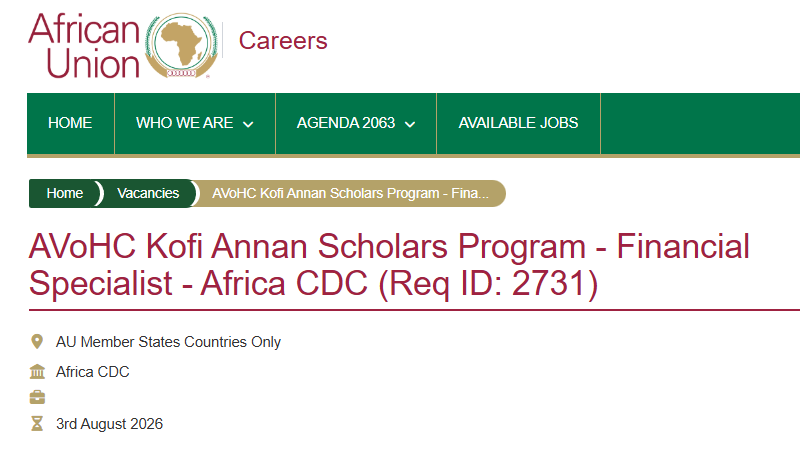
Africa CDC Opens Applications for 20 Financial Specialist Positions Under the Kofi Annan Scholars Program
Unknown
Doha Debates Ambassador Program Cohort 9 (2026): Global Leadership Opportunity for Young Changemakers Aged 18–26
26