
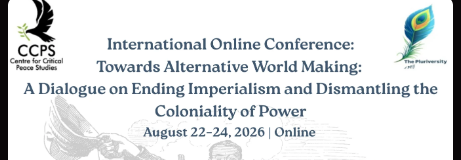
Towards Alternative World Making: Global Scholars Launch International Online Conference on Ending Imperialism and Dismantling Colonial Power (August 22–24, 2026) @24, 2026)
As the geopolitical landscape continues to shift after the crises and conflicts that intensified from late 2023 onward, scholars, activists, educators, and grassroots movements across the Global South are calling for new ways of imagining the future.
In response to these transformations, The Pluriversity Lahore and its international partners have announced a major online conference titled “Towards Alternative World Making: A Dialogue on Ending Imperialism and Dismantling the Coloniality of Power,” scheduled for August 22–24, 2026.
The free international conference invites academics, researchers, students, Indigenous thinkers, activists, and practitioners from around the world to critically examine imperialism, coloniality, global inequality, and the urgent need for alternative political, economic, epistemic, and ecological systems.
Why This Conference Matters in 2026
The organizers argue that the world has entered a historic turning point. The past several years have exposed deep fractures in the so-called “rules-based international order,” raising difficult questions about global governance, military power, media narratives, economic inequality, and institutional legitimacy.
Across many regions of the world, growing numbers of scholars and social movements are questioning whether existing international systems truly serve justice, peace, and humanity equally. Discussions surrounding Gaza, climate catastrophe, debt dependency, digital surveillance, racialized violence, and economic extraction have intensified debates around coloniality and imperial power structures.
According to the conference convenors, many decolonization conversations remain confined to universities and elite academic spaces. The event aims to bridge that divide by bringing together critical scholarship with lived experiences, activist knowledge, Indigenous perspectives, and grassroots organizing.
The conference seeks to foster deeper South-South dialogue while creating space for collaborative visions of pluriversal futures — futures that move beyond systems rooted in extraction, domination, and inequality.
Key Themes: Decolonization, Justice, and Alternative Futures
The conference will explore a wide range of urgent global themes through interdisciplinary dialogue and critical inquiry.
Reading the Present Moment
Participants are encouraged to examine how colonial modernity continues to shape today’s world order. Topics include:
- Wars, genocide, and political violence
- Climate collapse and ecological destruction
- Artificial intelligence and digital colonialism
- Higher education and epistemic injustice
- Student movements and academic resistance
- The crisis of international institutions
- Media manipulation and information control
The conference specifically calls attention to the relationship between power, knowledge, and global inequality, urging scholars to rethink the role of universities and intellectual production in contemporary society.
Designing Alternative Worlds
Another major focus of the event is imagining new futures beyond imperial systems. Organizers are inviting discussions on:
- Pluriversal political and economic systems
- Ethical and regenerative economies
- Climate justice and ecological restoration
- Community-led knowledge systems
- Digital resistance and technological sovereignty
- Decolonized publishing and education models
Rather than limiting decolonization to critique alone, the conference emphasizes the practical creation of alternative institutions, solidarities, and systems of collective life.
Coloniality of Power and Global Inequality
A central framework of the conference is the concept of the “coloniality of power” — the idea that colonial structures continue to shape global hierarchies long after formal colonial rule ended.
Conference contributors are invited to examine how colonial logics continue to operate through:
- Economic extraction and debt systems
- Militarism and sanctions
- Racism and racialized labor exploitation
- Settler colonialism and land dispossession
- Eurocentric knowledge production
- Academic dependency and intellectual imperialism
- Big tech monopolies and data extraction
The organizers argue that understanding these systems is necessary in order to dismantle them and build more equitable global futures.
Technology, AI, and Digital Colonialism
One of the most forward-looking sections of the conference focuses on artificial intelligence and emerging technologies.
The conference asks urgent questions about how AI may reshape labor markets, governance, democracy, and technological sovereignty in the Global South. Scholars are invited to investigate the risks of data extraction, misinformation, surveillance, and the displacement of local knowledge systems.
The organizers also encourage critical reflection on whether technological systems developed primarily within dominant global powers may reinforce new forms of colonial dependency.
Indigenous Knowledge and Social Innovation
The conference places strong emphasis on Indigenous knowledge systems and traditional peoples’ ways of organizing social life.
Participants are encouraged to explore how Indigenous communities produce alternative forms of science, resistance, memory, ecology, and collective governance. Organizers believe these knowledge traditions are essential to rebuilding relationships between territory, culture, education, and justice.
This focus reflects a broader shift in global scholarship toward recognizing that solutions to contemporary crises may emerge not only from institutions of power, but from historically marginalized communities.
South-South Solidarity and Global Justice
A major objective of the conference is strengthening solidarity across the Global South.
The organizers argue that anti-imperialist and decolonial struggles often remain fragmented across regions despite facing interconnected systems of domination. By facilitating dialogue among scholars and activists from Africa, Asia, Latin America, and other regions, the event hopes to support collaborative strategies for social justice, reparations, ecological restoration, and political transformation.
Discussions will also examine reparative justice for colonialism, including debt cancellation, wealth redistribution, cultural restitution, and environmental rehabilitation.
Call for Abstracts and Participation
The conference is open to abstract submissions, session proposals, interdisciplinary research presentations, activist interventions, and community-based perspectives.
Participation is free of charge and fully online, making the event accessible to global audiences.
Submission Deadline
June 25, 2026
Conference Dates
August 22–24, 2026
Submission Email
worlds.without.imperialism@gmail.com
The event is convened by The Pluriversity Lahore and the Centre for Critical Peace Studies, UMT, alongside an international network of scholars and researchers from institutions across Pakistan, Brazil, South Africa, Ireland, Hong Kong, and the Philippines.
As debates around imperialism, inequality, climate breakdown, and technological power continue to intensify worldwide, the conference aims to create a vital space for dialogue, resistance, and the collective imagining of alternative futures.
FIND FULL TEXT HERE
For more opportunities such as these please follow us on Facebook, Instagram, Twitter, LinkedIn and WPChannel
Disclaimer: Global South Opportunities (GSO) is not the organization offering this opportunity. For any inquiries, please contact the official organization directly. Please do not send your applications & CVs to GSO, as we are unable to process them. Due to the high volume of emails, we receive daily, we may not be able to respond to all inquiries. Thank you for your understanding
JOIN GSO WHATSAPP CHANNEL NOW
Towards Alternative World Making: Global Scholars Launch International Online Conference on Ending Imperialism and Dismantling Colonial Power (August 22–24, 2026)
@24, 2026)
Location
USA / Global
Work Mode
fellowship
Posted
about 14 hours ago
Beware of scams! When applying for jobs, you should NEVER have to pay anything. Learn about job scams.
Get jobs in your inbox
Join over 10,000 subscribers receiving our weekly newsletter.
You might also like
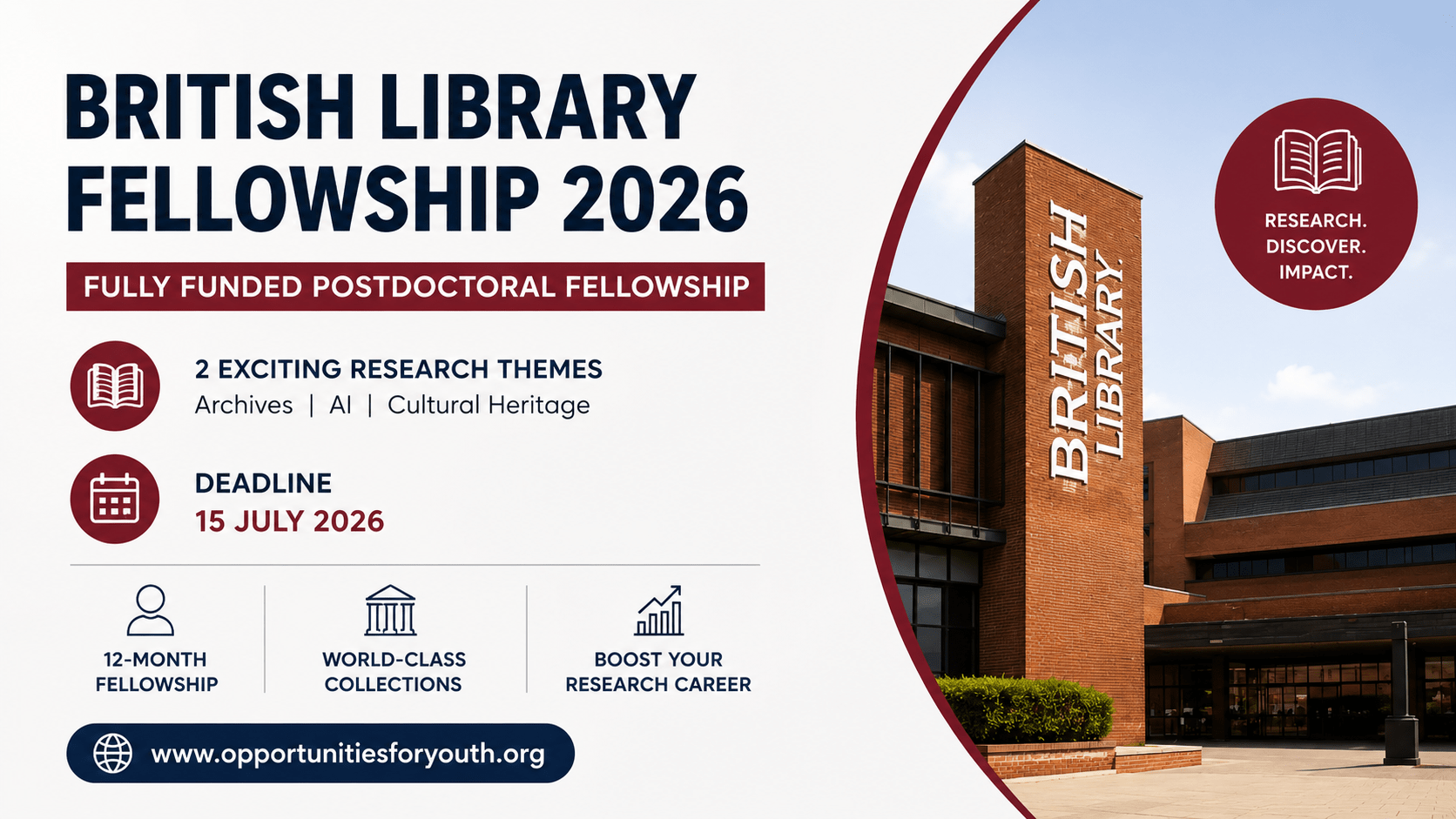
The British Library Joanna and Graham Barker Fellowship Scheme 2026–2027 | Fully Funded Postdoctoral Fellowship Opportunities in the UK
2027 | Fully Funded Postdoctoral Fellowship Opportunities in the UK
ITTO Fellowship Programme 2026 for Forestry and Sustainable Development Professionals
International Tropical Timber Organization (ITTO)
Talent Accelerator Programme
AfriLabs
Research Fellowships in Sustainable Agriculture, Forestry and Fisheries
Organisation for Economic Co-operation and Development (OECD)

NDC Youth Ambassador
Care About Climate
AMLD Africa Ambassador
Africa Machine Learning and Deep Learning (AMLD Africa)