








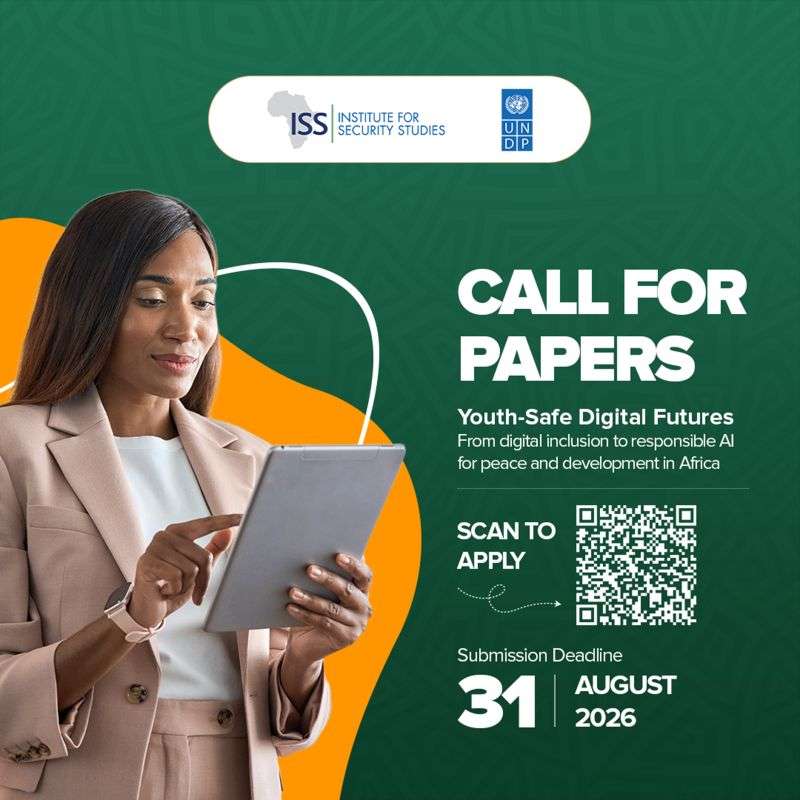
UNDP & ISS Call for Papers 2026: Submit Your Research on Youth-Safe Digital Futures in Africa ·Safe Digital Futures in Africa
The United Nations Development Programme (UNDP), in partnership with the Institute for Security Studies (ISS), has officially launched the Call for Papers: Youth-Safe Digital Futures, inviting researchers, practitioners, youth experts, digital rights advocates, and technology policy specialists from across Africa to contribute to an important new policy compendium focused on creating safer, more inclusive digital environments for young people.
The forthcoming publication, titled “Youth-Safe Digital Futures: From Digital Inclusion to Responsible AI for Peace and Development in Africa,” seeks high-quality analytical papers that explore how Africa can build digital ecosystems where young people can safely access opportunities, participate in governance, innovate, and benefit from emerging technologies such as Artificial Intelligence (AI).
As digital transformation accelerates across Africa, this initiative recognizes that providing internet access alone is no longer enough. Instead, the focus is shifting toward ensuring that digital technologies promote peace, inclusion, accountability, innovation, and sustainable development while protecting young people from online risks and harms.
Researchers and practitioners with expertise in digital governance, AI, youth development, peacebuilding, cybersecurity, media, and public policy are encouraged to submit original policy papers before the application deadline.
About the Youth-Safe Digital Futures Compendium
Young Africans are increasingly using digital platforms to:
- Access education.
- Build sustainable livelihoods.
- Launch startups and social enterprises.
- Participate in civic engagement.
- Advocate for policy change.
- Contribute to democratic processes.
- Engage in entrepreneurship and innovation.
However, rapid digital transformation has also introduced numerous challenges.
Young people frequently encounter:
- Online harassment.
- Cyber scams and fraud.
- Surveillance.
- Algorithmic discrimination.
- Digital exclusion.
- Online misinformation and disinformation.
- Manipulated digital content.
- Technology-facilitated violence.
- Limited representation of African languages and local realities in AI systems.
Recognizing these challenges, the UNDP and ISS are developing a policy compendium that moves beyond digital access toward creating youth-safe digital futures, where young people can participate confidently, safely, and meaningfully in digital and AI-enabled societies.
Purpose of the Compendium
The publication seeks to answer several critical policy questions, including:
- How can African youth access and benefit from AI-enabled transformation?
- What governance mechanisms are needed to minimize AI-related risks?
- How can digital trust be strengthened to promote peace and social cohesion?
- How can AI contribute positively to sustainable development?
- Who benefits from AI-driven innovation?
- How can digital systems become more inclusive, equitable, and accountable?
The publication aligns with major regional and global policy frameworks, including:
- African Union Digital Transformation Strategy for Africa (2020–2030)
- African Union Continental Artificial Intelligence Strategy
- Global Digital Compact
- UNDP Digital and Artificial Intelligence Strategy
Scope of the Publication
The compendium will include:
- 8–10 thematic policy papers
- 3–4 African case studies
- A comprehensive synthesis chapter outlining a policy agenda for youth-safe digital futures across Africa
Contributors are expected to provide analytical and evidence-based papers rather than descriptive summaries. Papers should connect local experiences with national, regional, and continental policy discussions while drawing primarily on African evidence and experiences.
Thematic Areas
Authors should submit papers addressing one of the following four themes.
Theme 1: Digital and AI Inclusion for Peace and Development
Topics may include:
- Digital inclusion
- Affordable internet access
- AI literacy
- Digital literacy
- Rural and urban digital inequalities
- Gender gaps in digital access
- Disability inclusion
- Local language technologies
- Online safety
- Algorithmic bias
- Digital exclusion
Theme 2: Safe Digital Spaces, Rights and Protection
Possible topics include:
- Cyberbullying
- Online harassment
- Technology-facilitated gender-based violence
- Digital scams
- Online exploitation
- Extremist recruitment
- Privacy and surveillance
- Mental health and digital wellbeing
- Digital rights
- Child and youth online protection
Theme 3: Information Integrity, Media and Social Cohesion
Authors may explore:
- Misinformation
- Disinformation
- Hate speech
- Election-related misinformation
- Digital trust
- Social media governance
- Civic participation
- Fact-checking
- Digital media
- Peacebuilding through information integrity
Theme 4: Youth Innovation, Digital Livelihoods and Resilience
Suggested areas include:
- Artificial Intelligence innovation
- Youth entrepreneurship
- Digital startups
- Creative industries
- Climate technology
- Civic technology
- Community resilience
- Peacebuilding innovation
- Financing digital innovation
- Public-private partnerships
Who Should Submit Papers?
The organizers welcome submissions from individuals and organizations with expertise in relevant fields.
Eligible contributors include:
- Researchers
- Academics
- Youth experts
- Civil society organizations
- Technology policy specialists
- Digital rights advocates
- Peacebuilding practitioners
- Think tanks
- Development professionals
- Youth-led organizations
Editorial Requirements
Submitted papers must:
- Be approximately 2,000 words.
- Present original analysis.
- Be intellectually authored by humans.
- Not be simultaneously submitted elsewhere.
- Successfully pass plagiarism screening.
- Undergo editorial review.
- Undergo external peer review.
While AI-assisted tools may be used for editing, transcription, coding, translation, or literature organization, authors must disclose such use. AI-generated papers will not be accepted.
Required Paper Structure
Each submission should include:
- Executive summary or abstract.
- Problem statement.
- Definitions of key concepts.
- Methodology section.
- Evidence-based analysis.
- Gender considerations.
- Youth inclusion considerations.
- Disability inclusion considerations.
- Conflict-sensitive analysis.
- Policy recommendations at:
- Community level
- National level
- Regional level
- Continental level
- Complete reference list using:
- APA 7th Edition, or
- Chicago Author-Date referencing style
Submission Process
Authors should submit their completed 2,000-word paper by email.
Submissions should be sent to:
- Raquel Leandro – raquel.leandro@undp.org
- Christella Igiraneza – christella.igiraneza@undp.org
- Emmaculate Liaga – eliaga@issafrica.org
Important Dates
| Activity | Date |
|---|---|
| Call for Papers Opens | 23 July 2026 |
| Submission Deadline | 31 August 2026 |
| Internal Review | End of September 2026 |
| External Peer Review | Mid-October 2026 |
| Editing and Finalization | Mid-November – December 2026 |
For More Information
To learn more about the Youth-Safe Digital Futures Call for Papers, including submission requirements, thematic guidance, editorial expectations, and the complete announcement, applicants should visit the official UNDP Africa webpage HERE
Prospective contributors are encouraged to review the official guidance carefully before preparing and submitting their papers to ensure they meet all editorial and submission requirements.
Why You Should Apply
This Call for Papers provides a valuable opportunity to contribute to one of Africa’s most important policy discussions on digital transformation, artificial intelligence, youth participation, and peacebuilding. Selected contributors will help shape evidence-based recommendations that can influence digital governance, AI policy, and youth-focused development across the continent.
Whether you are a researcher, policymaker, practitioner, or digital rights advocate, your work can contribute to building a future where Africa’s young people not only access digital technologies but also use them safely, equitably, and meaningfully.
Conclusion
The UNDP and ISS Youth-Safe Digital Futures Call for Papers 2026 offers an important platform for African experts to contribute original research and policy analysis on the future of digital inclusion, AI governance, online safety, and youth empowerment. By bringing together evidence from across the continent, this compendium aims to inform policies that strengthen peace, digital rights, innovation, and inclusive development. Interested contributors should begin preparing their original analytical papers early and submit them no later than 31 August 2026 to be considered for inclusion in this landmark publication.
Discover more global Research opportunities on OFY HERE
UNDP & ISS Call for Papers 2026: Submit Your Research on Youth-Safe Digital Futures in Africa
@Safe Digital Futures in Africa
Location
USA / Global
Work Mode
jobs
Posted
about 3 hours ago
Beware of scams! When applying for jobs, you should NEVER have to pay anything. Learn about job scams.
Get jobs in your inbox
Join over 10,000 subscribers receiving our weekly newsletter.
You might also like

YEDx 2026 Applications Open: Host a Youth Environmental Dialogue with UNEP’s Children and Youth Major Group (CYMG)
Unknown
Call for Applications: Early-Career Researchers Invited to Review the IPCC Seventh Assessment Report AR7 Draft
Career Researchers Invited to Review the IPCC Seventh Assessment Report AR7 Draft

Call for Applications: Regional Coordinators
Unknown
Call for Applications: VACE Project Supports Agri-Food SMEs to Develop New Ginger and Tomato Products in Nigeria (2026)
Food SMEs to Develop New Ginger and Tomato Products in Nigeria (2026)
The Josef Korbel School of Global & Public Affairs at the University of Denver is Recruiting for a Postdoctoral Research Fellow: Apply by 18 August 2026
the University of Denver is Recruiting for a Postdoctoral Research Fellow: Apply by 18 August 2026
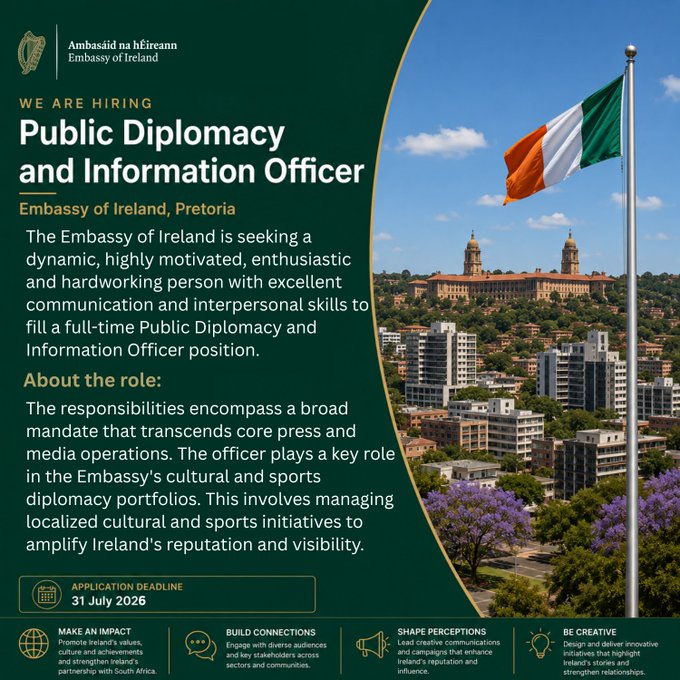
Embassy of Ireland in Pretoria Hiring Public Diplomacy and Information Officer – Applications Open Until 31 July 2026
Applications Open Until 31 July 2026