








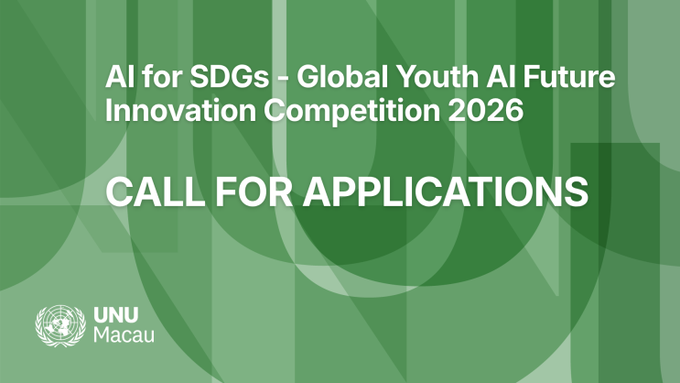
AI for SDGs Global Youth AI Future Innovation Competition 2026 Opens Applications for Global Innovators ·Unknown
The United Nations University (UNU) Global AI Network has announced the opening of applications for the AI for SDGs – Global Youth AI Future Innovation Competition 2026, an international innovation programme designed to empower young innovators, researchers, entrepreneurs, and organisations to use artificial intelligence (AI) technologies to address global sustainable development challenges.
The 2026 competition focuses on the theme “AI and Education: AI Transforming the Educational Paradigm and Enhancing AI Literacy”, highlighting the growing role of artificial intelligence in reshaping education systems, improving access to learning, and preparing societies for an increasingly digital future.
The initiative is guided by the United Nations University and organised by the UNU Global AI Network, with UNU Macau and Venture Cup China serving as co-organisers. The competition seeks innovative AI-driven solutions that contribute to the achievement of the Sustainable Development Goals (SDGs), particularly SDG 4: Quality Education, while also supporting innovation, inclusion, and global partnerships.
AI and Education: Transforming Learning Systems Through Innovation
The 2026 competition addresses two major areas shaping the future of education: the transformation of educational systems through AI and the development of AI literacy among learners, educators, and communities.
Artificial intelligence is increasingly influencing how education is delivered, managed, and accessed. Through the competition, participants are encouraged to develop solutions that improve learning experiences, increase educational accessibility, and create more inclusive opportunities for communities worldwide.
Key areas of interest include:
• Personalised learning platforms and intelligent tutoring systems
• AI-supported curriculum development and educational content creation
• Automated assessment and feedback technologies
• Predictive analytics to support student success and early intervention
• AI-powered educational administration and resource management
• Language learning and translation technologies
• Inclusive learning solutions for people with disabilities
• AI-assisted teacher training and professional development
The competition also emphasises the importance of AI literacy by encouraging projects that help individuals and communities understand, use, and responsibly develop artificial intelligence technologies.
Competition Tracks Supporting Global AI Innovation
The Global Youth AI Future Innovation Competition 2026 features three main competition tracks designed to encourage diverse AI applications for education and social impact.
AI for Education
This category focuses on using artificial intelligence to improve teaching methods, learning systems, and educational institutions.
Eligible solutions may include:
• Adaptive learning technologies that personalise education experiences
• AI-powered teaching assistants and tutoring tools
• Digital platforms improving access to educational resources
• Technologies supporting inclusive and accessible learning environments
• AI solutions that enhance teacher effectiveness
This track directly supports SDG 4: Quality Education by promoting innovative approaches to improving learning outcomes worldwide.
AI for Social Innovation
This track focuses on applying artificial intelligence to address social challenges and promote equitable development through education.
Potential applications include:
• AI platforms expanding access to quality education
• Solutions addressing the digital divide
• AI tools supporting lifelong learning and workforce development
• Community education and civic engagement technologies
• Digital citizenship and misinformation prevention tools
• AI solutions promoting gender equality and social inclusion
• Data-driven tools supporting education policy reform
Projects in this category contribute to SDG 4, SDG 5, SDG 10, and SDG 16 by supporting inclusive societies and reducing inequalities.
AI for Less Developed Countries (LDCs)
The third track focuses on developing affordable and accessible AI solutions that strengthen education systems in underserved communities and less developed countries.
Priority areas include:
• Low-cost AI learning tools suitable for limited-resource environments
• Mobile-based educational technologies for remote communities
• AI literacy programmes for educators and young people
• Localised AI content supporting cultural and language diversity
• Teacher training solutions for underserved regions
• Infrastructure-light AI solutions, including SMS and voice-based platforms
• Community-led AI education initiatives
This track supports SDG 4, SDG 9, and SDG 10 by promoting technology solutions that bridge education and digital access gaps.
Eligibility Requirements for Global Participants
The competition welcomes participation from individuals, groups, and companies worldwide. Applicants do not need to be from a specific country or region.
Applicants must meet the following requirements:
• Participation is open globally regardless of nationality or background
• Projects must have reached Technology Readiness Level (TRL) 6 or above
• Solutions must demonstrate real-world validation potential and innovation capacity
• Incorporated companies must have been established for fewer than 10 years
• Applications, supporting documents, and evaluations must be submitted in English
• No registration, training, or participation fees are required
Technology Readiness Levels between TRL 7 and TRL 9 are considered advanced stages of development, including operational prototypes, commercially ready systems, and solutions already proven through real-world deployment.
Application Timeline and Final Competition in Macau
The 2026 Global Youth AI Future Innovation Competition will take place through three stages: the initial application round, semi-final evaluation, and global final.
Important dates include:
• Open Application: Now until 15 September 2026
• Judging Round: 16 September – 30 September 2026
• Semi-Final Round: 1 October – 15 October 2026
• Global Final and Award Ceremony: 26 November 2026 in Macau
Finalist teams will receive complimentary hotel accommodation during the global final programme in Macau. Selected teams may also apply for limited travel support of up to US$1,000 per team before tax.
Advancing Responsible AI for Sustainable Development
Through the AI for SDGs Global Youth AI Future Innovation Competition 2026, UNU Global AI Network aims to encourage responsible artificial intelligence development while empowering young innovators to create solutions for global challenges.
The initiative reflects the growing importance of combining technological advancement with social responsibility, ensuring that AI contributes to inclusive education, sustainable development, and equitable opportunities worldwide.
Applications and further information are available through the official competition organisers.
VISIT OFFICIAL WEBSITE TO APPLY
For more opportunities such as these please follow us on Facebook, Instagram, Twitter, LinkedIn and WPChannel
Disclaimer: Global South Opportunities (GSO) is not the organization offering this opportunity. For any inquiries, please contact the official organization directly. Please do not send your applications & CVs to GSO, as we are unable to process them. Due to the high volume of emails, we receive daily, we may not be able to respond to all inquiries. Thank you for your understanding.
AI for SDGs Global Youth AI Future Innovation Competition 2026 Opens Applications for Global Innovators
@Unknown
Location
USA / Global
Work Mode
opportunity
Posted
about 3 hours ago
Beware of scams! When applying for jobs, you should NEVER have to pay anything. Learn about job scams.
Get jobs in your inbox
Join over 10,000 subscribers receiving our weekly newsletter.
You might also like
Ghana2Germany Initiative Opens Applications for Lifeguard Training and Germany Apprenticeship Pathway for Young Ghanaians
Unknown

GAUC Climate x Leadership Training Program 2025: Empowering the Next Generation of Global Climate Leaders for a Carbon-Neutral Future
Neutral Future
Free UNITAR Food Waste Prevention Course with Digital Certificate: Learn How to Reduce Food Waste and Support Sustainable Development
Unknown

New openings with KNCV Tuberculosis Foundation
Unknown
Girls Who Code Pathways Program 2026: Free Global Coding, AI, Cybersecurity, Data Science & Web Development Program for High School Students
Unknown
EU Environment Academy 2026 in Ukraine: Fully Funded Training on EU Environmental Law and Accession
Unknown