








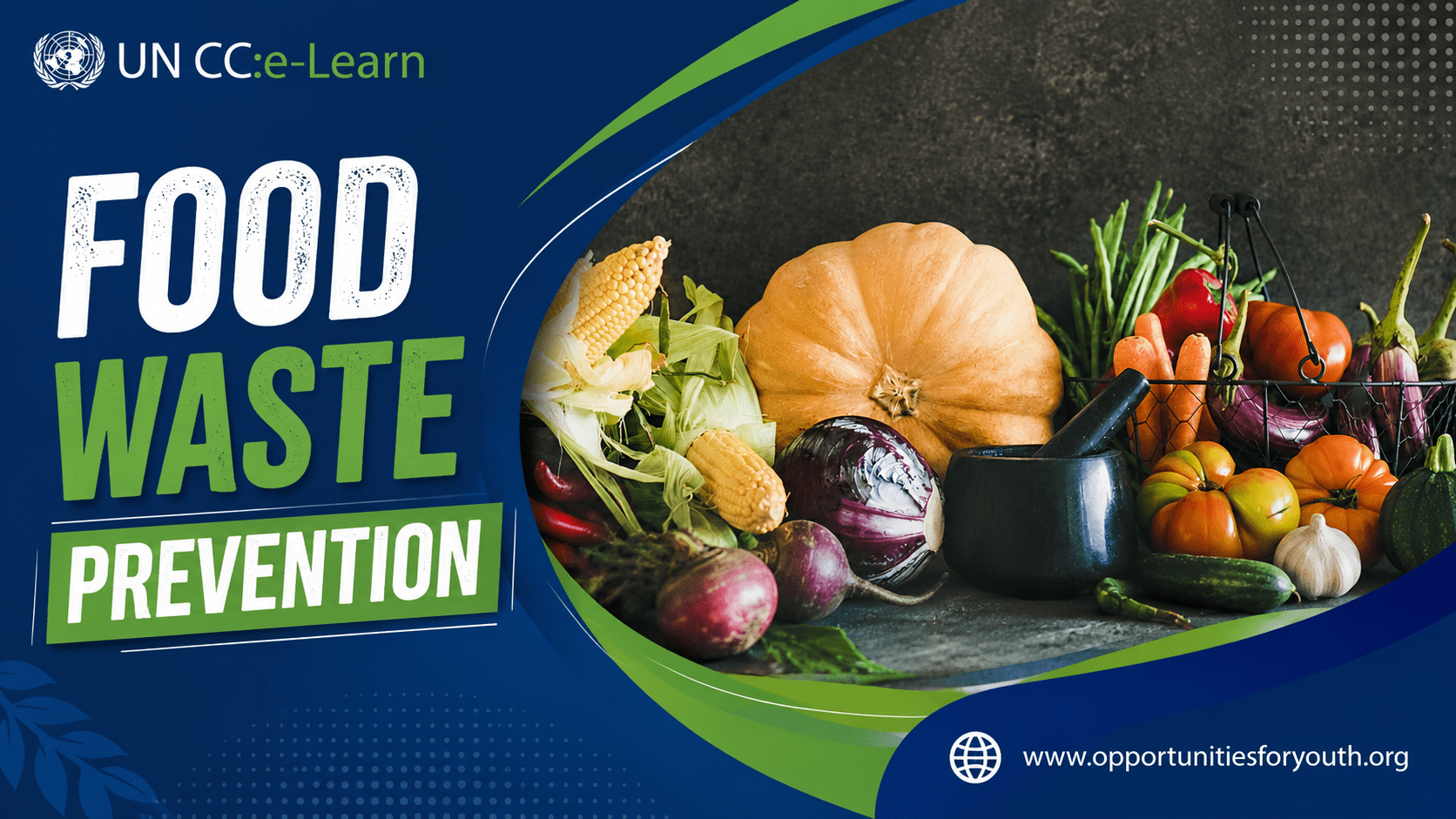
Free UNITAR Food Waste Prevention Course with Digital Certificate: Learn How to Reduce Food Waste and Support Sustainable Development ·Unknown
Food waste is one of the world’s most pressing sustainability challenges, contributing significantly to climate change, environmental degradation, and economic losses. Every year, enormous quantities of edible food are lost or wasted throughout the food supply chain, while millions of people around the world continue to face hunger and food insecurity.
To address this growing global issue, the United Nations Institute for Training and Research (UNITAR) has launched the Food Waste Prevention e-learning course. This comprehensive online course is designed to raise awareness and strengthen the knowledge and skills needed to prevent food waste across every stage of the food chain—from food manufacturing and retail to restaurants, food services, and households.
The course provides learners with practical strategies for reducing food waste, improving resource efficiency, and contributing to sustainable food systems. Participants who successfully complete the course also have the opportunity to obtain a UNITAR Digital Certificate of Completion, making it an excellent learning opportunity for professionals, students, policymakers, entrepreneurs, and sustainability advocates worldwide.
About the UNITAR Food Waste Prevention Course
The Food Waste Prevention course is a self-paced online learning programme developed to help individuals understand the causes, impacts, and solutions related to food waste.
The course supports the development of climate change literacy by equipping learners with practical knowledge that enables informed decision-making and encourages sustainable behaviours.
Rather than focusing solely on theory, the course explores real-world solutions that can be implemented across different sectors of the food chain. It highlights the role that governments, businesses, institutions, and individual consumers all play in preventing unnecessary food waste.
The programme is particularly relevant for learners from rapidly developing and emerging economies where changing consumption patterns present both challenges and opportunities for improving food waste prevention systems.
Why Take This Course?
Food waste has far-reaching consequences that affect food security, natural resources, economies, and the global climate.
This course helps learners understand these interconnected challenges while providing practical tools to reduce food waste at multiple stages of the food supply chain.
Participants will gain valuable knowledge that can be applied in both professional and personal settings to support more sustainable food production and consumption.
The course also contributes to global efforts to achieve Sustainable Development Goal (SDG) 12.3, which aims to reduce food waste by 50 percent by the year 2030.
Learning Objectives
Upon successful completion of the course, participants will be able to:
- Explain the scale of global food waste and its environmental, economic, and social impacts.
- Understand how food waste affects climate change and sustainable development.
- Identify the roles and responsibilities of different stakeholders in preventing food waste.
- Measure and account for food waste across various stages of the food chain.
- Describe practical strategies for preventing food waste during production, processing, retail, food services, and household consumption.
- Recommend effective interventions where food waste prevention is not possible by minimizing waste and improving resource efficiency.
- Apply food waste prevention principles in professional and everyday contexts.
Course Structure
The Food Waste Prevention programme consists of five comprehensive learning modules that guide participants through the entire food supply chain.
Module 1: The State of Play
The first module introduces learners to the global food waste crisis.
Topics covered include:
- The current scale of food waste worldwide.
- Major sources of food waste.
- Environmental impacts.
- Social and economic consequences.
- National and international strategies for reducing food waste.
This module establishes a strong foundation for understanding why food waste prevention is critical to sustainable development.
Module 2: Food Waste in Manufacturing
This module focuses on food losses during processing and manufacturing.
Participants will learn:
- Where food waste occurs during food production.
- Common causes of waste in manufacturing facilities.
- Practical strategies manufacturers can adopt to reduce waste.
- Best practices for improving production efficiency.
Module 3: Food Waste in Retail
Retailers play a major role in reducing food waste.
This module examines:
- Sources of food waste in supermarkets and retail stores.
- Inventory management strategies.
- Consumer purchasing behaviour.
- Practical interventions that retailers can implement to minimize food losses.
Module 4: Food Waste in the Service Industry
Restaurants, hotels, catering services, and other food service providers generate significant amounts of food waste.
Participants will explore:
- Why food waste occurs within food service operations.
- Kitchen management strategies.
- Portion planning.
- Menu optimization.
- Operational practices that reduce waste while improving efficiency.
Module 5: Food Waste in Households
Households are among the largest contributors to food waste globally.
This module teaches participants how consumers can reduce waste through:
- Better meal planning.
- Smart food purchasing.
- Proper food storage.
- Understanding food labels.
- Managing leftovers effectively.
- Responsible food consumption habits.
Expert Instructors
The course is taught by an international team of specialists with extensive experience in food security, sustainability, agriculture, environmental policy, and food systems.
The instructors include:
- Andrea Biswas Tortajada – Food Security, Human Rights, and Agricultural Development Expert; PhD Candidate at the Geneva Graduate Institute.
- Anita Lundström – Senior Advisor, Swedish Environmental Protection Agency (Country Specialist – Sweden).
- Gao Si – Head of China Division, Swedish Environmental Research Institute (Country Specialist – China).
- Nicola Jenkin – Director, Pinpoint Sustainability, South Africa (Country Specialist – South Africa).
- Dr. Gustavo Porpino – Analyst, Brazilian Agricultural Research Corporation (EMBRAPA) (Country Specialist – Brazil).
Their combined expertise provides learners with global perspectives and practical insights into food waste prevention across different regions and sectors.
Digital Certificate
Participants who successfully complete the course may obtain a UNITAR Digital Certificate of Completion.
To qualify for the certificate, learners must:
- Achieve a minimum score of 70% on the final assessment.
- Complete the final quiz within a maximum of three attempts.
After successfully passing the final assessment, participants may purchase and download the official digital certificate upon payment of USD 20.
The digital certificate provides a verified record of achievement that can be shared on professional platforms, included in CVs, and used to demonstrate knowledge of sustainable food systems and food waste prevention.
Who Should Enrol?
This course is suitable for a wide range of learners, including:
- Students.
- Researchers.
- Sustainability professionals.
- Environmental practitioners.
- Agricultural professionals.
- Food manufacturers.
- Retail managers.
- Restaurant and hospitality professionals.
- Government officials.
- Policymakers.
- NGO professionals.
- Climate advocates.
- Development practitioners.
- Educators.
- Consumers interested in sustainable living.
It is particularly valuable for learners from emerging economies such as:
- China.
- Brazil.
- South Africa.
- India.
However, the course is open to participants from around the world.
Benefits of the Course
Participants will benefit from:
- Free access to high-quality online learning.
- Self-paced study that fits individual schedules.
- Practical knowledge applicable across the food supply chain.
- Internationally relevant sustainability content.
- Expert instruction from global specialists.
- Increased understanding of food systems and climate action.
- Skills that support Sustainable Development Goal 12.3.
- Opportunity to obtain a UNITAR Digital Certificate.
Supporting Climate Change Literacy
The course forms part of broader efforts to improve climate literacy and sustainability education.
By helping individuals understand the relationship between food waste, environmental sustainability, and responsible consumption, the programme empowers learners to contribute meaningfully to climate action within their workplaces, communities, and households.
Important Notes
The course is intended solely for educational purposes.
Its objective is to provide participants with balanced, evidence-based information about food systems, environmental sustainability, and food waste prevention so they can make informed decisions that align with their personal values, cultures, and priorities.
Illustrations and references included throughout the course are used exclusively for educational purposes.
Application Deadline
There is no application or enrolment deadline currently announced for this course. Interested learners can register and begin the programme at any time while it remains available online.
Visit HERE to learn more about the Free UNITAR Food Waste Prevention Course with Digital Certificate
Conclusion
The UNITAR Food Waste Prevention course offers an outstanding opportunity for individuals seeking practical knowledge on one of the world’s most urgent sustainability challenges. Through expert instruction, comprehensive learning modules, and globally relevant case studies, participants gain the skills needed to reduce food waste across households, businesses, and institutions while contributing to global climate action and sustainable development. Whether you are a student, professional, policymaker, or sustainability advocate, this free online course provides valuable knowledge that can help create more efficient, resilient, and environmentally responsible food systems. For those wishing to formally recognize their achievement, the optional UNITAR Digital Certificate adds further value by showcasing expertise in food waste prevention and sustainable development.
For more global grants, scholarships, fellowships, internships, jobs, conferences, competitions, and other career opportunities for young people, visit the Opportunities for Youth (OFY) website at www.opportunitiesforyouth.org.
Free UNITAR Food Waste Prevention Course with Digital Certificate: Learn How to Reduce Food Waste and Support Sustainable Development
@Unknown
Location
USA / Global
Work Mode
opportunity
Posted
about 5 hours ago
Beware of scams! When applying for jobs, you should NEVER have to pay anything. Learn about job scams.
Get jobs in your inbox
Join over 10,000 subscribers receiving our weekly newsletter.
You might also like

New openings with KNCV Tuberculosis Foundation
Unknown
Girls Who Code Pathways Program 2026: Free Global Coding, AI, Cybersecurity, Data Science & Web Development Program for High School Students
Unknown
EU Environment Academy 2026 in Ukraine: Fully Funded Training on EU Environmental Law and Accession
Unknown

JOB OPPORTUNITY – STATE FIELD SUPERVISORS (NATIONWIDE)
STATE FIELD SUPERVISORS (NATIONWIDE)

2 Fully Remote Climate Adaptation Consultancy Opportunities at WIEGO: Applications Open for Global Climate Project Roles
WIEGO: Applications Open for Global Climate Project Roles

Now Hiring: Global Opportunities at Saudi Aramco
Saudi Aramco