








FREE WHO-TDR Implementation Research Online Course 2026: Apply for the Global MOOC and Earn a Free Certificate ·TDR Implementation Research Online Course 2026: Apply for the Global MOOC and Earn a Free Certificate
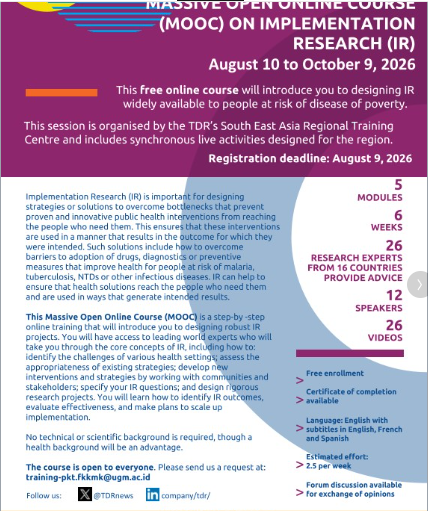
Applications are now open for the 2026 WHO TDR Massive Open Online Course (MOOC) 2.0 on Implementation Research, a free online professional development programme designed to strengthen implementation research capacity among health professionals, researchers, policymakers, and students worldwide.
Organised by the Center for Tropical Medicine, Universitas Gadjah Mada (UGM)—a TDR-supported Regional Training Centre under the WHO Special Programme for Research and Training in Tropical Diseases (TDR)—the internationally recognised course equips participants with practical knowledge and skills to bridge the gap between research evidence and real-world public health implementation.
Participants who successfully complete the programme will receive a free certificate of completion, while eligible learners may also compete for Mini Grants to support implementation research projects in selected countries.
If you are passionate about improving health systems, controlling infectious diseases, or advancing evidence-based public health interventions, this is an excellent opportunity to gain valuable expertise at no cost.
About the WHO-TDR Implementation Research MOOC
Implementation research plays a critical role in ensuring that proven health interventions are effectively delivered in real-world settings. While many health programmes are backed by scientific evidence, challenges often arise when translating these interventions into sustainable public health practice.
The TDR MOOC 2.0 on Implementation Research was developed to help participants understand how to identify implementation barriers, develop practical solutions, and evaluate health interventions that improve outcomes in low- and middle-income countries (LMICs).
Hosted by the Center for Tropical Medicine at Universitas Gadjah Mada, the course brings together internationally recognised experts in implementation science, epidemiology, global health, and public health research.
Why You Should Enrol
Participants will benefit from a comprehensive learning experience designed to strengthen implementation research competencies.
Key benefits include:
- Free enrolment with no tuition fees
- Free Certificate of Completion upon meeting course requirements
- Comprehensive introduction to implementation research concepts and methodologies
- Practical guidance on designing, implementing, and evaluating evidence-based health interventions
- Learning from internationally recognised experts in global health and implementation science
- Participation in three live interactive learning sessions
- Opportunity to network with participants from around the world
- Eligibility to compete for Mini Grants supporting implementation research projects in selected countries
The course combines self-paced learning with interactive sessions that encourage collaboration and knowledge sharing among participants.
FREE WHO-TDR Implementation Research Online Course 2026: Who Should Apply?
The programme welcomes applicants from diverse educational and professional backgrounds.
Priority will be given to individuals working in or interested in the following areas:
- Public Health
- Global Health
- Medicine
- Clinical Practice
- Epidemiology
- Health Systems Research
- Nursing
- Allied Health Sciences
- Pharmacy
- Biomedical Sciences
- Development Practice
- Health Policy
- Programme Management
The course is also suitable for:
- University students
- Early-career researchers
- Public health professionals
- Healthcare workers
- Programme managers
- Non-governmental organisation staff
- Government officials
- Policymakers
Whether you are beginning your career or already leading health programmes, the course offers valuable knowledge that can strengthen your professional practice.
FREE WHO-TDR Implementation Research Online Course 2026: What Will Participants Learn?
The curriculum focuses on helping learners understand how to implement evidence-based interventions effectively within different health system contexts.
Participants will explore topics such as:
- Principles of implementation research
- Implementation science theories and frameworks
- Designing implementation research studies
- Monitoring and evaluation approaches
- Stakeholder engagement strategies
- Scaling successful health interventions
- Addressing barriers to programme implementation
- Strengthening health systems through evidence-based decision-making
These skills are increasingly important for professionals working in infectious disease control, health policy, global health, and sustainable development.
FREE WHO-TDR Implementation Research Online Course 2026: Mini Grant Opportunity
One of the unique features of this programme is the opportunity for eligible participants to compete for Mini Grants that support ongoing implementation research projects.
The Mini Grant scheme is available for qualifying projects based in:
- Indonesia
- Viet Nam
- Bhutan
- India
- Philippines
- Malaysia
- Nepal
- Sri Lanka
- Cambodia
- Lao PDR
These grants are intended to strengthen ongoing implementation research initiatives that contribute to improved health outcomes within participating countries.
Important Dates
Applicants should take note of the following deadlines:
Application Deadline: 9 August 2026
Course Begins: 10 August 2026
As places may be competitive, interested applicants are encouraged to submit their applications as early as possible.
FREE WHO-TDR Implementation Research Online Course 2026: Why Implementation Research Matters
Implementation research has become one of the fastest-growing fields in global health because it focuses on ensuring that proven interventions actually reach the communities that need them most.
Rather than asking whether an intervention works under controlled conditions, implementation research examines how programmes can be successfully delivered within complex real-world health systems.
This approach is particularly important in low- and middle-income countries where health systems often face resource limitations, workforce shortages, and unique implementation challenges.
Professionals with implementation research expertise are increasingly sought after by governments, international organisations, universities, NGOs, and research institutions working to improve healthcare delivery and achieve the Sustainable Development Goals (SDGs).
Why You Should Apply
The WHO-TDR Implementation Research MOOC 2.0 represents an outstanding opportunity for anyone interested in public health, infectious diseases, implementation science, and health systems strengthening.
With free access to high-quality learning materials, internationally recognised instructors, live interactive sessions, and a certificate upon completion, the programme provides valuable professional development without financial barriers.
For eligible participants, the additional opportunity to compete for Mini Grant funding makes this one of the most attractive implementation research training programmes currently available.
If you are looking to strengthen your research skills, expand your professional network, and contribute to evidence-informed public health practice, this free global course should be high on your list of opportunities for 2026.
Application Deadline: 9 August 2026
Course Starts: 10 August 2026
SEE FULL TEXT & APPLY HERE
For more opportunities such as these please follow us on Facebook, Instagram, Twitter, LinkedIn and WPChannel
Disclaimer: Global South Opportunities (GSO) does not take ownership or credit for the opportunities shared on this platform. All opportunities are sourced from official announcements and external sources for informational purposes only. Applicants are encouraged to verify all details, deadlines, and eligibility requirements from the official source before applying. Opportunities may be updated or changed by the providing organisations.
JOIN GSO WHATSAPP CHANNEL NOW
FREE WHO-TDR Implementation Research Online Course 2026: Apply for the Global MOOC and Earn a Free Certificate
@TDR Implementation Research Online Course 2026: Apply for the Global MOOC and Earn a Free Certificate
Location
USA / Global
Work Mode
grant
Posted
about 3 hours ago
Beware of scams! When applying for jobs, you should NEVER have to pay anything. Learn about job scams.
Get jobs in your inbox
Join over 10,000 subscribers receiving our weekly newsletter.
You might also like
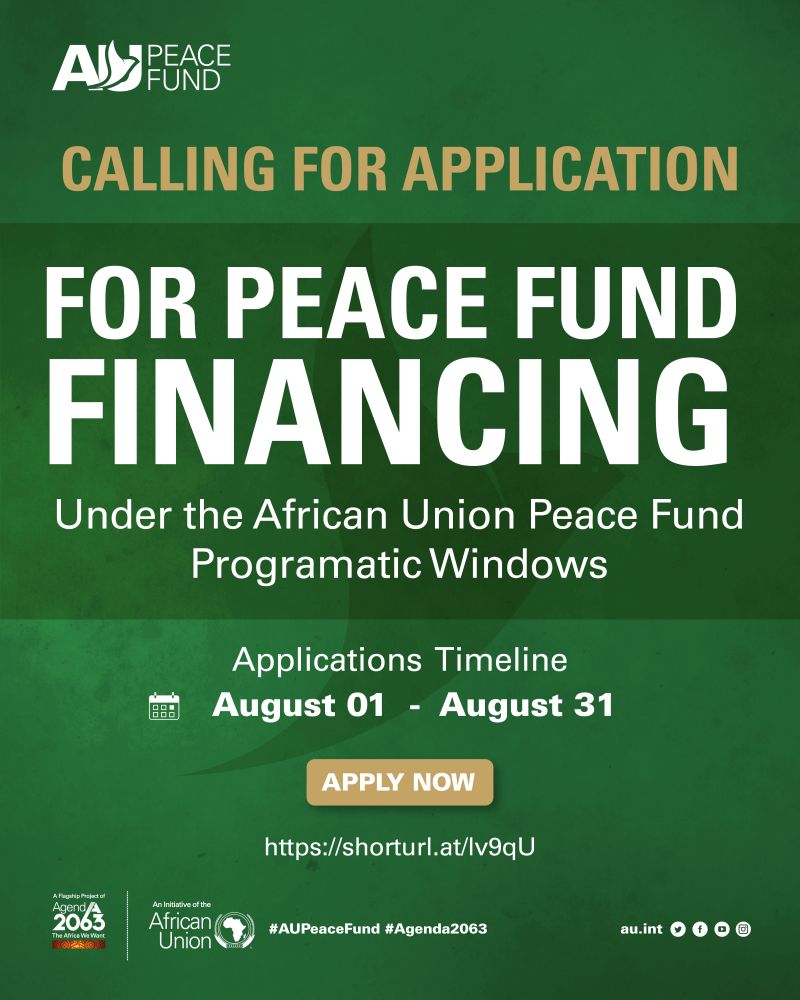
African Union Peace Fund Opens 2028 Funding Cycle: Applications Now Open for Peacebuilding and Conflict Prevention Initiatives
Unknown
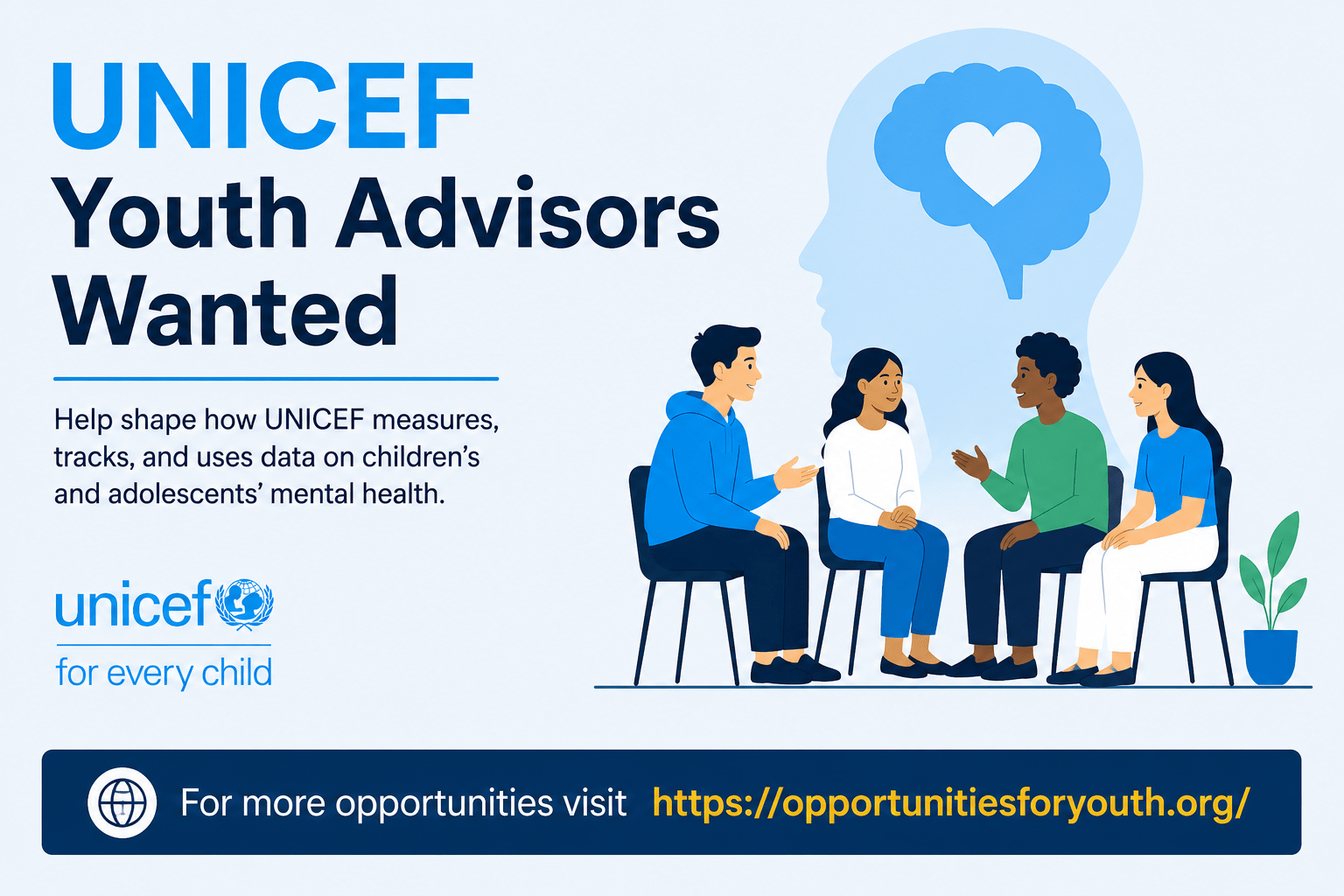
UNICEF Youth Advisors 2026: Join the Technical Advisory Group on Child and Adolescent Mental Health Measurement (TAG-CAMHM)
CAMHM)
Second Nature Opens Applications for 2026 Catalyst Grants Supporting Campus Climate Action
Unknown
FAO and Smart Africa Launch Innovate Africa Challenge 2026 to Scale AI Solutions for Climate-Smart Agriculture
Smart Agriculture

Call for Applications: African Union Peace Fund (AUPF) Programmatic Windows – Funding Cycle 2028
Funding Cycle 2028

CJID AI Newsroom Engagement Programme 2026
Unknown